
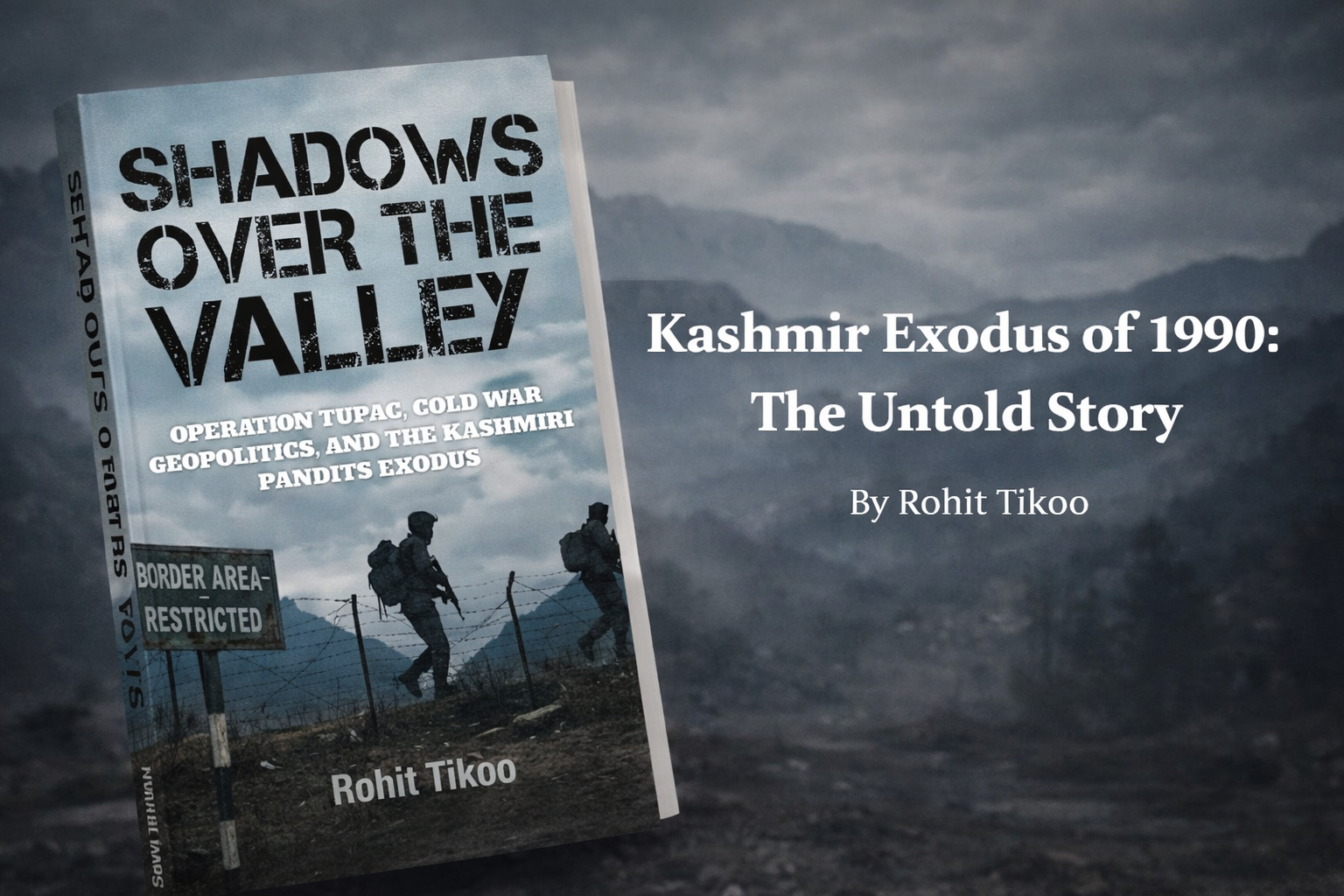
The Kashmir Exodus 1990: The Story You Were Never Allowed to Mourn
A documented account of Operation Tupac, the displacement of 350,000 Kashmiri Pandits, and the geopolitical silence that followed.
The Kashmir Exodus 1990: What the World Chose to Ignore
The Kashmir exodus of 1990 began in January when over 350,000 Kashmiri Pandits were forced to flee their ancestral homeland under threat of death. Within weeks, a minority community that had lived in the Valley for centuries was erased from its own land.
The world knows Kashmir as a territorial dispute. A line on a map. A political bargaining chip.
What it does not know are the names of the families who left in the night. The professors who were killed for refusing to flee. The children who grew up in exile without knowing why.
The narrative has been controlled. The human cost has been buried. And for decades, one question has remained unasked:
What happened to the people who lived there before the violence began?
Operation Tupac and the Kashmiri Pandit Exodus: What This Book Reveals
- How Operation Tupac was designed, funded, and executed as a covert strategy to destabilise Kashmir through terror and force the Kashmir exodus of 1990.
- The systematic targeting of Kashmiri Pandits, a minority that became invisible in its own homeland.
- The exodus that began in January 1990, when over 350,000 people were forced to leave under threat of death, and the world looked away.
- The cold war geopolitics that allowed the Kashmiri Pandit exodus to happen, and the silence that followed.
- The voices of those who survived, those who did not, and those who refuse to let history be rewritten.
This is not a book about politics. It is a book about people. And it refuses to let them be forgotten.
Why This Book About the Kashmir Exodus Had to Be Written
Because silence is complicity.
Because entire communities do not vanish without someone bearing witness.
Because history is not neutral. It is written by those who survive to tell it. And for too long, one side of the 1990 Kashmir exodus has been told without interruption.
This book exists because the author could not stay quiet. Because the weight of inherited trauma demands documentation. Because the next generation deserves to know what was done, and why, and at what cost.
It is not written in anger. It is written in defiance of erasure.
Who Should Read This Book About the Kashmiri Pandit Exodus?
This book is for you if:
- You want to understand the 1990 Kashmir exodus beyond headlines and propaganda.
- You believe that truth matters more than convenience.
- You are interested in Cold War history, Operation Tupac, geopolitics, and insurgency.
- You care about human rights, displacement, and ethnic cleansing.
- You are a student, journalist, policymaker, or historian looking for primary documentation on the Kashmiri Pandit exodus.
- You are ready to sit with discomfort in exchange for clarity.
This book is not for you if:
You are looking for political entertainment. You want your existing beliefs confirmed without challenge. You believe that some stories are better left untold. You are not willing to confront the human cost of ideological violence.
What Readers Are Saying About Shadows Over the Valley
“I thought I knew what happened during the Kashmir exodus in 1990. I did not. This book broke something open in me. I had to stop reading multiple times. Not because it was sensational, but because it was true. And I realised how much I had been allowed not to know.”
“My father never spoke about why we left during the Kashmiri Pandit exodus. He would change the subject. After reading this, I finally understand his silence. This book gave me the language to grieve what was taken from us. It also gave me the courage to ask him, one last time, to tell me what he remembers.”
“As a journalist, I have covered conflict zones for two decades. This is the most restrained and devastating account I have read of the 1990 Kashmir exodus. No melodrama. No propaganda. Just facts, dates, names, and the unbearable weight of what those facts mean.”
What Makes Shadows Over the Valley Different from Other Books on Kashmir
It does not argue. It documents.
It does not sensationalise. It presents.
It does not claim to be the only truth. But it insists on being part of the record.
Unlike opinion columns and political commentary, this book about the 1990 Kashmir exodus is built on lived experience, archival research, and testimonies that have been ignored for decades. It does not exist to win a debate. It exists so that what happened cannot be denied.
It is written with the rigour of journalism and the heart of someone who lost a homeland during the Kashmiri Pandit exodus.
About Rohit Tikoo, Author of Shadows Over the Valley
Rohit Tikoo is a researcher and writer focused on the intersection of conflict, displacement, and memory. His work draws on both historical documentation and his personal inheritance of the 1990 Kashmir exodus.
He writes not as an observer, but as someone whose family was part of the Kashmiri Pandit exodus. His approach is deliberate: to let the facts carry the weight, and to resist the urge to dramatise what is already unbearable.
This book is the result of years of research, interviews, and the decision to break a silence that had been passed down through generations.
Read the Untold Story of the Kashmir Exodus 1990
You can close this page and return to what you were doing.
Or you can read the book that asks you to remember what the world was told to forget about the Kashmiri Pandit exodus.
This is not entertainment. This is testimony.
And it is waiting for you.