
Kheer Bhawani Festival 2026: Faith, Memory and the Eternal Bond of Kashmiri Pandits

Kheer Bhawani Festival 2026 devotees offering prayers at the sacred spring of Mata Ragnya Devi Temple in Tulmulla, Kashmir

As devotees gather today for the Kheer Bhawani Festival 2026, I find myself unable to begin with history, dates, or rituals. I must begin where every Kashmiri Pandit heart begins. At the feet of the Mother When villages emptied, your name remained. When hope flickered, your name remained. Maej Daya Kar. Mata Nazar Kar. Maej … Read more

Mehjoor: The Father of Modern Kashmiri Poetry

Peerzada Ghulam Ahmad Mehjoor commemorative India Post stamp issued in 2013

Few poets have shaped the cultural identity of a people as profoundly as Peerzada Ghulam Ahmad Mahjoor. Revered as Shair-e-Kashmir (Poet of Kashmir), Mehjoor transformed Kashmiri poetry by bringing it closer to the language, emotions, and aspirations of ordinary people. Literary historians widely regard him as the father of modern Kashmiri poetry because he expanded … Read more

Pakistan-Occupied Kashmir Protest: Why Rawalakot Exposed Islamabad’s Kashmir Narrative

Security forces patrol a street in Rawalakot during the Pakistan-Occupied Kashmir protest movement in June 2026 following the ban on the Jammu Kashmir Joint Awami Action Committee (JAAC).

A Kashmiri Pandit’s Perspective on the Pakistan-Occupied Kashmir Protest I left Kashmir thirty-six years ago. My family did not leave by choice, nor had we planned to abandon the valley that our community had called home for centuries. In January 1990, a campaign of targeted killings, threats broadcast from mosque loudspeakers, and organised terror forced … Read more

Arnimal: The Kashmiri Poet Who Turned Abandonment Into Poetry
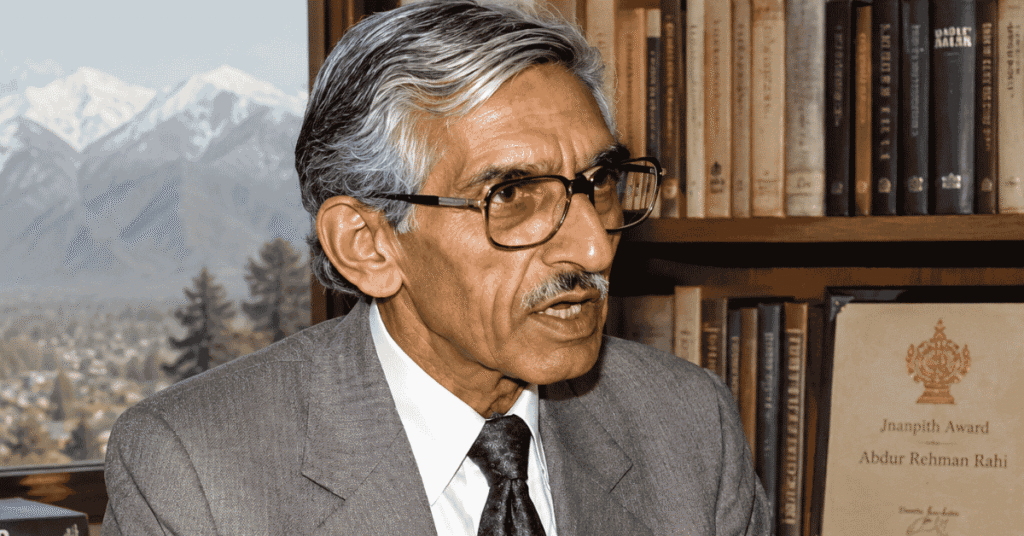
Portrait of Arnimal in traditional Kashmiri Pandit attire, wearing authentic Dejhoor earrings and seated against a scenic Kashmir backdrop, symbolizing the poetess's life, love, and literary legacy.

Pain has a strange, insular effect on the human psyche. It possesses the unique capacity to shut out the external world, creating a sudden silence in which a person is forced to look at themselves with absolute clarity, perhaps for the very first time. For Arnimal, the eighteenth-century Kashmiri poet, this silence was not chosen. … Read more

From Exile to Erasure: How NFSA Integration Threatens Kashmiri Pandit Identity

Sacred representation of Kashmiri Pandits with Lord Shiva, Goddess Sharika, and a Shivling in a Himalayan valley symbolizing faith, loss, and exile.

The concept of ‘home’ for the Kashmiri Pandit community has undergone a radical, involuntary transformation. Since the exodus of 1990, the physical markers of our civilisation (Our heritage temples, the intricate woodwork of our ancestral houses, and the holy touch of Vitasta have been relegated to the realm of memory. Yet, as we cling to … Read more

April 1990 Killings in Kashmir: Stories Behind Targeted Killings

Memorial collage featuring Sarla Bhat, Bansi Lal Sapru, and Sarvanand Kaul Premi with Virender Kaul, Targeted victims of April 1990 Killings in Kashmir

April 1990 Killings in Kashmir marked a grim phase of targeted violence, where individuals were singled out and killed in a climate of fear and silence. This article documents verified names and case profiles, including Bansi Lal Sapru, Sarla Bhat, BHL Khera, and Sh. Sarvanand Kaul Premi with his son Virender Kaul, to present a … Read more

The Killing of Bansi Lal Sapru in1990

Memorial-style image depicting the killing of Bansi Lal Sapru in Kashmir 1990, with candle and tribute note representing Kashmiri Pandit exodus violence.

  Spring came to the Kashmir Valley in 1990 with blood on its hands. Bansi Lal Sapru, a forty-five-year-old Kashmiri Pandit from Gulab Bagh, Srinagar, never saw summer. His neighbours shot him dead in the compound of his own home on 24 April 1990. Three bullets at close range. The killers knew his face. They … Read more

Bhushan Lal Raina: The Night Before He Was to Leave Kashmir

Illustrated collage showing Bhushan Lal Raina with grieving mother, scenes of violence during the 1990 Kashmiri Pandit exodus, and portraits of Girija Tickoo, Verinder Kaul Premi, Sarvanand Kaul Premi, and Sarla Bhat

Bhushan Lal Raina was 29 years old and worked at the Sher-i-Kashmir Institute of Medical Sciences (SKIMS) in Soura. He lived in Ompora, Budgam, with his elderly mother and was soon to be married. He had no political affiliations and no connection to militancy of any kind. He was preparing to leave the Valley, as … Read more

Kalhana: Kashmir’s First and Greatest Historian

Kalhana writing the Rajatarangini in ancient Kashmir with temples, kings, and battle scenes in the background

Kalhana was Kashmir’s first and greatest historian. He wrote without royal patronage, without flattery, and without the political obligations that corrupted nearly every other chronicle of his era. What he left behind was the Rajatarangini, a work that nine centuries of scholarship have not managed to replace. Royal courts used it to glorify ruling kings … Read more

📘 Blogs