
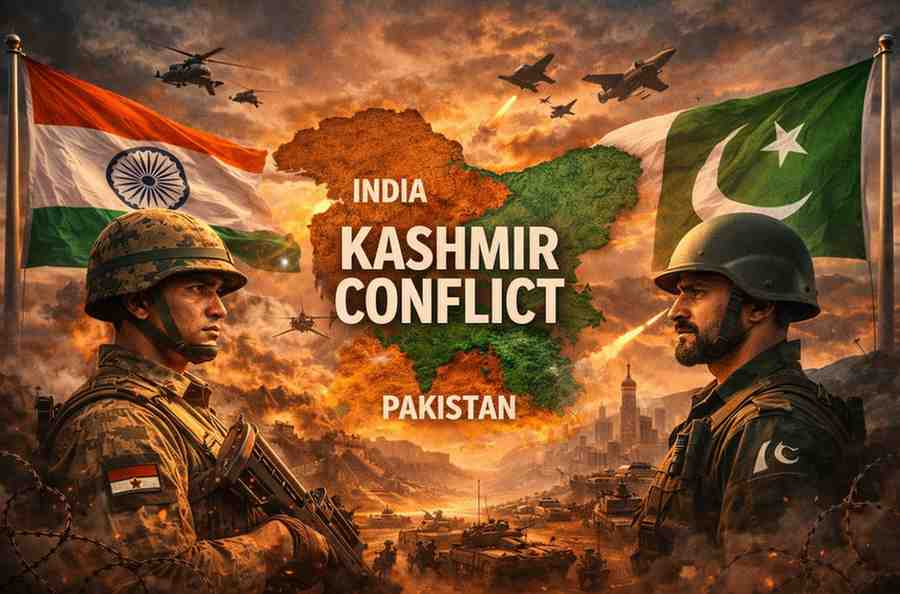
The Kashmir issue represents the longest unresolved territorial dispute between India and Pakistan. This conflict has shaped South Asian geopolitics for 77 years, triggered three wars, and continues to impact millions of lives in the region.
What Is the Kashmir Issue?
The Kashmir issue is a territorial and political dispute over the Jammu and Kashmir region. India and Pakistan both claim the entire territory, though each controls different portions. The conflict began in 1947 during the partition of British India and remains unresolved despite multiple wars, UN resolutions, and peace attempts.
The dispute affects approximately 17 million people living in the region. India administers roughly 55% of the territory, including Jammu, the Kashmir Valley, and Ladakh. Pakistan controls about 30%, comprising Azad Kashmir and Gilgit-Baltistan. China holds the remaining 15%, including Aksai Chin.
Historical Background of the Kashmir Conflict
The 1947 Partition and Accession
When British colonial rule ended in August 1947, the Indian subcontinent split into Hindu-majority India and Muslim-majority Pakistan. Princely states could choose which country to join. Kashmir, ruled by Hindu Maharaja Hari Singh, governed a predominantly Muslim population.
The Maharaja hesitated to decide, hoping to maintain independence. This delay proved catastrophic. In October 1947, tribal militias backed by Pakistan invaded Kashmir. The panicked Maharaja signed the Instrument of Accession on October 26, 1947, joining India in exchange for military protection.
Pakistan disputes this accession, arguing it occurred under duress without consulting the Kashmiris. India maintains that the accession was legal and binding. This fundamental disagreement anchors the entire Kashmir dispute.
The First India-Pakistan War Over Kashmir
Indian forces airlifted into Srinagar and pushed back the invasion. Fighting continued until the UN brokered a ceasefire on January 1, 1949. The ceasefire line, later renamed the Line of Control (LoC), divided Kashmir between the two nations.
The UN Resolution and Plebiscite Promise
The UN Security Council passed resolutions in 1948 and 1949 calling for a plebiscite to determine Kashmir’s future. The resolutions required Pakistan to withdraw forces first, followed by India reducing troops, then holding a referendum.
This plebiscite never happened. Pakistan refused to withdraw first. India argued that conditions had changed, making the resolution obsolete. Today, India asserts that the Instrument of Accession settled the matter permanently. Pakistan continues demanding a UN-supervised plebiscite.
Major Wars and the Kashmir Conflict
1965 War: Operation Gibraltar
Pakistan launched Operation Gibraltar in 1965, infiltrating forces into Indian-administered Kashmir, hoping to trigger an uprising. The operation failed. The conflict escalated into a full-scale war, ending in a stalemate with no territorial changes.
1971 War and the Simla Agreement
The 1971 war stemmed from Bangladesh’s independence struggle, but fighting occurred in Kashmir too. India decisively defeated Pakistan. The Simla Agreement of 1972 converted the ceasefire line into the Line of Control and committed both nations to resolving disputes bilaterally.
1999 Kargil Conflict
Pakistani soldiers and militants infiltrated across the LoC in 1999, occupying strategic heights in the Kargil district. India launched military operations to evict them. The Kargil War lasted two months and ended with Pakistan’s withdrawal under international pressure. The conflict demonstrated how Kashmir tensions could escalate dangerously between nuclear powers.
The Kashmir Insurgency Era
The late 1980s brought a dramatic transformation. Allegations of rigged state elections in 1987 triggered mass disillusionment among Kashmiri youth. An armed insurgency erupted in 1989, initially led by the Jammu Kashmir Liberation Front seeking independence.
Pakistan-backed groups gradually dominated the movement. The conflict became intensely violent. Indian security forces are deployed in massive numbers. Tens of thousands died, including civilians, militants, and security personnel.
The Kashmiri Pandit Exodus
Kashmiri Pandits, the Hindu minority in the Kashmir Valley, faced targeted violence from militants. By 1990, most of the community had fled. Estimates suggest 300,000 to 400,000 Pandits left the valley, becoming refugees in their own country. Their exodus remains deeply traumatic and politically contentious.
Article 370 and Kashmir’s Special Status
India’s Constitution granted Jammu and Kashmir special status under Article 370. This provision gave the state autonomy in most matters except defence, foreign affairs, and communications. Article 35A allowed the state to define who was a permanent resident and to restrict their property rights.
This arrangement was contentious. Some Indians viewed it as unjust special treatment. Many Kashmiris saw it as a constitutional promise protecting their identity.
2019: Revocation of Article 370
On August 5, 2019, the Indian government revoked Article 370, stripped Jammu and Kashmir of statehood, and split it into two Union Territories: Jammu and Kashmir and Ladakh. The government imposed strict security measures, detained political leaders, and cut internet and phone services for months.
The government defended this as necessary for development and integration. Critics called it an unconstitutional assault on Kashmiri autonomy. Pakistan condemned the move vehemently. This decision fundamentally altered Kashmir’s constitutional relationship with India.
2025 Developments: Pahalgam Attack and Escalation
On April 22, 2025, gunmen attacked tourists in Pahalgam, killing 26 people. This marked the deadliest attack in Indian territory since the 2008 Mumbai attacks. India blamed Pakistan for harbouring militant groups. Pakistan denied involvement.
India suspended the Indus Waters Treaty, terminated visa-free travel, and closed border crossings. On May 6, 2025, India launched Operation Sindoor, conducting strikes on sites in Pakistan and Pakistan-administered Kashmir. Pakistan retaliated with its own strikes. The situation marked the most significant bilateral confrontation since 2019.
A US-brokered ceasefire was established on May 10, 2025. However, underlying tensions remain unresolved. The incident demonstrated how quickly the Kashmir issue can escalate into a dangerous military confrontation between nuclear-armed nations.
Competing Positions on the Kashmir Dispute
India’s Position on Kashmir
India maintains that Kashmir was legally acceded in 1947. The entire state is integral to India. Pakistan illegally occupies Indian territory and sponsors terrorism. India views the conflict as Pakistani aggression, not a self-determination issue. India argues that development and integration will resolve grievances and insists on bilateral negotiations without international mediation.
Pakistan’s Position on Kashmir
Pakistan views Kashmir as disputed territory awaiting a UN-mandated plebiscite. Pakistan argues India occupies Kashmir against the will of its Muslim-majority population. Pakistan provides diplomatic support to what it calls a legitimate freedom struggle. Pakistan welcomes international mediation and points to UN Security Council resolutions.
Kashmiri Aspirations and Voices
Many Kashmiris want independence from both India and Pakistan. Others prefer joining Pakistan. Some accept remaining with India if granted genuine autonomy and dignity. Many simply want normalcy, economic opportunity, and an end to violence. Kashmiri Pandits want to return safely to their homeland.
The diversity of Kashmiri opinion often gets erased by competing nationalisms. Kashmiris themselves have limited agency in determining their future.
Why the Kashmir Issue Remains Unresolved
Several factors make resolution extraordinarily difficult:
National Identity: Both nations view Kashmir as existential. For Pakistan, Kashmir validates the two-nation theory. Abandoning the claim would undermine national identity. For India, ceding Kashmir would encourage separatism elsewhere and contradict secular founding principles.
Domestic Politics: Politicians in both countries face accusations of betrayal if they suggest compromise. Hardline positions win elections. Moderate voices get sidelined.
Nuclear Deterrence: Nuclear weapons raise the stakes of any conflict. They paradoxically enable low-intensity proxy warfare without risking full-scale war.
Strategic Importance: Water resources from Kashmir feed rivers critical to both nations. The territory provides strategic military positions. China’s involvement through Aksai Chin and the economic corridor through Gilgit-Baltistan adds complexity.
Limited Kashmiri Agency: Kashmiri preferences rarely determine outcomes. International attention waxes and wanes. Great powers prioritise their own interests over Kashmiri self-determination.
International Perspective on the Kashmir Conflict
The international community generally recognises Kashmir as disputed territory. However, most countries avoid taking strong positions, viewing it as a bilateral issue for India and Pakistan to resolve.
The UN continues to recognise Kashmir as a disputed territory on its agenda. However, there is no significant international pressure for a resolution. The US, UK, and other Western powers emphasise the need for bilateral dialogue while urging both sides to respect human rights.
China’s position is complicated by its control of Aksai Chin and its strategic partnership with Pakistan through the China-Pakistan Economic Corridor.
The Path Forward: Resolving the Kashmir Issue
Any solution requires acknowledging complexity. India and Pakistan both have legitimate security concerns. Kashmiris have legitimate aspirations for dignity, autonomy, and peace.
The conflict cannot be resolved solely through military force. Nor can it be resolved by ignoring the wishes of Kashmiris themselves. Sustainable peace requires:
- Meaningful dialogue between India and Pakistan
- Including Kashmiri voices in negotiations
- Addressing human rights concerns
- Building confidence through people-to-people contacts
- Gradually demilitarising the region
- Creating economic opportunities for Kashmiris
Conclusion
The Kashmir issue is not simply a territorial dispute over borders. It represents colonial legacies, religious nationalism, competing ideas of nationhood, and decades of violence that have traumatised generations.
The tragedy is that while governments debate sovereignty, ordinary people endure violence, fear, and lost opportunities. That human cost, more than any territorial claim, should urgently drive the search for peace.
Until India, Pakistan, and Kashmiris themselves can negotiate honestly with each other, the Kashmir conflict will remain frozen in violence and mutual grievance. The region’s future depends on moving beyond nationalist rhetoric toward genuine dialogue that prioritises human dignity and self-determination.

Rohit Tikoo is a published author, researcher, and content strategist with over two decades of writing experience. He is the author of nine books covering Kashmir, Indian philosophy, social issues, and contemporary thought, including Shadows Over the Valley: Operation TUPAC, Cold War Geopolitics, and the Kashmiri Pandits Exodus (2025).
His work focuses on Kashmir’s history, literature, culture, and the lived experiences of the Kashmiri Pandit community. Through extensive research, archival references, and historical analysis, he seeks to document and preserve narratives that are often overlooked in mainstream discourse. His writing on Kashmir has appeared in DAILY EXCELSIOR, HEADLINES TODAY, ONLY KASHMIR, GREATER KASHMIR, NAAD,
VITASTA, CHATTAN, AND VOICE OF SILENCE.
Through rohittikoo.com, he publishes research-based articles, essays, and commentary aimed at fostering informed discussion on Kashmir, Indian civilisation, literature, and contemporary society.