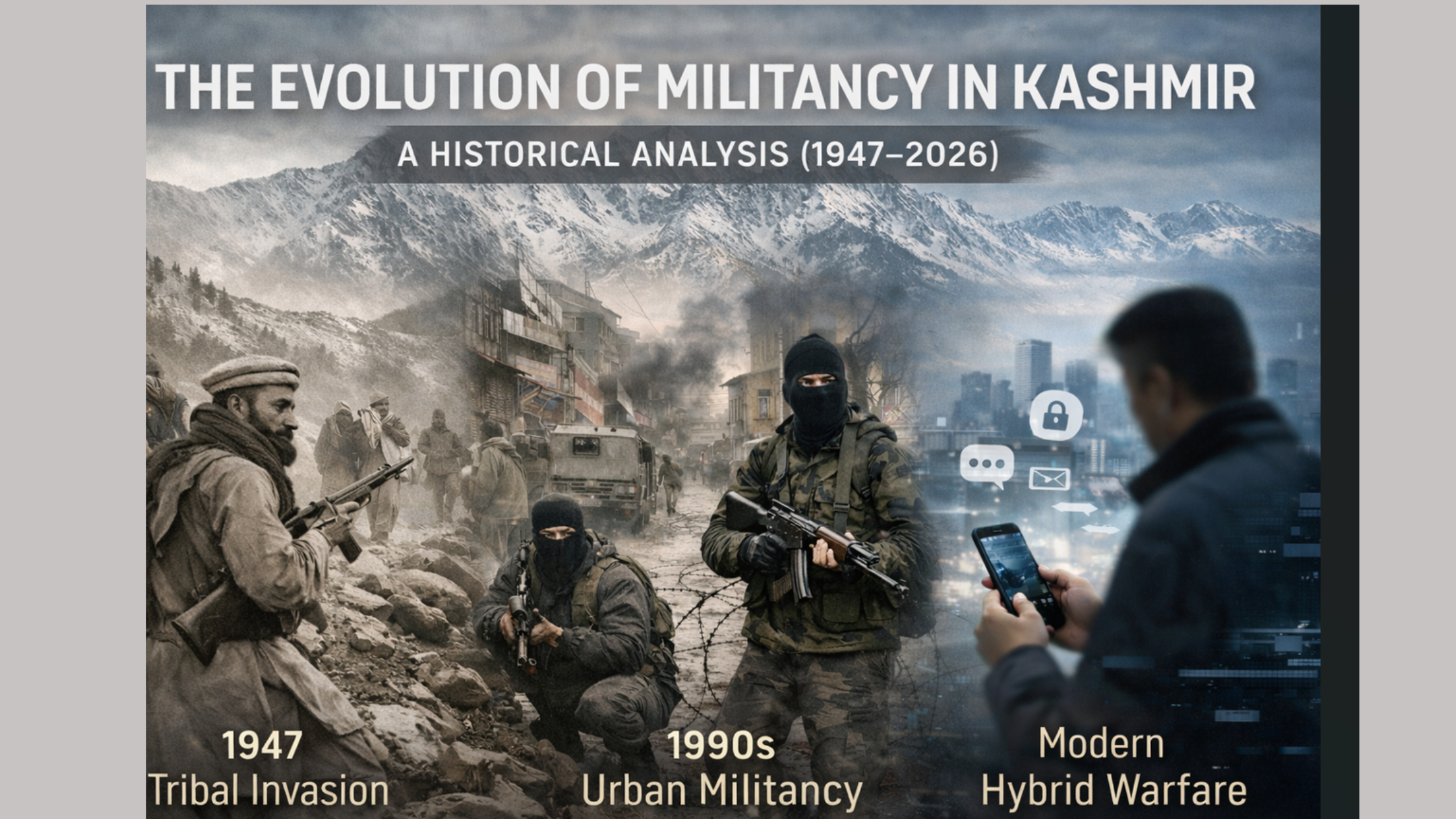
This document provides a comprehensive, fact-based analysis of the evolution of militancy in Kashmir, spanning from the initial tribal invasion of 1947 through the modern era of hybrid warfare. The analysis is structured chronologically to trace the transformation from early armed incursions to sophisticated contemporary operations, examining key organisations, pivotal incidents, and the shifting nature of insurgency tactics.
1. Pre-1988: The Genesis and Precursors
Before the full-scale insurgency that erupted in 1989, several smaller operations and clandestine networks laid the groundwork for what would become a prolonged conflict. Early attempts at armed intervention characterise this period, as do the formation of underground networks and the gradual development of organisational structures that would later evolve into major militant groups.
Operation Gulmarg (1947)
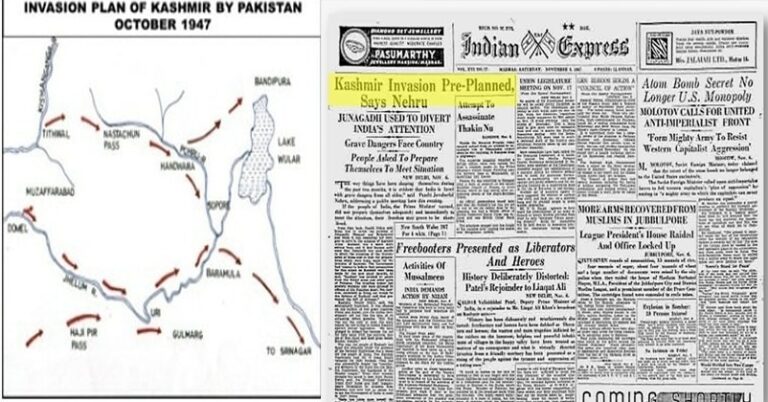
Operation Gulmarg represents the first major armed intervention in Kashmir. Planned by the Pakistani military establishment as early as August 20, 1947, just days after Pakistan’s independence, this operation involved recruiting approximately 20 lashkars (tribal militias), each consisting of 1,000 Pashtun tribe members from Pakistan’s North-West Frontier Province.
The operation was launched on the intervening night of October 21-22, 1947. Over 2,000 Pathan tribesmen first captured the bridge spanning the Kishanganga River, and by morning, Muzaffarabad had fallen. The invasion was facilitated by desertion among Kashmiri Muslim troops and was supported by Pakistani Army officers who provided training, arms, and logistics.
Key figures involved included Sardar Shaukat Hayat Khan, a close confidant of Muhammad Ali Jinnah, and Major Khurshid Anwar, who was given responsibility for contacting tribal chiefs. The Pakistani treasury allocated 300,000 rupees for the operation. The invaders engaged in widespread atrocities in captured territories, with estimates suggesting between 35,000 and 40,000 deaths during the campaign. The massacre at Baramulla on October 26, 1947, was particularly devastating.
Al-Fatah and Early Underground Networks
Al-Fatah emerged as a key militant group in the late 1960s and early 1970s. Many of its members would later join the Jammu Kashmir Liberation Front (JKLF). The group operated alongside other clandestine networks, including the Master Cell, which was active in the 1960s and involved in sabotage and infiltration operations.
The Plebiscite Front, founded by Mirza Afzal Beg in the 1950s, represented an important political precursor to armed militancy. Its UK chapter, based in Birmingham, would eventually transition into the modern JKLF structure, providing an important diaspora base for the movement.
National Liberation Front (NLF)
The National Liberation Front, co-founded by Maqbool Bhat and Amanullah Khan, served as the direct armed precursor to the JKLF. Maqbool Bhat (born February 18, 1938, in Trehgam) emerged as a pivotal figure in the Kashmir independence movement. He studied at St. Joseph’s School and College in Baramulla, graduating with a Bachelor of Arts degree in History and Political Science around 1957.
After moving to Pakistan in 1958, Bhat founded the NLF with a vision of Kashmiri independence. The organisation engaged in various operations throughout the 1960s and early 1970s, establishing the template for future militant activities. In April 1965, political activists from Azad Kashmir formed the Jammu Kashmir Plebiscite Front, with Maqbool Bhat serving as Publicity Secretary.
Tala Party and Islamic Students League
In the early 1980s, Yasin Malik founded the Tala Party, a youth organisation that would later evolve into the Islamic Students League (ISL). This group represented the growing radicalisation of Kashmiri youth and would play a crucial role in the events following Maqbool Bhat’s execution. The core group that emerged from this network—Hamid Sheikh, Ashfaq Wani, Javed Mir, and Yasin Malik , known as the Haji Group, would become central figures in the 1989 insurgency.
2. High-Profile Incidents and Figures (1971-1989)
Several landmark events during this period transformed the Kashmir conflict from sporadic militant activity into an international security concern. These incidents not only drew global attention to the Kashmir issue but also established operational templates and demonstrated the expanding reach of militant organisations.
The Ganga Hijacking (1971)
On January 30, 1971, an Indian Airlines Fokker F27 named “Ganga” was hijacked on the Srinagar-Jammu route by Hashim Qureshi (then 17 years old) and his cousin Ashraf Qureshi. The hijackers, operating under the NLF and following orders attributed to Maqbool Bhat, diverted the aircraft to Lahore Airport in Pakistan using makeshift weapons—a toy pistol and a wooden grenade.
The hijackers demanded the release of 36 NLF members imprisoned in India. All 26 passengers and four crew members were released after the aircraft remained on the tarmac for 80 hours. On the advice of Pakistani authorities, the aircraft was set ablaze. Zulfikar Ali Bhutto, then chairman of the Pakistan Peoples Party, met with the hijackers at the airport, initially hailing them as heroes.
India’s response was significant: a ban on Pakistani aircraft overflights of Indian territory. This proved crucial during the Bangladesh Liberation War later that year, as it severely hampered Pakistan’s ability to transport troops and supplies to East Pakistan. The hijackers were later arrested and tried in Pakistan under charges of collaboration with Indian intelligence services, with Hashim Qureshi receiving a 19-year prison sentence.
Maqbool Bhat Execution (February 11, 1984)
Maqbool Bhat’s execution in Tihar Jail became a watershed moment in Kashmir’s militant history. After returning to Kashmir in May 1976 against the advice of associates, he was captured by Indian forces. The Indian Supreme Court restored his death sentence in 1978, and he was transferred to Delhi’s Tihar Prison.
The immediate trigger for his execution came when JKLF operatives kidnapped Indian diplomat Ravindra Mhatre in Birmingham on February 3, 1984. When India refused to negotiate, Mhatre was executed by his captors. In response, India carried out Bhat’s execution on February 11, 1984, just eight days later. The execution bypassed certain judicial norms, with questions raised about an unsigned execution order from the Jammu and Kashmir High Court.
Bhat’s hanging catalysed radicalisation, particularly for the “HAJY” group (Hamid Sheikh, Ashfaq Wani, Javed Mir, and Yasin Malik). His body was buried within the Tihar Jail premises, where it remains today. Since his death, separatist groups have observed annual shutdowns on February 11, and JKLF has consistently demanded the return of his remains. He is referred to as “Baba-e-Qaum” (Father of the Nation) by supporters.
Ravindra Mhatre Kidnapping and Murder (1984)
On February 3, 1984, Ravindra Mhatre, an assistant to the Indian Deputy High Commissioner in Birmingham, was kidnapped by JKLF operatives. The kidnappers demanded Maqbool Bhat’s release in exchange for Mhatre’s safe return. When the Indian government refused to negotiate, Mhatre was killed. This incident demonstrated the JKLF’s international operational capability and had immediate and severe consequences, accelerating the decision to execute Maqbool Bhat.
Kashmir Liberation Army (KLA)
The Kashmir Liberation Army served as the militant wing of the JKLF, actively involved in early international operations. The UK chapter of the Plebiscite Front was renamed the Jammu and Kashmir Liberation Front in May 1977, and an armed wing, the National Liberation Army, was formed shortly thereafter. Amanullah Khan assumed the role of General Secretary of the JKLF in February 1978, operating from the United Kingdom with support from the British Mirpuri community.
Operation Gibraltar (1965)
Operation Gibraltar was a failed Pakistani infiltration plan that preceded the Indo-Pakistani War of 1965. The operation involved sending armed irregulars into Indian-administered Kashmir to foment an insurgency. The failure of this operation demonstrated the limitations of covert military interventions and influenced future strategic thinking about Kashmir operations.
3. The 1990s Transition: From Nationalist to Jihadi Operations
The period from 1989 onwards marked a fundamental transformation in Kashmir militancy. What began as a largely nationalist, secular independence movement gradually evolved into an increasingly Islamist jihadi insurgency, with profound implications for the conflict’s character, tactics, and targeting patterns.
Rubaiya Sayeed Kidnapping (December 8, 1989)
The kidnapping of Rubaiya Sayeed is widely considered the spark that emboldened militants and demonstrated the vulnerability of the Indian state. On December 8, 1989, Rubaiya Sayeed, the 23-year-old daughter of Union Home Minister Mufti Mohammad Sayeed, was abducted by JKLF militants near Lal Ded Hospital in Srinagar while returning from her medical internship.
The kidnappers, including Yasin Malik, demanded the release of five jailed JKLF members: Abdul Hamid Sheikh, Sher Khan, Noor Mohammad Kalwal, Altaf Ahmed, and Javed Ahmed Jargar. After five days of intense negotiations, the V.P. Singh government capitulated to the demands. Rubaiya was released on December 13, 1989, and the five militants were freed, triggering widespread celebrations in the Kashmir Valley.
Then-Chief Minister Farooq Abdullah strongly opposed the exchange, later claiming his government was threatened with dismissal if militants were not released. He warned that releasing these militants would “open floodgates” for terrorism. The incident proved to be a watershed moment—mass support for militants became visible on the streets, and militancy increased exponentially in the following months. Some of the released militants were later involved in the 1999 IC-814 hijacking.
The case was transferred to the CBI in 1990 under the TADA Act. In 2022, Rubaiya testified before the court and identified Yasin Malik as one of her abductors. Yasin Malik is currently serving a life sentence in Tihar Jail. As recently as December 2025, CBI arrested Shafat Ahmad Shangloo, a former JKLF activist and alleged close confidant of Yasin Malik, in connection with the kidnapping.
The Shift to Jihadi Operations
As the 1990s progressed, Pakistan-based jihadi organisations increasingly dominated the militant landscape, eclipsing indigenous nationalist groups like JKLF. Groups such as Lashkar-e-Taiba (LeT), Jaish-e-Mohammed (JeM), and Hizbul Mujahideen (HM) brought a distinctly Islamist ideology and more sophisticated operational capabilities.
Al-Faran, a front for Harkat-ul-Ansar (later Harkat-ul-Mujahideen), exemplified this shift. In 1995, the group kidnapped Western tourists, demonstrating the expanding target set and international dimensions of the conflict. This period also saw the introduction of fidayeen (suicide squad) attacks by groups like LeT in the late 1990s, bringing a new level of lethality to operations.
Expansion of Targeting Beyond Kashmiri Pandits
The Chittisinghpura Massacre of March 20, 2000, marked a significant expansion of militant targeting. Thirty-six Sikhs were killed in this attack, highlighting that religious minorities beyond the Pandit community were now being systematically targeted. This broadening of targets reflected the increasingly sectarian nature of the insurgency.
The 2001 Legislative Assembly bombing represented an attack on the very seat of power in Kashmir, demonstrating militant groups’ ability to strike high-value political targets. Throughout this period, attacks on security forces, government installations, and infrastructure increased in frequency and sophistication.
4. Modern Era (2019-2026): Hybrid Warfare and Facade Groups
The abrogation of Article 370 on August 5, 2019, fundamentally altered the security landscape in Kashmir. In response to India’s move to revoke the region’s special constitutional status and impose stringent security measures, militant groups adapted their organisational structures and operational tactics. This period is characterised by the emergence of “facade groups,” the rise of hybrid militancy, and the sophisticated use of social media for recruitment and propaganda.
Hybrid Militants: A New Operational Model
Hybrid militants represent a fundamental evolution in insurgency tactics. Unlike traditional full-time militants, hybrid operatives are part-time attackers who maintain ordinary civilian lives—working regular jobs, attending schools or universities—while conducting targeted killings and attacks when called upon. This model makes them significantly harder to track, as they have no prior police records and often operate with weapons provided just before an attack, which they return immediately afterwards.
The hybrid model emerged partly in response to increased counterterrorism pressure and communication restrictions following the 2019 crackdown. With cross-border infiltration more difficult due to enhanced border security, handlers in Pakistan increasingly relied on recruiting locals through Over Ground Workers (OGWs). These hybrid operatives enable groups to conduct attacks without revealing the larger organisational design, a tactic officials have termed “soft killings.”
The Resistance Front (TRF)
The Resistance Front emerged in October 2019, shortly after the abrogation of Article 370, announcing its existence via the encrypted messaging platform Telegram on October 12, 2019. The announcement followed a grenade attack at Hari Singh High Street in Srinagar that injured seven civilians.
TRF represents a strategic rebranding effort. Unlike traditional Kashmir militant groups that bear Islamic names, TRF uses non-religious nomenclature and symbolism to project a secular, indigenous Kashmiri resistance image. However, Indian security agencies and U.S. intelligence assessments identify TRF as an offshoot or front organisation for Lashkar-e-Taiba (LeT), created to maintain plausible deniability for Pakistan-based groups under Financial Action Task Force (FATF) scrutiny.
Key characteristics of TRF operations include: extensive use of social media for propaganda and claiming attacks; targeted killings of minorities (Kashmiri Pandits, Hindus, Sikhs); attacks on non-local labourers and migrant workers; assassination of government employees and politicians; and systematic threats against those perceived as supporting Indian administration, including issuing public “hit lists.”
Led by Mohammad Abbas Sheikh, one of Kashmir’s most experienced fighters who reportedly joined the rebellion in 1996, TRF has been responsible for numerous high-profile attacks. In October 2021, the group carried out a series of targeted civilian killings, including the murder of Makhan Lal Bindroo, a prominent Kashmiri Pandit pharmacy owner in Srinagar. TRF was designated as a terrorist organisation by India in 2023 and by the United States in 2025.
Since 2019, there have been 131 arrests and killings linked to TRF. The group’s digital footprint was substantial until Indian authorities blocked its Twitter and Telegram accounts in May 2020, after which the TRF migrated to the encrypted Russian messaging platform Telegram.
Other Facade Groups
People’s Anti-Fascist Front (PAFF): Emerged in late 2019 following the abrogation of Article 370, PAFF operated primarily in the Poonch area and other locations in Kashmir. The group engaged in armed encounters and ambushes against security forces. Indian authorities claim PAFF was created by Jaish-e-Mohammed (JeM) as another front organisation, using secular rhetoric while pursuing jihadi objectives.
Other groups that emerged during this period include Kashmir Tigers, Kashmir Freedom Fighters (KFF), J&K Ghaznavi Force (JKGF), Lashkar-e-Mustafa, and United Liberation Front. Many of these groups existed only briefly, often not surviving the arrest or killing of their leaders. All adopted secular-sounding names as part of the broader rebranding strategy.
The Pahalgam Attack (April 22, 2025)
On April 22, 2025, five militants carried out the deadliest attack on civilians in Kashmir since the 2000s, killing 26 people in the Baisaran Valley near Pahalgam, Anantnag district. The attack specifically targeted Hindu tourists during peak tourist season. Witnesses reported that attackers asked victims to recite Islamic verses before executing them with point-blank headshots.
TRF initially claimed responsibility on Telegram, stating that “violence will be directed toward those attempting to settle illegally,” referring to the extension of domicile status to non-locals following the abrogation of Article 370. However, days later, TRF retracted its claim, asserting it was the result of a coordinated cyber intrusion—likely due to widespread condemnation and pressure from Pakistani handlers.
The attack prompted international condemnation, with the United Nations calling for perpetrators to be brought to justice. The incident occurred during a visit to India by U.S. Vice President JD Vance, guaranteeing global attention. In a subsequent operation named Operation Mahadev, launched on May 22, 2025, Indian security forces killed three LeT terrorists—Suleman (also known as Faizal Jatt), Hamza Afghani, and Zibran—who were identified as the attackers involved in the Pahalgam massacre.
Operation Sindoor (May 2025)
In response to the Pahalgam attack, India launched Operation Sindoor on the intervening night of May 6-7, 2025. The operation represented a significant escalation in India’s counterterrorism posture, marking the first time India conducted large-scale strikes deep inside Pakistan proper since the 1971 war.
The operation involved coordinated tri-service strikes using long-range stand-off weapons, including air-launched missiles and loitering munitions. India targeted nine terrorist camps and infrastructure sites belonging to Lashkar-e-Taiba and Jaish-e-Mohammed in Pakistan and Pakistan-administered Kashmir. Target locations included sites in Muzaffarabad (including Sawai Nala camp and Syedna Bilal camp), Kotli, and four locations in Pakistan’s Punjab province: Bahawalpur, Muridke, Shakar Garh, and near Sialkot.
According to Indian sources, the operation killed over 100 terrorists, along with their trainers and handlers. The operation marked several significant developments: it was the first large-scale use of integrated air defence systems and demonstrated India’s precision-strike capability at extended ranges; it represented a tri-service coordinated effort showcasing enhanced jointness; and it signalled a shift in India’s deterrence posture, with officials stating that no distinction would be made between terrorists and their state sponsors.
Pakistan claimed civilian casualties from the strikes, including damage to a mosque in Muzaffarabad and the Masjid Abbas in Kotli. Pakistan responded with retaliatory drone and missile strikes on Indian military installations, claiming to have shot down five Indian aircraft. The ensuing conflict saw several days of tit-for-tat exchanges before a ceasefire was brokered on May 10, 2025, following hotline communications between the Directors General of Military Operations (DGMOs) of both countries, mediated by the U.S.
Operation Sindoor was named using the Hindi word for vermillion (sindoor), the reddish pigment worn by Hindu married women on their foreheads—a symbolic reference to the Hindu men targeted in Pahalgam who were killed, leaving their wives widowed. Defence Minister Rajnath Singh emphasised in Parliament that the operation was conducted in self-defence and stated it has been “halted, not ended,” warning of more intense responses to future attacks.
Modern Tactical Innovations
Sticky Bombs (Magnetic IEDs): A modern tactic employed for targeted assassinations involves magnetic improvised explosive devices attached to vehicles of officials and security convoy members. These weapons allow for precision targeting while minimising collateral damage, fitting the pattern of selective violence characteristic of hybrid warfare.
Social Media and Digital Warfare: Modern militant groups have demonstrated sophisticated use of encrypted messaging platforms (Telegram, Tam Tam), social media for recruitment and propaganda, and body-camera footage of attacks. PAFF notably used body-cams during ambushes to create propaganda material. This digital sophistication marks a significant evolution from earlier periods.
Reduced Infiltration, Increased Local Recruitment: Enhanced border security and technological surveillance have significantly reduced cross-border infiltration. In response, handlers have shifted to recruiting locals through OGW networks, creating the hybrid militant model. This localisation of operations provides better intelligence, facilitates easier integration with civilian populations, and reduces operational signatures.
5. Conclusion: Phases of Kashmir Militancy
The evolution of militancy in Kashmir can be understood through distinct phases, each characterised by different organisational structures, operational methods, and ideological orientations:
| Era | Key Organisation/Event | Primary Keyword | Time Period | Character |
| Foundational | Operation Gulmarg / Al-Fatah / NLF | State-Sponsored Intervention | 1947-1970s | Tribal invasion, underground networks |
| Hijack Era | Ganga Hijacking | Air Piracy & International Attention | 1971 | Internationalising the issue |
| Catalyst | Maqbool Bhat Execution | Martyrdom Narrative | 1984 | Radicalisation ofthe HAJY group |
| Insurrection | Rubaiya Sayeed Kidnapping / JKLF / HAJY Group | Mass Insurgency Launch | 1989-1990s | State capitulation, urban warfare |
| Jihadi Phase | LeT / JeM / HM Dominance | Islamist Jihad | Mid-1990s-2010s | Fidayeen attacks, sectarian targeting |
| Modern | TRF / PAFF / Hybrid Militancy | Facade Groups & Targeted Killings | 2019-Present | Part-time operatives, digital warfare |
This historical analysis demonstrates that Kashmir militancy has undergone profound transformations over nearly eight decades. From the state-sponsored tribal invasion of 1947 to the sophisticated hybrid warfare tactics of 2025, the conflict has continuously evolved in response to changing political contexts, security environments, and technological capabilities. The current phase, characterised by facade groups and hybrid militants, represents an adaptation to increased counterterrorism pressure and represents perhaps the most challenging operational environment for security forces, as the line between civilian and militant becomes increasingly blurred.
FAQs – Kashmir Militancy History (1947-2026)
Q1: What was Operation Gulmarg in 1947? Operation Gulmarg was the first major armed intervention in Kashmir, launched on October 21-22, 1947, by Pakistan. The operation involved approximately 20,000 Pashtun tribesmen who invaded Kashmir with support from Pakistani Army officers. The invasion led to widespread massacres, including the Baramulla massacre on October 26, 1947, with an estimated 35,000-40,000 deaths during the campaign.
Q2: Who was Maqbool Bhat, and why is he significant? Maqbool Bhat (1938-1984) was a militant leader who co-founded the National Liberation Front (NLF), the precursor to JKLF. He was executed in Tihar Jail on February 11, 1984, following the kidnapping and murder of Indian diplomat Ravindra Mhatre in Birmingham. His execution became a catalyst for radicalisation among Kashmiri youth, particularly the “HAJY” group (Hamid Sheikh, Ashfaq Wani, Javed Mir, Yasin Malik), who would later launch the 1989 insurgency.
Q3: What was the Ganga hijacking incident? On January 30, 1971, an Indian Airlines Fokker F27 named “Ganga” was hijacked by Hashim Qureshi (age 17) and Ashraf Qureshi on the Srinagar-Jammu route and diverted to Lahore, Pakistan. The hijackers demanded the release of 36 NLF members. All passengers were released after 80 hours, and the aircraft was set ablaze. India’s response included banning Pakistani aircraft overflights, which proved crucial during the 1971 Bangladesh Liberation War.
Q4: Why is the Rubaiya Sayeed kidnapping considered a turning point? The December 8, 1989, kidnapping of Rubaiya Sayeed, daughter of Union Home Minister Mufti Mohammad Sayeed, is viewed as the spark that emboldened militants. The Indian government’s decision to release five jailed JKLF members in exchange for her safety demonstrated state vulnerability and triggered mass support for militancy in the Kashmir Valley. The incident marked the beginning of a full-scale insurgency.
Q5: What is the JKLF (Jammu Kashmir Liberation Front)? JKLF is a separatist militant organisation that emerged from the National Liberation Front. Founded by Maqbool Bhat and Amanullah Khan, it was the dominant armed group in the late 1980s and early 1990s. The organisation advocated for Kashmir’s independence and was responsible for numerous attacks, including the Rubaiya Sayeed kidnapping. Key leaders included Yasin Malik, who is currently serving a life sentence in Tihar Jail.
Q6: How did Kashmir militancy shift from JKLF to jihadi groups? In the mid-1990s, Pakistan-based jihadi organisations like Lashkar-e-Taiba (LeT), Jaish-e-Mohammed (JeM), and Hizbul Mujahideen (HM) increasingly dominated the militant landscape. These groups brought Islamist ideology and more sophisticated operational capabilities, including fidayeen (suicide squad) attacks. This shift transformed the insurgency from armed separatism to religiously motivated jihadi terrorism.
Q7: What were fidayeen attacks? Fidayeen attacks were suicide missions introduced by groups like Lashkar-e-Taiba in the late 1990s. Attackers, often wearing explosive vests or carrying heavy weaponry, would conduct high-casualty assaults on military installations, government buildings, or security forces with no intention of survival. These attacks brought unprecedented lethality to Kashmir militancy.
Q8: What was the Chittisinghpura Massacre? On March 20, 2000, 36 Sikhs were massacred in Chittisinghpura village, marking a significant expansion of militant targeting beyond the Kashmiri Pandit community. The attack highlighted the increasingly sectarian nature of the insurgency and demonstrated that all religious minorities were now targets.
Q9: What are hybrid militants? Hybrid militants are part-time attackers who maintain ordinary civilian lives—working regular jobs, attending schools—while conducting targeted killings when called upon. Unlike traditional full-time militants, they have no prior police records and often receive weapons just before attacks, returning them immediately afterwards. This model makes them significantly harder to track and emerged in response to increased counterterrorism pressure after 2019.
Q10: What is The Resistance Front (TRF)? The Resistance Front emerged in October 2019, shortly after the abrogation of Article 370. Despite using secular nomenclature and symbolism to project an indigenous Kashmiri resistance image, Indian and U.S. intelligence agencies identify TRF as an offshoot of Lashkar-e-Taiba (LeT). The group specialises in targeted killings of minorities, non-local workers, and government employees. TRF was designated as a terrorist organisation by India (2023) and the United States (2025).
Q11: What are “facade groups” in Kashmir militancy? Facade groups are front organisations created by established terrorist groups like LeT and JeM to maintain plausible deniability, especially under FATF scrutiny. These groups use secular-sounding names (TRF, PAFF, Kashmir Tigers) rather than Islamic nomenclature to appear indigenous. They allow Pakistan-based handlers to continue operations while avoiding direct attribution to banned organisations.
Q12: What was the Pahalgam attack of April 2025? On April 22, 2025, five militants killed 26 Hindu tourists in Baisaran Valley near Pahalgam, making it the deadliest attack on civilians in Kashmir since the 2000s. Witnesses reported that attackers asked victims to recite Islamic verses before executing them. TRF initially claimed responsibility but later retracted, claiming cyber intrusion. The attack prompted international condemnation and led to Operation Sindoor.
Q13: What was Operation Sindoor? Operation Sindoor was launched on May 6-7, 2025, as India’s response to the Pahalgam attack. It marked the first large-scale Indian strikes deep inside Pakistan proper since the 1971 war. The tri-service operation targeted nine terrorist camps belonging to LeT and JeM in Pakistan and Pakistan-administered Kashmir, reportedly killing over 100 terrorists. The operation demonstrated India’s enhanced precision-strike capability and marked a significant escalation in counter-terrorism posture.
Q14: Why was it named “Operation Sindoor”? Sindoor (vermillion) is the reddish pigment worn by Hindu married women on their foreheads. The operation was symbolically named to reference the Hindu men targeted in Pahalgam who were killed, leaving their wives widowed. Defence Minister Rajnath Singh stated that the operation was “halted, not ended,” warning of a strong response to future attacks.
Q15: What are sticky bombs in Kashmir militancy? Sticky bombs are magnetic improvised explosive devices (IEDs) attached to vehicles of officials and security personnel. This modern tactic enables precision targeting while minimising collateral damage, aligning with the pattern of selective violence characteristic of hybrid warfare in the post-2019 era.
Q16: How do modern militant groups use social media? Modern groups such as TRF and PAFF demonstrate a sophisticated use of encrypted platforms (Telegram, Tam Tam) for recruitment and propaganda. PAFF notably used body-cameras during ambushes to create propaganda material. Groups issue “hit lists” of targets, claim attacks in real-time, and recruit through digital channels, marking a significant evolution from earlier periods.
Q17: What are Over Ground Workers (OGWs)? OGWs are civilian support networks that provide logistical support, shelter, reconnaissance, and facilitate recruitment for militant groups. With enhanced border security reducing cross-border infiltration post-2019, handlers increasingly rely on OGW networks to recruit local hybrid militants. OGWs operate without carrying weapons themselves but are crucial to militant operations.
Q18: What was Operation Gibraltar in 1965? Operation Gibraltar was a failed Pakistani infiltration plan that preceded the Indo-Pakistani War of 1965. The operation involved sending armed irregulars into Indian-administered Kashmir to foment an insurgency. Its failure demonstrated the limitations of covert military interventions and influenced future strategic thinking about Kashmir operations.
Q19: Who was the “HAJY” group? HAJY refers to Hamid Sheikh, Ashfaq Wani, Javed Mir, and Yasin Malik—four young men who were radicalised following Maqbool Bhat’s execution in 1984. This group, which emerged from the Tala Party and Islamic Students League, became a central figure in launching the 1989 insurgency. Yasin Malik is currently serving a life sentence in Tihar Jail.
Q20: How has Article 370’s abrogation impacted militancy? The August 5, 2019, abrogation of Article 370, which revoked Kashmir’s special constitutional status, fundamentally altered the security landscape. It led to the emergence of facade groups, increased use of hybrid militants, enhanced digital warfare, and a shift in targeting patterns toward non-locals and perceived collaborators. The move prompted groups to rebrand with secular names and adapt operational tactics to circumvent heightened security measures.
Note: All information in this document has been verified through multiple credible sources, including government records, court documents, academic research, and established media reports.