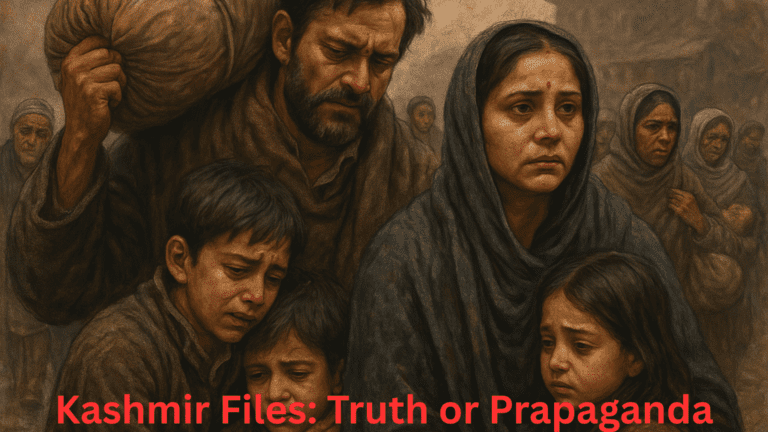
Kashmiri Pandit exodus 1990 is often presented as a sudden catastrophe. Many believe the community was forced out overnight in the depths of winter. This framing, though emotionally powerful, obscures a deeper and more disturbing truth. The departure of an entire community was not a spontaneous event. It was the culmination of years of systematic violence, administrative failure, and deliberate silence.
Understanding what made January 1990 inevitable requires looking beyond that single month. We must examine the years preceding it. This was when the machinery of governance collapsed completely. Targeted killings created an atmosphere of sustained terror. Silence became a weapon wielded by those in power and those who stood aside.
The Exodus Did Not Begin in January 1990
The narrative of a sudden exodus serves a particular purpose. It creates a stark and memorable image. But it also distorts historical reality in significant ways. Communities do not abandon their homes, their ancestral land, and their entire way of life because of a single night’s panic.
They leave when staying becomes untenable. They leave when the structures meant to protect them have failed. They leave when the society around them has fractured completely. They leave when violence has made it clear that there is no future for them.
Why the Idea of an Overnight Exodus Is Misleading
The exodus was gradual in its build-up, even if its final phase appeared sudden. Families had been sending their children away to relatives outside Kashmir months before January 1990. Professionals had begun accepting transfers to other states. Women stopped venturing out after dark in many localities. These were not acts of panic or impulsive decisions.
They were calculated responses to escalating danger that everyone could see. Fear preceded migration by years, not just days. The psychological landscape of the Valley had changed long before the physical departure began. When people finally left, they were not fleeing an unexpected threat.
They were responding to a threat that had been growing, unchecked and unaddressed, for years. The Kashmir conflict had been building through systematic failures at every level.
Understanding Inevitability in Historical Events
Historians speak of inevitability with caution and careful qualification. Few events are truly predetermined in any absolute sense. But when state structures collapse, when violence goes unpunished, and when a community is systematically targeted without protection, the range of possible outcomes narrows dramatically.
The exodus was not inevitable in the sense of being fated. It was inevitable in the sense that every condition necessary for it had been created and left unaddressed. Every warning sign had been ignored by those with the power to act.
Societies fracture before they flee in any mass displacement event. The social bonds that hold communities together erode gradually. Trust between neighbours, faith in shared institutions, and belief in a common future all dissolve slowly. Once these bonds reach a breaking point, physical separation follows naturally.
Understanding this process means recognising that the exodus was not a sudden disaster. It was the final stage of a long collapse that unfolded over the years. The history of communal violence in Kashmir shows this pattern clearly.
Kashmir Between 1986 and 1989: A Valley Slipping Out of Control
The period between 1986 and 1989 witnessed a transformation in Kashmir. This was not yet the phase of open armed insurgency that would come later. But it was no longer a time of normalcy or relative peace. The Valley was slipping between states of existence.
It was neither at peace nor fully at war. It existed somewhere between uncertainty and fear, with both growing daily. The political situation in Kashmir deteriorated month by month.
The 1986 Anantnag Riots and the First Communal Fracture
The riots in Anantnag in 1986 marked a shift in the public atmosphere. What had been localised tensions became communal in nature for the first time. For the first time in decades, the minority community in Kashmir felt openly vulnerable.
Shops were attacked without police intervention arriving in time. Homes were threatened by mobs in broad daylight. The violence was limited in scope and duration. But its symbolic impact was profound and long-lasting.
Minority insecurity became visible to everyone in the Valley. It was no longer something whispered about in private conversations. It was public, and the state’s response was inadequate. The police struggled to restore order in affected areas.
Political leaders issued statements but failed to address the underlying causes of tension. The message to the Pandit community was clear and unmistakable. You are on your own in this new environment.
Erosion of Civil Administration and Local Governance
The late 1980s saw the steady erosion of administrative capacity in Kashmir. Police morale was low across all ranks and stations. Officers faced political interference in routine law enforcement matters. Investigations into violence were stalled at multiple levels of authority.
Transfers were used as both punishment and reward, thereby undermining institutional coherence. The Kashmir police force rapidly lost effectiveness.
Local governance structures, already weakened by years of political manipulation, began to break down. District officials found themselves caught between central directives, state-level politics, and ground realities beyond their control. The result was paralysis at every level of decision-making.
Decisions were delayed for weeks or months without clear reasons. Enforcement became selective based on political considerations. The administration retreated from difficult areas where its presence was most needed.
The Vacuum Where Governance Once Existed
When institutions retreat, something else fills the space they leave behind. In Kashmir, that something was fear and uncertainty. In towns and villages where police presence diminished to minimal levels, where officials stopped making rounds, and where courts delayed cases indefinitely, people were left to fend for themselves.
Fear grows more quickly in unoccupied spaces than in occupied ones. It grows faster when those spaces were once governed, once safe. The psychological impact of abandonment by the state is profound and lasting. Citizens increasingly recognise that they cannot rely on institutions.
They make their own arrangements for security and protection. They form their own networks of information and mutual support. Eventually, when those too fail, they leave their homes behind. The breakdown of governance in Kashmir had predictable consequences.
Selective Killings as a Strategy, Not Random Violence
The violence that preceded the exodus was not random or spontaneous. It was targeted, calculated, and designed to send a message far beyond the immediate victims. Understanding this requires recognising that terror works not through mass casualties but through careful selection of targets.
The amplification of fear through strategic violence is well documented in history. The pattern of targeted killings followed a clear logic.
Why Pandit Assassinations Were Targeted
The killings focused on specific individuals with particular characteristics. Judges, government officials, professionals, and community leaders were primary targets. These were not crimes of passion or opportunistic violence of any kind.
They were symbolic killings meant to decapitate the community’s leadership structure. Each assassination was designed to eliminate the community’s most visible members. When a judge was killed, the message was that the law had no authority.
When a government employee was targeted, the message was that serving the state made you a legitimate target. When teachers and doctors were murdered, the message was that no profession could protect you. No neutrality, no matter how carefully maintained, would keep you safe.
How Killing a Few Terrified Thousands
Terrorism relies on psychological warfare more than actual body counts. You do not need to kill everyone to terrorise a community effectively. You need to kill selectively, publicly, and without facing any consequences. Each unpunished murder serves as a lesson to the entire community.
The silence that followed these killings amplified their impact exponentially. When no arrests were made in high-profile cases, when investigations stalled indefinitely, when political leaders remained silent or issued perfunctory statements, the message was clear. This violence is acceptable to those in power.
No one is coming to protect you from what happens next. Each killing, therefore, terrified not just the victim’s immediate family but thousands of others. They saw themselves reflected in the victim and understood their vulnerability. The psychology of communal fear explains this pattern.
When Protection Became Uncertain
Protection is not just about physical security or armed guards. It is about the certainty that the state will act on your behalf. By 1989, that certainty had vanished completely from Kashmir. Police were unable or unwilling to provide security to threatened individuals.
Intelligence agencies collected information, but enforcement lagged behind threat assessments. Warnings were issued to individuals about specific threats against them. However, the nature of the threat rendered warnings without action meaningless.
When people realised that staying meant relying on their own resources in the face of organised violence, the calculus shifted fundamentally. Protection had become uncertain in every practical sense. Uncertainty, in the face of a lethal threat, is intolerable for families. The failure of state protection drove rational decisions to leave.
Silence as a Weapon: Political, Administrative, and Social
Silence does not simply mean the absence of speech or communication. It is an active force with real consequences. In the years before the exodus, silence worked at multiple levels to achieve specific ends.
Political, administrative, and social silence combined to normalise violence against minorities. This silence erased the plight of the minority from public consciousness. It made departure seem inevitable rather than preventable. The role of silence in ethnic violence is well documented globally.
Political Inaction and Delayed Decision Making
The question of responsibility for Kashmir was contested between the central and state governments. Both pointed to the other as having primary responsibility. Both delayed action on critical security matters. This was not simply bureaucratic inefficiency or normal political friction.
It was a deliberate avoidance of difficult decisions that required political courage. The cost of hesitation was borne by those without the power to compel action. Each delay meant more violence went unpunished and emboldened perpetrators further. Each postponed meeting meant that conditions on the ground deteriorated further.
Political inaction was not neutral in its effects or consequences. It allowed the situation to worsen until the only option left was mass departure. The political history of Kashmir shows repeated failures at critical moments.
Media Silence and the Disappearing Minority
What was not reported in the late 1980s is as significant as what was. National media largely ignored the targeting of Kashmiri Pandits in their coverage. Local media, facing its own pressures from militant groups, often downplayed incidents significantly. Some avoided communal framing entirely, even when it was relevant.
This normalisation of threat had profound consequences for the community. Without media attention, there was no national pressure on the government to act. Without documentation, the community’s experience could later be questioned or minimised by sceptics.
Silence in the press meant that the minority effectively disappeared from public consciousness. They disappeared even before they physically left their homes. The media’s role in Kashmir during this period deserves scrutiny.
Silence of Neighbours and the Collapse of Trust
The most painful silence was often the closest and most personal. Neighbours who had lived side by side for generations began to withdraw. Some withdrew out of fear for their own safety. Some out of complicity with the changing order.
Some out of helplessness in the face of forces they could not control. Social withdrawal preceded physical separation by months and years. When people stopped visiting each other’s homes, sharing meals, and trusting one another with everyday concerns, the fabric of coexistence began to tear.
Fear replaced trust in relationships that had existed for lifetimes. Once that replacement is complete, a community is already fractured internally. The physical departure is merely the final acknowledgement of what has already been lost. The breakdown of social trust was gradual but total.
Lived Fear Before Migration: What Families Remember
Understanding the exodus requires listening to what families remember from the months and years before departure. These memories are not abstract or theoretical. They are specific, embodied, and rooted in everyday decisions. Those decisions suddenly carried existential weight for entire families.
The oral histories of exodus survivors provide crucial documentation.
Nights of Rumour, Announcements, and Uncertainty
Families remember nights filled with rumour and mounting anxiety. Loudspeakers in some areas broadcast threats against the minority community directly. In others, whisper networks carried news of fresh violence in neighbouring localities. Each night brought uncertainty about whether danger would arrive at your door.
These were not isolated incidents that could be dismissed as aberrations. They were sustained, deliberate campaigns to create an atmosphere of unrelenting terror. The psychological toll of living under such conditions is difficult to overstate. People stopped sleeping properly at night, listening for sounds of danger.
They planned escape routes from their homes in advance. They rehearsed scenarios of what to do if attacked. This is not how communities function normally or maintain their coherence. This is how communities prepare to cease existing in their current form.
Everyday Decisions That Became Existential
Sending children to relatives became common among Pandit families in 1989. Parents framed it as an educational opportunity or a temporary safety measure for children. But everyone understood what it meant in the broader context. It meant that parents no longer believed they could keep their children safe at home.
Locking homes that were never reopened became a shared experience across the community. People left for what they thought would be a few weeks at most. They took only small bags containing immediate necessities. They left valuables behind, locked the doors, and expected to return soon.
The realisation that return was impossible came gradually over months. It came painfully as conditions in Kashmir deteriorated further. But the decision to leave, in the moment, was often framed as temporary. This was a psychological buffer against the enormity of what was actually happening.
When Staying Felt More Dangerous Than Leaving
There comes a moment when the calculation shifts fundamentally for families. The known dangers of staying outweigh the unknown risks of departure completely. For many families, that moment came in late 1989. For others, it came in January 1990 when violence escalated dramatically.
But it was not a single moment across the community simultaneously. It was a cascade of individual decisions, each shaped by specific circumstances. However, all points are in the same direction toward departure. This was not panic or irrational fear driving decisions.
This was calculation under fear by rational people assessing threats. People weighed the options carefully using the available information. They consulted family members about the best course of action. They sought ways to remain in their homeland. When they left, it was because staying had become the more dangerous choice.
Administrative Collapse as the Hidden Engine of Exodus
Behind the visible violence and public silence lay a less visible but equally crucial factor. The collapse of administrative capacity and will to act was fundamental. The state did not simply fail to protect Kashmiri Pandits adequately. It ceased to function effectively as a guarantor of anyone’s security.
The administrative history of Kashmir reveals systemic failures.
Intelligence Inputs Without Enforcement
Intelligence agencies were not blind to developments in Kashmir. They regularly collected information on threats against specific individuals. They identified militant groups and their members through various means. They issued warnings to potential targets about imminent danger.
But information without action is useless in preventing violence. The gap between what was known and what was done grew wider each month. This gap was not accidental or attributable solely to a lack of resources. It reflected deeper problems within the governance system.
Political interference in police operations prevented effective action. A lack of coordination among agencies resulted in ineffective information sharing. The absence of a clear chain of command created confusion about responsibilities. Ultimately, the lack of political will to confront the sources of violence was decisive.
Law and Order Without the Will to Act
Law enforcement requires not just personnel and equipment but the will to act decisively. By 1989, that will was absent at multiple levels of administration. Police officers who attempted to take action against militants found themselves transferred punitively. Investigations into killings went nowhere despite clear evidence in some cases.
Deterrence collapsed as perpetrators faced no consequences for their actions. When violence goes unpunished, it sends a message to both perpetrators and potential victims. To perpetrators, it signals impunity and encourages further violence. To victims, it signals abandonment by the state that should protect them.
The erosion of deterrence meant that each act of violence made the next one more likely. It made each subsequent act more brazen and public. The failure of law enforcement had cascading effects.
How the State Lost Moral Authority
The state’s authority rests not simply on its monopoly of force or coercive power. It rests on its legitimacy in the eyes of citizens. Citizens must fundamentally believe that the state acts in their interest. They must believe it will protect them from harm. They must believe it represents a framework of justice they can trust.
By 1989, in Kashmir, that belief had collapsed among the Pandit community. When citizens cease to believe in protection, they cease to rely entirely on the state. They make their own safety arrangements as best they can. When those arrangements prove inadequate in the face of organised violence, they leave.
The exodus was, in this sense, a vote of no confidence in the state. It reflected the state’s inability or unwillingness to protect its own citizens. The crisis of state legitimacy was complete.
January 1990: The Tipping Point, Not the Beginning
January 1990 is remembered as the month of exodus in popular memory. But it was not the beginning of the story of displacement. It was the tipping point at which accumulated pressures overwhelmed the remaining reasons to stay. It was when the final stage of a long process became visible to the outside world.
What Had Already Been Lost Before That Winter
By January 1990, much had already been lost by the community. Safety had been lost gradually over three years of escalating violence. Faith in institutions had eroded with each unpunished killing and ignored warning. The social fabric had frayed with each withdrawal of a neighbour.
Trust in the future had disappeared as militant groups gained strength unchecked. The physical departure was the final loss in a series of losses. But it followed logically from what had already gone before. Communities do not abandon everything they have built on impulse or whim.
They do so when everything that made staying possible has already been taken from them. The timeline of displacement shows this clearly.
Why Departure Became the Only Rational Choice
The decision to leave was rational rather than panicked for most families. People weighed the risks carefully with available information. Staying meant facing continued targeted violence with no protection from the state. It meant raising children in an atmosphere of terror and uncertainty.
It meant daily uncertainty about survival for the entire family. Leaving meant loss of homes that had been in families for generations. It meant loss of livelihoods built over decades of work. It meant loss of community, identity, and sense of belonging.
But it also meant immediate safety for loved ones. When those are the options presented to families, when the state has failed to provide any middle ground, departure becomes rational. Understanding this is crucial to an honest assessment of the exodus.
The exodus was not a failure of nerve among those who left. It was a failure of the state to provide conditions under which staying was possible. The refugee crisis that followed was entirely preventable.
Who Failed the Kashmiri Pandits?
Assigning responsibility for the exodus requires care and precision. Simplistic blame is easy but unhelpful for understanding. Understanding the layers of failure is harder but necessary for historical accuracy. Multiple actors failed at multiple levels in different ways.
Militancy and Targeted Violence
The direct responsibility lies with those who planned and executed targeted killings. Militant groups that identified Pandits as enemies bear primary responsibility. Groups that issued threats against the community created an atmosphere of terror. Those who carried out the assassinations of civilians are directly responsible.
This responsibility cannot be minimised or explained away by any political context. Whatever political grievances existed in Kashmir, targeting civilians based on their community identity is indefensible. The violence was deliberate, systematic, and aimed at forcing a community out. The militant groups in Kashmir must be held accountable.
State Government Breakdown
The state government’s failure was institutional and comprehensive. The administration withdrew from areas where it was needed most desperately. Police forces were demoralised and politically compromised at every level. Decision-making was paralysed by competing power centres and a lack of clear authority.
This was not simply inefficiency or normal bureaucratic friction. It was a collapse of governance at the most basic level. When the primary responsibility of any government becomes impossible to fulfil, when protecting citizens becomes secondary to political calculations, the government has failed. The Kashmir state government bore significant responsibility.
Central Government Delay and Distance
The central government’s failure was one of policy lag and political calculation. Warnings from Kashmir were treated as regional problems rather than national crises. They were not given the urgency they required for effective intervention. Decisions were delayed as on-the-ground conditions deteriorated.
Resources were withheld when immediate deployment was required. The distance, both geographical and political, between Delhi and Srinagar meant delayed responses. By the time action was taken, it was too late to prevent the exodus.
The consequences of this delay were borne by those with no ability to compel faster action. Policy failures in distant offices translated into existential threats in Kashmiri homes. The central government’s Kashmir policy failed the community.
Understanding the Exodus Without Reducing It
The exodus of Kashmiri Pandits cannot be understood through simple narratives or single-cause explanations. It was not solely a religious conflict, though religion played a significant role. It was not solely a political failure, though politics failed comprehensively. It was not solely a security breakdown, though security collapsed completely.
It was all of these factors intersecting and reinforcing each other over time. The complexity of the Kashmir conflict requires a nuanced understanding.
Why Simplistic Narratives Do Long-Term Damage
Reducing the exodus to slogans or single causes does damage in multiple ways. It prevents a genuine understanding of how such events become possible in the first place. It makes it more difficult to prevent similar failures elsewhere in the future.
It dishonours the complexity of people’s experiences during those years. History flattened into slogans becomes unusable for any serious purpose. It cannot teach meaningful lessons about preventing violence. It cannot warn about early indicators of communal breakdown.
It can only serve immediate political purposes, which shift with time and circumstance. The people who lived through the exodus deserve better than to have their experience reduced to a mere narrative. They deserve better than to have their suffering turned into talking points.
Remembering the Exodus as Process, Not Event
The exodus was a process that unfolded over years, not a single event. It involved the gradual erosion of security, trust, and hope. It involved thousands of individual decisions made under impossible circumstances by ordinary people.
It involved the failure of multiple institutions at multiple levels of governance. Understanding it as a process means recognising the warning signs that appeared early. How violence becomes normalised when left unchecked by authorities. How institutions fail when political will is absent.
How silence enables terror when those with voices remain quiet. How distance allows deadly delays when urgency is required. These are lessons applicable beyond Kashmir, beyond India, beyond any single context. The lessons from Kashmir have global relevance.
What This History Demands From Us Today
This history demands accuracy in how we remember and discuss it. It demands that we resist the temptation to simplify for political convenience. It demands that we listen to those who lived through it directly. It demands that we examine the documentary record carefully and honestly.
It demands that we acknowledge complexity rather than seek easy answers. It also demands responsibility to memory and to those who suffered. The people who left Kashmir in 1990 did not choose displacement willingly. They were forced out by a combination of targeted violence and state failure.
Accurately remembering this is not about assigning collective guilt to any community. It is about understanding how such failures occur in governance and society. It is about committing to preventing their recurrence wherever they occur. The memory of the exodus must be preserved accurately.
The exodus of Kashmiri Pandits was not inevitable in the sense of being predetermined by fate. It was inevitable in the sense that every condition necessary for it was created systematically. Each condition was left unaddressed by those with the authority to act. That distinction is crucial to understanding responsibility.
This means that different choices could have produced different outcomes for all parties involved. It means that responsibility for what happened lies with those who made those choices. It lies with those who failed to act when action was desperately needed. Understanding this is the first step toward ensuring that such failures are not repeated.
The future of Kashmir depends on an honest reckoning with this past.
FAQs
1. What was the Kashmiri Pandit exodus of 1990?
The Kashmiri Pandit exodus of 1990 was the forced mass migration of the Hindu minority community from the Kashmir Valley. Between 100,000 and 150,000 Kashmiri Pandits left their ancestral homes due to targeted violence and the complete failure of state protection. The exodus was not a sudden event but the culmination of years of systematic violence, administrative collapse, and deliberate silence between 1986 and 1989.
2. When did the Kashmiri Pandit exodus actually begin?
The exodus did not begin in January 1990 as commonly believed. The process began between 1986 and 1989. Families began sending children away in 1989. Professionals accepted transfers to other states. The community faced escalating targeted violence without state protection. January 1990 marked the tipping point for the final wave of departures, not the beginning of the crisis.
3. How many Kashmiri Pandits left Kashmir during the exodus?
Estimates vary between 100,000 and 150,000 Kashmiri Pandits who left the Kashmir Valley. Some sources suggest the number could be as high as 200,000. The exact figure remains disputed due to a lack of comprehensive documentation at the time. What is undisputed is that the community’s presence was reduced from a substantial minority to nearly zero within months.
4. Why did Kashmiri Pandits leave Kashmir?
Kashmiri Pandits left due to multiple intersecting failures. Militant groups conducted targeted killings of community members, including judges, officials, and professionals. The state administration and police completely withdrew protection. Both state and central governments delayed action despite clear warnings. Media and society remained silent about the targeting. Trust between communities collapsed completely. Staying became more dangerous than leaving for most families.
5. Were Kashmiri Pandits specifically targeted?
Yes, Kashmiri Pandits were specifically and systematically targeted by militant groups. The killings focused on judges, government employees, professionals, teachers, and community leaders. These were not random acts but calculated assassinations designed to terrorise the entire community. Each killing sent a message that no profession or neutrality could protect them. The violence was selective, but its psychological impact affected thousands.
6. What happened in the 1986 Anantnag riots?
The 1986 Anantnag riots marked the first major communal fracture in Kashmir in decades. Shops owned by Pandits were attacked. Homes were threatened by mobs. The violence was limited in scope but symbolically profound. The state’s inadequate response signalled that the minority community could not rely on protection. This event marked when minority insecurity became visible and public in Kashmir.
7. What was Kashmir like between 1986 and 1989?
Kashmir between 1986 and 1989 was a valley slipping out of control. It was not yet an open insurgency, but no longer peaceful. Police morale collapsed due to political interference. Local governance structures broke down completely. Targeted killings of community members increased without arrests or consequences. Fear grew in spaces where state presence diminished. The period created all conditions necessary for the eventual mass exodus.
8. What role did the Kashmir conflict play in the exodus?
The broader Kashmir conflict created the political environment for the exodus. Rising militancy from 1988 onwards targeted those perceived as pro-India. Kashmiri Pandits, many of whom were in government service, became visible targets. However, the exodus was not inevitable solely due to the conflict. It became inevitable due to the state’s failure to protect citizens. Different government responses could have prevented the mass displacement.
9. How did militancy in Kashmir lead to the exodus?
Militant groups identified Kashmiri Pandits as enemies and legitimate targets. They issued public threats through loudspeakers in some areas. They conducted selective assassinations of prominent community members. They created an atmosphere of sustained terror through psychological warfare. The militancy alone did not cause the exodus. It was militancy combined with complete absence of state protection that made staying impossible.
10. What were the warning signs before January 1990?
Warning signs appeared years before January 1990. The 1986 Anantnag riots revealed communal tensions. Targeted killings began increasing from 1988 onwards. Intelligence agencies issued warnings that went unheeded. Families started sending children away in 1989. Police presence diminished in vulnerable areas. Social trust between communities deteriorated visibly. Each unpunished murder sent signals that violence was acceptable.
11. What happened in the 1986 Anantnag riots?
The 1986 Anantnag riots marked the first major communal fracture in Kashmir in decades. Shops owned by Pandits were attacked. Homes were threatened by mobs. The violence was limited in scope but symbolically profound. The state’s inadequate response signalled that the minority community could not rely on protection. This event marked when minority insecurity became visible and public in Kashmir.
12. What was Kashmir like between 1986 and 1989?
Kashmir between 1986 and 1989 was a valley slipping out of control. It was not yet an open insurgency, but no longer peaceful. Police morale collapsed due to political interference. Local governance structures broke down completely. Targeted killings of community members increased without arrests or consequences. Fear grew in spaces where state presence diminished. The period created all conditions necessary for the eventual mass exodus.
13. What role did the Kashmir conflict play in the exodus?
The broader Kashmir conflict created the political environment for the exodus. Rising militancy from 1988 onwards targeted those perceived as pro-India. Kashmiri Pandits, many of whom were in government service, became visible targets. However, the exodus was not inevitable solely due to the conflict. It became inevitable due to the state’s failure to protect citizens. Different government responses could have prevented the mass displacement.
14. How did militancy in Kashmir lead to the exodus?
Militant groups identified Kashmiri Pandits as enemies and legitimate targets. They issued public threats through loudspeakers in some areas. They conducted selective assassinations of prominent community members. They created an atmosphere of sustained terror through psychological warfare. The militancy alone did not cause the exodus. It was militancy combined with the complete absence of state protection that made staying impossible.
15. What were the warning signs before January 1990?
Warning signs appeared years before January 1990. The 1986 Anantnag riots revealed communal tensions. Targeted killings began increasing from 1988 onwards. Intelligence agencies issued warnings that went unheeded. Families started sending children away in 1989. Police presence diminished in vulnerable areas. Social trust between communities deteriorated visibly. Each unpunished murder sent signals that violence was acceptable.