Key Facts About the Kashmiri Pandit Genocide:
- Date of Mass Exodus: 19 January 1990
- People Displaced: 350,000-400,000 Kashmiri Hindus
- Death Toll: 1,623+ killed (1989-2005, official records)
- Current Status: Still homeless after 36 years
- Recognition: “Akin to genocide” – National Human Rights Commission of India
- Population Decline: From 15% (1947) to 0.01% (2011) of Kashmir’s population
Quick Navigation:
- What Happened on 19 January 1990?
- Timeline of Killings (1989-1990)
- How Many Were Killed?
- The Forced Exodus
- Life After 36 Years
- Pakistan’s Role
- Frequently Asked Questions
- Sources and References
What Happened on 19 January 1990? The Night Kashmir Changed Forever
On the night of 19 January 1990, the Kashmir Valley witnessed systematic ethnic cleansing of its Hindu minority population. This date marks the beginning of the Kashmiri Pandit exodus, when 350,000 to 400,000 Kashmiri Hindus were forced to flee their ancestral homeland under the threat of death.
The night began with a coordinated blackout across the entire Kashmir Valley. Terrorists deliberately cut off electricity to all Hindu neighbourhoods. Only the mosques remained illuminated, their loudspeakers broadcasting messages throughout the darkness.
From sunset until dawn, mosque loudspeakers across Kashmir blared threats and ultimatums targeting the Hindu minority. The messages declared Kashmiri Pandits as “Kafirs” (non-believers) and presented Hindu males with three stark choices: convert to Islam, leave Kashmir immediately, or face death. Those who chose to leave received orders to abandon their women behind.
The slogan that echoed through every street became the defining cry of ethnic cleansing: “Raliv, Tchaliv, Ya Galiv” – convert, leave, or die in the Kashmiri language.
This was not spontaneous mob violence. This was an orchestrated genocide broadcast from religious platforms with calculated precision. Within months, an entire civilisation that had flourished in Kashmir for thousands of years faced near-complete elimination.
What is the Kashmiri Pandit Genocide?
The Kashmiri Pandit genocide refers to the systematic targeting, killing, and forced displacement of Kashmiri Hindus (Pandits) from the Kashmir Valley between 1989 and 1991, with violence continuing through the 2000s. The National Human Rights Commission of India officially described these atrocities as “akin to genocide.”
The genocide had clear objectives: eliminate the Hindu presence from Kashmir, erase indigenous Hindu culture, and facilitate the Islamisation of the Kashmir Valley. Terrorists achieved this through targeted assassinations, mass rape, property destruction, and sustained psychological terror.
Why Were Kashmiri Pandits Targeted? Understanding Our Only Crime
Kashmiri Pandits were indigenous to Kashmir, having lived in the valley for over 5,000 years according to historical and archaeological evidence. We were educators, doctors, lawyers, engineers, teachers, and civil servants. We were economically successful and educationally accomplished.
Our community had preserved Kashmir’s ancient Hindu heritage, maintained Sanskrit scholarship, and protected temples dating back millennia. We had contributed significantly to Kashmiri culture, literature, philosophy, and arts.
But in the eyes of Islamic militants and separatists, we committed unforgivable crimes.
Our crimes were:
- Refusing to support the separatist movement demanding Kashmir’s independence from India
- Maintaining loyalty to the Indian Constitution and Indian national identity
- Serving in government positions that upheld Indian sovereignty
- Preserving Hindu religious and cultural practices
- Achieving educational and economic success
We refused to betray India. We refused to abandon our Hindu identity. We refused to support terrorism. For this, militants marked us for elimination.
The terrorist organisations, primarily Jammu and Kashmir Liberation Front (JKLF), Hizbul Mujahideen, and Lashkar-e-Taiba, viewed our presence as an obstacle to their goal of an Islamic Kashmir. Our commitment to Indian unity contradicts their separatist agenda. Our existence itself became our death sentence.
Timeline of Kashmiri Pandit Killings: How the Genocide Unfolded (1989-2003)
The systematic killing of Kashmiri Pandits began months before the mass exodus of 19 January 1990. Each assassination sent waves of terror through our community, signalling that no Hindu was safe in Kashmir.
September 1989: The Killing Begins
14 September 1989 – Tika Lal Taploo Assassination
Tika Lal Taploo, a prominent lawyer and Bharatiya Janata Party (BJP) leader, was murdered by JKLF terrorists in his Srinagar home. Taploo had been a vocal advocate for Kashmir’s integration with India and opposed the growing separatist movement.
His assassination sent a clear message: any Hindu who supported Indian sovereignty would be killed. The terrorists who murdered him were never arrested or prosecuted. This killing announced open season on Kashmiri Pandits.
Justice Neelkanth Ganjoo – Killed for Upholding Indian Law
Justice Neelkanth Ganjoo had sentenced JKLF founder Maqbool Bhat to death for terrorism. Militants assassinated him in revenge. His crime was administering justice in accordance with Indian law within Indian territory.
February 1990: Terror Intensifies
2 February 1990 – Satish Tikoo Murder
Satish Tikoo, a young Hindu social worker, was shot dead near his house in Habba Kadal, Srinagar. His killing demonstrated that even non-political Hindus engaged in social service were not safe.
13 February 1990 – Lassa Kaul Assassination
Lassa Kaul, Station Director of Srinagar Doordarshan (state television), was murdered. His position in the media made him a target. Terrorists wanted to eliminate Hindu voices from public discourse.
April 1990: Cultural Leaders Targeted
29 April 1990 – Sarwanand Koul Premi and Son Murdered
Sarwanand Koul Premi, a veteran Kashmiri poet and cultural icon, was shot along with his son. After shooting them, the terrorists hanged their bodies publicly as a warning to other Hindus.
The killing of cultural and literary figures aimed to erase Kashmir’s Hindu intellectual heritage. Premi had dedicated his life to preserving the Kashmiri language and culture.
June 1990: The Most Horrific Crime
4 June 1990 – Girija Tickoo Gang Rape and Murder
Girija Tickoo was a Kashmiri Hindu schoolteacher. Terrorists abducted her, subjected her to brutal gang rape, and then committed unspeakable torture.
While she was still alive and conscious, the terrorists cut open her abdomen. They then used a saw machine to cut her body into two pieces. This barbaric killing was designed to terrorise the remaining Kashmiri Pandit community into complete submission or flight.
The Girija Tickoo case represents the sexual violence and extreme brutality used against Kashmiri Hindu women. Many Kashmiri Pandit women were kidnapped, raped, and murdered throughout the exodus period. Most families never reported these crimes due to stigma and fear.
2003: The Killing Never Stopped
24 March 2003 – Nadimarg Massacre
Thirteen years after the mass exodus, terrorists proved that Kashmiri Pandits remaining in Kashmir still faced death.
On 24 March 2003, militants entered the village of Nadimarg in Pulwama district. They lined up 24 Kashmiri Pandits, including women, children, and elderly persons, and executed them systematically.
The victims included infants and women over 80 years old. This massacre occurred more than a decade after we “left” Kashmir, proving the genocide was not about politics but about eliminating Hindus entirely.
Table 1: Major Kashmiri Pandit Killings (1989-2003)
| Date | Victim Name | Occupation | Location | Method | Organisation |
|---|---|---|---|---|---|
| 14 Sep 1989 | Tika Lal Taploo | Lawyer, BJP Leader | Srinagar | Shot | JKLF |
| Nov 1989 | Justice Neelkanth Ganjoo | Judge | Srinagar | Shot | JKLF |
| 2 Feb 1990 | Satish Tikoo | Social Worker | Habba Kadal, Srinagar | Shot | JKLF |
| 13 Feb 1990 | Lassa Kaul | Doordarshan Director | Srinagar | Shot | JKLF |
| 29 Apr 1990 | Sarwanand Koul Premi | Poet | Srinagar | Shot and hanged | Militants |
| 4 Jun 1990 | Girija Tickoo | Teacher | Bandipora | Gang raped, sawed alive | Militants |
| 24 Mar 2003 | 24 civilians | Villagers (incl. children) | Nadimarg, Pulwama | Execution | Lashkar-e-Taiba |
How Many Kashmiri Pandits Were Killed? Analysing the Death Toll
The exact number of Kashmiri Pandits killed during the genocide remains disputed. Different sources provide varying estimates, but every number represents a stolen life, a destroyed family, and a dream that ended in terror.
Official Government Data
According to the Indian Ministry of Home Affairs, 217 Hindu civilians were killed in Kashmir between 1988 and 1991. From 1991 to 2005, another 1,406 Hindu civilians lost their lives to terrorism.
The total official death toll stands at 1,623 Kashmiri Hindu civilians killed between 1988 and 2005.
Community Surveys and Estimates
The Kashmiri Pandit Sangharsh Samiti conducted comprehensive surveys in 2008 and 2009. Their research estimated that 357 Hindus were killed in Kashmir, specifically in 1990. Seventy-five per cent of these murders occurred during the first year of insurgency.
Various Kashmiri Pandit organisations estimate that over 2,000 community members have been killed since 1989. This higher figure includes:
- Unreported deaths in remote villages
- Deaths that occurred during the chaotic exodus
- Indirect deaths from trauma, suicide, and displacement
- Deaths of those who died from injuries sustained in attacks
Why the Discrepancy in Numbers?
Several factors explain the difference between official and community estimates:
First, many families fled Kashmir immediately after witnessing violence against neighbours. They never filed official reports about missing family members.
Second, numerous deaths occurred in remote villages where documentation was minimal or non-existent. The breakdown of civil administration during 1990 meant many violent deaths went unrecorded.
Third, the official statistics typically count only direct killings. They exclude deaths from trauma, medical emergencies during exodus, suicides resulting from PTSD, and deaths in refugee camps from harsh conditions.
Fourth, families feared retribution if they reported crimes. Many chose silence over official complaints to protect surviving family members.
Beyond Numbers: The Human Cost
Statistics cannot capture the full magnitude of suffering. Behind each number was a human being with dreams, a family, and a future.
Each murder destroyed entire families. When breadwinners were killed, wives became widows and children became orphans overnight. Economic devastation followed every assassination.
The psychological trauma extended across generations. Children who witnessed their fathers being killed, women who survived sexual violence, elderly parents who watched their sons murdered – these wounds never heal.
The true death toll includes not just those physically killed but an entire civilisation that died in Kashmir.
Table 2: Kashmiri Pandit Death Toll Estimates (1988-2005)
| Source | Time Period | Estimated Deaths | Notes |
|---|---|---|---|
| Indian Ministry of Home Affairs | 1988-1991 | 217 | Hindu civilians only |
| Indian Ministry of Home Affairs | 1991-2005 | 1,406 | Hindu civilians only |
| Official Total | 1988-2005 | 1,623 | Government records |
| Kashmiri Pandit Sangharsh Samiti | 1990 only | 357 | Survey-based estimate |
| Various Pandit Organisations | 1989-2005 | 2,000+ | Includes unreported deaths |
| Nadimarg Massacre | 24 March 2003 | 24 | Single incident |
The Forced Exodus: 350,000 Driven from Our Homeland
The exodus of Kashmiri Pandits represents one of the largest forced migrations in post-independence India. Within months, centuries of Hindu civilisation in Kashmir faced near-complete erasure.
First Wave: January to March 1990
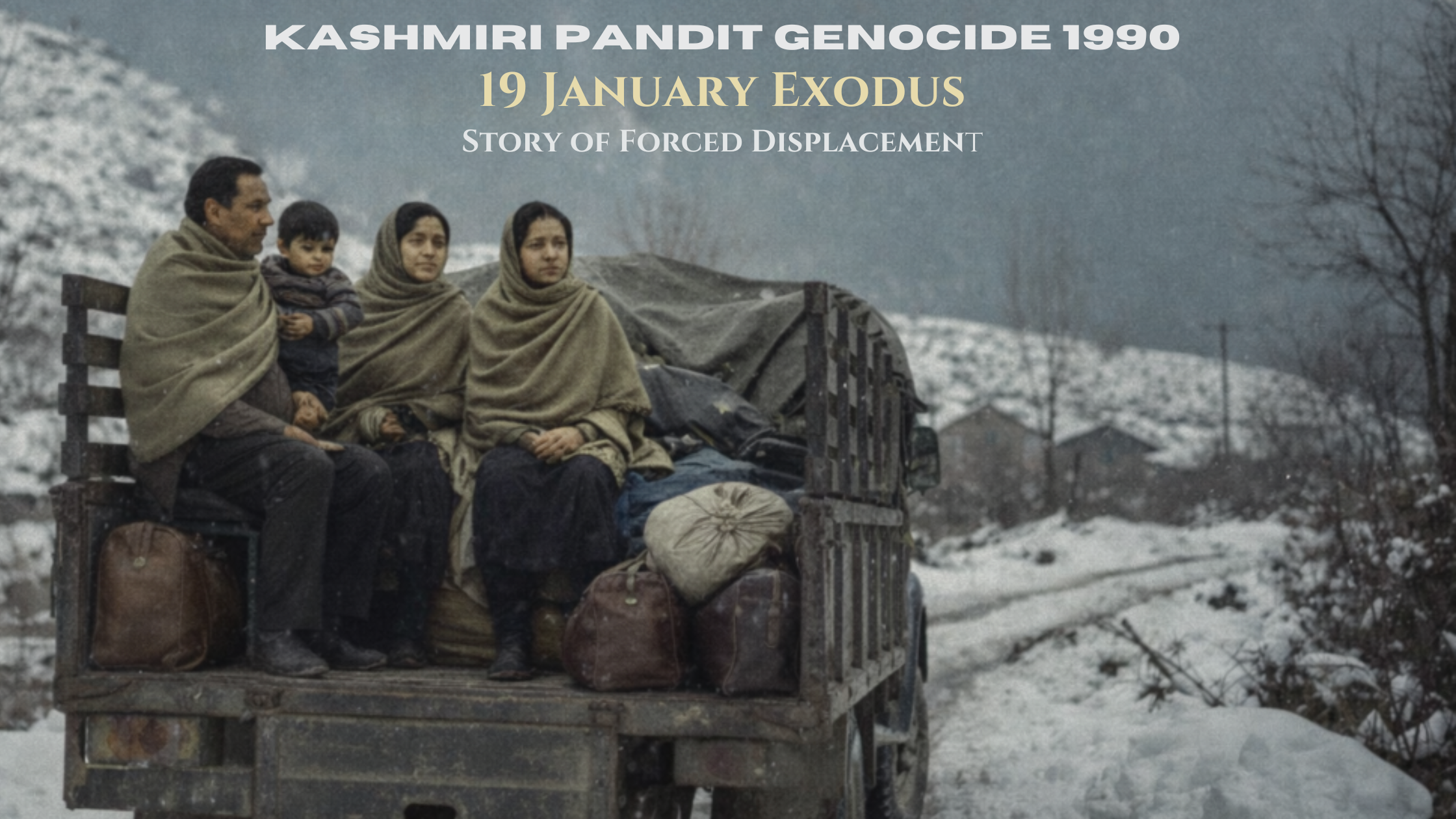
Following the terror of 19 January 1990, Kashmiri Pandit families began fleeing Kashmir in panic. The threats broadcast from mosque loudspeakers made it clear that staying meant death.
We fled with whatever belongings we could carry. Most families believed this displacement would be temporary – perhaps days or weeks until the violence subsided. We packed light, assuming we would return soon to our homes and normal lives.
Between 90,000 and 100,000 Pandits left the Kashmir Valley by mid-1990. The exodus occurred in waves as different neighbourhoods faced escalating threats and violence.
Total Displacement by the End of 1990
By the end of 1990, over 350,000 Kashmiri Pandits had been driven from Kashmir. Some estimates place the figure as high as 400,000, accounting for the total Hindu population, including those living in rural areas.
The exodus represented nearly the entire Kashmiri Hindu population. Whole neighbourhoods emptied overnight. Centuries-old communities vanished within weeks.
What We Lost: The Economic Devastation
The economic destruction of the Kashmiri Pandit community was systematic and total:
Agricultural Losses: Approximately 50,000 Kashmiri Pandit agricultural families lost their ancestral lands. These were not just economic assets but lands that families had cultivated for generations.
Business Destruction: Over 20,000 Kashmiri Pandit businesses were destroyed, looted, or forcibly occupied. These included shops, factories, workshops, and trading establishments.
Property Abandonment: Virtually all Kashmiri Pandit families abandoned their homes, often with belongings still inside. These properties were subsequently looted, burned, or illegally occupied.
Temple Desecration: Hundreds of Hindu temples across Kashmir were desecrated, demolished, or converted. Ancient temples representing thousands of years of heritage were destroyed within months.
Our community lost not just material wealth but irreplaceable cultural heritage. Libraries containing ancient Sanskrit manuscripts were burned. Family heirlooms accumulated over generations were looted. Temples that had stood for millennia were reduced to rubble.
The Refugee Journey
Kashmiri Pandit families fled primarily to Jammu, Delhi, and other parts of India. The journey itself was traumatic and dangerous.
Families travelled in overcrowded buses and trucks, constantly fearing militant attacks. Women hid their jewellery and religious symbols to avoid identification at checkpoints. Parents sedated young children to keep them quiet during dangerous passages.
Many elderly people died during the exodus itself, unable to survive the physical and emotional trauma of forced displacement.
Table 3: Kashmiri Pandit Population Decline (1947-2025)
| Year | Kashmiri Pandit Population | Percentage of J&K Population | Context |
|---|---|---|---|
| 1947 | 650,000 | 15% | At the time of independence |
| 1981 | 124,000 | 5% | After decades of migration |
| 1990 (Jan) | 120,000-140,000 | 3.8% | Before the mass exodus |
| 1990 (Dec) | 3,000-5,000 | 0.02% | After exodus |
| 2011 | 3,000-4,000 | 0.01% | Census data |
| 2025 | ~2,800 | <0.01% | Current estimate |
Key Insight: In just 10 months (January-December 1990), the Kashmiri Pandit population declined from 140,000 to under 5,000 – a reduction of over 96%.
Life in Exile: 36 Years of Homelessness and Suffering
The Jammu Refugee Camps: Where Dignity Died
The Indian government established refugee camps in Jammu to house displaced Kashmiri Pandits. These camps became our homes for years, even decades. For many, they remain home today, 36 years later.
The conditions in these camps were inhuman and degrading. Families who had lived in spacious ancestral homes for generations were packed into single-room tenements measuring 8×8 feet or 10×10 feet. Multiple generations shared these cramped spaces with no privacy or dignity.
The climate proved deadly. Jammu experiences scorching heat that regularly exceeds 45°C (113°F) during the summer months. Kashmiri Pandits had spent their entire lives in Kashmir’s cool, temperate climate. The sudden exposure to extreme heat killed hundreds of elderly community members.
Heat stroke, dehydration, and heat-related illnesses ravaged the refugee camps. Elders who had survived terrorism in Kashmir died from sunstroke in Jammu refugee camps. This cruel irony – surviving genocide only to die in government camps – characterised our exile.
Death in the Camps
Beyond heat-related deaths, other causes killed refugees:
- Snakebites in makeshift shelters
- Inadequate medical facilities leading to preventable deaths
- Infectious diseases are spreading rapidly in overcrowded conditions
- Depression and suicide among those who lost everything
- Malnutrition affecting children and the elderly
The psychological trauma was equally devastating. Men who had been successful professionals became unemployed refugees dependent on government rations. Women who had managed comfortable households found themselves queuing for food and water. Children who had attended good schools now studied in overcrowded camp schools with minimal resources.
Economic Destruction Across Generations
The economic impact of displacement destroyed wealth accumulated over generations:
First Generation: Lost businesses, agricultural lands, properties, and lifetime savings. Professionals who had been doctors, lawyers, and engineers found themselves unemployed and unemployable in their 50s and 60s.
Second Generation: Lost educational continuity. Students preparing for crucial exams had their education disrupted. Many could not afford to continue higher education after displacement.
Third Generation: Born in exile, they grew up in poverty despite coming from historically prosperous families. They faced discrimination and struggled to rebuild what their grandparents had lost.
The destruction of the Kashmiri Pandit economic prosperity was systematic. A community known for educational achievement and professional success was reduced to refugee status, dependent on government assistance.
Children Born in Exile
An entire generation of Kashmiri Pandits has been born and raised in exile. These children have never seen the Kashmir their parents describe. They have never walked the streets where their ancestors lived for 5,000 years. They have never prayed in the temples their forefathers built.
For these children, Kashmir exists only in their parents’ traumatic memories and old family photographs. Their identity is defined by displacement, a homeland they cannot visit, and a heritage they cannot fully access.
Scattered Across India: The Diaspora
Not all Kashmiri Pandits remained in refugee camps. Many were scattered across India, seeking employment and rebuilding their lives in Delhi, Mumbai, Bangalore, and other cities.
This dispersal destroyed community cohesion. Extended families that had lived in the same neighbourhoods for centuries now live thousands of kilometres apart. Traditional community gatherings, festivals, and social structures collapsed.
We became strangers in our own country. Despite being Indian citizens in Indian cities, we were refugees, displaced persons carrying trauma and loss wherever we went.
Current Status of Kashmiri Pandits: Where Are We Now in 2026?
The Numbers Today
As of 2025-2026, approximately 2,800 to 3,200 Kashmiri Pandit families remain in the Kashmir Valley. This represents less than 0.01% of Kashmir’s total population.
The vast majority of Kashmiri Pandits continue to live in exile:
- Jammu: Approximately 60,000-65,000 are still in refugee camps or Jammu city
- Delhi NCR: 35,000-40,000
- Other Indian Cities: 50,000-60,000
- Abroad: 15,000-20,000 migrated to the USA, UK, Canada, and other countries
Return and Rehabilitation Efforts
The Indian government has announced multiple rehabilitation packages since 1990. These include:
PM Package (2008-2015): The Prime Minister’s Relief and Rehabilitation Package offered government jobs to 6,000 Kashmiri Pandit youth with posted positions in the Kashmir Valley. The package included salary, accommodation, and security measures.
However, the programme faced serious challenges. Many recruits faced security threats. Several were killed by terrorists. Accommodation provided was inadequate and often in insecure locations.
Post-Article 370 Abrogation (2019-Present): On 5 August 2019, the Indian government abrogated Article 370, which had granted special status to Jammu and Kashmir. The state was reorganised into two Union Territories: Jammu and Kashmir and Ladakh.
The government has since announced new rehabilitation initiatives, land rights restoration, and security measures for returning Kashmiri Pandits. However, ground-level implementation remains inconsistent.
Why Return Remains Difficult
Despite government initiatives, the mass return of Kashmiri Pandits faces substantial obstacles:
Security Concerns: Targeted killings of Kashmiri Pandits have continued sporadically. In 2022, several Kashmiri Pandit government employees were killed by terrorists, triggering fresh exodus from the valley.
Property Occupation: Many Kashmiri Pandit properties have been illegally occupied, destroyed, or sold under fraudulent documents. Legal reclamation is complex and often impossible.
Economic Challenges: Rebuilding businesses and livelihoods after 36 years is economically unfeasible for most families, especially elderly returnees.
Psychological Barriers: Who wants to return to neighbourhoods where neighbours marked our homes for killing? Who wants to live among people who remained silent while we were slaughtered?
Demographic Reality: Kashmiri Pandits would return as a tiny minority in a region where we once thrived. The demographic transformation is irreversible.
Actual Return Statistics
According to official data, as of October 2015, only one Kashmiri Pandit family had returned to the Kashmir Valley to live permanently since 1990.
This statistic speaks volumes about the impossibility of return under current conditions. Despite government packages, financial incentives, and political promises, Kashmiri Pandits do not feel safe returning to Kashmir.
Recent targeted killings have reinforced these fears, demonstrating that the threat to Kashmiri Hindu lives in Kashmir has not disappeared.
Pakistan’s Role in the Kashmiri Pandit Genocide
Cross-Border Terrorism and ISI Involvement
The genocide of Kashmiri Pandits was not spontaneous communal violence. It was carefully orchestrated terrorism with substantial Pakistani state involvement.
Pakistan’s Inter-Services Intelligence (ISI) implemented a systematic strategy of low-intensity warfare aimed at destabilising the Kashmir region through cross-border terrorism. This strategy had multiple components:
Arming and Training Militants: ISI established training camps in Pakistan-occupied Kashmir (PoK) and Pakistan, where Kashmiri youth were radicalised and trained in warfare and terrorism.
Weapons and Financial Support: Sophisticated weapons, including AK-47 rifles, grenades, and explosives, flowed across the border from Pakistan. Terrorist organisations received substantial financial support from Pakistani intelligence agencies.
Ideological Radicalisation: Pakistan exported Islamist ideology that portrayed the Kashmir conflict as a religious jihad rather than a political dispute. This framing justified violence against Hindu civilians.
Infiltration Networks: ISI established and maintained infiltration routes across the Line of Control (LoC) to send trained militants into Indian Kashmir.
Pakistani Proxy Organisations
The terrorist organisations that killed Kashmiri Pandits operated as Pakistani proxies:
Jammu and Kashmir Liberation Front (JKLF): Formed in the 1960s, it received Pakistani support and training. The organisation was responsible for numerous Kashmiri Pandit assassinations, including Tika Lal Taploo.
Hizbul Mujahideen: A Pakistani-backed organisation that became the largest indigenous militant group in Kashmir. Hizbul Mujahideen targeted Kashmiri Pandits for supporting Indian sovereignty.
Lashkar-e-Taiba: A Pakistan-based terrorist organisation responsible for the 2003 Nadimarg massacre and numerous other attacks on civilians.
Strategic Objectives
Pakistan’s support for terrorism in Kashmir served specific strategic objectives:
First, destabilising Kashmir challenged Indian control over the region and kept the Kashmir dispute internationally relevant.
Second, eliminating the pro-India Kashmiri Pandit population removed a significant demographic obstacle to Pakistan’s Kashmir claims.
Third, creating a humanitarian crisis in Kashmir diverted Indian resources and international attention.
Evidence and Documentation
Multiple sources document Pakistani involvement:
Captured Militants: Hundreds of captured terrorists have testified to receiving training in Pakistan.
Intercepted Communications: Intelligence agencies have intercepted communications between terrorists in Kashmir and handlers in Pakistan.
Arms Analysis: Weapons recovered from terrorists have been traced to Pakistani military sources.
International Reports: Various international security analysts and terrorism experts have documented ISI’s role in Kashmir terrorism.
The UK Parliament’s Early Day Motions commemorating the 19 January 1990 attacks specifically mention “cross-border Islamic terrorists,” acknowledging the international dimension of the violence.
International Response: The Silence That Enabled Genocide
Why the World Looked Away
The international community’s response to the Kashmiri Pandit genocide ranged from silence to active disregard. Several factors explain this abandonment:
Geopolitical Considerations: Western nations maintained complex relationships with both India and Pakistan during the Cold War and post-Cold War periods. The Kashmir issue was considered an internal Indian matter or a bilateral India-Pakistan dispute.
Victim Profile: Kashmiri Pandits were Hindus, Indians, and generally pro-India. This profile did not fit the prevailing international narratives about oppressed Muslim minorities. Our genocide was inconvenient to acknowledge.
Media Coverage: International media largely ignored or minimised the ethnic cleansing of Kashmiri Pandits. Coverage focused on the broader Kashmir conflict without distinguishing the specific targeting of Hindu civilians.
Human Rights Organisations: Major international human rights organisations paid minimal attention to the Kashmiri Pandit suffering. Their Kashmir reports typically emphasised Indian security force actions while downplaying or ignoring terrorist violence against civilians.
Limited Recognition
Some international acknowledgement has emerged over time:
UK Parliament Early Day Motions: The British Parliament has passed Early Day Motions commemorating the coordinated attacks on Kashmiri Pandits in January 1990. These motions acknowledge the role of cross-border Islamic terrorists in the violence.
However, Early Day Motions are parliamentary expressions of opinion, not binding legislation. They represent symbolic recognition without material consequences.
Academic Documentation: Some international scholars and researchers have documented the Kashmiri Pandit genocide in academic publications. This scholarship provides an important historical record but has a limited public impact.
National Human Rights Commission
India’s National Human Rights Commission conducted investigations and described the atrocities committed against Kashmiri Pandits as “akin to genocide.”
This official recognition from a statutory human rights body validated the Kashmiri Pandit claims. However, recognition without justice remains incomplete.
The Cost of International Silence
International inaction had devastating consequences:
First, it emboldened terrorists who faced no international pressure or consequences for ethnic cleansing.
Second, it denied Kashmiri Pandits the global solidarity and support extended to other displaced populations.
Third, it allowed the genocide to be minimised, denied, or forgotten in international discourse.
Fourth, it created a precedent that Hindu persecution would not receive the same international attention as persecution of other religious minorities.
The Seventh Exodus: Historical Context of Kashmiri Pandit Persecution
The 1990 genocide was not the first time Kashmiri Pandits faced persecution. Our community has survived repeated attempts at elimination throughout history.
First Exodus: Sultan Sikandar Butshikan (1389-1413)
Sultan Sikandar, known as “Butshikan” (idol-breaker), launched systematic persecution of Kashmiri Hindus. He destroyed hundreds of temples, forced conversions to Islam, and killed those who refused.
Thousands of Kashmiri Pandits fled to other parts of India during his reign. Those who remained faced severe religious restrictions and discriminatory laws.
Second Exodus: Fateh Shah II (1505-1514)
Fateh Shah intensified persecution, destroying remaining temples and forcing mass conversions. His reign saw brutal violence against Hindu scholars and religious leaders.
Third Exodus: Mughal Period
Although some Mughal rulers showed relative tolerance, periods of intense persecution occurred under specific emperors. Discriminatory jizya taxes and temple destruction forced many Kashmiri Pandits to flee.
Fourth Exodus: Afghan Durrani Invasion (1752)
The Afghan invasion under Ahmad Shah Durrani was exceptionally brutal. Mass killings, forced conversions, and temple destruction devastated the Kashmiri Pandit community.
Historical accounts describe rivers running red with Hindu blood during this period. Survivors fled to remote areas or left Kashmir entirely.
Fifth Exodus: 1931 Riots
In 1931, communal riots targeted Kashmiri Pandits for their perceived support of the Dogra ruler. Hindu properties were looted and burned. Many families fled to Jammu and other regions.
Sixth Exodus: 1947-1989
Following India’s independence and the Kashmir conflict, ongoing violence and discrimination led to gradual emigration. The Kashmiri Pandit population declined from 15% in 1947 to 5% by 1981.
Seventh Exodus: 1990
The 1990 genocide differed from previous persecutions in its totality. For the first time, Kashmiri Pandits were almost completely driven out with no possibility of return.
Each previous exodus saw some recovery and return. The seventh exodus appears permanent.
Frequently Asked Questions About the Kashmiri Pandit Genocide
1. What happened to Kashmiri Pandits on 19 January 1990?
On 19 January 1990, mosques across the Kashmir Valley broadcast threats through loudspeakers ordering Kashmiri Pandits to convert to Islam, leave Kashmir, or face death. This coordinated campaign of terror sparked the mass exodus of 350,000 Kashmiri Hindus from their ancestral homeland over the following months. Between 1989 and 2005, over 1,600 Kashmiri Pandits were killed in targeted terrorist violence.
2. How many Kashmiri Pandits were killed in the genocide?
According to official Indian government data, 1,623 Kashmiri Hindu civilians were killed between 1988 and 2005. The Ministry of Home Affairs records 217 deaths from 1988-1991 and 1,406 deaths from 1991-2005. However, various Kashmiri Pandit organisations estimate that over 2,000 community members were killed, including unreported deaths in remote areas and indirect deaths from trauma and displacement.
3. Why did Kashmiri Pandits leave Kashmir in 1990?
Kashmiri Pandits fled Kashmir due to systematic terrorism, targeted killings, rape, and death threats. Terrorist organisations, primarily JKLF and Hizbul Mujahideen, marked Hindus for elimination through mosque announcements. The slogan “Raliv, Tchaliv, Ya Galiv” (convert, leave, or die) made clear that Hindus had no future in Kashmir. Prominent community members were assassinated to terrorise the population into fleeing.
4. Where did Kashmiri Pandits go after the exodus?
Most Kashmiri Pandits fled to Jammu, where the Indian government established refugee camps. Approximately 60,000-65,000 still reside in Jammu today. Another 35,000-40,000 moved to Delhi and the surrounding areas. About 50,000-60,000 are scattered across other Indian cities, including Mumbai, Bangalore, and Pune. An estimated 15,000-20,000 migrated abroad to the USA, UK, Canada, and other countries.
5. How many Kashmiri Pandits are left in Kashmir today?
As of 2025-2026, only approximately 2,800 to 3,200 Kashmiri Pandit families remain in the Kashmir Valley, representing less than 0.01% of Kashmir’s total population. This compares to approximately 140,000 Kashmiri Pandits living in Kashmir before the 1990 exodus. The demographic transformation is nearly complete.
6. What does “Raliv, Tchaliv, Ya Galiv” mean?
“Raliv, Tchaliv, Ya Galiv” is a Kashmiri language slogan that translates to “Convert, Leave, or Die.” This phrase was broadcast from mosque loudspeakers across Kashmir on 19 January 1990 and subsequent nights, giving Kashmiri Pandits three choices: convert to Islam (Raliv), leave Kashmir (Tchaliv), or be killed (Galiv). The slogan encapsulates the genocidal intent behind the ethnic cleansing of Kashmiri Hindus.
7. Has anyone been punished for the Kashmiri Pandit killings?
No meaningful justice has been delivered. Despite 1,600+ documented murders, virtually no perpetrators have been arrested, prosecuted, or convicted. The terrorists who killed Tika Lal Taploo, Girija Tickoo, and hundreds of others remain free. No comprehensive investigation was ever conducted. The lack of accountability remains one of the most painful aspects of the genocide for survivors.
8. Can Kashmiri Pandits return to Kashmir now?
While the Indian government has announced rehabilitation packages and security measures, genuine return remains difficult. As of 2015, only one Kashmiri Pandit family had returned to live permanently in Kashmir since 1990. Security concerns persist – several Kashmiri Pandit government employees were killed by terrorists as recently as 2022. Most community members cite safety fears, property occupation issues, and psychological trauma as barriers to return.
9. What is the Nadimarg massacre?
The Nadimarg massacre occurred on 24 March 2003 in Pulwama district, Kashmir. Terrorists lined up and executed 24 Kashmiri Pandits, including infants and elderly women over 80 years old. This massacre happened 13 years after the main exodus, proving that the targeting of Kashmiri Hindus never stopped. The organisation Lashkar-e-Taiba claimed responsibility for this atrocity.
10. How did Pakistan contribute to the Kashmiri Pandit exodus?
Pakistan’s Inter-Services Intelligence (ISI) armed, trained, and financed terrorist organisations, including JKLF, Hizbul Mujahideen, and Lashkar-e-Taiba. ISI established training camps in Pakistan-occupied Kashmi,r where militants were radicalised and trained. Sophisticated weapons flowed across the border from Pakistan. The UK Parliament’s Early Day Motions specifically acknowledge “cross-border Islamic terrorists” in the 1990 attacks, recognising Pakistani involvement.
11. Who are Kashmiri Pandits?
Kashmiri Pandits are Kashmiri Hindus, an indigenous community that has lived in the Kashmir Valley for over 5,000 years, according to historical and archaeological evidence. We are ethnically Kashmiri and speak the Kashmiri language. Historically, the community was known for scholarship, particularly in Sanskrit, philosophy, and administration. We preserved Kashmir’s Hindu cultural heritage, including temples, literature, and traditions.
12. What was the Kashmiri Pandit population before and after 1990?
In 1947, Kashmiri Pandits numbered approximately 650,000, representing 15% of Kashmir’s population. By 1981, this had declined to 124,000 (5%). In January 1990, approximately 140,000 Kashmiri Pandits lived in Kashmir. By December 1990, fewer than 5,000 remained – a 96% reduction in ten months. Today, fewer than 3,000 families remain, representing less than 0.01% of Kashmir’s population.
13. Why is 19 January significant for Kashmiri Pandits?
19 January marks the night in 1990 when coordinated threats were broadcast from mosques across Kashmir, triggering the mass exodus. Kashmiri Pandits observe this date as Exodus Day, Holocaust Day, or the Kristallnacht of Kashmir. It is a day of remembrance for those killed, displaced, and for the civilisation destroyed. Every year, the community commemorates this date to ensure the genocide is not forgotten.
14. What is Article 370 and how does it relate to Kashmiri Pandits?
Article 370 of the Indian Constitution granted special autonomous status to Jammu and Kashmir. It was abrogated on 5 August 2019 by the Indian government. While some Kashmiri Pandits hoped this would facilitate return and rehabilitation, the ground reality remains complex. The abrogation does not erase 36 years of exile, restore murdered family members, or eliminate security concerns that prevent mass return.
15. What happened to Girija Tickoo?
Girija Tickoo was a Kashmiri Hindu schoolteacher who was abducted by terrorists on 4 June 1990. She was subjected to brutal gang rape and horrific torture. While still alive and conscious, the terrorists cut open her abdomen and then used a saw machine to cut her body in half. Her murder represents the extreme sexual violence and barbarism used against Kashmiri Pandit women to terrorise the community into fleeing.
Table 4: Kashmiri Pandit Exodus Statistics (1990)
| Category | Numbers | Details |
|---|---|---|
| Total Displaced | 350,000-400,000 | Nearly the entire Hindu population |
| Families Displaced | 60,000-70,000 | Multi-generational families |
| Agricultural Families | 50,000 | Lost ancestral lands |
| Businesses Destroyed | 20,000+ | Shops, factories, trading establishments |
| Temples Desecrated | 300+ | Ancient Hindu religious sites |
| Properties Abandoned | 65,000+ | Homes looted or occupied |
| Exodus Timeline | Jan-Dec 1990 | Peak: January-March |
| Primary Destination | Jammu | Refugee camps established |
| Secondary Destinations | Delhi, other Indian cities | Scattered across India |
Comparing the Kashmiri Pandit Genocide to Other Historical Genocides
Understanding the Kashmiri Pandit genocide within the broader context of 20th and 21st century genocides helps establish its magnitude and systematic nature. While each genocide has unique characteristics, certain patterns emerge.
Common Elements
Dehumanisation: Like other genocides, Kashmiri Pandits were dehumanised through religious labelling (“Kafirs”) and portrayed as enemies of the people.
Systematic Organisation: The use of mosque networks for coordination mirrors how other genocides used existing institutional structures for organisation.
Sexual Violence: Rape and sexual torture as weapons of terror appear across genocides from Bangladesh to Rwanda to Kashmir.
Property Destruction: Economic destruction of the targeted group is a consistent feature, seen in the Holocaust, the Armenian genocide, and Kashmir.
Forced Displacement: Mass exodus under threat of death characterises many genocides, including the Bengali genocide and Kthe ashmiri Pandit exodus.
Scale and Recognition
While the absolute numbers of Kashmiri Pandits killed (1,600-2,000) is smaller than mass genocides like Rwanda (800,000) or the Holocaust (6 million), the proportional impact on the community was devastating. Over 96% of the population was displaced, and the community faced near-total elimination from its ancestral homeland.
The international recognition gap is significant. While some genocides receive substantial global attention and legal prosecution (Rwanda, Yugoslavia), the Kashmiri Pandit genocide remains largely unrecognised internationally.
How to Support the Kashmiri Pandit Community and Seek Justice
Awareness and Education
Share Information: The most immediate action is sharing accurate information about the genocide. Use social media, write articles, and discuss the topic to counter historical erasure.
Educational Initiatives: Support educational programmes that teach about the Kashmiri Pandit genocide in schools and universities.
Documentary Support: Watch and promote documentaries like “The Kashmir Files” (2022) that bring this history to broader audiences.
Supporting Organisations
Several organisations work for Kashmiri Pandit rights, rehabilitation, and justice:
Kashmiri Pandit Sangharsh Samiti (KPSS): Advocates for community rights and justice.
Panun Kashmir: Works towards establishing a separate homeland for Kashmiri Pandits within Kashmir.
All India Kashmiri Samaj (AIKS): Provides community support and cultural preservation.
Kashmiri Pandit Association: Operates in various cities, supporting displaced families.
Political Advocacy
Contact Representatives: Write to elected representatives demanding justice for Kashmiri Pandits, an investigation into the killings, and support for rehabilitation.
International Advocacy: Petition international human rights organisations to recognise and document the genocide.
Legal Action: Support legal efforts to prosecute perpetrators and hold them accountable.
Memorial and Remembrance
Attend Commemoration Events: Participate in 19 January memorial events in your city.
Create Memorials: Support the establishment of memorials and museums documenting Kashmiri Pandit history and genocide.
Oral History Projects: Record testimonies of elderly survivors before their stories are lost.
Economic Support
Support Kashmiri Pandit Businesses: Actively patronise businesses owned by community members.
Donate to Relief Organisations: Contribute to organisations providing assistance to displaced families still in refugee camps.
Educational Scholarships: Support scholarship programmes for Kashmiri Pandit students.
Resources and Further Reading About the Kashmiri Pandit Genocide
Books
“Our Moon Has Blood Clots” by Rahul Pandita: A powerful memoir by a Kashmiri Pandit who witnessed the exodus firsthand. Pandita’s account combines personal narrative with historical documentation.
“The Untold Saga of a Hindu Exodus” by Tej K. Tikoo: Comprehensive documentation of the genocide, displacement, and exile.
“Tragedy of Kashmiri Pandits” by Anand Koul: Historical analysis of persecution across centuries.
“Kashmir’s Untold Story: Declassified” by Iqbal Chand Malhotra and Maroof Raza examines the political and security dimensions.
“A Long Dream of Home” by Siddhartha Gigoo: Personal accounts and community history.
Documentaries
“The Kashmir Files” (2022): Feature film based on first-hand accounts of Kashmiri Pandit victims. Directed by Vivek Agnihotri, it brought mainstream attention to the genocide.
“And the World Remained Silent”: Documentary examining international response to the exodus.
“Voices of the Survivors”: Interviews with genocide survivors and displaced families.
Academic Papers and Reports
National Human Rights Commission Reports: Official investigations describing atrocities as “akin to genocide.”
UK Parliament Early Day Motions: Parliamentary recognition of the 19 January 1990 attacks.
“Ethnic Cleansing in Kashmir” – Various academic journals: Scholarly analysis of the exodus and its causes.
Online Archives
Kashmir Pandit History Website: Digital archives of documents, photographs, and testimonies.
Genocide Documentation Project: Comprehensive database of killings, missing persons, and destroyed properties.
Survivor Testimony Archives: Video and written testimonies from genocide survivors.
Government Reports
Ministry of Home Affairs Data: Official statistics on civilian deaths in Kashmir.
Parliamentary Committee Reports: Various Indian parliamentary investigations into Kashmir violence.
State Human Rights Commission Reports: Documentation of human rights violations.
Our Demands: What Kashmiri Pandits Want After 36 Years
Recognition
We demand that the Indian government and the international community officially recognise what happened to us as genocide. The National Human Rights Commission called it “akin to genocide.” This must become formal recognition.
The United Nations and international human rights bodies must document the Kashmiri Pandit genocide in their records of 20th and 21st century genocides.
Justice
We demand prosecution of those who killed us, raped our women, and drove us from our homes. Perpetrators who remain free mock our suffering and deny us justice.
We demand formal investigations into every killing. We demand accountability for those who planned, organised, and executed ethnic cleansing.
We demand that Pakistan be held internationally accountable for sponsoring terrorism that destroyed our community.
Right of Return
We demand the right to return to our homeland with genuine security guarantees, not symbolic gestures.
We demand restoration of our properties or fair compensation for what was looted and destroyed.
We demand demographic balance be restored through planned rehabilitation that makes return viable, not tokenistic.
Temple and Heritage Restoration
We demand our desecrated and destroyed temples be rebuilt. These are not just religious sites but monuments to thousands of years of civilisation.
We demand the protection of the remaining Hindu heritage sites in Kashmir.
We demand that our cultural heritage be preserved and taught as part of Kashmir’s history.
Education and Remembrance
We demand that the Kashmiri Pandit genocide be included in Indian school curricula so future generations understand this history.
We demand that 19 January be observed nationally as a remembrance day.
We demand memorials be established to honour victims and educate visitors about the genocide.
Never Again
We demand constitutional and legal safeguards ensuring that never again will Hindus or any minority be ethnically cleansed from any part of India.
We demand systems that prevent the conditions that enabled our genocide: radicalisation through religious institutions, cross-border terrorism, and state failure to protect minority citizens.
Message to the Next Generation of Kashmiri Pandits
You were born in exile. You never saw the Kashmir we knew. You never experienced the life we lived. But this is your heritage. This is your identity. This is your truth.
Your grandparents owned orchards where apples grew. They lived in neighbourhoods where everyone knew each other’s names. They celebrated festivals in temples that stood for centuries. They spoke Kashmiri as their mother tongue.
All of this was stolen on 19 January 1990 and the months that followed.
You must carry this memory forward. Not with hatred, but with determination. Not with revenge, but with resolve. Not with despair, but with dignity.
Remember:
- We were driven from our homeland for being Hindu
- We were targeted for being Indian patriots
- We lost everything because we refused to betray our nation and faith
- Kashmir was ours for 5,000 years
One night of terror stole it from us. But our claim remains. Our right remains. Our identity remains.
Learn your history. Speak your truth. Demand your rights. Build your future. But never forget where you came from and what was taken from you.
You are Kashmiri Pandits. You are survivors of genocide. You are inheritors of 5,000 years of civilisation. This is who you are.
Honour it. Preserve it. Pass it forward.
19 January: Our Day of Remembrance
Every year on 19 January, Kashmiri Pandits across the world observe the darkest day in our history. We call it Exodus Day. Some call it our Holocaust Remembrance Day. Others call it the Kristallnacht of Kashmir.
On this day, we remember every Pandit who was killed. We honour every family that was destroyed. We mourn the homeland we lost.
We light candles for Tika Lal Taploo. For Satish Tikoo. For Lassa Kaul. For Girija Tickoo. For Sarwanand Koul Premi. For Justice Neelkanth Ganjoo. For the 24 victims of Nadimarg. For the hundreds whose names we know and the thousands whose stories remain untold.
We remember the children who grew up homeless. The elders who died in refugee camps. The women who suffered violence. The men who lost everything they built.
We remember not out of hatred. We remember because forgetting would dishonour the dead. We remember because the world must know what happened. We remember because justice demands truth.
On 19 January each year, we gather. We share stories. We cry together. We support each other. We recommit to seeking justice.
We also celebrate survival. Despite genocide, we survived. Despite exile, we preserved our culture. Despite trauma, we rebuilt our lives. Despite everything, we continue.
This is our day. This is our memory. This is our truth.
Conclusion: 36 Years and Counting – Our Ongoing Struggle
Today is 19 January 2026. Thirty-six years have passed since our world ended. Thirty-six years of homelessness. Thirty-six years of waiting. Thirty-six years without justice.
The genocide of Kashmiri Pandits represents one of the most significant but least acknowledged ethnic cleansings of the late 20th century. Over 350,000 people are displaced. Over 1,600 killed. An entire civilisation was nearly erased from its ancestral homeland.
We have not forgotten what happened to us. We have not forgiven those who killed us. We have not moved on from our homeland.
Kashmir is our home. It will always be our home. No matter how many decades pass in exile. No matter how many generations are born away from our ancestral land.
We will remember. We will speak. We will demand justice. We will fight for recognition. We will work for a return.
This is our story. This is our truth. This is what happened on 19 January 1990 and the years that followed.
The world ignored us then. The world minimises our suffering now. But we will not be silenced. We will not be forgotten. We will not disappear.
We are Kashmiri Pandits. We are survivors. We are witnesses. We are the memory of a genocide the world chose to ignore.
And we will ensure that our story is finally heard, our truth is finally acknowledged, and our justice is finally delivered.
Never forget. Never forgive. Never again.
Sources and References
- Ministry of Home Affairs, Government of India. (1991). “Data on Civilian Deaths in Jammu and Kashmir 1988-1991.”
- Ministry of Home Affairs, Government of India. (2006). “Statistics on Terrorist Violence in Jammu and Kashmir 1991-2005.”
- Kashmiri Pandit Sangharsh Samiti. (2009). “Survey Report on Hindu Deaths in Kashmir Valley During Insurgency Period.”
- National Human Rights Commission of India. (2003). “Report on Nadimarg Massacre and Kashmiri Pandit Situation.”
- UK Parliament Early Day Motion 703. (2011). “Commemorating the Exodus of Kashmiri Pandits from Kashmir.”
- UK Parliament Early Day Motion 1494. (2006). “Kashmiri Pandits.”
- Pandita, Rahul. (2013). “Our Moon Has Blood Clots: The Exodus of the Kashmiri Pandits.” Random House India.
- Tikoo, Tej K. (2013). “Kashmir: Its Aborigines and their Exodus.” Lancer Publishers.
- Gigoo, Siddhartha. (2014). “A Long Dream of Home: The Persecution, Exodus and Exile of Kashmiri Pandits.” Rupa Publications.
- Census of India. (1981, 1991, 2001, 2011). “Population Statistics for Jammu and Kashmir.”
- Malhotra, Iqbal Chand and Raza, Maroof. (2015). “Kashmir’s Untold Story: Declassified.” Bloomsbury India.
- Evans, Alexander. (2002). “A Departure from History: Kashmiri Pandits, 1990-2001.” Contemporary South Asia, Vol. 11, No. 1.
- Bhan, Mridu Rai. (2004). “Hindu Rulers, Muslim Subjects: Islam, Rights, and the History of Kashmir.” Princeton University Press.
- Rai, Mridu. (2004). “The Kashmir Pandit Question: An Analysis.” Economic and Political Weekly.
- South Asia Terrorism Portal. (2005). “Fatalities in Terrorist Violence in Jammu and Kashmir 1988-2005.” Institute for Conflict Management.
- Schofield, Victoria. (2003). “Kashmir in Conflict: India, Pakistan and the Unending War.” I.B. Tauris.
- Ganguly, Sumit. (1997). “The Crisis in Kashmir: Portents of War, Hopes of Peace.” Cambridge University Press.
- Koul, Anand. (2004). “Tragedy of Kashmiri Pandits.” Utpal Publications.
- Government of India. (2008). “Prime Minister’s Relief and Rehabilitation Package for Kashmiri Migrants.” Press Information Bureau.
- Jammu and Kashmir Government. (2015). “Report on Return and Rehabilitation of Kashmiri Pandits.”
- Human Rights Watch. (1999). “India’s Secret Army in Kashmir: New Patterns of Abuse Emerge in the Conflict.”
- Amnesty International. (2011). “A Lawless Law’: Detentions under the Jammu and Kashmir Public Safety Act.”
- The Hindu. (1990-2025). Various news reports on Kashmir violence and the Kashmiri Pandit situation.
- Indian Express. (1990-2025). Various news reports documenting the Kashmiri Pandit exodus and killings.
- Times of India. (1990-2025). Archive of Kashmir conflict reporting.