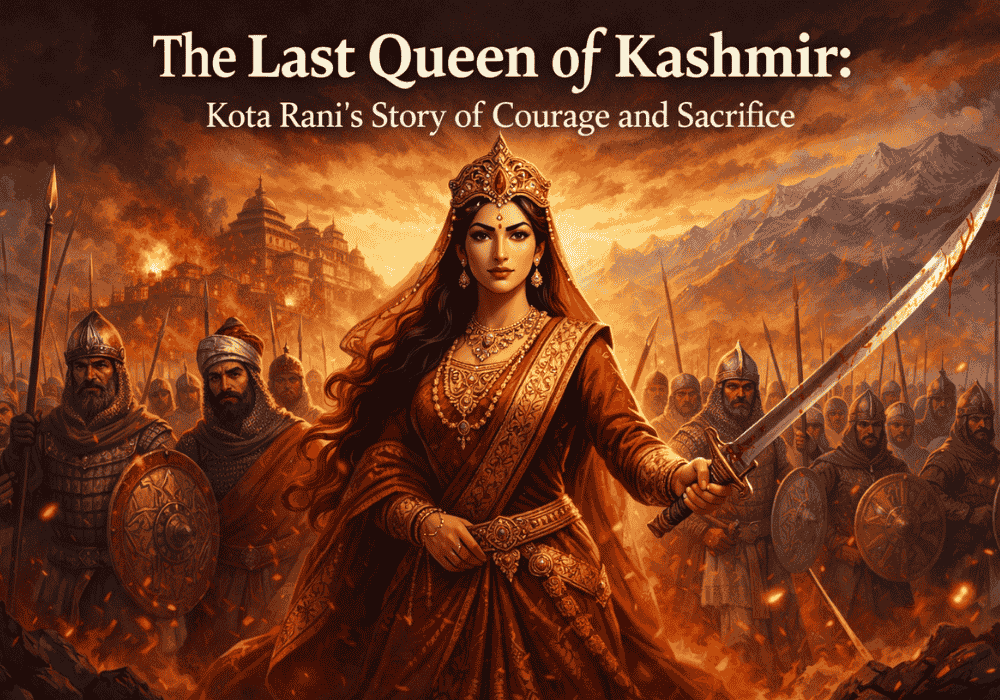
The world remembers its warrior queens. Joan of Arc rallied France. Cleopatra ruled Egypt with cunning and grace. India honours Rani Lakshmibai for her valour. But Kashmir had Kota Rani, a sovereign whose intelligence, courage, and unwavering commitment to her people made her one of the most remarkable rulers in Indian history.
Her story deserves to be told not just as a tale of defeat but as a testament to her leadership and resilience during Kashmir’s most turbulent period, inspiring admiration for her courage and strategic mind.
When Chaos Descended on Paradise
The year 1319 brought devastation to the Kashmir Valley. Dulcha, a Mongol warlord commanding fifty thousand cavalry, invaded the kingdom. King Suhadeva, who should have defended his subjects, fled to Kishtwar instead. For eight harrowing months, the valley endured systematic looting, arson, and mass enslavement. The socio-economic foundations of the Hindu state crumbled.
When Dulcha finally withdrew, Kashmir faced absolute anarchy. Into this void stepped Ramachandra, the Commander-in-Chief who had remained in the valley throughout the invasion. A man of honour and capability, he worked tirelessly to restore order. Assisting him was his daughter, Kota, whose intelligence and administrative skills had already earned recognition despite her youth.
Ramachandra appointed Rinchan, a Buddhist prince who had fled from Ladakh to Kashmir, as administrator of the Lar and Ladakh regions. This act of trust and generosity would prove fatal. Rinchan harboured ambitions far beyond the position granted to him.
In an act of calculated treachery, Rinchan sent soldiers disguised as merchants into the Lahara Fort. They took the garrison by surprise and assassinated Ramachandra, taking his family prisoner. The man who had given Rinchan refuge and opportunity now lay murdered by the very person he had trusted.
Rinchan understood that naked power alone could not sustain his rule in a valley grieving for its martyred commander. He needed legitimacy. So he appointed Ramachandra’s son, Ravanachandra, as his chief advisor with the title ‘Raina.’ And he forced Kota Rani, the daughter of the man he had murdered, into marriage.
Kota Rani accepted the marriage, not out of submission, but as a strategic decision to protect her people and inspire respect for her leadership during crises.
This was her first great sacrifice for Kashmir, but it would not be her last.
A Ruler in All But Name
Rinchan ruled from 1320 to 1323, but those who study this period carefully recognize Kota Rani’s influence throughout his reign. When Rinchan sought to convert to Hinduism, the Shaivite priest Devaswami rejected him on grounds of caste hierarchy. This rejection altered Kashmir’s religious trajectory. Spurned by the Hindu orthodoxy, Rinchan converted to Islam under the guidance of the Sufi saint Bulbul Shah, adopting the name Sultan Sadruddin.
This marked the formal establishment of Islam in Kashmir, though the administrative structure remained largely intact under Kota Rani’s steady governance. She understood that while rulers might change, the people needed continuity, order, and wise administration.
When rebel ministers assassinated Rinchan in 1323, his son Haider Khan was too young to assume the throne. The kingdom again stood at a crossroads. Kota Rani, demonstrating her political wisdom, facilitated the return of Udayanadeva, the late King Suhadeva’s brother, from his exile in Swat. To cement this transition and provide stability, she married Udayanadeva.
This was her second political marriage, her second compromise for the greater good of Kashmir.
While Udayanadeva held the title of Maharaja from 1323 to 1338, historical records make clear that Kota Rani wielded the real power. She handled the intricate manoeuvres of the court. She managed the defence of the realm. She ensured her young son, Haider Khan, remained under the trusted guardianship of Shah Mir. And when the most significant military threat of her era emerged, she proved herself not just an administrator, but a brilliant military strategist.
The Defender of Kashmir
Achala, a Turko-Mongol commander, invaded Kashmir with the same destructive intent that had motivated Dulcha. When the enemy approached, Udayanadeva repeated his brother’s shameful error and fled, this time to Tibet. Once again, a Lohara king abandoned his subjects in their hour of greatest need.
Kota Rani stayed.
Kota Rani’s understanding that wars are won with strategy and psychology, not just swords, showcased her brilliance as a military tactician in defending Kashmir from Achala.
She sent an envoy to Achala with a proposal: peaceful surrender and a marriage alliance. But she added something brilliant. She convinced him that a new king should not arrive with a large foreign army, as this would alienate his future subjects. Wouldn’t it demonstrate wisdom and goodwill if he dismissed most of his troops before entering the capital?
Achala, confident in his impending victory, agreed. He dispersed his forces.
Kota Rani personally oversaw Achala’s execution, demonstrating her unwavering moral integrity and commitment to her people’s safety.
This victory established her reputation as the saviour of Kashmir. The absentee king eventually returned, but everyone, from the nobility to the ordinary people, knew who had truly defended the realm. Kota Rani’s courage and cunning had preserved Kashmir when its titular ruler had abandoned it.
A Sovereign in Her Own Right
Her brief reign as the sole monarch showcased her administrative brilliance and her ability to lead Kashmir through its most challenging times with resilience and vision.
She commissioned the Kute Kol canal, an ambitious hydraulic engineering project that addressed Srinagar’s chronic flooding problems. The canal diverted water from the Jhelum River at the city’s entrance. It rejoined it beyond the city limits, creating a bypass that protected the urban core during monsoon and snowmelt seasons. The historian Jonaraja praised this work, comparing her nourishment of the people through wealth and infrastructure to the way her canal nourished the cultivated fields.
The canal still flows through Srinagar today, a lasting testament to her vision and care for her subjects.
Kota Rani also understood the political landscape with remarkable clarity. She recognized the growing influence of Shah Mir, who had spent fifteen years building support among the Muslim community and ordinary people. To counter this, she appointed Bhatta Bhikshana, a brilliant scholar and loyal administrator, as her Prime Minister and guardian of her second son, Bhola Ratan.
This appointment was both wise and necessary, but it precipitated the final crisis of her reign.
Treachery Rewarded with Ultimate Defiance
Shah Mir had arrived in Kashmir as a refugee from Swat. The kingdom had sheltered him. Kota Rani had entrusted him with her son’s guardianship and had utilized his military services. Yet he harboured ambitions that could only be realized through her downfall.
In July 1339, Shah Mir orchestrated a stunning act of treachery. He feigned serious illness, prompting Kota Rani to send Bhatta Bhikshana to inquire after his health. When the Prime Minister entered Shah Mir’s bedchamber, Shah Mir murdered him. He immediately launched a military coup against the queen, who had placed such faith in him.
Kota Rani retreated to the fort of Andarkot. But Shah Mir had spent years subverting her troops’ loyalty. Many soldiers, seeing the tides shift, defected to avoid certain death. Surrounded and outmanoeuvred, Kota Rani faced surrender.
Shah Mir proposed marriage. This union would have legitimized his seizure of power while creating an illusion of continuity. Some rulers, facing similar circumstances, might have accepted preserving their lives.
Kota Rani chose differently.
According to the Dvitiya Rajatarangini written by Jonaraja, she appeared to accept the proposal. She dressed in bridal finery and prepared for the wedding. But concealed beneath her ornate robes was a sharp dagger. When Shah Mir entered her chamber, she drove the blade into her own abdomen.
The detail that has echoed through seven centuries: she pulled out her own intestines and offered them to him as a “wedding gift.” This was not madness but a deliberate message. She would not give her consent. She would not legitimize his treachery. She would not allow her marriage to be used to erase the crime of his betrayal.
Other chronicles suggest that Shah Mir, suspicious of her true intentions, imprisoned her after the marriage, and that she took her own life in captivity. But the core truth remains the same in every account: Kota Rani refused to live under the rule of the man who had betrayed her trust and murdered her Prime Minister.
A Legacy That Endures
Kota Rani’s death in 1339 marked the end of the thousand-year-old Hindu Lohara dynasty. The Shah Mir Sultanate that followed would rule Kashmir for over two centuries. Some might call this a defeat. But true defeat lies not in how a reign ends, but in what it accomplished and what it stood for.
Kota Rani governed during the most perilous period in Kashmir’s medieval history. She navigated invasions, internal dissensions, and political treachery with intelligence and courage. She married twice, both times setting aside personal feelings for the stability of her kingdom. She defended her people when their kings fled. She built infrastructure that served generations. She maintained administrative continuity during profound religious and political transitions.
The Sanskrit chronicles, written by those who understood what was lost, call her a “luminary to the white lotus.” Jonaraja viewed her death as a civilizational tragedy, the moment when the specialized political status of Kashmiri women began its decline. This marked the beginning of profound transformations in Kashmir’s cultural fabric, changes that would echo through centuries and culminate in events like the Kashmiri Pandit exodus that reshaped the valley’s identity
Under the Lohara dynasty, upper-class Kashmiri women had enjoyed a degree of freedom and political participation unique in the Indian subcontinent. Queens like Didda and Kota Rani had wielded absolute power. After Kota Rani’s death, even under religiously tolerant rulers like Sultan Zain-ul-Abidin, this tradition was never fully restored.
Yet her physical legacy remains visible. The Kute Kol canal still protects Srinagar from floods. Her administrative foundations laid the foundation for the stability that followed. Her example of courage continues to inspire. In 2019, major production houses announced plans for a biographical film, comparing her to Cleopatra for her beauty, political acumen, and the dramatic arc of her life. Modern politicians in Jammu and Kashmir are compared to her, a recognition that her standard of leadership still resonates.
Rakesh Kaul’s 2016 historical novel “The Last Queen of Kashmir” portrays her as an icon of resistance, exploring the universal values of Kashmiri civilization through her story. Hindus remember her as a Rani, respected by some Muslim traditions as a Sultana, and honoured by all as a symbol of Kashmir’s complex, layered identity.
The Queen Who Chose Honour
Kota Rani faced impossible choices throughout her life. She could have refused to marry Rinchan and watched her kingdom descend further into chaos. She could have fled when Achala invaded, as her husband did. She could have accepted Shah Mir’s proposal and lived.
Instead, she chose sacrifice over safety, duty over comfort, and honour over survival.
She was betrayed by those she trusted. Rinchan betrayed her father’s generosity. Her husbands betrayed their duty by fleeing. Shah Mir betrayed her trust and the sanctuary Kashmir had provided him. Yet through each betrayal, she maintained her commitment to her people and her principles.
Her final act was not one of despair but of defiance. She refused to allow her name, her person, and her throne to be used to legitimize treachery. She refused to let history record that she had accepted what was unacceptable. She chose to write her own ending rather than have it written for her.
The historian records her governance with a “firm hand” during a period of civilizational peril. They praise her intelligence, administrative skill, military genius, and beauty. But her most outstanding quality was her unwavering moral clarity. She knew right from wrong. She knew duty from convenience. She knew honour from survival.
And when the final choice came, she chose honour.
Kota Rani was not the last queen of a defeated dynasty. She was a sovereign who ruled with wisdom and courage, who repeatedly sacrificed for her people, who defended her kingdom when its kings would not, and who, to the very end, refused to compromise her principles.
Kashmir has known many rulers in its long history. But it has known few who loved their people more, served them better, or left a more enduring legacy than Kota Rani, the Mother Queen, the defender of the valley, the woman who chose death over dishonour.
Her canal still flows. Her story still inspires. Her sacrifice still speaks to the eternal truth that some things matter more than survival, and that true sovereignty lies not in holding power, but in the courage to let it go rather than see it corrupted.
Frequently Asked Questions About Kota Rani
Who was Kota Rani?
Kota Rani was the last Hindu sovereign of Kashmir, ruling from 1338 to 1339 AD. She was the daughter of Commander-in-Chief Ramachandra and served as the de facto ruler during much of the reign of her second husband, Udayanadeva (1323-1338 AD). She is remembered for her administrative brilliance, military strategy, and her ultimate sacrifice to preserve her honour when Shah Mir staged a coup in 1339.
What was Kota Rani’s greatest military achievement?
Kota Rani’s greatest military achievement was defending Kashmir against the Turko-Mongol commander Achala. When her husband Udayanadeva fled to Tibet, she remained and used brilliant psychological warfare. She convinced Achala to dismiss most of his troops as a gesture of goodwill before entering the capital, then mobilised the Damara lords to destroy his weakened forces. She personally oversaw Achala’s execution, saving Kashmir from devastation.
What is the Kute Kol canal, and why is it significant?
The Kute Kol canal is an ambitious hydraulic engineering project commissioned by Kota Rani to address Srinagar’s chronic flooding problems. The canal diverted water from the Jhelum River at the city’s entrance and rejoined it beyond the city limits, protecting the urban core during monsoon and snowmelt seasons. The canal still flows through Srinagar today, serving as a lasting testament to her administrative vision and care for her subjects.
Why did Kota Rani marry Rinchan, her father’s murderer?
After Rinchan assassinated her father, Ramachandra, through treachery, he forced Kota Rani into marriage to legitimise his rule. She accepted this marriage not out of submission, but as a strategic decision to prevent further bloodshed and maintain stability in Kashmir, which was already fractured from the devastating Mongol invasion of 1319. This was her first great sacrifice for the welfare of her people.
How did Kota Rani die?
According to the Dvitiya Rajatarangini by Jonaraja, when Shah Mir staged a coup in July 1339 and proposed marriage to legitimise his rule, Kota Rani appeared to accept. However, she concealed a dagger beneath her bridal robes and committed suicide when he entered her chamber, offering her own intestines as a ‘wedding gift’ in a visceral rejection of the forced alliance. Other chronicles suggest Shah Mir imprisoned her, and she took her life in captivity. In either account, she chose death over dishonour, refusing to legitimise his betrayal.
What happened to Kashmir after Kota Rani’s death?
Kota Rani’s death in 1339 marked the end of the thousand-year-old Hindu Lohara dynasty. Shah Mir established the Shah Mir Sultanate (also known as Sultan Shams-ud-Din), which ruled Kashmir for over two centuries. While this represented a major religious and political transition, the administrative foundations Kota Rani had built enabled the stability that followed, contributing to what became known as the ‘Golden Age’ under rulers like Sultan Zain-ul-Abidin.
When did Kota Rani rule Kashmir?
Kota Rani ruled independently as the sole sovereign of Kashmir from 1338 to 1339 AD, following the death of her second husband, Udayanadeva. However, she was the de facto ruler during much of Udayanadeva’s reign (1323-1338 AD) and wielded significant influence during her first husband Rinchan’s reign (1320-1323 AD). Her total period of influence spanned nearly two decades during the most turbulent period in medieval Kashmir.
Why is Kota Rani called the ‘Last Queen of Kashmir’?
Kota Rani is known as the ‘Last Queen of Kashmir’ because she was the last sovereign of the Hindu Lohara dynasty, which had ruled the Kashmir Valley for a thousand years. Her death in 1339 marked the end of Hindu rule and the beginning of the Islamic Sultanate period. She was also the last woman to rule Kashmir with independent sovereign authority until modern times.
What was the Dulcha invasion, and how did it affect Kashmir?
The Dulcha invasion of 1319 AD was a catastrophic event when Mongol-Turkic warlord Dulcha (also known as Zulju) descended upon Kashmir with fifty thousand cavalry. King Suhadeva fled to Kishtwar, abandoning his subjects. For eight months, the valley endured systematic looting, arson, and mass enslavement that effectively destroyed the socio-economic foundations of the Hindu state, creating the power vacuum that led to Kota Rani’s eventual rise.
Who was Shah Mir and what was his role in Kashmir’s history?
Shah Mir was a refugee from the Swat region who arrived in Kashmir seeking sanctuary. Over the course of 15 years, he built a political network among the Muslim community and the common people. Kota Rani had trusted him with her son’s guardianship and used his military services. In July 1339, he betrayed this trust by murdering the Prime Minister Bhatta Bhikshana and staging a military coup. After Kota Rani’s death, he established the Shah Mir Sultanate as Sultan Shams-ud-Din, ruling Kashmir for over two centuries.
What sources tell us about Kota Rani’s life?
The primary sources about Kota Rani’s life come from two traditions: the Sanskrit chronicle Dvitiya Rajatarangini by Jonaraja (15th century), which portrays her sympathetically as a civilizational tragedy, and Persian chronicles like Baharistan-i-Shahi (17th century), which acknowledge her capabilities while emphasising the transition to the Sultanate. Modern historians like PNK Bamzai and G.M.D. Sufis have synthesised these accounts to create a more complete picture of her reign.
What is Kota Rani’s legacy in modern Kashmir?
Kota Rani’s legacy endures in multiple ways. The Kute Kol canal she built still protects Srinagar from floods. She is invoked in modern political discourse as a benchmark for female leadership. Rakesh Kaul’s 2016 novel ‘The Last Queen of Kashmir’ revived interest in her story. In 2019, major production houses announced plans for a biographical film comparing her to Cleopatra. She is remembered by Hindus as a Rani and respected by some Muslim traditions as a Sultana, symbolising Kashmir’s complex identity.
Works cited
- Kota Rani – Wikipedia, accessed on January 23, 2026, https://en.wikipedia.org/wiki/Kota_Rani
- Kota Rani – “The Last Queen of Kashmir” | Author – Rakesh Kaul – YouTube, accessed on January 23, 2026, https://www.youtube.com/watch?v=2onsz7MT1ms
- Queen Kota Rani Inspiration for Millennials – Daily Excelsior, accessed on January 23, 2026, https://www.dailyexcelsior.com/queen-kota-rani-inspiration-for-millennials/
- History of Kashmir – Wikipedia, accessed on January 23, 2026, https://en.wikipedia.org/wiki/History_of_Kashmir
- Kota Rani – The forgotten daughter of Vitasta – Early Times, accessed on January 23, 2026, https://www.earlytimes.in/newsdet.aspx?q=191791
- Kota Rani | PDF | Kashmir – Scribd, accessed on January 23, 2026, https://www.scribd.com/document/782681667/Kota-Rani
- Kota Rani: Forgotten ‘Last Hindu Queen’ of Kashmir, accessed on January 23, 2026, https://freepresskashmir.news/2021/02/12/kota-rani-forgotten-last-hindu-queen-of-kashmir/
- The Last Queen: Kota Rani and the Twilight of Hindu Kashmir – India Today, accessed on January 23, 2026, https://www.indiatoday.in/india/story/the-last-queen-kota-rani-twilight-of-hindu-kashmir-2843784-2025-12-30
- The Decline of Kashmir – MYind.net, accessed on January 23, 2026, https://myind.net/Home/viewArticle/the-decline-of-kashmir
- Face to Face: The Queen who defied empires: Khwaja Farooq Renzushah on Sultana Kota Rani’s enduring legacy in Kashmir, accessed on January 23, 2026, https://risingkashmir.com/face-to-face-the-queen-who-defied-empires-khwaja-farooq-renzushah-on-sultana-kota-ranis-enduring-legacy-in-kashmir/
- Kota Rani: The Last Female Ruler of Kashmir | People – Times Now, accessed on January 23, 2026, https://www.timesnownews.com/lifestyle/people/kota-rani-the-last-female-ruler-of-kashmir-article-151475608
- The Last Queen of Kashmir – Travel The Himalayas, accessed on January 23, 2026, https://travelthehimalayas.com/kiki/2018/12/24/the-last-queen-of-kashmir
- Rinchan – Wikipedia, accessed on January 23, 2026, https://en.wikipedia.org/wiki/Rinchan
- (PDF) An Overview of Geographical Status of Kashmir under …, accessed on January 23, 2026, https://www.researchgate.net/publication/359165335_An_Overview_of_Geographical_Status_of_Kashmir_under_Shamiri_Dynasty_1339-1554
- Kota Rani Facts for Kids, accessed on January 23, 2026, https://kids.kiddle.co/Kota_Rani
- Kashmir Sultanate – Wikipedia, accessed on January 23, 2026, https://en.wikipedia.org/wiki/Kashmir_Sultanate
- Kota Rani: Mother Queen of Kashmir – HinduPost, accessed on January 23, 2026, https://hindupost.in/history/kota-rani-mother-queen-of-kashmir/
- View of The end of the Muslim Sultanate era in Kashmir – ScienceScholar, accessed on January 23, 2026, https://sciencescholar.us/journal/index.php/ijhs/article/view/10191/6799
- Kota Rani – Wikiquote, accessed on January 23, 2026, https://en.wikiquote.org/wiki/Kota_Rani
- The end of the Muslim Sultanate era in Kashmir – Neliti, accessed on January 23, 2026, https://media.neliti.com/media/publications/574759-the-end-of-the-muslim-sultanate-era-in-k-8b5472d3.pdf
- Baharistan I Shahi | PDF | History – Scribd, accessed on January 23, 2026, https://www.scribd.com/document/508095/Baharistan-i-Shahi
- SITUATING BAHARISTAN-I- SHAHI AMONG PERSIAN CHRONICLES OF KASHMIR, accessed on January 23, 2026, http://data.conferenceworld.in/ICASH2/5.pdf
- Role of women in ancient and medieval politics of Kashmir: – Jetir.Org, accessed on January 23, 2026, https://www.jetir.org/papers/JETIR2303550.pdf
- History of Women in the Lohara Dynasty – Great Britain Journals Press, accessed on January 23, 2026, https://journalspress.com/LJRHSS_Volume23/History-of-Women-in-ihe-Lohara-Dynasty.pdf
- Kota Rani: Mother Queen of Kashmir – India Tribune, accessed on January 23, 2026, https://indiatribune.com/public/kota-rani-mother-queen-of-kashmir
- Sultana Kota Rani: Reshi Queen of Kashmir – An Exclusive Interview with Author Khwaja Farooq Renzushah, accessed on January 23, 2026, https://www.knskashmir.com/sultana-kota-rani–reshi-queen-of-kashmir-%E2%80%93-an-exclusive-interview-with-author-khwaja-farooq-renzushah-192768
- “The Last Queen of Kashmir” Rakesh Kaul in Conversation – Sutra Journal, accessed on January 23, 2026, http://www.sutrajournal.com/the-last-queen-of-kashmir-rakesh-kaul-in-conversation
- Battle Of Kashmiri Queens: Queen Didda To Take On The Last Hindu Queen Of Kashmir Kota Rani In The Clash Of Bollywood – EurAsian Times, accessed on January 23, 2026, https://www.eurasiantimes.com/battle-of-kashmiri-queens-queen-didda-to-take-on-the-last-hindu-queen-of-kashmir-kota-rani-in-the-clash-of-bollywood/
- “The Last Queen of Kashmir KOTA RANI” – YouTube, accessed on January 23, 2026, https://www.youtube.com/watch?v=Ve_dqpurgX4
- Kota Rani: Phantom Films to produce film on the last Hindu queen of Kashmir. Details inside, accessed on January 23, 2026, https://www.hindustantimes.com/bollywood/kota-rani-phantom-films-to-produce-film-on-last-hindu-queen-of-kashmir-details-inside/story-6c091iPKIQE8hFzAlSJSKI.html
- Kota Rani: Story of Kashmir’s last Hindu queen to get big screen treatment – India TV News, accessed on January 23, 2026, https://www.indiatvnews.com/entertainment/bollywood-kota-rani-story-of-kashmir-s-last-hindu-queen-to-get-big-screen-treatment-545142
- A film on Kashmir’s last Hindu queen ‘Kota Rani’ in the works – The Statesman, accessed on January 23, 2026, https://www.thestatesman.com/entertainment/a-film-on-kashmirs-last-hindu-queen-kota-rani-in-the-works-1502792645.html