Operation Gulmarg: How Pakistan's 1947 Treachery Triggered India's Finest Hour in Kashmir
I write this as a Kashmiri Pandit — a descendant of those who witnessed firsthand what calculated aggression does to a people and to a land. My ancestors walked the same streets of Srinagar that Pakistan tried to seize on that cold October morning in 1947. For us, Operation Gulmarg is not a chapter in a history textbook. It is the wound from which Kashmir has never fully healed. It is the moment that defined every subsequent decade of sorrow, displacement, and resilience that my community has lived through. To understand what happened to Kashmir — and to Kashmiri Pandits — one must understand what was set in motion on 22 October 1947.
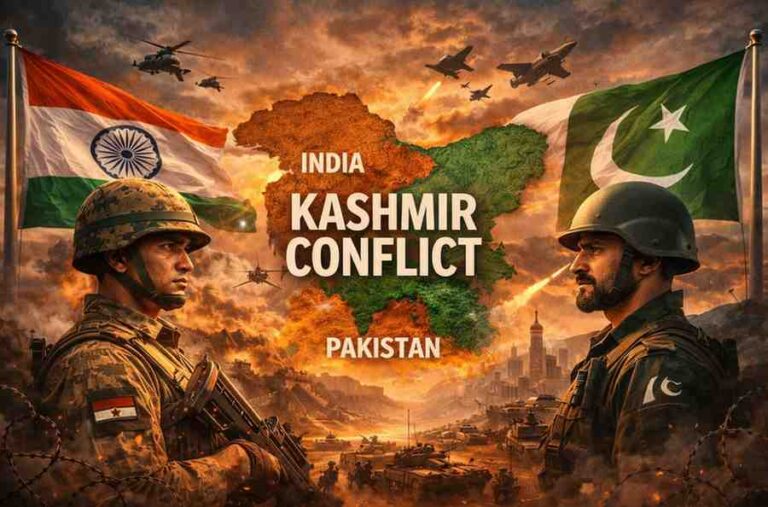
Operation Gulmarg was Pakistan's military code name for a treacherous, state-sponsored tribal invasion of the princely state of Jammu and Kashmir (J&K), launched on 22 October 1947 — barely weeks after the two nations came into existence. Planned in Rawalpindi and executed under the command of Major General Akbar Khan of the Pakistan Army, the operation unleashed approximately 20,000 armed tribal Lashkar fighters on a peaceful, defenceless population. Its objective was to seize Srinagar, capture the valley, and force Kashmir's accession to Pakistan through violence and fait accompli — before the Maharaja or India could respond. What Pakistan did not count on was the courage of one Maharaja, the speed of one Indian airlift, and the sacrifice of Indian soldiers who gave their lives so that Kashmir could remain part of Bharat. This is the story of that betrayal — and of India's finest response to it.
Key Facts at a Glance
- Date of Aggression: 22 October 1947 — Pakistan launched the invasion just ten weeks after Independence.
- Pakistan's Deception: Directed by Pakistan Army's Major General Akbar Khan under the alias 'General Tariq,' while Islamabad publicly denied any involvement — a lie later confirmed by Akbar Khan himself in his own memoir, Raiders in Kashmir.
- Scale of the Attack: ~20,000 tribal Lashkar fighters from the North-West Frontier Province (NWFP), armed and transported by the Pakistani state.
- Civilian Atrocities: Thousands of unarmed civilians massacred — most horrifically in Baramulla and Muzaffarabad, including nuns killed at St. Joseph's Convent.
- India's Legal Right: Maharaja Hari Singh signed the Instrument of Accession on 26 October 1947, making J&K legally and constitutionally part of India.
- India's Response: 329 soldiers of the 1st Sikh Regiment airlifted into Srinagar on 27 October 1947 — one of history's most decisive tactical airlifts.
- Price Paid by India's Heroes: Major Somnath Sharma laid down his life at Badgam. Brigadier Rajinder Singh fought to his last breath at Uri. India will never forget them.
- Lasting Consequence: The ceasefire of 1 January 1949 created the Line of Control — a scar on the subcontinent drawn by Pakistan's original aggression.
The Betrayal: Pakistan's Calculated Plan to Seize Kashmir by Force
Let us be absolutely clear about what Operation Gulmarg was — because Pakistan spent decades trying to obscure it. This was not a spontaneous uprising. It was not the cry of a people yearning for freedom. It was a meticulously planned military aggression, conceived in the offices of the Pakistan Army, funded by the Pakistani state, and executed with military precision — all while Pakistan maintained a fraudulent public posture of innocence.
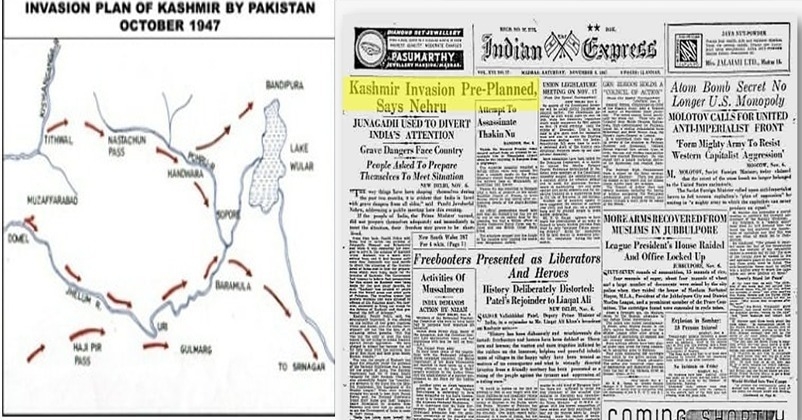
Direct evidence from N.S. Sarila's The Shadow of the Great Game reveals that the plan took shape as early as August 1947 — before the ink on the partition documents was even dry. Pakistan's leadership, unable to secure Kashmir through legal or diplomatic means, chose deceit and violence instead. They would dress up a military invasion as a 'tribal uprising' — a cynical manipulation designed to give Rawalpindi plausible deniability on the world stage.
The Standstill Agreement: Pakistan's First Deception
Pakistan's treachery began even before the first Lashkar crossed the border. On 15 August 1947, Pakistan signed a Standstill Agreement with Maharaja Hari Singh — a solemn, legal commitment to maintain the status quo while the Maharaja considered his options of accession. What did Pakistan do with this agreement? It violated it almost immediately.
By September 1947, Islamabad had already imposed a systematic economic blockade against Jammu and Kashmir — halting supplies of petrol, salt, and food grains that moved through Sialkot and Rawalpindi, as documented by M. Guruswamy and confirmed in Josef Korbel's Danger in Kashmir. Pakistan was strangling a sovereign state it had just promised to respect. This was not the act of a good-faith neighbour — it was the calculated softening of a target before the killing blow.
How They Built Their Army of Invasion
In his own memoir, Raiders in Kashmir, Major General Akbar Khan describes with remarkable candour how he organised the invasion: 11 Lashkars of approximately 1,000 men each, armed with surplus military hardware, each tribal unit assigned a regular Pakistani Army officer as tactical commander. The logistics — trucks, fuel, weapons, supply lines — were coordinated through the NWFP's Chief Minister, Abdul Qayyum Khan, who facilitated the transport of thousands of fighters, as documented in M.Y. Saraf's Kashmiris Fight for Freedom. This was Pakistan's Army in tribal clothing.
The discovery of the actual 'Operation Gulmarg' orders by Indian Intelligence — in the luggage of a Pakistani officer, as documented in S.K. Sinha's Operation Rescue — stripped away every last pretence. The documents laid out the date of attack, the number of Lashkars, and the logistical support provided by the Pakistan Army. There was no longer any room for doubt, nor any moral space for equivocation.
Timeline: From Pakistan's Treachery to India's Triumph
| August 1947 | Pakistan begins planning Operation Gulmarg — barely weeks after Independence. Major General Akbar Khan designated as operational commander (N.S. Sarila, The Shadow of the Great Game). |
| September 1947 | Pakistan imposes economic blockade on J&K, violating the Standstill Agreement it had signed just weeks earlier (Guruswamy; Korbel, Danger in Kashmir). |
| 22 Oct 1947 | Pakistan launches Operation Gulmarg. ~20,000 tribal Lashkar fighters pour across the border into J&K, burning villages and massacring civilians as they advance. |
| 26 Oct 1947 | Lashkars enter Baramulla and spend two days in an orgy of looting and massacre — killing ~3,000 civilians. This fatal delay costs Pakistan the war. Maharaja Hari Singh signs the Instrument of Accession, uniting J&K with India (V.P. Menon, The Story of the Integration of the Indian States). |
| 27 Oct 1947 | India responds: 329 soldiers of the 1st Sikh Regiment are airlifted into Srinagar in civilian Dakotas — Operation Jak — under Lt. Col. Dewan Ranjit Rai. The Valley is saved (IAF Historical Cell records). |
| 3 Nov 1947 | Battle of Badgam. Major Somnath Sharma and his company of 4 Kumaon hold the line against seven times their number, giving their lives to prevent the airfield from falling. India's first Param Vir Chakra, awarded posthumously (Ian Cardozo, Param Vir: Our Heroes in Battle). |
| 7 Nov 1947 | Maqbool Sherwani — a Kashmiri civilian — is executed by the invaders after deliberately misleading them with false directions and delaying their advance (Karan Singh, Heir Apparent; R. Tikoo, Kashmir History Project). |
| Nov 1947 | Battle of Shalateng. Indian forces decisively push the invaders back from the Srinagar valley. |
| 1 Jan 1949 | UN-mandated ceasefire. The Ceasefire Line — now the Line of Control — is created. The portion of Kashmir held by Pakistan's proxies becomes Pakistan-Occupied Kashmir (PoK). A wound that endures to this day. |
Baramulla: The Massacre That Saved Kashmir
There is a bitter irony at the heart of Operation Gulmarg. The invaders Pakistan sent — men who were supposed to be liberators in Islamabad's telling — committed such appalling atrocities in Baramulla that they inadvertently saved the very city they were marching to conquer.
On 26 October 1947, the Lashkar entered Baramulla. They were 35 kilometres from Srinagar. The airfield was undefended. Srinagar lay open. What did they do? According to Frank Moraes's eyewitness reporting in Visit to Kashmir, instead of pressing their military advantage, the invaders spent two days in an orgy of plunder, rape, and murder. An estimated 3,000 civilians were killed. Homes were ransacked. Women were abducted.
The invaders then turned on St. Joseph's Convent — attacking unarmed nuns who had come to Kashmir to serve its people. Mother Superior Aldertrude, Sister Teresalina, and a European family were killed, according to Catholic Herald Archive records. The brutality shocked the international community and tore away whatever thin legitimacy Pakistan had tried to construct around its 'tribal uprising' narrative.
The tribesmen spent two days in Baramulla satisfying their lust for gold and women. Had they moved instantly, Srinagar would have fallen before the first Indian Dakota touched down.
That delay was Pakistan's undoing. And India's salvation.
Maqbool Sherwani: Kashmir's First Martyr of the Modern Age
While Pakistan's Lashkars were slaughtering civilians in Baramulla, a young Kashmiri man named Maqbool Sherwani was doing something extraordinary. Armed with nothing but his wits and his love for his homeland, Sherwani approached the invaders and offered to guide them toward Srinagar. He then led them in entirely the wrong direction — buying India precious hours, according to R. Tikoo's research in The Lion of Baramulla: Maqbool Sherwani, published by the Kashmir History Project.
When the invaders discovered the deception, they captured him. On 7 November 1947, Maqbool Sherwani was executed — crucified, according to some accounts — by the very men who claimed to be Kashmir's liberators. He was barely out of his youth. His courage stands as eternal proof that the people of Kashmir — including ordinary Kashmiri civilians — did not want what Pakistan was offering. They chose India. Some paid for that choice with their lives.
India's Finest Hour: The Instrument of Accession and Operation Jak
When Maharaja Hari Singh signed the Instrument of Accession on 26 October 1947, he did not capitulate to pressure — he exercised his legal and sovereign right as the ruler of a princely state, a right explicitly guaranteed under the terms of British withdrawal. Under the Government of India Act (1935) and the Independence of India Act (1947), Jammu and Kashmir became a legal, constitutional, and undeniable part of India the moment that document was signed and accepted by Governor-General Lord Mountbatten. No subsequent claim, resolution, or revision can change that foundational legal fact.
India did not hesitate. The 161 Infantry Brigade was immediately mobilised. The next morning, India demonstrated to the world — and to Pakistan — precisely what it meant to defend one's own land.
Operation Jak, 27 October 1947: The Airlift That Saved the Valley
On the morning of 27 October 1947, 329 soldiers of the 1st Sikh Regiment, commanded by Lieutenant Colonel Dewan Ranjit Rai, were loaded onto civilian Dakota aircraft and flown into Srinagar Airport — the very airfield that Pakistan's Lashkars had failed to seize because they were too busy looting Baramulla. According to IAF Historical Cell records, this remains one of the most consequential tactical airlifts in the history of modern warfare. A handful of Indian soldiers, outnumbered and far from home, landed in a city that was hours away from falling into enemy hands — and held it.
India's Heroes Who Held the Line
History should speak the names of these men loudly — for they gave everything so that Kashmir could remain India's.
On 3 November 1947, Major Sharma and his company faced an invading force seven times their size at Badgam — the critical gateway to the Srinagar airfield. Outnumbered, outgunned, and fully aware of the odds, Major Sharma chose to hold his ground. He held that position until the enemy broke — and he gave his life doing so. His sacrifice prevented the airfield from being encircled and cut off. If Badgam had fallen, the Indian airlift would have ended. If the airlift had ended, Srinagar would have fallen. The chain of cause and effect runs directly from Major Sharma's final stand to Kashmir's continued place within India.
Honour: India's first Param Vir Chakra, awarded posthumously — the highest military honour the nation can bestow.
When a portion of Muslim troops within the J&K State Forces deserted to join the invaders at Muzaffarabad, Brigadier Rajinder Singh did not retreat. He led what remained of his men to Uri, destroyed the Jhelum bridge, and held the enemy at bay for two days — two days that allowed Maharaja Hari Singh to reach Jammu and sign the Instrument of Accession. Without Rajinder Singh's last stand, there may have been no accession. Without the accession, there would have been no legal basis for India's intervention. His sacrifice lies at the very foundation of India's claim to Kashmir, as documented by R. Rikhye and the Kashmir History Project.
Honour: Mahavir Chakra, awarded posthumously.
The Truth Pakistan Cannot Escape: Evidence of State-Sponsored Aggression
For decades, Pakistan maintained the fiction that Operation Gulmarg was a spontaneous tribal uprising with which Islamabad had no involvement. This lie has been comprehensively dismantled — not by Indian historians alone, but by Pakistan's own officers.
- Akbar Khan's own memoir: In Raiders in Kashmir, Pakistan's operational commander described in detail how he personally planned and executed the invasion — obliterating Islamabad's claims of non-involvement.
- The 'Gulmarg Plan' documents: Indian Intelligence found the actual military orders — naming dates, Lashkar numbers, and Pakistan Army logistical support — in the luggage of a Pakistani officer (S.K. Sinha, Operation Rescue).
- The economic blockade: A sovereign state does not blockade a neighbour it is supposedly neutral toward. Pakistan's September 1947 blockade was an act of aggression before the invasion itself began.
- Pakistani Army officers embedded with Lashkars: Every tribal unit had a Pakistani Army officer providing tactical command — this is not a 'tribal uprising,' this is a regular military operation with civilian cover.
Even Pakistan's own evolving scholarship has increasingly acknowledged the Army's operational role, as noted in A. Sheikh's analysis in the Journal of Strategic Studies, Islamabad. The world has caught up with what India knew in 1947: this was an act of state-sponsored military aggression against a sovereign princely state that had every legal right to accede to India.
What the People of Kashmir Chose — And What Was Taken From Them
The Pakistani narrative has always claimed to speak for the people of Kashmir. Maqbool Sherwani's execution gives the lie to that claim. He was a Kashmiri Muslim — the very community Pakistan claimed to be 'liberating' — and he laid down his life to stop the invaders. He chose India. He chose to protect his homeland from those who arrived with guns and greed wearing the mask of religion.
For Kashmiri Pandits — my community — Operation Gulmarg marked the beginning of a long and painful story. The same forces unleashed in 1947 would mutate and return in different forms over the following decades, culminating in the exodus of 1989–90, when hundreds of thousands of Kashmiri Pandits were driven from the valley they had called home for three thousand years. The seeds of that catastrophe were planted on 22 October 1947.
We must never forget the connection between Operation Gulmarg and what followed. The tribal invaders of 1947, the militancy of the 1980s, the terror campaigns of the 1990s — they share the same ideological parentage, the same strategic sponsorship, and the same contempt for Kashmir's pluralist, ancient civilisation. Understanding Operation Gulmarg is understanding the root of everything that came after.
Frequently Asked Questions About Operation Gulmarg
Every answer below is drawn exclusively from documented historical sources.
Akbar Khan was tasked by Pakistan's political leadership to secure Kashmir through force. He designed a plan involving 11 Lashkars of approximately 1,000 men each, coordinated through the NWFP's Chief Minister, Abdul Qayyum Khan, to create the appearance of an independent tribal movement. General Douglas Gracey, the British Commander-in-Chief of the Pakistan Army, was reportedly aware of some troop movements but did not intervene initially, according to N.S. Sarila's The Shadow of the Great Game. Pakistan's claim of non-involvement was a deliberate, documented lie.
The word Gulmarg means Meadow of Flowers — a name of devastating irony given the bloodshed the operation unleashed. Copies of the Operation Gulmarg orders were recovered by Indian Intelligence and documented in S.K. Sinha's Operation Rescue. They outlined the attack date, the number of Lashkars, and the logistical support from the Pakistan Army, leaving no room for Islamabad's denials.
Under the Government of India Act (1935) and the Independence of India Act (1947), princely states had the right to accede to either dominion. Once the Instrument was signed and accepted by Governor-General Mountbatten, Jammu and Kashmir was legally and constitutionally India's. India's military intervention was not an annexation — it was the defence of India's own territory against a foreign-backed invasion. This is documented in V.P. Menon's The Story of the Integration of the Indian States and confirmed in the National Archives of India. Any suggestion that India's presence in Kashmir is 'occupation' collapses entirely against this foundational legal reality.
The Standstill Agreement was Pakistan's solemn commitment to maintain normal relations with J&K while the Maharaja deliberated on accession. Pakistan violated it in two stages: first through an economic blockade in September 1947 that halted essential supplies of petrol, salt, and food grains (documented by Guruswamy and Korbel); then through the military invasion on 22 October 1947. Maharaja Hari Singh cited this breach explicitly in his letter to Mountbatten. Pakistan's violation of the Standstill Agreement was itself the act that legally and morally justified the Maharaja's decision to sign the Instrument of Accession with India.
When the Lashkars entered Baramulla on 26 October 1947, Srinagar was 35 kilometres away and the airfield was undefended. Instead of advancing immediately, the invaders spent two days in an orgy of plunder and mass murder, as documented by war correspondent Frank Moraes in Visit to Kashmir and confirmed by Colonel Desmond Young's eyewitness account. An estimated 3,000 civilians were killed. That 48-hour window of depravity was the difference between Pakistan seizing Kashmir and India saving it.
Maqbool Sherwani was a local youth from Baramulla who, when faced with Pakistan's invading Lashkars, chose to resist in the only way available to him — deception. He offered to guide the invaders toward Srinagar and then led them in entirely the wrong direction, buying India critical hours. When his deception was discovered, he was captured and executed on 7 November 1947. His story, documented in R. Tikoo's The Lion of Baramulla (Kashmir History Project) and referenced in Karan Singh's autobiography Heir Apparent, destroys the Pakistani narrative that the Kashmiri people supported the invasion. A Kashmiri Muslim gave his life to stop Pakistan. Remember his name.
The siege of Baramulla was a war crime by any measure. Approximately 3,000 civilians were killed. The attack on St. Joseph's Convent — a place of healing and education — resulted in the deaths of Mother Superior Aldertrude, Sister Teresalina, and a European family, according to Catholic Herald Archive records. Far from being liberators, Pakistan's tribal proxies visited terror on the very population they claimed to be saving.
In Baramulla alone, contemporary reports by journalist Margaret Bourke-White and records in the Kashmir Sentinel Archive suggest at least 3,000 killed. In Muzaffarabad and Mirpur, the numbers were significantly higher, with large-scale communal violence and the brutal displacement of minorities, according to M.C. Cohen's military review. These deaths were not collateral to some legitimate military operation — they were the direct result of Pakistan sending armed tribesmen into a civilian population.
The J&K State Forces were under-equipped and undermanned against the scale of Pakistan's operation. When a portion of Muslim troops deserted to join the invaders at Muzaffarabad, the situation became critical. But Brigadier Rajinder Singh led his remaining men to Uri, destroyed the Jhelum bridge, and held the line for two days — those two days allowed the Maharaja to safely reach Jammu and sign the Instrument of Accession, as documented by R. Rikhye and the Kashmir History Project. Rajinder Singh died in that action.
Following the Battle of Shalateng in November 1947, Indian forces pushed the invaders back from the Srinagar valley. A UN-mandated ceasefire took effect on 1 January 1949, creating the Ceasefire Line — now the Line of Control — that divided the state Pakistan had failed to fully seize. The portion that remained under Pakistan's control became Pakistan-Occupied Kashmir (PoK). Operation Gulmarg did not end in 1949. It created the conditions for every subsequent decade of insurgency, terrorism, and tragedy that Kashmir — and Kashmiri Pandits — have endured since. The Line of Control is not a border. It is the permanent monument to Pakistan's original act of aggression.
Remembering the Fallen: Memorials That Bear Witness
In Baramulla, a memorial stands for Maqbool Sherwani — the civilian who chose his homeland over his safety. In Srinagar, Major Somnath Sharma's name is etched in stone. These are not merely memorials to individuals. They are the nation's vow that the sacrifices of October and November 1947 will not be reduced to a footnote, will not be relativised in the name of diplomatic balance, and will not be forgotten as time distances us from the events themselves.
Every Indian who visits Kashmir walks on soil that was defended at extraordinary cost. The least we owe to those who defended it is the truth, told plainly and without apology.
About the Author
Rohit Tikoo is a military historian and researcher whose work is devoted to recovering the documented truth of Kashmir's history — a history that has too often been obscured by geopolitical fog, diplomatic euphemism, and deliberate revisionism. As a Kashmiri Pandit, he writes not only as a scholar but as a member of a community whose own existence stands as testimony to what happens when the forces first unleashed in 1947 are allowed to run unchecked. His research draws on primary military archives, personal memoirs, government records, and oral histories to deliver accounts that are both rigorously evidenced and humanly honest.
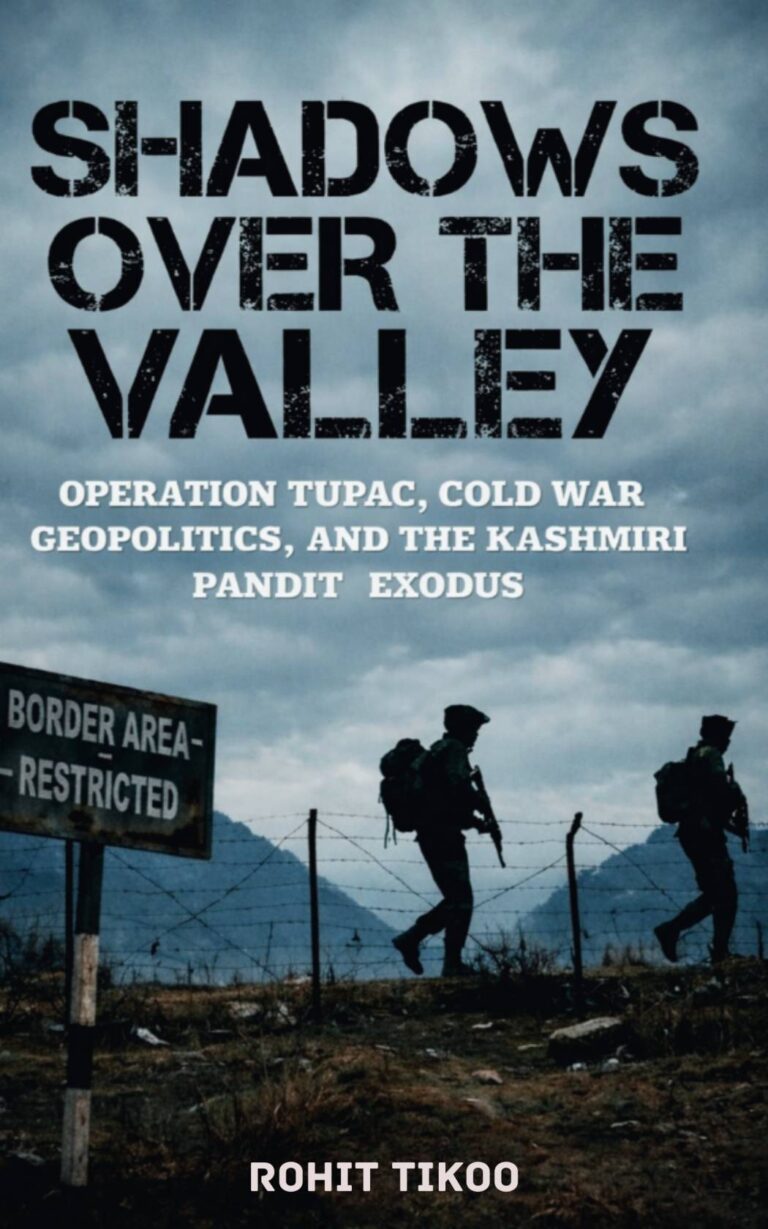
- Shadows Over The Valley: Operation Tupac, Cold War, Geopolitics and the Kashmiri Pandit Exodus — A forensic examination of the covert Pakistani intelligence operation and how it engineered the conditions for the 1989–90 exodus of Kashmiri Pandits from their ancestral homeland.
- Uprooted & Forlorn: The Tale of Kashmiri Pandits in Exile — Intimate narratives of displacement, loss, and identity from Kashmiri Pandits living in camps and cities across India, far from the Valley they still call home.
- Kashmiri Pandits: A Tale of Solitude & Survival: A comprehensive chronicle of the Kashmiri Pandit community — their three thousand years of civilisational presence in the Valley, their catastrophic displacement, and their continuing struggle for recognition, justice, and return.
Primary Sources & Historical References
- Akbar Khan, Raiders in Kashmir (1970) — Pakistan's own commander's account
- V.P. Menon, The Story of the Integration of the Indian States (1956)
- D.K. Palit, Jammu and Kashmir Arms: History of the J&K Rifles
- S.K. Sinha, Operation Rescue — documents recovery of Gulmarg Plan orders
- Karan Singh, Heir Apparent (autobiography)
- Meher Chand Mahajan, Looking Back (autobiography)
- Colonel Desmond Young, Rommel: The Desert Fox — eyewitness Baramulla account
- S. Shreedhar, The First Indo-Pak War: 1947–48
- P.S. Jha, The Origins of a Dispute: Kashmir 1947
- N.S. Sarila, The Shadow of the Great Game
- M.Y. Saraf, Kashmiris Fight for Freedom
- P.N.K. Bamzai, Culture and Political History of Kashmir
- Alastair Lamb, Kashmir: A Disputed Legacy, 1846–1990
- Josef Korbel, Danger in Kashmir
- Victoria Schofield, Kashmir in Conflict
- Andrew Whitehead, A Mission in Kashmir
- Ian Cardozo, Param Vir: Our Heroes in Battle
- R. Tikoo, The Lion of Baramulla: Maqbool Sherwani — Kashmir History Project
- Margaret Bourke-White, Halfway to Freedom
- Frank Moraes, Visit to Kashmir
- Catholic Herald Archive — Baramulla Convent, October 1947
- IAF Historical Cell records — Operation Jak airlift documentation
- UN Security Council Resolution 47 — UN Digital Library
- Ministry of Defence, Government of India — Official War History
- National Archives of India — Instrument of Accession documentation