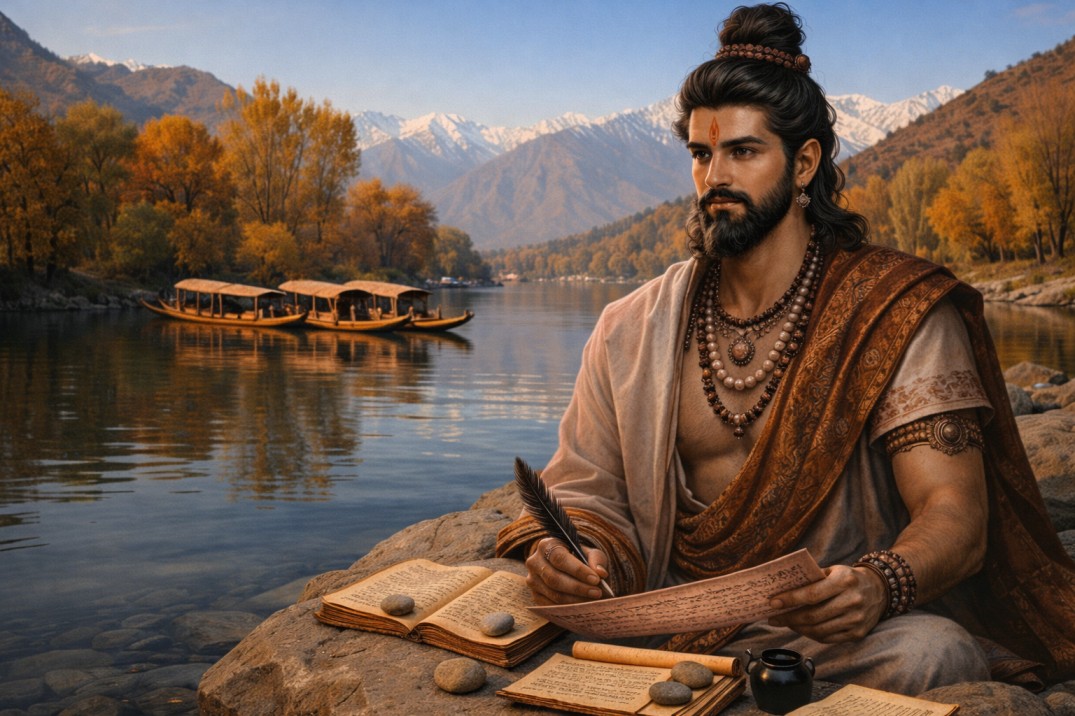
“He alone is worthy to narrate the history of kings whose mind, though cleansed by the waters of knowledge, remains unruffled by passion — who regards the deeds of rulers with the impartiality of Time itself.”
— Kalhana, Rajatarangini, Book I, Verse 7 (Trans. M.A. Stein, 1900)
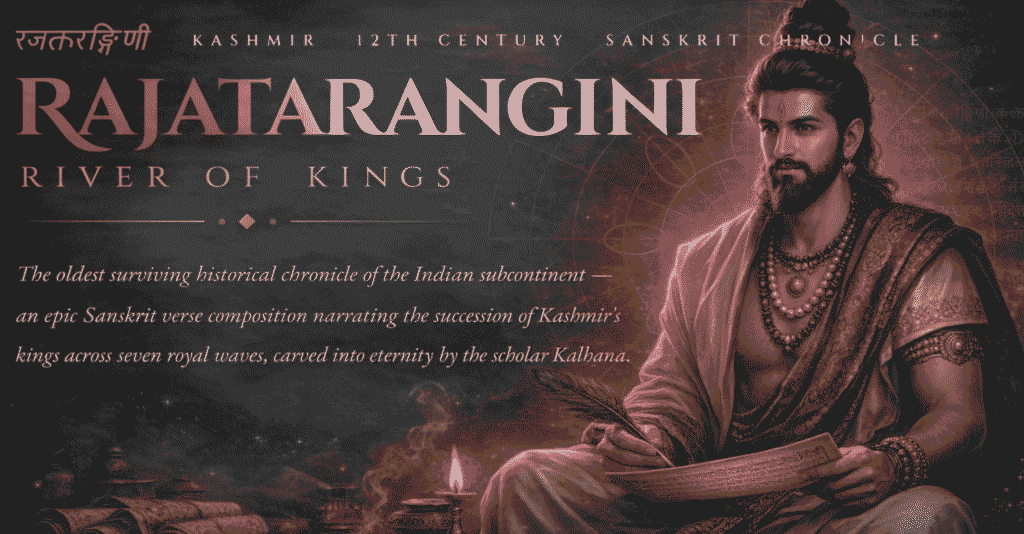
Rajatarangini: The Chronicle No One Taught You About
In 1149 CE, a Kashmiri Brahmin scholar named Kalhana completed a Sanskrit text that would spend the next seven centuries in near-total obscurity outside the valley where it was written. He called it the Rajatarangini — the River of Kings. It covered 2,300 years of Kashmiri royal history across 7,826 verses. It cited its sources. It questioned its sources. It criticised dead kings and living ones with equal frankness. It admitted, in several places, that the evidence was too thin to reach a firm conclusion.
No other Indian text before it had done any of these things.
The Kalhana’s Rajatarangini is India’s oldest surviving work of critical historiography. This is not a contested claim among serious scholars. What remains contested is what that fact means — for how we understand Indian intellectual history, for how we read the Sanskrit literary tradition, and for how we engage with Kashmir’s layered, politically charged past.
This article covers the Rajatarangini in full: its structure, methodology, most significant characters, archaeological corroboration, continuators, and continuing relevance.
Rajatarangini — Key Facts
- 7,826 Sanskrit verses across 8 Tarangas (Books)
- Approximately 2,300 years of Kashmiri history covered
- Over 11 earlier chronicles consulted by Kalhana
- Completed approximately 1149–1150 CE
- First complete English translation by Aurel Stein, 1900
- Three scholars continued the tradition after Kalhana
Part One: The Colonial Claim and Why the Rajatarangini Demolishes It
From the early 19th century onward, a particular argument about Indian civilisation gained authority in European scholarship and colonial administration: India had no history. Not “India wrote history differently.” The claim was more sweeping — that Indian civilisation, absorbed in philosophical and religious thought, had no tradition of secular, critical, time-bound historical writing.
G.W.F. Hegel advanced this position in his Lectures on the Philosophy of History (1820s). James Mill codified it in The History of British India (1817). It shaped how British administrators understood and governed the subcontinent, and it became deeply embedded in academic discourse to the point that even some Indian nationalist intellectuals in the early 20th century found it difficult to refute cleanly.
The Rajatarangini is the most direct scholarly rebuttal available.
Not because it proves that all of Indian civilisation was oriented toward secular historical writing — the broader Sanskrit literary tradition was not, and pretending otherwise misreads both the tradition and the text. The claim is more specific: that at least one Indian scholar, working without knowledge of Greek or Roman historiographical models, without institutional support for historical inquiry, and within a literary culture that had no established genre for what he was attempting, independently produced a work of critical history that satisfies the basic methodological criteria of the discipline.
Romila Thapar (Jawaharlal Nehru University), in Ancient Indian Social History (Orient Longman, 1978, p. 284), writes that the Rajatarangini “breaks the pattern of retrospective idealisation so endemic in Sanskrit literature” — distinguishing it from king-lists, dynastic genealogies, and royal panegyrics not merely in content but in intellectual orientation.
Part Two: Kalhana — Background, Sources, and Motivation
Kalhana was a Kashmiri Brahmin whose father, Champaka, served as a minister under King Harsha of Kashmir (r. 1089–1101 CE). This family connection to royal administration gave Kalhana two advantages most Sanskrit scholars of his era lacked: access to royal archives and direct exposure to the political processes through which official historical memory was constructed and distorted.
He spent years in preparation before writing. In the methodological preface to Book I of the Rajatarangini, he lists his sources: eleven earlier chronicles of Kashmir, royal genealogies, copper-plate grants (tamrashasanas), stone inscriptions (shilapattas), and oral testimony from elderly courtiers who had served under Harsha. He notes where these sources contradict each other. He identifies which types of sources he considers more reliable and explains why.
This is not a conventional Sanskrit literary preface. Conventional prefaces in the Sanskrit Kavya tradition invoke deities, praise the patron, and situate the work within its genre. Kalhana’s preface is a methodological argument. It reads, structurally, as an answer to a question no one in his tradition had previously thought to ask: on what basis should a historical claim be accepted or rejected?
He completed the Rajatarangini during the reign of King Jayasimha (r. 1128–1155 CE), to whom the work is implicitly dedicated — though Kalhana does not exempt Jayasimha’s predecessors, or Jayasimha himself, from honest assessment. Kashmir had emerged from decades of civil war, administrative collapse, and natural disaster. The political context shaped the intellectual project: Kalhana was documenting how catastrophes befall kingdoms and what patterns of royal behaviour produce them.
Part Three: Methodology — What Made the Rajatarangini Different
The methodological principles Kalhana articulates in Book I of the Rajatarangini are specific enough to be compared directly with the criteria of modern historical criticism.
Source plurality. A claim supported by a single source is weaker than one found in multiple independent witnesses. Kalhana consulted over eleven earlier chronicles alongside physical evidence — copper plates, stone inscriptions, coins — precisely because he understood that narrative sources were susceptible to motivated revision.
Internal consistency testing. Contradictions within a single source signal may be either scribal error or deliberate manipulation. Rather than silently resolving such contradictions by choosing the version that fits his narrative, Kalhana flags them explicitly and tells the reader what he has done.
Material evidence priority. Physical documents — copper-plate grants, inscribed stones — are harder to falsify after the fact than narrative chronicles. Kalhana treats them as more reliable than court poetry for this reason, a methodological preference that anticipates the archival turn in modern historiography by several centuries.
Temporal proximity. Sources closer in time to the events they describe carry more evidential weight. This is the structural explanation for why the Rajatarangini’s later Tarangas are so much longer than the earlier ones: Kalhana had access to denser, more recent, more verifiable sources for recent events.
Authorial bias recognition. Chronicles composed to flatter royal patrons are structurally compromised as historical evidence. Kalhana acknowledges this explicitly — an unusual degree of self-awareness for a court-adjacent scholar writing within a tradition where flattery of the powerful was a professional expectation.
Acknowledged uncertainty. When the available evidence cannot resolve a question, Kalhana says so. This is the criterion that most clearly distinguishes the Rajatarangini from every other major Indian historical text of its era.
Rajatarangini vs. Other Classical Indian Historical Texts
| Text Type | Cites Sources | Questions Sources | Admits Uncertainty | Criticises Rulers | Chronological Order |
| Puranas | No | No | No | No | Partial |
| Royal Prashastis | No | No | No | No | No |
| Buddhist Vamsas | Partial | No | Rare | No | Yes |
| Arthashastra | No | No | No | N/A | N/A |
| Rajatarangini | Yes | Yes | Yes | Yes | Yes |
Sheldon Pollock (Columbia University), in The Language of the Gods in the World of Men (University of California Press, 2006, p. 423), identifies the Rajatarangini as the point at which Sanskrit literary culture directed its formidable ornamental resources toward historical writing — local, time-bound, contingent — rather than the cosmopolitan, timeless Kavya tradition that had dominated Sanskrit letters for centuries.
Max Müller, in India: What Can It Teach Us? (1882), offers the most direct assessment: Kalhana is “the first Indian writer who may, without any stretch of language, be called a historian.”
Part Four: Structure of the Rajatarangini — The Eight Tarangas
The word Taranga means wave or current in Sanskrit. The eight Tarangas of the Rajatarangini are of deliberately unequal length, and that inequality reflects a precise historiographical decision. Where sources are thin, Kalhana writes briefly. Where sources are dense and events are recent, he writes at length. The structure of the text is itself a record of the evidentiary landscape Kalhana was navigating.
Taranga I — 388 verses Coverage: Mythological era to approximately 1182 BCE. The origins of Kashmir as a drained lake in cosmological tradition. The legendary Gonanda dynasty. Ashoka Maurya’s traditional association with the valley, including the founding of an early Srinagara. Kalhana identifies these accounts explicitly as resting on tradition rather than documentation, a distinction he maintains consistently throughout.
Tarangas II and III — 703 verses combined Coverage: c. 1182 BCE to c. 600 CE. Early Gonandiya kings. The legendary Fourth Buddhist Council, attributed to Kanishka, is said to have been held at Harwan near Srinagar. The Naga and early Karkota dynasty origins. Archaeological finds at Harwan — distinctive Kushana-period tilework now in the Sri Pratap Singh Museum, Srinagar — are broadly consistent with the 2nd- to 3rd-century CE Buddhist activity the text implies.
Taranga IV — 719 verses Coverage: 600–855 CE. The Karkota dynasty at its peak. The reign of Lalitaditya Muktapida (r. 724–761 CE), his campaigns, and his construction of the Martand Sun Temple. The most archaeologically corroborated section of the Rajatarangini. Aurel Stein’s fieldwork in the 1890s confirmed that Kalhana’s architectural and geographical descriptions of Martand match the excavated ruins with a precision that is not coincidental.
Tarangas V and VI — 847 verses combined Coverage: 855–1003 CE. The Utpala dynasty, the emergence of the Lohara line, and the extended portrait of Queen Didda, who governed Kashmir for over two decades as regent and then as sovereign in her own right. This section contains some of the Rajatarangini’s most detailed administrative and political material.
Taranga VII — 1,696 verses Coverage: 1003–1101 CE. The reigns of Sangramaraja and his successors culminated in Harsha’s catastrophic decline. The increasing length of this Taranga reflects Kalhana’s proximity to events — his father served at Harsha’s court, and the account draws on testimony from people who had direct experience of the period.
Taranga VIII — 3,473 verses Coverage: 1101–1149/50 CE. Nearly half of the entire Rajatarangini. Kalhana is writing partly as a direct witness, partly from documentary records of the recent past. The section includes a detailed account of the Vitasta river flood that devastated Srinagar during Jayasimha’s reign — a passage notable for its specificity, its account of administrative failure, and its absence of the moralising overlay that characterises earlier sections.
Part Five: Three Kings — Kalhana’s Most Significant Portraits
Lalitaditya Muktapida (r. 724–761 CE)
Lalitaditya is the dominant figure of Taranga IV and the subject of the Rajatarangini’s most extensively corroborated historical claims. Kalhana portrays him as a military conqueror who campaigned from Central Asia to Bengal, suppressed Arab expansion in the northwest, and built on a scale that transformed Kashmir’s architectural landscape. The Martand Sun Temple — 84 columns in limestone, oriented to the Himalayan sunrise — was his most enduring commission.
Western scholars initially treated Kalhana’s account of Lalitaditya’s campaigns as poetic exaggeration. The Arab geographer Al-Baladhuri, writing in the 9th century CE in Futuh al-Buldan, records that a powerful Kashmiri king resisted Arab military advances in the northwest at dates consistent with Lalitaditya’s reign. The Chinese pilgrim Xuanzang’s 7th-century Great Tang Records on the Western Regions corroborates Kashmir’s significance as a Buddhist learning centre in the period immediately before Lalitaditya consolidated Shaiva patronage.
Kalhana also records Lalitaditya’s restlessness — a king who could conquer territory but not consolidate it, whose campaigns eventually became self-sustaining rather than strategically purposeful. He died, according to the Rajatarangini, somewhere beyond Kashmir’s borders — possibly in Central Asia. Kalhana cannot confirm the circumstances. He says so directly, rather than constructing a death scene appropriate to the legend.
Queen Didda (r. 980–1003 CE)
Didda was the daughter of the Lohara king Simharaja and the wife of King Kshemagupta of Kashmir. Following Kshemagupta’s death, she governed as regent for a succession of young sons and grandsons who died in quick succession, until she ruled in her own name for the final years of her reign. The total span of her effective governance exceeded two decades.
Kalhana’s portrait of Didda is analytically honest in a manner unusual for 12th-century Sanskrit literature. He records her administrative capability and political acumen without reducing her to either a saint or a villain. He documents her relationship with Tunga — a man of low caste whom she elevated to significant influence at court, in open defiance of Brahmin convention — and criticises the excess of that favouritism while not allowing it to define his overall assessment of her governance.
The Didda section of the Rajatarangini deserves more attention than it receives in mainstream Indian historical education, both for what it reveals about women’s political agency in medieval Kashmir and for what it demonstrates about Kalhana’s capacity to extend impartial analysis beyond male subjects.
King Harsha (r. 1089–1101 CE)
Harsha is the figure in the Rajatarangini closest to Kalhana’s own family history, and the portrait is correspondingly the most psychologically detailed in the text. Kalhana’s father Champaka served in Harsha’s administration. The account of Harsha’s reign in Taranga VII draws on sources that almost certainly included direct testimony from people Kalhana knew personally.
Harsha’s early reign showed genuine administrative competence and cultural patronage. His later reign — documented in exhaustive and damning detail by Kalhana — involved the systematic looting of temple treasuries to fund military campaigns, the replacement of experienced ministers with compliant favourites, and a descent into the kind of paranoid isolation that historically precedes political collapse. He was killed in 1101 CE in a coup organised by his own nobles.
Kalhana does not attribute Harsha’s failure to divine punishment or cosmic fate — the standard explanatory framework in Sanskrit royal literature. He attributes it to specific decisions, miscalculations, and the dynamic between a ruler who grew increasingly authoritarian and a court that responded by withdrawing cooperation. The analysis is political and causal, not theological.
Part Six: Archaeological Evidence — The Rajatarangini in the Field
The physical corroboration of the Rajatarangini is extensive enough to have decisively shifted scholarly opinion from scepticism to cautious acceptance.
Martand Sun Temple.
Described architecturally in Taranga IV, the temple’s ruins near Anantnag were systematically surveyed by Aurel Stein in the 1890s. The column count, structural proportions, and site orientation match Kalhana’s descriptions with a specificity that cannot be attributed to generic temple-building conventions of the period. (Stein, Rajatarangini Vol. II, pp. 312–327)
Avantipora
The temples built by King Avantivarman — described in Taranga V — were excavated by the Archaeological Survey of India. Stone inscriptions recovered on-site corroborate the royal genealogy recorded by Kalhana, providing independent documentary confirmation of his dynastic sequence.
Harwan
Associated by Kalhana with Kushana-era Buddhist activity, the Harwan site yielded distinctive Kushana-period tile work during excavation. The tiles are now in the Sri Pratap Singh Museum, Srinagar, and are consistent with a 2nd- to 3rd-century CE date — matching the timeline the Rajatarangini implies for that period of the valley’s history.
Arabic corroboration
Al-Baladhuri’s Futuh al-Buldan (9th century CE, trans. Hitti, Columbia University Press, 1916) records a powerful Kashmiri king who blocked Arab military expansion in the northwest. The geographic and chronological alignment with Kalhana’s account of Lalitaditya is sufficiently close to constitute independent external corroboration — the strongest kind of historical evidence.
Chinese corroboration
Xuanzang’s 7th-century account of Kashmir as a major Buddhist centre corroborates Kalhana’s description of the valley’s pre-Karkota religious landscape, providing independent Chinese-language confirmation of the conditions Kalhana describes in Kashmiri sources.
Part Seven: The Continuators — Four Centuries of Chronicle
The Rajatarangini did not end with Kalhana. Three scholars continued the chronicle across the following four centuries, each working within the methodological tradition he established.
Jonaraja
Jonaraja served as court scholar to Sultan Zain-ul-Abidin of Kashmir (r. 1420–1470 CE) and continued the chronicle from 1150 to 1459 CE. His Dvitiya Rajatarangini covers Kashmir’s transition from Hindu Shaiva dynasties to the Muslim Sultanate. Walter Slaje’s critical edition (Kingship in Kāśmīr, Halle Studies in the Anthropology of Eurasia, 2014) has renewed scholarly attention to a text that treats the arrival of Islam in Kashmir with considerably more nuance than either Hindu nationalist or Islamist historiography tends to permit.
Shrivara
Shirvara: Jonaraja’s student, continued the chronicle from 1459 to 1486 CE. His section contains the most detailed Sanskrit account of Sultan Zain-ul-Abidin’s reign — a ruler who restored temples destroyed by his predecessors, reinstated Brahmin scholars expelled from court, and patronised translation between Sanskrit and Persian. Shrivara’s even-handed treatment of a Muslim ruler within a Sanskrit chronicle tradition is a direct inheritance of Kalhana’s commitment to impartiality over communal allegiance.
Prajyabhatta and Shuka
Prajyabhatta and Shuka extended the chronicle to 1586 CE and the Mughal conquest of Kashmir under Akbar. The Rajatarangini corpus, taken as a whole, is a continuous Sanskrit historiographical tradition spanning over four centuries after Kalhana — maintained across three dynastic transitions and one civilizational shift, by scholars who understood themselves to be working within a framework that demanded honesty about power regardless of its religious or political character.
Part Eight: Why the Rajatarangini Remains Relevant
The Kashmir historiographical question. Any serious engagement with Kashmir’s modern political condition requires engagement with its pre-modern history, which begins with the Rajatarangini. The text documents a Kashmir of documented religious plurality — not as an ideological claim but as a historical record. Mridu Rai (Hindu Rulers, Muslim Subjects, Princeton University Press, 2004, pp. 12–19) argues that the political complexity of modern Kashmir cannot be understood without engaging the historiographical record that the Rajatarangini establishes and its continuators extend.
The Indian historiography debate. The question of whether classical Indian civilisation produced critical historical writing has significant implications beyond the academy. It affects how India understands its intellectual inheritance and how pre-colonial South Asian scholarship is positioned in global conversations about the history of knowledge. The Rajatarangini represents the strongest available evidence that critical historiographical thinking was within the capacity of classical Indian scholarship — demonstrated by the fact that Kalhana practised it.
The honest scholarship question. Kalhana wrote critically about kings whose courts employed his own family. He documented the failures of rulers still celebrated in the cultural memory of his own community. He admitted the limits of his own evidence. These are not minor virtues. In a political and intellectual environment — then and now — where historical scholarship is routinely instrumentalised to serve present-day agendas, the Rajatarangini’s insistence on impartial, evidence-based, honest inquiry remains a standard of great utility.
Part Nine: Aurel Stein and the Rediscovery
The Rajatarangini circulated in Kashmir through the medieval period and into the colonial era in Sharada script manuscripts. It was known within the valley. It was not translated or widely accessible outside of it.
Marc Aurel Stein, a Hungarian-born British scholar who arrived in Kashmir as Principal of the Oriental College, Lahore, in the 1880s, obtained manuscripts of the Rajatarangini and began a translation project that distinguished itself from comparable efforts through its fieldwork component. Stein did not translate from a desk. He took the text into Kashmir’s landscape and systematically cross-referenced every geographical reference, site description, and architectural account against physical reality.
The results confirmed the text’s historical credibility to a degree that even sympathetic scholars found surprising. The Martand ruins matched Kalhana’s description. The river courses matched. The distances between sites matched within the margins of expected historical change. Stein published his two-volume translation and commentary through Archibald Constable in London in 1900. It remains the standard scholarly edition. (Stein, M.A. Kalhana’s Rajatarangini: A Chronicle of the Kings of Kasmir, 2 vols., Archibald Constable, 1900)
Conclusion
The Rajatarangini by Kalhana is not a recovered curiosity of medieval Indian scholarship. It is an active reference text in South Asian historical studies, Kashmir political analysis, Sanskrit literary scholarship, and the ongoing debate about India’s intellectual history.
It was written by a man who understood that official accounts of power are structurally unreliable. Who spent years assembling and testing sources before writing a word. Who documented the failures of revered rulers because an honest record of failure is more useful to the future than a flattering record of imagined success. Who admitted, in multiple places, that his evidence was insufficient to reach a firm conclusion — and said so, rather than inventing certainty.
Those are not 12th-century virtues. They are permanent ones.
The complete English translation by Aurel Stein is freely available via the Internet Archive. The Sanskrit text is accessible through the GRETIL digital archive at the University of Göttingen. R.S. Pandit’s Sahitya Akademi translation remains the most widely read Indian edition.
Sources
Stein, M.A. (1900). Kalhana’s Rajatarangini: A Chronicle of the Kings of Kasmir, 2 vols. Archibald Constable, London.
- Thapar, Romila (1978). Ancient Indian Social History: Some Interpretations. Orient Longman, New Delhi. pp. 279–296.
- Pollock, Sheldon (2006). The Language of the Gods in the World of Men. University of California Press. p. 423.
- Rai, Mridu (2004). Hindu Rulers, Muslim Subjects. Princeton University Press. pp. 12–19.
- Slaje, Walter (2014). Kingship in Kāśmīr (AD 1148–1459). Halle Studies in the Anthropology of Eurasia.
- Müller, F. Max (1882). India: What Can It Teach Us? Longmans, Green and Co., London.
- Pandit, R.S. (1960). Rajatarangini: The Saga of the Kings of Kasmir. Sahitya Akademi, New Delhi.
- Kulke, H. and Rothermund, D. (2004). A History of India, 4th ed. Routledge, London.
- Bamzai, P.N.K. (1994). Culture and Political History of Kashmir, 3 vols. M.D. Publications, New Delhi.
- Witzel, Michael (1990). “On Indian Historical Writing: The Role of the Vamsavalis.” Journal of the Japanese Association for South Asian Studies, 2, pp. 1–57.
- Al-Baladhuri (9th century CE). Futuh al-Buldan, trans. P.K. Hitti, Columbia University Press, 1916.
- Archaeological Survey of India — Excavation Reports: Martand Sun Temple, Avantipora, Harwan. ASI Memoirs series.
Frequently Asked Questions
What is the Rajatarangini?
The Rajatarangini is a Sanskrit verse chronicle written by Kalhana of Kashmir around 1149–1150 CE. Across 7,826 verses and 8 Tarangas, it covers approximately 2,300 years of Kashmiri royal history. It is India’s earliest surviving work of critical historiography — the first Indian text to systematically cite sources, question contradictions between them, admit evidentiary uncertainty, and assess rulers on the basis of documented evidence rather than conventional flattery.
Who was Kalhana?
Kalhana was a Kashmiri Brahmin scholar-poet whose father Champaka served as a minister under King Harsha of Kashmir. He completed the Rajatarangini during the reign of King Jayasimha (r. 1128–1155 CE). His proximity to royal administration gave him access to archives and to people with direct experience of the events he was documenting for the recent period.
What does Rajatarangini mean?
The word combines Raja (king), tarang (wave or current), and the feminine suffix -ini to form a noun meaning “River of Kings” or “Stream of Kings”. The title asserts that kings are transient — waves on the river of time rather than permanent monuments — which is consistent with the text’s unflinching documentation of royal failure alongside royal achievement.
What are the 8 Tarangas?
The eight Tarangas cover: (I) Legendary origins to c. 1182 BCE; (II–III) Early dynasties and Buddhist Kashmir to c. 600 CE; (IV) The Karkota peak including Lalitaditya, 600–855 CE; (V–VI) The Utpala and Lohara dynasties including Queen Didda, 855–1003 CE; (VII) Civil war and King Harsha’s reign, 1003–1101 CE; (VIII) The period within Kalhana’s own living memory, 1101–1149 CE. Taranga VIII contains 3,473 of the text’s 7,826 total verses.
Who continued the Rajatarangini after Kalhana?
Three scholars continued the tradition: Jonaraja (1150–1459 CE), Shrivara (1459–1486 CE), and Prajyabhatta with Shuka (to 1586 CE). Together they form the complete Rajatarangini corpus — a continuous Sanskrit historiographical tradition spanning over four centuries.
Where can I read the Rajatarangini in English?
Aurel Stein’s 1900 translation is in the public domain and fully digitised at archive.org — search “Rajatarangini Stein.” The Sanskrit text is at gretil.sub.uni-goettingen.de. R.S. Pandit’s Sahitya Akademi edition is available in print from major Indian bookstores.
What archaeological evidence supports the Rajatarangini?
The Martand Sun Temple ruins near Anantnag match Kalhana’s architectural description. Inscriptions at Avantipora corroborate his dynastic genealogy. Kushan-period tilework at Harwan is consistent with the Buddhist activity he describes for that era. Arabic and Chinese sources independently corroborate the Kashmiri political and religious conditions documented by the Rajatarangini.
The Rajatarangini by Kalhana is available free in Aurel Stein’s complete English translation via the Internet Archive. The Sanskrit original is accessible through the GRETIL archive at the University of Göttingen. Start with Taranga IV for Lalitaditya’s campaigns and the Martand Temple account, or Taranga VIII for Kalhana’s eyewitness documentation of flood, political collapse, and administrative failure. Either section demonstrates why this text remains essential reading for anyone serious about Indian history.