Introduction
Kashmir. The name conjures alpine lakes, saffron fields, and snow-capped peaks. But behind this beauty lies the History of the Kashmiri Pandits
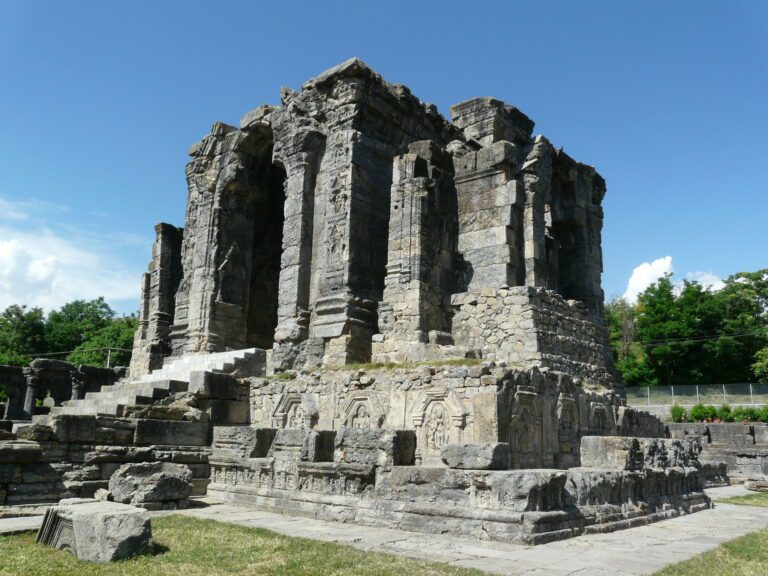
At its heart stands a people who shaped one of South Asia’s greatest intellectual traditions. The Kashmiri Pandits, the indigenous Brahmin community of the Kashmir Valley, built a civilisation that influenced philosophy, literature, and the arts for over two millennia.
Their history spans more than three thousand years. It passes through ancient kingdoms, medieval sultanates, Mughal courts, and colonial transitions. It ends, for now, in displacement. But displacement does not erase achievement. To understand the Kashmiri Pandits is to understand a central thread in South Asian civilisation.
This article traces the History of the Kashmiri Pandits. It moves chronologically, pausing at the moments of greatest creation and greatest crisis. It draws on verified historical sources. Where scholars disagree, it says so. Where evidence is thin, it does not speculate.
Explore related reading on the roots of Kashmiri culture to accompany this article.
Ancient History of the Kashmiri Pandits
The earliest textual reference to a settled community in Kashmir appears in the Nilmata Purana, a Sanskrit text composed between the sixth and seventh centuries CE. This text describes the valley’s Naga cult, its seasonal rituals, and its sacred geography. It establishes the religious foundations on which later Kashmiri culture would build.
Kashmir also appears in the Mahabharata and in Puranic literature as a land of spiritual power. The valley sat at a crossroads of trade and pilgrimage routes linking Central Asia, the Indian subcontinent, and China. This geography made it a site of continuous cultural convergence.
The Kashmiri Pandits emerged as the custodians of Sanskrit learning in this region. They maintained temple traditions, performed elaborate rituals, and preserved a large body of written and oral knowledge. Theirs was not a culture turned inward. They absorbed ideas from across Asia and transformed them into something distinctly Kashmiri.
The Age of Sanskrit Scholarship
Between the eighth and twelfth centuries CE, Kashmir became one of the most important centres of Sanskrit scholarship in the world. Scholars, poets, and philosophers flourished in the courts of its kings. This era produced works that scholars still study closely.
Grammar and poetics found some of their finest expressions here. The scholar Anandavardhana, writing in the ninth century CE, developed the theory of dhvani, or resonance, in his work Dhvanyaloka. He argued that the suggestive power of language, what lies beneath the surface of words, is the soul of poetry. This idea permanently transformed Sanskrit literary criticism.
The playwright and theorist Rajashekara, active in Kashmir in the late ninth and early tenth centuries CE, wrote extensively on poetic creativity. His work, Kavyamimamsa, remains a key reference in Sanskrit aesthetics. These scholars were not writing in isolation. They were in dialogue with traditions from all across the subcontinent, and their ideas travelled just as far.
Kashmir Shaivism: A Philosophical Revolution
No contribution of the Kashmiri Pandits rivals their development of Kashmir Shaivism. This school of non-dual philosophy reshaped Indian metaphysics. It continues to influence contemplative traditions across the world.
The tradition traces its formal origins to Vasugupta, who lived around 875 CE. Vasugupta received or composed the Shiva Sutras, the foundational text of the school. Whether one accepts the traditional account of their divine origin or treats them as a composed work, the Shiva Sutras launched a philosophical movement of extraordinary depth.
Utpaladeva, writing around 900 to 950 CE, developed the Pratyabhijna or Recognition school of thought. His Ishvarapratyabhijna-karikas argued that consciousness itself is divine. Spiritual liberation, in his framework, consists in recognising one’s own nature as Shiva. This was not a distant theological claim. It was a philosophy of immediate, lived awareness.
The tradition reached its summit with Abhinavagupta. Born around 950 CE and active until approximately 1020 CE, Abhinavagupta wrote works of staggering scope. His Tantraloka systematised the entire corpus of Kashmiri Shaiva tantra. His Abhinavabharati remains the most comprehensive commentary on the Natyashastra, the classical text on performing arts. He wrote on aesthetics, poetry, philosophy, and ritual with equal authority.
“Abhinavagupta’s concept of aesthetic experience as a form of spiritual awareness influenced Indian classical arts for centuries.” — Widely cited in studies of Indian aesthetics
His concept of rasa, or aesthetic flavour, linked artistic experience to spiritual liberation. This idea shaped Indian classical music, dance, and drama from the medieval period onwards. Scholars regard Abhinavagupta as one of the greatest thinkers produced by the Indian subcontinent. Read more on the philosophy of Kashmir Shaivism in greater depth.
Kalhana and the Birth of Historical Writing
In 1149 to 1150 CE, a Kashmiri Brahmin named Kalhana completed the Rajatarangini, or River of Kings. This chronicle of Kashmir’s rulers stands as one of the earliest works of rigorous historical writing in the Sanskrit tradition.
Kalhana set out to write history with impartiality. He stated his purpose plainly: the worthy historian examines the past with the equanimity of a judge, free from favour and resentment. This commitment to a critical perspective was remarkable for its time.
“The poet who does not give himself up to partiality alone deserves praise.” — Kalhana, Rajatarangini, Book I (trans. M. A. Stein, 1900)
The Rajatarangini covers Kashmir’s history from mythological origins through the twelfth century CE. Kalhana drew on earlier chronicles, royal inscriptions, coins, and oral traditions. The British Indologist M. A. Stein, who translated and annotated the text in 1900, described it as one of the most valuable historical documents in Sanskrit literature. It remains the primary source for the pre-Islamic history of Kashmir.
Lal Ded: The Voice of Mystic Kashmir
The fourteenth century produced a figure who transcended all boundaries of caste, gender, and religion. Lalleshwari, known to history as Lal Ded or Lalla, lived between approximately 1320 and 1392 CE. She was a Kashmiri Pandit woman who became one of the valley’s most enduring voices.
Lal Ded composed vakhs, short lyrical verses in the Kashmiri language. These verses spoke of the search for the divine within oneself. They called for moving past outward religious form towards inner experience. Her poetry drew on both Shaiva philosophy and the Sufi mysticism then entering Kashmir.
“My Guru gave me but one precept: from without withdraw your gaze within.” — Lal Ded, Vakhs (trans. various scholars)
Lal Ded remains a shared inheritance of Kashmiri Hindus and Muslims alike. She represents the syncretic spirit that scholars identify as Kashmiriyat, a distinctive quality of Kashmiri civilisation that prizes coexistence and shared devotion over sectarian division. For more on her life and legacy, visit this profile of Lal Ded.
The Sultanate Period: Persecution and Pluralism
The political character of Kashmir changed decisively in 1339 CE, when Shah Mir established the first Muslim sultanate. Kashmiri Pandits now lived under a new political order. Their experience under successive sultans varied sharply, and it would be wrong to characterise this period as uniformly hostile or uniformly benign.
Under Sultan Sikandar, who ruled from approximately 1389 to 1413 CE, the community faced serious persecution. Sikandar earned the epithet Butshikan, or idol-breaker, for ordering the destruction of temples and compelling conversions. Many Pandits fled the valley. Others converted. Historians continue to debate the full scale of events, but the disruption to Hindu religious and cultural life was significant.
The reign of Zain-ul-Abidin, who ruled from approximately 1418 to 1470 CE, brought recovery. Widely known as Budshah, or the Great King, he revoked discriminatory laws, invited exiled Pandits to return, and patronised scholarship in both Sanskrit and Persian. He commissioned translations between the two languages, creating a shared intellectual culture. His court became a model of religious pluralism in the medieval world.
This alternation between persecution and patronage shaped the Kashmiri Pandit experience across the sultanate era. The community survived by adapting. Many Pandits learned Persian and served as administrators, physicians, and scholars in Muslim courts. Their expertise in Sanskrit gave them an irreplaceable role in the translation projects that built a shared Indo-Persian tradition.
The Mughal Era: Integration and Opportunity
Akbar conquered Kashmir in 1586 CE, bringing the valley into the Mughal Empire. For the Kashmiri Pandits, Mughal rule opened new opportunities in imperial service. Mughal emperors prized Kashmir as a summer destination and site of cultural refinement.
Emperor Jahangir wrote in his memoirs that Kashmir was among the most beautiful places he had ever seen. Pandits served in Mughal revenue administration, in the arts, and in scholarly roles at the imperial court. Some rose to positions of distinction. The Mughal period also saw the continued development of Kashmiri textiles, music, and craft traditions in which Pandit families played a central part.
Pandit families maintained traditions of Sanskrit learning while fully participating in the Persian literary culture of the Mughal court. This dual fluency made them culturally nimble. It also made them valuable to whoever held power in the valley.
Afghan Misrule and Sikh Conquest
The collapse of Mughal authority in Kashmir around 1753 CE brought Afghan rule under the Durrani Empire. Historians record this period as one of the harshest in Kashmiri memory. Both Pandits and Muslims suffered under severe taxation and arbitrary governance. Kashmiri Pandits, as a largely urban and literate community, faced particular vulnerability.
Many fled the valley during this period. Others endured by drawing on the resilience their community had built across centuries of adaptation. The Afghan period lasted until 1819 CE, when forces loyal to Maharaja Ranjit Singh conquered Kashmir and incorporated it into the Sikh Empire.
Sikh rule (1819 to 1846 CE) brought greater stability. Kashmir remained a distant and at times neglected province. But for the Kashmiri Pandits, it was a period of recovery after the Afghan years.
Dogra Rule and the Modern Intelligentsia
The Treaty of Amritsar in 1846 CE transferred Kashmir from Sikh to Dogra rule under Maharaja Gulab Singh. The Dogra dynasty, itself Hindu, created conditions that enabled Kashmiri Pandits to regain influence in administration and the professions.
Under the Dogra rule, Pandits dominated government service, law, medicine, and education. Their high literacy rates and command of administrative skills made them central to the Dogra state. This period saw the expansion of formal schooling and the emergence of a modern Kashmiri Pandit intelligentsia.
One of its most distinguished members was Jawaharlal Nehru. Nehru’s ancestors were Kashmiri Pandits who had migrated to the plains of north India in the eighteenth century. Nehru himself wrote with pride and tenderness about his Kashmiri heritage in his autobiography, Toward Freedom (1936). His family’s story illustrates the broader contribution of the Kashmiri Pandit diaspora to Indian public life.
The Exodus of 1990
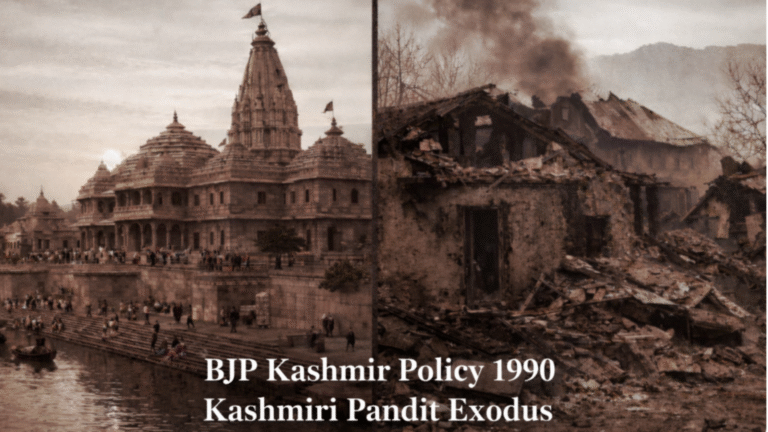
The year 1990 marks the most traumatic rupture in modern Kashmiri Pandit history.
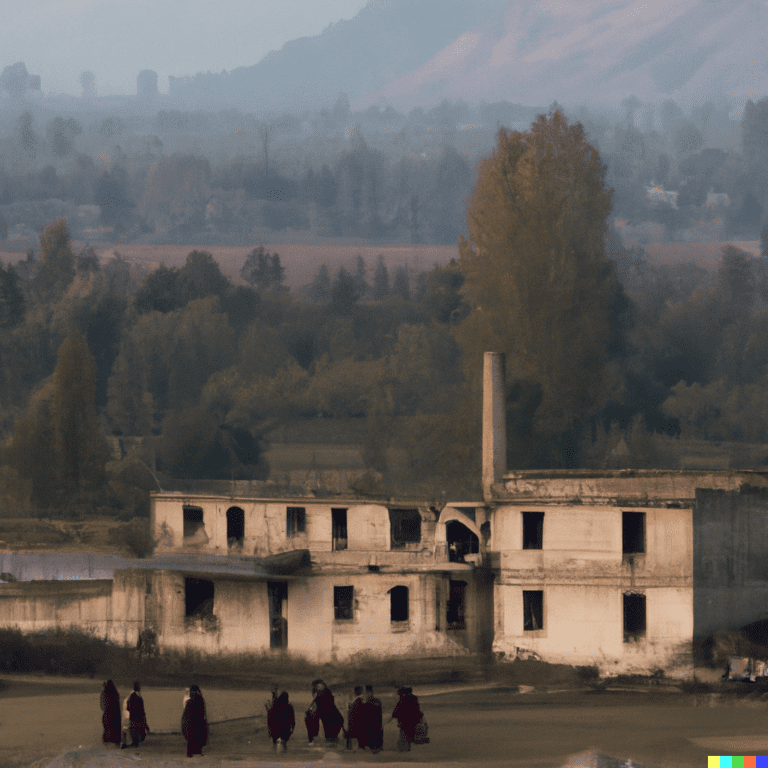
Amid an armed insurgency and a breakdown of state authority in the Kashmir Valley, the community came under severe threat. Targeted killings, public threats over mosque loudspeakers, and an atmosphere of acute fear drove the vast majority of Kashmiri Pandits from the valley in the early months of 1990.
Estimates vary, but scholars and human rights organisations suggest that between 100,000 and 500,000 Pandits left the valley within a few months of January 1990. They relocated primarily to Jammu and Delhi. Many lived for years in temporary refugee camps. The Government of India established migrant camps at Muthi and Purkhoo near Jammu, where conditions were difficult and displacement prolonged.
The events of 1990 remain contested. Debates continue about the roles of militant violence, state failure, and political decisions. Multiple perspectives exist, and a full reckoning with these events requires engagement with testimony from all sides. What is not contested is the fact of displacement itself. A community with an unbroken presence in the valley for over three thousand years was left within weeks. The human cost was immense.
For a broader discussion of this period and its context, see this overview on the 1990 Kashmir crisis.
Legacy and Continuing Significance
The Kashmiri Pandits shaped South Asian civilisation in ways that reach far beyond the valley and far beyond their present numbers.
Kashmir Shaivism, with its non-dual vision of consciousness, influenced Indian philosophy from the medieval period to the present. Its ideas permeated tantric traditions across the subcontinent, attracted serious Western scholarly attention from the twentieth century onwards, and shaped contemplative practices that continue today.
The literary tradition, from Kalhana’s historical writing to the vakhs of Lal Ded, created a body of work that scholars worldwide study and translate. Anandavardhana’s dhvani theory became foundational to Sanskrit poetics. Abhinavagupta’s aesthetic philosophy remains one of the most sophisticated theories of art produced in any tradition anywhere.
The Kashmiri Pandits also served as a bridge. They transmitted Sanskrit learning into Persian and Arabic contexts. They carried Hindu philosophy into the courts of Muslim rulers. They helped shape the syncretic Kashmiri culture of Kashmiriyat. This role as intellectual intermediaries was not accidental. It grew from centuries of living at the crossroads of civilisations.
Today, Kashmiri Pandits maintain their cultural identity in exile across India and beyond. They preserve their language, Kashmiri, their ritual traditions, their music, and the memory of a homeland they have not been able to return to in large numbers. The Kashmiri Pandit diaspora has produced distinguished writers, scientists, politicians, and artists who carry this tradition into new contexts.
Their story is not only a story of loss. It is, above all, a record of intellectual and spiritual achievement that demands recognition on its own terms. A community that gave the world Abhinavagupta, Kalhana, and Lal Ded has left a mark that no displacement can erase.
Conclusion
The history of the Kashmiri Pandits is a long argument against forgetting.
From the ancient texts of the Nilmata Purana to the philosophical revolution of Kashmir Shaivism, from Kalhana’s pioneering historical method to the mystic poetry of Lal Ded, this community produced ideas and works that enriched all of South Asian civilisation. They survived foreign conquests, communal violence, forced conversions, and brutal misrule. They adapted, rebuilt, and continued to create.
The events of 1990 brought their continuous presence in the valley to a sudden and painful end. The full accounting of those events remains unfinished. But the historical contribution of the Kashmiri Pandits to Indian and world civilisation is not in doubt. It is substantial, it is documented, and it deserves to be widely known.
History does not belong only to those who hold power at any given moment. It belongs to those who create. By that measure, the Kashmiri Pandits hold one of the most distinguished places in the long history of human thought.
Key Sources and Further Reading
Primary and Secondary Sources:
Kalhana. Rajatarangini. Translated and annotated by M. A. Stein. Westminster: Archibald Constable, 1900.
Abhinavagupta. Tantraloka. Edited and translated by Navjivan Rastogi. Delhi: Motilal Banarsidass, 1987.
Dhar, T. N. The Kashmiri Pandit. New Delhi: APH Publishing, 2004.
Bazaz, P. N. The History of Struggle for Freedom in Kashmir. New Delhi: Kashmir Publishing, 1954.
Pandita, R. Our Moon Has Blood Clots. Noida: Random House India, 2013.
Lawrence, W. R. The Valley of Kashmir. London: Henry Froude, 1895.
For further exploration, visit: rohittikoo.com/blogs