
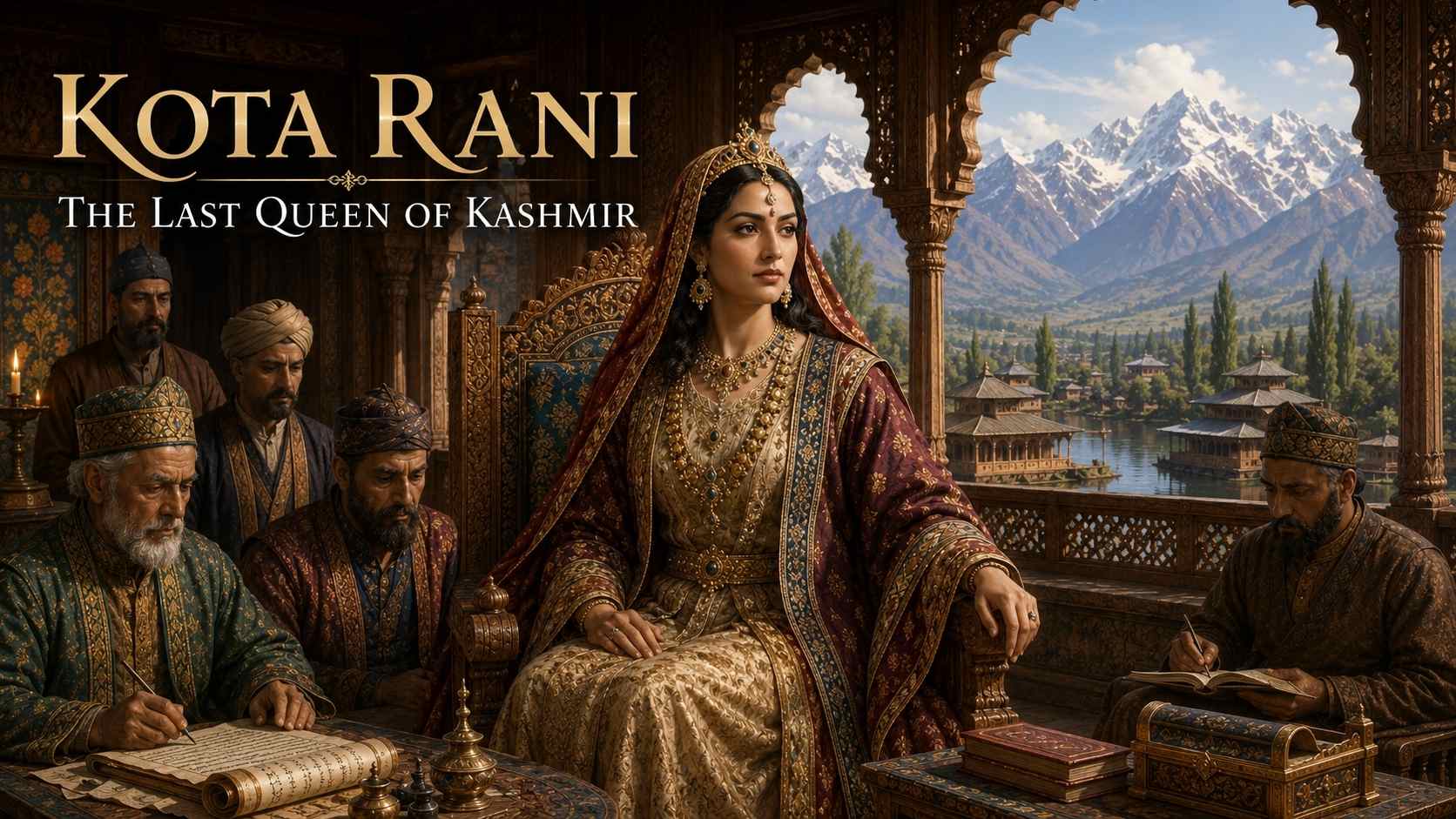
Few figures in Kashmir’s medieval history have inspired as much admiration and debate as Kota Rani. Celebrated as the last ruling queen of Kashmir before the establishment of the Shah Mir Sultanate, she governed during one of the most turbulent periods the valley had ever experienced. Political intrigue, foreign invasions, dynastic decline and shifting alliances transformed the kingdom within a few decades, placing extraordinary demands on its rulers.
Kota Rani emerged as one of the few leaders capable of navigating this instability. She served as queen, regent and administrator, earning a reputation for political acumen and resilience. Yet much of what is popularly written about her today blends documented history with later folklore. Dramatic stories surrounding her life and death often overshadow the historical evidence preserved in medieval chronicles.
This article explores Kota Rani’s life through the lens of available historical sources. It examines the political circumstances that shaped her rise, the challenges she faced as ruler, and the lasting significance of her reign in Kashmir’s history. Where historians disagree or evidence remains uncertain, those differing interpretations are clearly explained.
Who Was Kota Rani?
Kota Rani was the last independent ruling queen of medieval Kashmir. She ascended the throne during the early fourteenth century after serving as queen consort and later as regent under successive rulers. Her reign marked the closing chapter of centuries of Hindu and Buddhist dynastic rule in Kashmir before the emergence of the Shah Mir Sultanate in 1339.
Although her reign lasted only a short time, historians regard it as a decisive turning point. The political changes that followed permanently altered Kashmir’s system of governance, its ruling elite and, over time, its religious and cultural landscape.
Today, Kota Rani remains a symbol of courage, political intelligence and determination. However, separating the historical ruler from the legendary heroine requires careful reading of the available evidence.
Kashmir Before Kota Rani
To understand Kota Rani’s achievements, it is essential to appreciate the world into which she was born. By the beginning of the fourteenth century, Kashmir was no longer the prosperous and stable kingdom described in earlier centuries. Long-standing political divisions, factional rivalries and weakening royal authority had left the kingdom increasingly vulnerable.
The Legacy of the Lohara Dynasty
Kota Rani lived during the final years of the Lohara dynasty, which had ruled Kashmir for more than two centuries. Earlier rulers had presided over periods of prosperity, temple construction and literary achievement. However, by the late thirteenth century the dynasty faced growing internal conflict.
Court factions competed for influence, regional nobles exercised increasing autonomy and royal succession became uncertain. Weak monarchs struggled to maintain authority over ambitious ministers and military commanders. These internal divisions gradually eroded the stability of the kingdom.
Unlike sudden collapses caused by a single invasion or rebellion, the decline of the Lohara dynasty unfolded over several decades. Political institutions weakened, making it difficult for any ruler to respond effectively when external threats emerged.
A Kingdom Under Pressure
Kashmir’s geographical position made it both prosperous and vulnerable. The valley lay at the crossroads of important trade routes connecting South Asia, Central Asia and Tibet. While commerce enriched the kingdom, it also attracted ambitious invaders.
Readers looking for a broader overview of Kashmir’s geography and historical development can refer to Encyclopaedia Britannica’s overview of Kashmir.
At the beginning of the fourteenth century, neighbouring regions were themselves undergoing profound political change. The expansion of new powers across northern India and Central Asia created an increasingly uncertain environment for Kashmir.
Successive rulers had to contend not only with domestic rivalries but also with threats from beyond the mountain passes.
The Devastating Mongol Invasion
One of the defining events preceding Kota Rani’s rise was the invasion led by the Mongol commander Dulucha, also known in some sources as Zulju, around 1320.
Medieval chroniclers describe the invasion as catastrophic. Large areas of Kashmir were reportedly devastated, settlements were destroyed and many inhabitants either fled or were killed. Agricultural production suffered, trade declined and royal authority weakened further.
Although historians debate the precise scale of the destruction described in medieval chronicles, there is broad agreement that the invasion profoundly destabilised the kingdom. The crisis exposed the inability of the existing government to defend the valley effectively.
It also created the political vacuum that allowed ambitious newcomers to compete for power.
Suhadeva’s Rule
At the time of the invasion, Kashmir was ruled by King Suhadeva.
Historical accounts portray Suhadeva as struggling to maintain control during mounting crises. Faced with the Mongol invasion, he reportedly abandoned the capital rather than organising an effective defence. Whether this decision reflected military necessity or political weakness remains debated, but the result was clear. Confidence in the monarchy collapsed.
The kingdom fragmented rapidly as regional leaders and military commanders sought to secure their own positions.
Among those who emerged during this period was Rinchan, a young noble whose ambitions would transform the history of Kashmir.
Early Life of Kota Rani
Compared with later episodes of her life, relatively little is known about Kota Rani’s childhood.
Most surviving information comes from medieval chroniclers writing years or even decades after the events they describe. As a result, historians can reconstruct only parts of her early life with confidence.
She is generally believed to have belonged to an influential Kashmiri family closely connected with the royal court. Her upbringing would almost certainly have included exposure to court administration, diplomacy and elite political culture. Such an education would later prove invaluable.
Unlike many royal women whose historical presence is limited to dynastic marriages, Kota Rani would eventually play an active role in governing the kingdom.
Education and Political Awareness
Although medieval chronicles provide few direct details of her education, her later actions reveal remarkable political skill.
Throughout her career she demonstrated an understanding of diplomacy, statecraft and court politics. She successfully navigated shifting alliances, negotiated with powerful nobles and assumed leadership during repeated crises.
These abilities were unlikely to have developed suddenly after she became queen. They suggest years of experience within Kashmir’s political environment before she appeared prominently in historical records.
A Woman in an Unstable Court
Royal courts in medieval South Asia were often centres of intense political competition. Ministers, generals, nobles and members of the royal family all sought influence over succession and government.
Women of royal households sometimes exercised considerable authority, particularly during periods of instability. They acted as advisers, regents and diplomatic intermediaries, although their contributions were frequently underrepresented in contemporary chronicles.
Kota Rani would eventually become one of the most politically influential women in Kashmir’s recorded history. Her ability to survive repeated changes of ruler reflected not only personal resilience but also exceptional political judgement.
Sources and Historical Uncertainty
One challenge in studying Kota Rani is the limited nature of surviving evidence.
The principal accounts of her life come from later continuations of the Rajatarangini, particularly the work of Jonaraja, who wrote after the establishment of the Shah Mir Sultanate. Later Persian chronicles and modern historians supplement these narratives, but they occasionally differ in chronology, emphasis and interpretation.
Consequently, historians distinguish between events supported by multiple sources and stories that appear only in later traditions. This distinction is especially important when examining the dramatic accounts of Kota Rani’s final days, which will be discussed later in this article.
What remains beyond dispute is that, by the early 1320s, Kashmir had entered one of the most volatile periods in its history. Amid dynastic decline, foreign invasion and political uncertainty, Kota Rani was about to emerge as one of the kingdom’s most capable leaders.
Rinchan’s Rise and Kota Rani’s First Marriage
The political vacuum created by the Mongol invasion transformed Kashmir’s balance of power. Among those who seized the opportunity was Rinchan, also known as Rinchan Shah or Rinchana, a prince from the region of Ladakh or neighbouring Tibetan territories, depending on the historical source consulted.
Forced to leave his homeland after political upheaval, Rinchan arrived in Kashmir as an ambitious outsider. Rather than remaining a refugee, he quickly established himself within the kingdom’s fractured political landscape. He forged alliances with influential nobles, built military support and took advantage of the weakening authority of the Lohara rulers.
The collapse of central authority after Suhadeva’s departure enabled Rinchan to emerge as one of the most powerful figures in Kashmir. His ascent marked the beginning of a new political era, one in which military capability and strategic alliances proved more decisive than hereditary claims alone.
Marriage to Kota Rani
Following his rise to power, Rinchan married Kota Rani. The marriage was significant for both political and dynastic reasons.
For Rinchan, marrying a woman closely connected to Kashmir’s ruling elite strengthened his legitimacy among influential nobles. As an outsider, he needed acceptance from the established political class, and the marriage helped secure that support.
For Kota Rani, the marriage placed her at the centre of a rapidly changing kingdom. More importantly, contemporary accounts suggest she was not merely a ceremonial queen. She became an active participant in court affairs and governance, demonstrating administrative abilities that would later define her own reign.
Although medieval chronicles focus primarily on kings and military leaders, Kota Rani’s growing political influence becomes increasingly evident in the years that followed.
Rinchan’s Conversion and Religious Policy
One of the most discussed aspects of Rinchan’s reign concerns his conversion to Islam.
According to several medieval chronicles, Rinchan initially explored different religious traditions before eventually accepting Islam under the guidance of the Sufi saint Bulbul Shah. He subsequently adopted the name Sultan Sadr-ud-Din.
Modern historians, however, caution against reducing this decision to purely religious motives. Conversion also had political dimensions. Kashmir’s population included followers of multiple faiths, and aligning himself with an emerging Muslim community may have strengthened Rinchan’s position as ruler.
Some later traditions claim that Rinchan first sought initiation into Hinduism but was refused by Brahmin scholars. While this story remains widely circulated, historians disagree over whether it reflects historical fact or later interpretation. The surviving evidence is insufficient to establish the episode with certainty.
What is clear is that Rinchan’s reign illustrates the complex political and religious landscape of fourteenth-century Kashmir, where questions of legitimacy, diplomacy and faith were often closely intertwined.
Kota Rani’s Growing Role in Government
Rinchan’s reign was relatively brief, lasting only a few years. During this period, Kota Rani gained valuable experience in the administration of the kingdom.
Although the chronicles rarely describe her day-to-day responsibilities, her later effectiveness as regent and queen strongly suggests she was already involved in important affairs of state. She developed relationships with influential ministers, military commanders and regional nobles while acquiring first-hand knowledge of the kingdom’s administrative machinery.
These experiences would later enable her to guide Kashmir through repeated political crises.
The Death of Rinchan
Rinchan’s rule came to an abrupt end after he was mortally wounded during a rebellion led by rival factions. His death once again plunged Kashmir into uncertainty.
The kingdom now faced another succession crisis. Competing political groups sought to shape the future of the monarchy, while external threats remained ever present.
In many medieval kingdoms, the death of a ruler often triggered prolonged civil conflict. Kashmir appeared destined for a similar fate.
Instead, Kota Rani emerged as a stabilising force.
Regency and the Return of the Lohara Dynasty
Following Rinchan’s death, the question of succession became highly contentious.
Rather than claiming the throne immediately, Kota Rani supported the restoration of Udayanadeva, a member of the Lohara royal family whose dynastic lineage carried greater traditional legitimacy.
The decision reflected political pragmatism rather than personal ambition. Installing a recognised claimant helped reassure influential nobles and reduced the risk of immediate civil war.
Kota Rani subsequently married Udayanadeva, creating a political alliance designed to preserve stability during a period of exceptional uncertainty.
Marriage to Udayanadeva
Unlike her earlier marriage to Rinchan, which strengthened an ambitious newcomer’s claim to power, Kota Rani’s marriage to Udayanadeva sought to reinforce continuity with Kashmir’s traditional ruling dynasty.
Historical accounts frequently portray Udayanadeva as a comparatively weak ruler. While such descriptions should be treated with caution, many historians agree that Kota Rani exercised considerable influence during his reign.
As political instability continued, she increasingly assumed responsibility for the practical administration of the kingdom.
In effect, she became the government’s most capable and visible leader.
Governing During Crisis
The years following Udayanadeva’s accession remained extraordinarily difficult.
Kashmir faced multiple challenges:
-
Rival noble factions competing for influence.
-
Continuing threats from neighbouring powers.
-
Economic disruption caused by earlier invasions.
-
Administrative instability.
-
The need to restore public confidence in royal authority.
Contemporary accounts suggest that Kota Rani approached these problems with determination and political skill.
Rather than relying solely on military force, she cultivated alliances among influential nobles while strengthening the institutions of government. This balanced approach helped maintain relative stability despite the kingdom’s fragile condition.
The Kute Kol Canal and Public Works
One of the achievements traditionally associated with Kota Rani is the construction or improvement of the Kute Kol canal, an important water channel intended to reduce flooding around Srinagar.
Flooding had long posed a serious challenge in the Kashmir Valley. Seasonal overflow from the Jhelum River frequently damaged agricultural land and settlements, threatening both livelihoods and royal revenues.
Later historical tradition credits Kota Rani with sponsoring hydraulic works designed to improve water management and protect the capital.
Although historians debate the precise extent of her personal involvement and the chronology of the project, the persistence of these accounts reflects her enduring reputation as a practical and capable administrator who paid attention to the welfare of her subjects.
Whether every detail can be verified or not, the association between Kota Rani and public works distinguishes her from many rulers remembered primarily for warfare or dynastic conflict.
The Death of Udayanadeva
When Udayanadeva died, Kashmir once again stood at a crossroads.
Unlike previous succession crises, however, the kingdom now possessed a leader with proven administrative experience, broad political support and an established reputation for effective governance.
Rather than acting merely as queen consort or regent, Kota Rani assumed sovereign authority in her own right.
Her accession represented one of the most remarkable moments in Kashmir’s medieval history. At a time when political fragmentation threatened the kingdom’s survival, she became its undisputed ruler.
Yet even as she secured the throne, a new and formidable challenge was gathering strength within her own court.
Among her advisers was a noble named Shah Mir, whose ambitions would ultimately reshape the future of Kashmir.
Kota Rani as the Independent Ruler of Kashmir
Following the death of Udayanadeva, Kota Rani ascended the throne in her own right. Although her independent reign was relatively brief, historians regard it as one of the most significant episodes in medieval Kashmiri history.
She inherited a kingdom weakened by decades of invasion, dynastic disputes and political instability. The royal treasury had been strained, influential nobles had grown increasingly powerful and external threats remained ever present. Restoring order required far more than ceremonial authority. It demanded decisive leadership.
Unlike many rulers remembered primarily for military conquest, Kota Rani’s reputation rests largely on her administrative ability. Contemporary and later chroniclers portray her as an intelligent and energetic monarch who sought to preserve stability at a time when the kingdom stood on the brink of irreversible change.
Administration and Governance
Although surviving records provide only limited details of her administration, they consistently suggest that Kota Rani was an active ruler rather than a symbolic figurehead.
Her government faced several immediate priorities:
-
Restoring confidence in the monarchy.
-
Managing rival factions within the royal court.
-
Protecting agricultural production.
-
Maintaining law and order.
-
Strengthening the kingdom’s finances.
-
Defending Kashmir against internal and external threats.
Her experience as queen consort and regent had prepared her well for these responsibilities. Years spent navigating court politics enabled her to understand the ambitions of powerful nobles and the fragile alliances that held the kingdom together.
Rather than introducing sweeping reforms, she appears to have focused on preserving administrative continuity while responding to immediate crises.
Balancing Competing Interests
One of the greatest challenges facing any medieval ruler was maintaining the loyalty of influential aristocratic families.
Kashmir’s nobility did not always share common interests. Regional elites, military commanders and court officials frequently competed for influence over royal policy.
Kota Rani sought to balance these competing interests through diplomacy as much as force. Her ability to negotiate alliances helped delay political fragmentation, although it could not eliminate the underlying tensions that had accumulated over decades.
Among those who benefited from her confidence was Shah Mir.
His growing influence would ultimately determine the fate of the kingdom.
The Rise of Shah Mir
Shah Mir occupies a central place in Kashmir’s medieval history. Originally believed to have arrived from the region of Swat or neighbouring areas, he entered Kashmir during the reign of Suhadeva and gradually rose through the ranks of the royal court.
Unlike military conquerors who relied solely on force, Shah Mir built his position patiently.
He cultivated relationships with influential nobles, gained administrative experience and established himself as one of the kingdom’s most trusted advisers. Over many years, he transformed himself from a newcomer into one of the most powerful figures in Kashmir.
By the time Kota Rani became queen, Shah Mir possessed considerable political influence.
The balance of power within the kingdom had begun to shift.
Growing Political Tensions
Medieval chronicles describe increasing tension between Kota Rani and Shah Mir during the final years of her reign.
While the exact sequence of events differs between historical sources, there is broad agreement that Shah Mir steadily consolidated support among sections of the nobility.
Several factors worked in his favour:
-
Long-standing divisions within the court.
-
Rivalries among aristocratic families.
-
Fatigue after decades of political instability.
-
The weakening authority of the traditional royal dynasty.
Kota Rani remained an experienced and capable ruler, but her political position became increasingly precarious as support within the elite fragmented.
The Fall of Kota Rani
In 1339, Shah Mir successfully seized power, bringing an end to Kota Rani’s reign.
The transition marked far more than the replacement of one monarch by another. It represented the conclusion of the Lohara political tradition and the beginning of the Shah Mir Sultanate, which would rule Kashmir for more than two centuries.
For historians, this moment stands as one of the major turning points in the region’s history.
Exactly how Kota Rani lost power remains the subject of differing historical accounts.
Some medieval sources describe military confrontation, while others emphasise political manoeuvring and the gradual collapse of support for the queen. As with many events recorded in medieval chronicles, separating fact from later embellishment is not always straightforward.
How Did Kota Rani Die?
The circumstances surrounding Kota Rani’s death have inspired centuries of storytelling.
The most widely repeated version claims that after Shah Mir captured her, he proposed marriage in an attempt to legitimise his rule. According to later tradition, Kota Rani agreed but, before the ceremony could be completed, she took her own life by stabbing herself with a concealed dagger. Some versions add the dramatic claim that she declared Shah Mir could have only her lifeless body.
Another variation describes her disembowelling herself to prevent the marriage.
These accounts have become deeply embedded in popular narratives about Kota Rani and are frequently repeated in books, articles and online publications.
What Do Historians Say?
Modern historians approach these dramatic stories with caution.
The earliest available sources do not all describe her death in the same way, and several of the more sensational details appear only in later retellings.
As a result, scholars generally distinguish between:
Reasonably well-supported historical conclusions
-
Kota Rani lost power in 1339.
-
Shah Mir established a new ruling dynasty.
-
Her reign marked the end of the old political order.
Accounts that remain uncertain or disputed
-
The exact circumstances of her capture.
-
Whether Shah Mir proposed marriage.
-
The precise manner of her death.
-
Her reported final words.
This distinction is important because medieval chroniclers often combined historical reporting with literary and moral storytelling. While such narratives remain culturally significant, they cannot always be treated as literal historical fact.
Presenting these traditions as established history risks oversimplifying a much more complex historical record.
The End of an Era
With Kota Rani’s fall, Kashmir entered a new political phase.
Shah Mir became the first ruler of the Shah Mir Sultanate, inaugurating a dynasty that governed the valley until the late fifteenth century.
The transition did not erase Kashmir’s rich cultural heritage overnight. Administrative practices, artistic traditions and local institutions continued to evolve over subsequent generations.
Nevertheless, historians widely regard 1339 as a watershed year because it marked a lasting transformation in the kingdom’s political leadership.
For this reason, Kota Rani is remembered not simply as the last queen of Kashmir but as the final ruler of an era that had shaped the valley for centuries.
Kota Rani’s Legacy
More than six centuries after her death, Kota Rani continues to occupy a distinctive place in the historical imagination of Kashmir.
Her legacy rests on several foundations.
First, she demonstrated that effective leadership could emerge during periods of profound instability. Despite repeated invasions, succession disputes and court intrigues, she preserved the kingdom’s administration for as long as circumstances allowed.
Second, she remains one of the few women in South Asian medieval history who exercised sovereign authority over an entire kingdom during a period of exceptional political upheaval.
Third, the legends surrounding her final days have transformed her into a symbol of dignity, resistance and sacrifice. Whether every detail of those stories is historically accurate, their endurance reflects the deep impression she left on Kashmiri cultural memory.
Today, historians increasingly seek to move beyond legend alone. By examining contemporary chronicles alongside modern scholarship, they portray Kota Rani not merely as a tragic heroine but as a capable stateswoman whose political judgement shaped one of the most critical periods in Kashmir’s history.
Her reign was brief, but its consequences were profound. The decisions she made, the challenges she confronted and the transition that followed continue to influence how the history of medieval Kashmir is understood.
Historical Sources: How Do We Know About Kota Rani?
Reconstructing Kota Rani’s life presents a challenge because the surviving historical record is relatively limited. Unlike many later rulers, she left behind no inscriptions, royal memoirs or administrative documents that provide a detailed account of her reign. Instead, historians rely primarily on medieval chronicles and later historical analyses.
Jonaraja’s Rajatarangini
The most important source for Kota Rani’s life is Jonaraja’s continuation of the Rajatarangini. Kalhana’s original Rajatarangini, completed in the 12th century, ends before Kota Rani’s lifetime. Jonaraja continued the narrative into the 15th century, documenting the turbulent events that led to the establishment of the Shah Mir Sultanate.
Although Jonaraja wrote after the events he described, his work remains one of the principal historical sources for this period.
Later Chronicles
Subsequent historians, including Srivara and later Persian chroniclers, expanded upon Jonaraja’s narrative. While these works preserve valuable information, they sometimes differ in chronology, emphasis and interpretation.
As a result, historians compare multiple sources rather than relying on a single account.
Modern Scholarship
Contemporary historians have re-examined medieval chronicles alongside archaeological evidence and regional history to produce a more balanced understanding of Kota Rani’s reign.
Rather than accepting every medieval story literally, modern scholarship distinguishes between:
-
Events supported by multiple independent sources.
-
Accounts that appear only in later traditions.
-
Literary embellishments intended to convey moral or political lessons.
This approach helps separate historical probability from enduring legend.
Timeline of Kota Rani
| Year (Approx.) | Event |
|---|---|
| Early 14th century | Kota Rani is born into an influential Kashmiri family. |
| c. 1320 | Mongol commander Dulucha invades Kashmir, destabilising the kingdom. |
| c. 1320 | Rinchan seizes power following the political crisis. |
| c. 1320–1323 | Kota Rani marries Rinchan. |
| c. 1323 | Rinchan dies after being wounded during a rebellion. |
| c. 1323 | Udayanadeva becomes king, with Kota Rani playing a leading political role. |
| c. 1323–1338 | Kota Rani effectively administers much of the kingdom during repeated crises. |
| c. 1338 | Following Udayanadeva’s death, Kota Rani becomes the ruling queen of Kashmir. |
| 1339 | Shah Mir overthrows Kota Rani and establishes the Shah Mir Sultanate. |
| 1339 | Kota Rani dies under circumstances that remain historically disputed. |
Why Kota Rani Still Matters Today
Kota Rani occupies a unique position in the history of Kashmir.
She ruled during one of the kingdom’s most difficult periods, when political institutions were weakening and external pressures threatened the state’s survival. Her ability to maintain stability, however briefly, demonstrates exceptional administrative skill and political judgement.
She also represents an important example of female leadership in medieval South Asia. Although women exercised influence in many royal courts, relatively few ruled as sovereign monarchs during periods of such profound instability.
At the same time, her story illustrates the importance of approaching history critically. Popular narratives often simplify complex events into dramatic legends. Examining the available evidence allows us to appreciate Kota Rani not only as a legendary figure but also as a capable stateswoman whose decisions shaped the course of Kashmiri history.
More than six centuries after her reign, she remains one of the valley’s most compelling historical personalities.
Frequently Asked Questions
Who was Kota Rani?
Kota Rani was the last independent ruling queen of medieval Kashmir. She governed during the early 14th century before the establishment of the Shah Mir Sultanate in 1339.
Why is Kota Rani famous?
She is remembered for her political leadership during one of Kashmir’s most turbulent periods and for being the last queen before a major dynastic transition.
Was Kota Rani the last Hindu queen of Kashmir?
Most historians describe her as the last ruler associated with the Lohara dynasty before the Shah Mir Sultanate was established. The phrase “last Hindu queen” is widely used, although historians generally prefer to place her within the broader political context of the dynasty’s end.
Who was Rinchan?
Rinchan was a prince who rose to power in Kashmir following the political turmoil caused by the Mongol invasion. He married Kota Rani and ruled briefly before his death.
Who was Udayanadeva?
Udayanadeva was a member of the Lohara dynasty who became king after Rinchan’s death. During his reign, Kota Rani played an increasingly important role in governing the kingdom.
Who defeated Kota Rani?
Shah Mir overthrew Kota Rani in 1339 and founded the Shah Mir Sultanate, which ruled Kashmir for more than two centuries.
How did Kota Rani die?
The exact circumstances remain uncertain. Medieval traditions describe her taking her own life rather than marrying Shah Mir, but historians note that the dramatic details vary across sources and cannot be confirmed with certainty.
Did Kota Rani build the Kute Kol canal?
Later historical tradition associates Kota Rani with the construction or improvement of the Kute Kol canal for flood management around Srinagar. While historians acknowledge this tradition, the precise details remain debated.
Why is Kota Rani important in Indian history?
Her reign marks a significant political transition in Kashmir and highlights the role of female leadership during a period of exceptional instability.
Are the stories about Kota Rani historically accurate?
Some aspects of her life are well documented, while others, particularly the stories surrounding her death, are based on later traditions and remain historically uncertain.
Conclusion
Kota Rani’s life reflects both the possibilities and the limitations of leadership during times of profound political upheaval. She inherited a kingdom weakened by decades of dynastic conflict, foreign invasion and internal division, yet repeatedly demonstrated resilience, diplomatic skill and administrative competence.
Although her reign ended with the rise of the Shah Mir Sultanate, reducing her story to the dramatic circumstances of her death does a disservice to her historical significance. Her greatest achievement was not simply resisting political change but striving to preserve stability in a kingdom already facing immense structural challenges.
The legends surrounding Kota Rani continue to capture the public imagination, but the historical record reveals an equally compelling figure: a capable ruler navigating one of the most consequential transitions in Kashmir’s medieval history. Understanding her life through both historical evidence and cultural memory provides a richer appreciation of her enduring legacy.
To understand the political upheaval that shaped Kota Rani’s reign, read our detailed guide to the History of Kashmir.
Further Reading
For readers interested in exploring the subject in greater depth, the following works provide valuable historical context:
-
Jonaraja, Rajatarangini (continuation)
-
Srivara, Rajatarangini
-
Aurel Stein, Kalhana’s Rajatarangini (translation and commentary)
-
P. N. K. Bamzai, Culture and Political History of Kashmir
-
Mohibbul Hasan, Kashmir Under the Sultans
-
Chitralekha Zutshi, Kashmir: History, Politics, Representation

Rohit Tikoo is a published author, researcher, and content strategist with over two decades of writing experience. He is the author of nine books covering Kashmir, Indian philosophy, social issues, and contemporary thought, including Shadows Over the Valley: Operation TUPAC, Cold War Geopolitics, and the Kashmiri Pandits Exodus (2025).
His work focuses on Kashmir’s history, literature, culture, and the lived experiences of the Kashmiri Pandit community. Through extensive research, archival references, and historical analysis, he seeks to document and preserve narratives that are often overlooked in mainstream discourse. His writing on Kashmir has appeared in DAILY EXCELSIOR, HEADLINES TODAY, ONLY KASHMIR, GREATER KASHMIR, NAAD,
VITASTA, CHATTAN, AND VOICE OF SILENCE.
Through rohittikoo.com, he publishes research-based articles, essays, and commentary aimed at fostering informed discussion on Kashmir, Indian civilisation, literature, and contemporary society.