
In April 2026, a Right to Information response obtained by Congress leader Sanjay Sapru produced a number that no government statement in fifteen years had managed to say plainly: three. This is the story of Kashmiri Pandit Rehabilitation.
Three Kashmiri Pandit families have permanently resettled in the Kashmir Valley under India’s flagship rehabilitation programme since its launch. A programme with a stated budget of Rs 1,618.40 crore, announced in 2008, running for over fifteen years across two governments and multiple revisions.
Three.
Kashmiri Pandit Rehabilitation Package and What It Promised
The Prime Minister’s Comprehensive Economic Package of 2008 had explicitly stated goals. According to the Press Information Bureau, it covered financial assistance for purchasing, constructing, or repairing houses; transit accommodation in the Valley; cash relief; scholarships; employment and self-employment; agricultural and horticultural support; and a waiver of interest on unpaid loans.
The word in the title was return. Not relief. Return and rehabilitation.
Seven years later, in November 2015, the NDA government expanded it. The Cabinet approved 3,000 additional state government jobs for displaced Kashmiri migrants and 6,000 transit accommodation units in the Valley, at an estimated cost of Rs 920 crore for housing alone. This was on top of the 3,000 jobs already sanctioned under the 2008 package.
By 2026, across both packages, the government had committed thousands of crores and nearly two decades to the question of return.
The RTI answer was three families.
What the Government Counts as Progress
The numbers the government cites need to be laid out before they can be examined.
As CM Omar Abdullah told the J&K Assembly in March 2026: 6,000 government jobs have been sanctioned under both PM packages, of which 5,896 appointments have been made. 5,248 two-room tenements have been constructed in Jammu. 4,112 of the promised 6,000 transit accommodation units in the Valley have been completed.
These are real. The 5,896 Kashmiri Pandits who took government jobs under these schemes went back to the Valley. They work there; they live in transit accommodation during postings.
But here is the problem.
Those employees are posted wherever the government needs them, not in their ancestral districts. They live in guarded transit camps behind iron gates, not in their home neighbourhoods or on their family land. Nearly 1,900 of the 6,000 promised housing units are still unbuilt more than a decade after the scheme launched. And when you ask how many families have actually returned permanently under the housing and resettlement component of the package built for that purpose, the RTI answer is three.
Sapru said it plainly: “Filling posts or constructing transit units cannot be equated with dignified return. Rehabilitation is not a statistic. It is a lived reality and that reality is clearly missing.”
The 2008 package was not titled the PM’s Employment Provision Scheme. It was a scheme for return and rehabilitation. By that stated purpose, fifteen years and Rs 1,618 crore produced three families.
The Relief That Has Not Moved Since 2018
When Kashmiri Pandit families first registered as migrants in 1990, the Jammu and Kashmir government provided Rs 250 per household per month in cash, along with free ration. The amount was raised several times over the following decades. By 2015 it had reached Rs 6,600 per family. In May 2015 it was raised to Rs 10,000, at Rs 2,500 per person. In June 2018 it was raised again, from Rs 10,000 to Rs 13,000 per family, at Rs 3,250 per person.
That was the last revision. It has not changed since.
The current structure works on a per-head basis with a hard cap: one member in a family receives Rs 3,250 per month; two members receive Rs 6,500; three members receive Rs 9,750; four or more members receive Rs 13,000, regardless of family size. Along with this, the government provides 9 kg of rice and 2 kg of flour per person per month, and 1 kg of sugar per family.
A Parliamentary committee that reviewed these figures in 2022 noted: “The committee is of the view that given the historical circumstances and suffering of the Kashmiri migrant, the enhanced amount is still meagre.”
That was four years ago. The amount still has not moved.
What Rs 13,000 covered in Jammu in 2018 is not what it covers in 2026. Eight years of inflation, rising rents, and rising healthcare costs have steadily reduced its real value without any corresponding revision. A 73-year-old resident of Jagti camp told Outlook India that the monthly relief was not enough to pay for his medicines. He had owned a three-storey house in Srinagar’s Zaina Kadal and a shop at Maharaja Bazaar before 1990. He now lives alone.
The Cost of Going Back to Work
Rahul Bhat went back for the job, and so did many Kashmiri Pandits under the PM Package.
He was a Kashmiri Pandit who took a government clerk’s job under the PM package in 2010-11 and was posted in the revenue department at the Tehsil office in Chadoora, Budgam. He lived with his wife and daughter at Sheikhpora migrant colony in Budgam, one of the transit settlements built for Valley-posted employees. His parents were in Jammu’s Durga Nagar.
On May 12, 2022, two militants from The Resistance Front, an affiliate of Lashkar-e-Taiba, walked into his office and shot him at point-blank range. He died at Shri Maharaja Hari Singh Hospital in Srinagar. He was in his early thirties.
Police confirmed that the attacker, senior LeT/TRF commander Lateef Rather, was acting on directions from a Pakistan-based handler and had been involved in several other civilian killings. Rather was killed in an encounter in Budgam in August 2022.
What this case shows about the rehabilitation programme is not only the fact of the killing. It is the conditions under which Kashmiri Pandits employed under the scheme were expected to work: posted in districts they did not grow up in, living in transit camps, with no practical security arrangement inside their own offices. Bhat’s father told reporters: “If a person is shot inside his office, no one is safe in the valley. They have taken our children to die there and not for jobs.”
After the killing, hundreds of Kashmiri Pandit PM package employees staged protests at Vessu camp and blocked the Jammu-Srinagar national highway. Some left the Valley again.
The Camp That Never Became Temporary
The families who never went back to work in the Valley have been in government camps in Jammu since 1990.
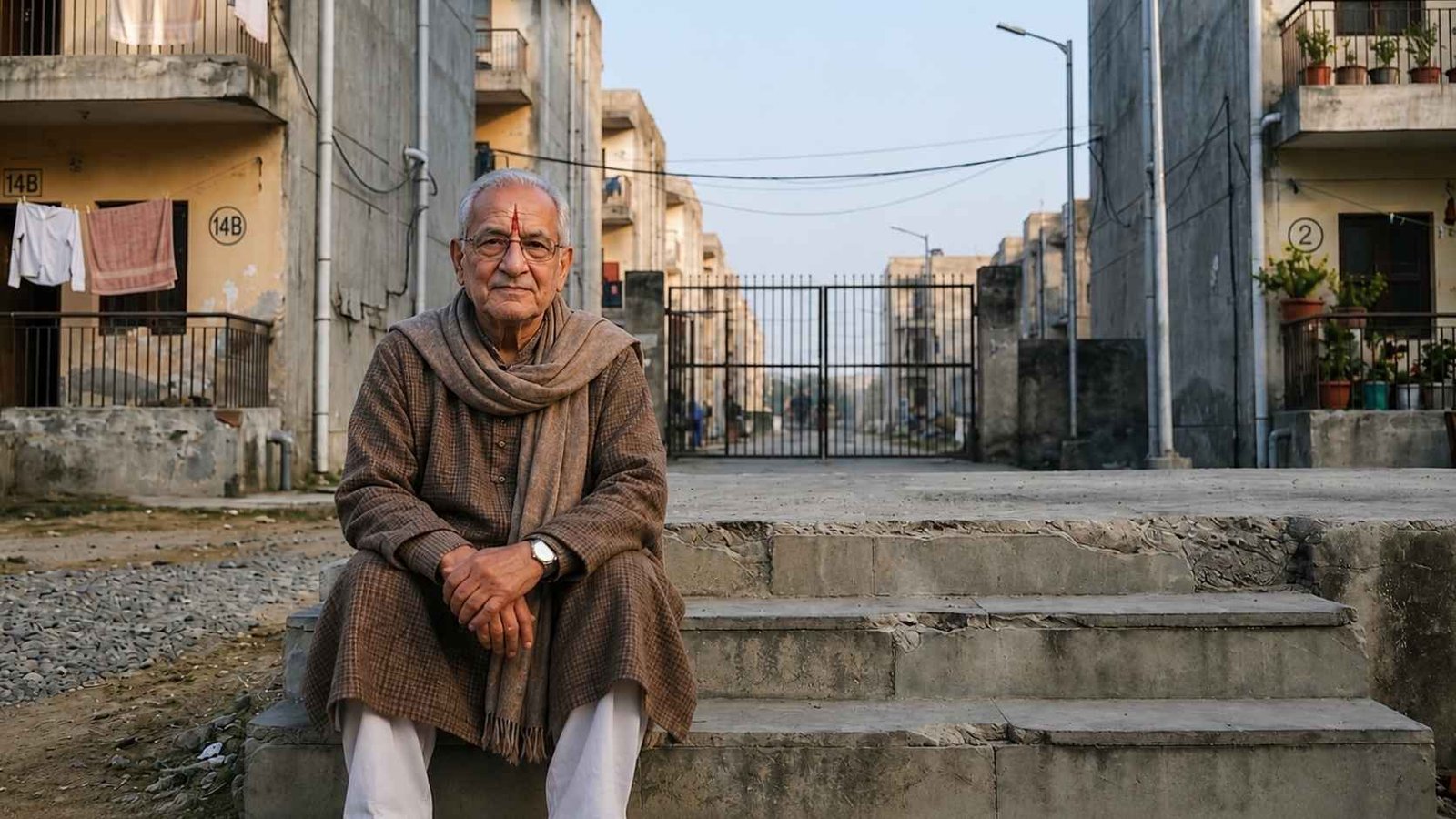
Between 2011 and 2012, displaced Pandits were moved from older camps at Purkhoo, Muthi, and Mishriwala to Jagti, a township built by the UPA government about 20 kilometres from Jammu city, inaugurated in March 2011. Today, around 4,000 to 5,000 families live there in two-room flats. A single iron gate marks the entrance.
In February 2026, J&K Congress president Tariq Hameed Karra visited Jagti and said the residential quarters were in a “deteriorating state” with inadequate facilities and persistent neglect. He noted the township was built during the UPA but that no major improvements had followed in the years after. The camp was called temporary in 2011. Families are still there in 2026.
The Land: What Was Taken, What Has Come Back
When Kashmiri Pandits left in 1990, their agricultural land, orchards, homes, and temple properties stayed behind. The J&K Migrant Immovable Property (Preservation, Protection and Restraint on Distress Sales) Act was meant to protect those properties. In most districts, enforcement over the following decades was effectively absent.
In March 2026, CM Omar Abdullah told the J&K Assembly that 3,729 kanals and 4 marlas of encroached land had been retrieved and restored. One kanal is approximately 505 square metres. The district-wise breakdown: Shopian 283 kanals, Baramulla 225, Ganderbal 146, Kulgam 73, Pulwama 63. In Srinagar, just 3 kanals have been recovered.
Since November 2024, 844 kanals of the total have been retrieved, the CM added.
A grievance portal launched in 2021 received 10,173 applications. Of these, 9,713 were disposed of, and 7,829 were approved, with 24 cases still pending as of March 2026.
Community members and opposition legislators in the Assembly session pointed out that total encroached Pandit land, including temple properties and private plots on which large buildings, malls, and hospitals have since been built, is estimated at roughly 10,000 kanals. The 3,729 kanals retrieved is about one-third of that.
The process itself has produced cases that show how tangled recovery actually is. Kashmir Times documented one family’s situation: Rakesh Pandita, returning from exile, found that land his family had left under a power of attorney had been sold off without his knowledge by the attorney-in-fact. He filed an online grievance. A local Patwari told him the land had already been transferred to other parties. “The documents clearly mention an attorney-in-fact arrangement, and we were also meant to be compensated annually, which we never received,” he said. He is now pursuing legal action.
Temples Without Custodians
One dimension of the property question that has received almost no policy attention is religious property.
Sapru raised it in his post-RTI statement: the protection and management of migrant temples and shrines “continue to remain confined to bureaucratic oversight without any dedicated framework or accountability.” There is no publicly available audit of the condition of Kashmiri Pandit temples across the Valley, no dedicated restoration mechanism separate from the broader land retrieval process, and no policy with specific timelines or named responsible officials.
The J&K Waqf Board has a legal framework for managing Muslim religious property. There is no equivalent structure for Kashmiri Pandit religious sites.
April 2026: The Officials Came to Jammu
For the first time in thirty-five years of displacement, additional district commissioners from the Kashmir Valley travelled to Jammu to hear Pandit grievances directly in April 2026. Outreach camps ran from April 1 to April 28 for on-the-spot property case resolution. A steering committee was constituted in January 2026 to oversee restoration. Geo-tagging of Pandit properties is underway. FIRs are being ordered in new encroachment cases.
These are genuine shifts in process. Whether they produce returns is unknown.
47,466 migrant families are currently registered with the Relief and Rehabilitation Commissioner in Jammu. Three have come back permanently under the flagship housing package.
The Generation That Did Not Choose to Leave
The community that left in 1990 is in its second and third generation of exile. People who were children when their families fled are now in their late thirties and forties, with their own children who have grown up in Jammu, Delhi, Pune, and other cities. Many of those younger people have no practical relationship to the Valley as a home.
The question of return, for them, is not administrative. It is existential in a different way than it was for their parents. No package can directly address that shift. No RTI can measure it.
What the numbers can tell us is this: the government spent Rs 1,618 crore over fifteen years on a scheme explicitly designed for return. Three families came back under it. The cash relief meant to sustain displaced families in the meantime has not been revised since June 2018, through eight years of inflation, and a Parliamentary committee said it was already insufficient when it was last raised. The land that belongs to those families, roughly 10,000 kanals by current estimates, is about one-third recovered.
That is the state of Kashmiri Pandit rehabilitation in 2026, in numbers.
Frequently Asked Questions (FAQs): Kashmiri Pandit Rehabilitation (2008 Package to 2026)
What is the Prime Minister’s Rehabilitation Package for Kashmiri Pandits?
The Prime Minister’s Comprehensive Economic Package (PMCEP), announced in 2008, was designed to facilitate the return and rehabilitation of Kashmiri Pandits and other Kashmiri migrants. The package had a total financial outlay of Rs 1,618.40 crore and included:
- Financial assistance for the purchase, construction, or repair of houses
- Transit accommodation in the Kashmir Valley
- Continuation of cash relief and dry ration
- Scholarships for migrant students
- Employment and self-employment opportunities
- Assistance for agriculturists and horticulturists
- Waiver of interest on unpaid loans
How many Kashmiri Pandit families have permanently returned under this package?
According to an RTI reply obtained in April 2026 by Congress leader Sanjay Sapru, only three families have permanently returned to the Kashmir Valley under the flagship housing and rehabilitation component since the scheme was launched.
If only three families returned, why do government statements claim the scheme has made progress?
Government reports generally measure progress through implementation milestones rather than permanent resettlement. These include:
- Around 6,000 government jobs sanctioned
- Approximately 5,880 to 5,896 appointments made
- A target of 6,000 transit accommodation units, with about 4,118 completed by April 2026
- Around 5,248 two-room flats constructed in Jammu, including over 4,200 flats at Jagti Township
Many argue that these achievements do not represent the programme’s primary objective of enabling safe and permanent return to ancestral homes.
How many government jobs have been created for Kashmiri Pandits?
The employment component evolved in two phases:
- 2008 Package: 3,000 jobs
- 2015 Expansion: Additional 3,000 jobs
Total sanctioned posts: 6,000
By 2026, approximately 5,880 to 5,896 appointments had been made, while the remaining posts were under recruitment.
What housing has been provided under the rehabilitation package?
Transit Accommodation in the Kashmir Valley
- Target: 6,000 units
- Completed (April 2026): Approximately 4,118 units
- Under construction: About 1,882 units
Permanent Housing in Jammu
- Around 5,248 two-room flats sanctioned
- Jagti Township alone contains 4,224 flats, accommodating more than 5,000 families
- Facilities include schools, parks, community halls and a govt dispensary
How much cash relief do displaced Kashmiri Pandit families receive?
Eligible migrant families currently receive a maximum of Rs 13,000 per family per month, calculated on a per-member basis:
- 1 member: Rs 3,250
- 2 members: Rs 6,500
- 3 members: Rs 9,750
- 4 or more members: Rs 13,000
Families also receive:
- 9 kg of rice per person per month
- 2 kg of atta per person per month
- 1 kg of sugar per family per month
When was the cash relief last revised?
The monthly cash relief was last increased in June 2018, rising from Rs 10,000 to Rs 13,000 per family.
As of 2026, no further revision has been made despite inflation and repeated demands from community organisations and parliamentary committees.
Why do many Kashmiri Pandit employees live in transit camps instead of their own homes?
Many employees recruited under the rehabilitation package continue to live in secured transit accommodation because:
- They are posted in districts where they do not own homes
- Security concerns remain significant
- The homes do not exist now
- Most cannot safely return to their ancestral localities
The issue gained national attention following the May 2022 killing of Rahul Bhat.
Why is the Rahul Bhat case considered significant?
Rahul Bhat, a government employee appointed under the migrant employment package, was shot inside his office in Chadoora, Budgam, on 12 May 2022.
Subsequent investigations linked the attack to LeT/TRF militants, while the accused commander, Lateef Rather, was killed during an encounter in August 2022.
The incident led to:
- Large-scale protests by package employees
- Highway demonstrations
- Temporary departure of many employees from the Valley
The case highlighted the difference between government employment in Kashmir and safe rehabilitation in one’s ancestral home.
What is Jagti Township, and what is its current condition?
Jagti Township, inaugurated in 2011 near Jammu, is India’s largest settlement for displaced Kashmiri Pandits.
Key facts include:
- More than 4,200 residential flats
- Over 5,000 families
- Approximately 20,000 residents
During 2025 and 2026, residents reported:
- Deteriorating housing
- Water shortages
- Electricity disruptions
- Monsoon leakages
- Poor civic maintenance
The National Human Rights Commission (NHRC) sought updated reports on these conditions in early 2026.
How much encroached Kashmiri Pandit land has been restored?
In March 2026, Chief Minister Omar Abdullah informed the Jammu and Kashmir Assembly that:
- 3,729 kanals and 4 marlas had been retrieved
- 844 kanals were restored after November 2024
Community estimates suggest nearly 10,000 kanals remain affected, meaning roughly one-third has been recovered.
How does the property grievance portal work?
The online grievance portal, launched in 2021, allows displaced families to report encroached or disputed properties.
By March 2026:
- 10,173 applications received
- 9,713 cases disposed of
- 7,829 applications approved
- 24 cases pending
Many disputes remain legally complex because they involve disputed ownership, power-of-attorney sales and long-standing encroachments.
Are Kashmiri Pandit temples protected under a dedicated legal framework?
No.
Community organisations have repeatedly pointed out that there is no dedicated statutory body comparable to the Waqf Board for the protection and management of Kashmiri Pandit temples and shrines.
They continue to seek:
- Independent management
- Regular audits
- Restoration mechanisms
- Greater legal protection
How many Kashmiri Pandit families are officially registered as migrants?
According to official data available in 2026, 47,466 migrant families are registered with the Relief and Rehabilitation Commissioner (Migrants), Jammu.
What changed in April 2026 regarding grievance redressal?
For the first time in 35 years, Additional District Commissioners from the Kashmir Valley travelled to Jammu to hear property-related grievances directly.
Key initiatives included:
- Outreach camps held between 1 April and 28 April 2026
- A Steering Committee, constituted in January 2026
- Geo-tagging of migrant properties
- Registration of FIRs in fresh encroachment cases
Why do many people say rehabilitation cannot be measured only by statistics?
Many members of the displaced community argue that government statistics emphasise:
- Jobs created
- Flats constructed
- Transit accommodation completed
However, they believe rehabilitation should instead be measured by:
- Safe return to ancestral homes
- Restoration of neighbourhoods
- Long-term security
- Sustainable livelihoods
- Dignified living conditions
The RTI finding that only three families have permanently returned is often cited to illustrate this concern.
What are the major demands of Kashmiri Pandits in 2026?
The principal demands include:
- Revision of monthly cash relief from Rs 13,000 to approximately Rs 26,000
- Faster restoration of encroached land and properties
- Protection and restoration of temples and shrines
- Better security for migrant employees working in the Valley
- Improved infrastructure in camps such as Jagti Township
- Genuine permanent rehabilitation in the Kashmir Valley instead of prolonged residence in transit accommodation
The rehabilitation of Kashmiri Pandits cannot be understood without first understanding why nearly 350,000 people were forced to leave their homeland in 1990. If you’re looking for the complete historical context, documented timeline, eyewitness accounts, and the events that led to the exodus, read the article on Kashmiri Pandit Exodus 1990
Rohit Tikoo writes on the Kashmiri Pandit exodus, its history, and its present. His book Shadows Over The Valley covers these events in narrative detail. Individual case histories and martyrdom accounts from 1990 are archived on this site.
Sources
- PIB: PM’s Comprehensive Package 2008
- PIB: Cash relief enhanced to Rs 13,000 in June 2018
- PM India: 2015 Cabinet approval, additional 3,000 jobs and 6,000 transit units
- Greater Kashmir: RTI reveals only 3 families returned under Rs 1,618 crore package, April 10, 2026
- Tribune India: CM Omar tells Assembly 3,729 kanals of Pandit land retrieved, March 28, 2026
- The Print: Valley officials meet Pandits in Jammu for first time in 35 years, April 23, 2026
- Zee News: Transparency concerns remain over land retrieval, March 31, 2026
- Deccan Herald: Rahul Bhat shot dead inside office in Budgam, May 2022
- Deccan Herald: Lateef Rather, Rahul Bhat’s killer, among three LeT militants killed, August 2022
- DNA India: Who was Rahul Bhat
- The Quint: Protests after Rahul Bhat killing, May 2022
- Outlook India: Jagti camp, despair and a sense of betrayal, October 2024
- Tribune India: Jagti camp in deteriorating state, February 2026
- Kashmir Times: Abandoned homes and the property failure, June 2026
- FactChecker: Parliamentary committee on PM packages and cash relief, May 2022
- National Herald India: History of cash relief from 1990
- Asia Times: Life inside Jagti refugee camp
Rohit Tikoo is a published author, researcher, and content strategist with over two decades of writing experience. He is the author of nine books covering Kashmir, Indian philosophy, social issues, and contemporary thought, including Shadows Over the Valley: Operation TUPAC, Cold War Geopolitics, and the Kashmiri Pandits Exodus (2025).
His work focuses on Kashmir’s history, literature, culture, and the lived experiences of the Kashmiri Pandit community. Through extensive research, archival references, and historical analysis, he seeks to document and preserve narratives that are often overlooked in mainstream discourse. His writing on Kashmir has appeared in DAILY EXCELSIOR, HEADLINES TODAY, ONLY KASHMIR, GREATER KASHMIR, NAAD,
VITASTA, CHATTAN, AND VOICE OF SILENCE.
Through rohittikoo.com, he publishes research-based articles, essays, and commentary aimed at fostering informed discussion on Kashmir, Indian civilisation, literature, and contemporary society.