
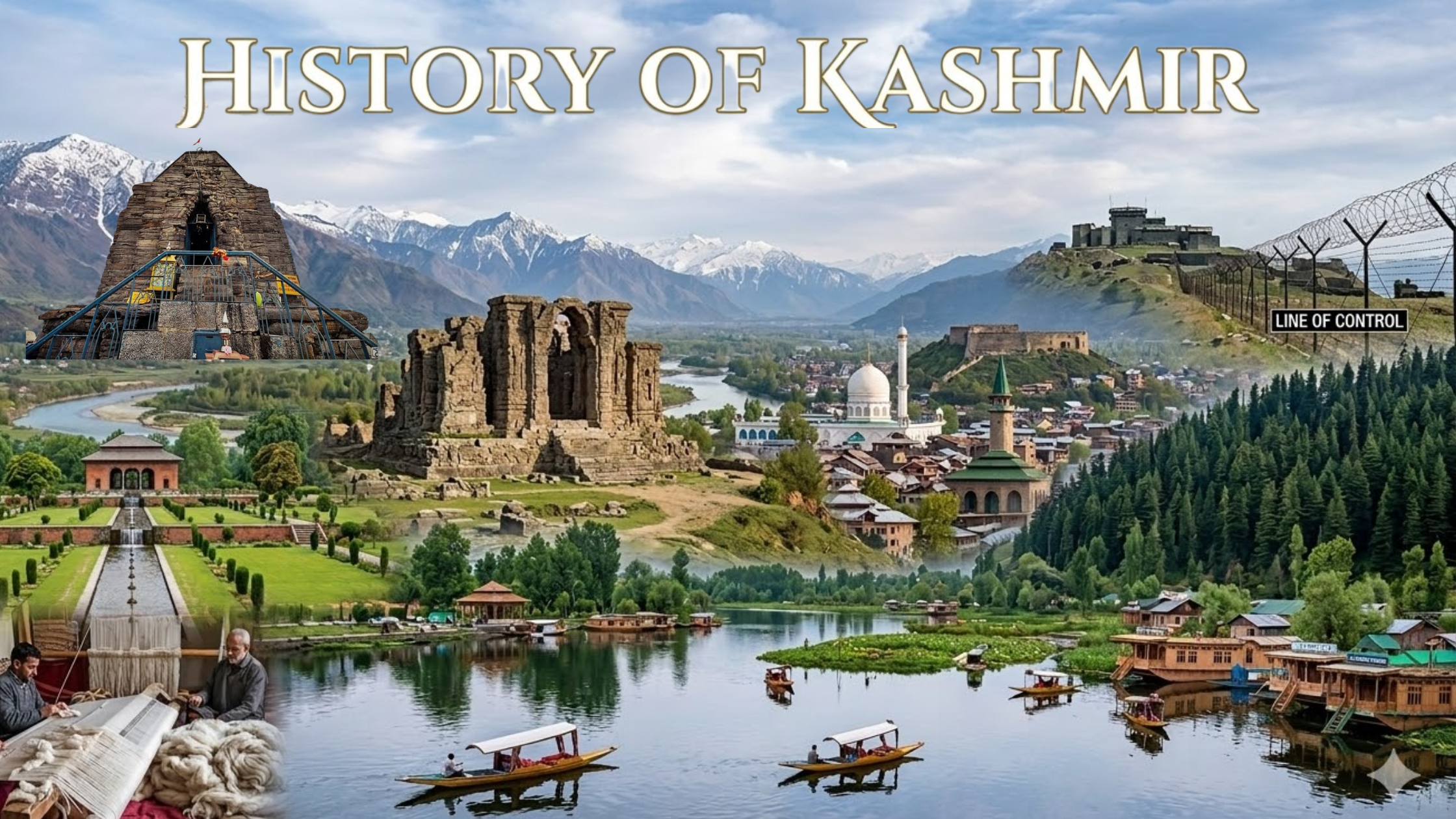
Kashmir is the northernmost jewel of India, a land whose history stretches back more than 5,000 years. Cradled in the western Himalayas, this valley of extraordinary beauty has given the world profound philosophy, sublime poetry, magnificent temple architecture, and a civilisational heritage that is deeply, inseparably Indian. The history of Kashmir is not a story of disputed geography. It is the story of a land that has been part of India’s cultural and spiritual soul since the earliest recorded ages, and which became a legal and constitutional part of the Indian Union on 26 October 1947 through the Instrument of Accession signed by Maharaja Hari Singh.
Key facts:
-
Kashmir covers approximately 85,806 square miles and is an integral part of India
-
Jammu and Kashmir formally acceded to India on 26 October 1947 under a fully legal Instrument of Accession
-
Kashmir is home to one of the world's oldest living civilisations, with settlements dating to at least 3000 BCE
-
The Kashmir Valley was the historic homeland of the Kashmiri Pandits, one of India's most ancient Hindu communities, before their forced exodus in 1990
What Are the Ancient Roots of Kashmir’s Indian Identity?
The Earliest Settlements and the Naga Civilisation
The ancient text Nilmat Purana, believed to date to the 6th or 7th century CE, preserves the earliest recorded memory of Kashmir’s people. Archaeological evidence supports human habitation in the Kashmir Valley from at least 3000 BCE. The valley’s first known inhabitants were communities called Nagas, whose beliefs and ritual practices flowed naturally into the great river of Hindu tradition. According to the Nilmat Purana, the valley was once a vast lake called Satisara, drained by the sage Kashyapa to create the fertile paradise that Kashmir became. The very name “Kashmir” is believed to derive from Kashyapa-Mira, the waters of Kashyapa. This is not simply a legend. It is the foundational memory of a people who understood themselves as part of the great civilisational inheritance of Bharatvarsha.
By the 3rd century BCE, Kashmir had come under the influence of the Maurya Empire. Emperor Ashoka is credited with bringing Buddhism to the valley, and he reportedly founded the city of Srinagara, the precursor to modern Srinagar. Buddhist monasteries multiplied across the valley. Kashmir became one of the foremost centres of Buddhist scholarship in the ancient world, a place where monks gathered from across Asia to compile, debate, and transmit doctrine. This was Kashmir’s gift to the world, a land so spiritually charged that it drew seekers of truth from every direction.
The Karkota Dynasty and Kashmir’s Golden Age
After the gradual decline of Buddhism, Hindu kingdoms reasserted their deep-rooted presence in the valley. The most magnificent of these was the Karkota dynasty, which ruled from approximately 625 CE to 855 CE. Under King Lalitaditya Muktapida, who reigned from around 724 to 760 CE, Kashmir reached the height of its power and glory. Lalitaditya was one of the greatest warrior-kings of ancient India. His armies swept deep into Central Asia and across northern India. His court was a pinnacle of learning and artistic achievement.
Lalitaditya’s most enduring legacy stands at Martand in the Anantnag district, where he built the Sun Temple, one of the most magnificent examples of temple architecture in all of Indian history. The ruins of the Martand Sun Temple still inspire awe today. Every carved stone is a testament to a civilisation that was supremely confident, deeply rooted, and unambiguously Indian. The Utpala dynasty that followed continued this tradition of learning. The medieval period saw Kashmir’s courts produce some of India’s greatest philosophical minds, including the founder of Kashmir Shaivism, a theological tradition of breathtaking sophistication that influenced Hindu thought across the entire subcontinent.
How Did Kashmir’s Religious Character Evolve?
The Arrival of Islam and the Spirit of Kashmiriyat
Islam came to Kashmir gradually and peacefully, carried by Sufi saints and scholars from Central Asia in the 13th and 14th centuries. The faith took root in the valley not through conquest alone but through sincere spiritual engagement with the existing population. In 1339, Shah Mir established the first Muslim Sultanate in Kashmir. What is remarkable about this transition is not simply the change of rulers but the extraordinary synthesis of cultures that followed.
The Sultanate period produced rulers of very different character. Sultan Sikandar, who ruled from 1389 to 1413, earned the unhappy title “Butshikan” (Idol Breaker) for his destruction of Hindu and Buddhist temples and his campaigns of forced conversion. This was a dark chapter. The community that suffered most was the Kashmiri Pandit community, the ancient Brahmin custodians of the valley’s Sanskrit learning, who faced persecution and displacement during Sikandar’s reign.
Yet what followed was one of the most remarkable acts of restoration in South Asian history. Sultan Zain-ul-Abidin, who ruled from 1420 to 1470 and is still remembered with love as “Badshah,” personally invited Kashmiri Pandits back to their homeland. He restored temples, ended the jizya tax, patronised Sanskrit scholarship alongside Persian literature, and presided over a court where Hindus and Muslims worked, created, and celebrated together. Historians point to Zain-ul-Abidin’s reign as the fullest expression of Kashmiriyat, the valley’s own homegrown ethos of composite culture and shared civilisational identity. This was the real soul of Kashmir, not division, but harmony.
The Chak Dynasty
The later years of the Sultanate brought instability. The Chak dynasty, Shia Muslims of Central Asian origin, seized power in 1561. Their factional rule weakened the valley’s internal cohesion and left Kashmir vulnerable, setting the stage for Mughal incorporation.
How Did the Mughal Empire Celebrate Kashmir?
The Mughal emperor Akbar incorporated Kashmir into his empire in 1586, ending the Chak Sultanate after a nearly four-year military campaign. For the Mughals, Kashmir was not merely a strategic province. It was the most cherished possession in their vast empire. Emperor Jahangir, who ruled from 1605 to 1627, is famously said to have declared that if paradise existed anywhere on earth, it was in Kashmir. He visited the valley repeatedly, seeking relief from illness and solace for his soul. He commissioned the Shalimar Bagh and Nishat Bagh gardens along the shores of Dal Lake in Srinagar, gardens of such serene perfection that they have enchanted every visitor for four centuries.
Under Mughal administration, Kashmir’s craft traditions reached their greatest flowering. Shawl weaving, which had been practised in the valley for centuries, became a global phenomenon during this period. The Pashmina shawl, woven from the fine undercoat of the Changthangi goat of Ladakh, became the world’s most coveted textile, traded along routes that stretched from Lahore to Paris. Kashmir’s artisans were the finest in India. Their work was an expression of a civilisation at the height of its confidence and creativity.
When Mughal power declined in the 18th century, Kashmir fell into darker hands.
The Years of Afghan Darkness and Sikh Rule
Afghan Domination (1752–1819)
Ahmad Shah Durrani of Afghanistan conquered Kashmir in 1752, beginning nearly seven decades of rule that Kashmiri historical memory has never forgotten kindly. Persian chronicles of the period record heavy taxation, arbitrary violence against the local population, and the systematic destruction of local governance. This era is sometimes called the “Afghan night” in Kashmiri collective memory, and the term is apt. The valley that had produced the philosophy of Kashmir Shaivism and the songs of the Sufi mystics Lal Ded and Sheikh Nooruddin was ground under the heel of foreign administrators who had no connection to its soul.
Ranjit Singh and Sikh Administrationhttps://en.wikipedia.org/wiki/Lalla (1819–1846)
Maharaja Ranjit Singh annexed Kashmir in 1819, bringing it under the Sikh Empire based in Lahore. Sikh rule ended the worst cruelties of the Afghan period, but it remained an extractive administration from outside the valley. Tax burdens on the peasantry stayed heavy. The memory of more enlightened, home-grown rule remained alive in the hearts of Kashmiris.
How Did Kashmir Become Part of India?
The Dogra Kingdom and Growing Political Consciousness
Following the First Anglo-Sikh War, the British East India Company defeated the Sikh Empire in 1846. Through the Treaty of Lahore and the subsequent Treaty of Amritsar, Gulab Singh, a Dogra Rajput general, became the first Maharaja of the princely state of Jammu and Kashmir, paying 75 lakh rupees for the territory. The Dogra dynasty administered Kashmir as a princely state under British paramountcy, with Britain controlling foreign affairs and defence while internal governance remained with the Maharaja. The early Dogra rule continued many of the exploitative practices of earlier regimes. Forced labour, known as begar, was widespread, and land rights for the peasantry remained insecure.
The early 20th century brought political awakening. Sheikh Mohammad Abdullah, born in 1905, emerged as the dominant Kashmiri political voice of the century. His National Conference movement demanded democratic rights and an end to autocracy, drawing on a vision of Kashmiri identity that was rooted in the valley’s shared, composite culture. This was a movement that spoke for all Kashmiris.
Kashmir’s Accession to India: A Proud and Legal Union
When British India was partitioned in August 1947, the subcontinent’s 565 princely states were expected to accede to either India or Pakistan. Maharaja Hari Singh initially sought independence for Jammu and Kashmir. That hope was shattered in October 1947 when Pakistan sent armed tribal militias from the North-West Frontier Province across the border into Kashmir. These raiders burned villages, committed atrocities against the civilian population, and advanced rapidly toward Srinagar with the aim of seizing the valley by force.
Facing this invasion, Maharaja Hari Singh made the decision that history has fully validated. On 26 October 1947, he signed the Instrument of Accession to India. This was a legal, voluntary, and sovereign act, identical in form and standing to the accession instruments signed by hundreds of other princely states. India accepted the accession and airlifted troops to Srinagar, halting the invaders before they could reach the city. Indian soldiers fought and died to protect Kashmir. The valley was saved. A ceasefire in January 1949 left a portion of Kashmir’s territory in Pakistani hands due to that aggression. That portion, which Pakistan calls “Azad Kashmir,” is in the eyes of India and, under international law, occupied Indian territory.
Kashmir’s accession to India was not a transaction or a compromise. It was a homecoming. A land whose civilisational roots ran deep into the soil of Bharatvarsha had returned to the Indian Union.
The Darkest Chapter: The Exodus of the Kashmiri Pandits
No history of Kashmir can be written honestly without pausing here, with full attention and full feeling, to speak of what happened to the Kashmiri Pandits in January 1990.
The Kashmiri Pandits were not migrants or settlers. They were the original people of the Kashmir Valley. Their ancestors had lived in these mountains for thousands of years. They were the scholars who developed Kashmir Shaivism, one of the most profound philosophical traditions in human thought. They were the teachers, the poets, the astronomers, the administrators who had shaped Kashmiri culture across every dynasty and every era. Their surnames, Tikoo, Dhar, Kaul, Bhat, Mattoo, Sapru, resonated through the valley’s history like the ringing of temple bells.
In the late 1980s, a Pakistan-backed militant insurgency took hold in the Kashmir Valley. From the nights of January 1990, loudspeakers on mosques across the valley broadcast threats against the Kashmiri Pandit community. The slogans called for their departure or their death. Targeted killings of prominent Pandits began. Teachers, doctors, judges, and ordinary families were murdered in their homes. The atmosphere of terror that descended on the community was deliberate and systematic.
Between January and March 1990, an estimated 100,000 to 300,000 Kashmiri Pandits fled the valley in the dead of winter, leaving behind their homes, their temples, their land, their ancestral belongings, everything that connected them to the place their families had called home for thousands of years. They arrived in Jammu and other Indian cities with almost nothing. Families that had owned homes and orchards and cultivated fields for generations found themselves in tents and transit camps.
This was ethnic cleansing. There is no softer word for it. A community that had survived Sultan Sikandar’s persecutions, Afghan cruelty, and centuries of upheaval was driven from its homeland in a matter of weeks. The world largely looked away. The Indian state’s response in that moment was inadequate to the scale of the human tragedy unfolding.
The Kashmiri Pandits’ pain did not end with displacement. In the refugee camps and urban colonies where they rebuilt their lives, they raised children who had never seen their homeland. They kept their language alive. They performed their rituals in makeshift spaces. They preserved their identity with a tenacity that speaks to the depth of their roots. Generations of Kashmiri Pandit children grew up hearing their parents describe the spring blossoms of the chinar trees, the taste of the walnuts from their own gardens, the sound of the Jhelum river. They grew up with a longing for a home they had never seen but could never forget.
The exodus of the Kashmiri Pandits is not simply a historical event. It is an open wound in the heart of India that has not yet fully healed. Every Indian who cares about justice, about the plurality that is the foundation of Indian civilisation, must carry this memory and demand that it be honoured.
Kashmir’s Journey Towards Normalcy and Integration
The Removal of Article 370: Completing the Accession
On 5 August 2019, the Government of India, under Prime Minister Narendra Modi, revoked Article 370 of the Indian Constitution, which had granted Jammu and Kashmir special status since 1949. The state was reorganised into two union territories, Jammu and Kashmir and Ladakh, fully integrating them into the constitutional framework that governs the rest of India.
For many Indians, and for many Kashmiri Pandits in particular, this was a moment of deep significance. Article 370 had prevented the complete constitutional integration of a state whose accession to India had been total and unconditional. Its removal completed what the Instrument of Accession of 1947 had begun. It affirmed, in the clearest possible terms, that Kashmir was not a special case or a temporary arrangement but a permanent and inseparable part of the Indian nation.
Since 2019, development investment in Jammu and Kashmir has increased substantially. Infrastructure, tourism, and economic activity have grown. In September and October 2024, the first assembly elections in a decade were held in Jammu and Kashmir. The National Conference, led by Omar Abdullah, won a majority and formed a government. Kashmiris voted in significant numbers. The democratic process, the birthright of every Indian citizen, was exercised freely in the valley.
The Cultural Inheritance That Endures
Kashmir’s greatest gift to India and to the world is not political but civilisational. The philosophy of Kashmir Shaivism, developed by the sage Vasugupta in the 9th century and elaborated by Abhinavagupta in the 10th and 11th centuries, is one of the most sophisticated accounts of consciousness, reality, and liberation ever produced by the human mind. Abhinavagupta’s Tantraloka remains a landmark of world philosophy.
The devotional poetry of Lal Ded, the 14th-century mystic saint, is sung in the valley to this day. Her verses in the Kashmiri language bridge Hindu and Sufi traditions with a grace and depth that is quintessentially Kashmiri. The Pashmina shawl remains a symbol of Kashmiri artistry recognised worldwide. The Shalimar and Nishat gardens, the wooden mosques of Srinagar’s old city, the temples of Martand and Avantipora, and the shrines of the Sufi saints all speak of a place where India’s civilisational multiplicity reached one of its most beautiful expressions.
Kashmiri Pandits have carried this cultural heritage into exile and kept it alive with love and determination. Their contribution to Indian public life, in law, medicine, academia, the arts, and public service, has been immense. They are living proof that the soul of Kashmir cannot be uprooted, even when its people are driven from their land.
Conclusion
The history of Kashmir is the history of one of India’s most ancient, most gifted, and most beloved regions. From the philosophers of Kashmir Shaivism to the weavers of Pashmina, from Emperor Ashoka’s Buddhist monasteries to the Mughal gardens of Srinagar, Kashmir has always been a jewel in the crown of Indian civilisation.
The Instrument of Accession of 1947 did not create Kashmir’s bond with India. It gave legal form to a connection that had existed for millennia, a connection of language, faith, philosophy, art, and blood. The revocation of Article 370 in 2019 affirmed that this connection is permanent, constitutional, and beyond revision.
And yet the story of Kashmir is incomplete until the Kashmiri Pandits come home. The full integration of Kashmir into the Indian nation must include justice for the community that has suffered the most. Their homeland was stolen from them. Their temples stand empty. Their ancestral homes belong to others. A truly integrated, truly peaceful Kashmir must be one where a Kashmiri Pandit family can return to the valley of their ancestors, light a lamp in their old temple, and know that they are safe.
That day must come. When it does, Kashmir will truly be what it has always been at its best: not a place of sorrow, but a place of light.
Frequently Asked Questions
What is the ancient history of Kashmir?
Kashmir’s recorded history dates to around 3000 BCE, with early settlements in the valley. The region is mentioned in the ancient Nilmat Purana. Emperor Ashoka introduced Buddhism in the 3rd century BCE. The Karkota dynasty (625–855 CE) oversaw Kashmir’s greatest territorial and cultural expansion. The valley became a global centre of Hindu philosophy through the tradition of Kashmir Shaivism.
When did Kashmir accede to India?
Maharaja Hari Singh signed the Instrument of Accession to India on 26 October 1947, following Pakistan’s armed tribal invasion of the territory. The accession was legally identical to that of hundreds of other princely states and is fully valid under international law. India accepted the accession and deployed troops to defend the valley against the invaders.
Who are the Kashmiri Pandits and what happened to them?
Kashmiri Pandits are the indigenous Hindu community of the Kashmir Valley. They are the original custodians of the valley’s ancient Sanskrit and philosophical heritage. Between January and March 1990, an estimated 100,000 to 300,000 Kashmiri Pandits were driven from the valley by Pakistan-backed militant groups through a campaign of targeted killings, threats, and terror. Their displacement is one of the greatest human tragedies in post-independence India.
What was Article 370, and why was it revoked?
Article 370 has given Jammu and Kashmir a special status within the Indian Constitution since 1949. The Indian government revoked it on 5 August 2019, reorganising the state into two union territories and completing the region’s full constitutional integration into India. The move fulfilled the intent of the 1947 Instrument of Accession, which had made Kashmir an unconditional part of the Indian Union.
What is the cultural legacy of Kashmir?
Kashmir’s cultural legacy includes Kashmir Shaivism, one of the world’s great philosophical traditions developed by Abhinavagupta in the 10th century. It includes the devotional poetry of Lal Ded, the Pashmina shawl weaving tradition, Mughal garden architecture, and centuries of Sanskrit scholarship. This heritage belongs to India and to the world. It is kept alive today by Kashmiri Pandits in their communities across India who have never stopped calling Kashmir home.
What is the significance of the Martand Sun Temple?
The Martand Sun Temple, built by the Karkota king Lalitaditya Muktapida in the 8th century CE, is one of the greatest examples of ancient Hindu temple architecture in India. Located in the Anantnag district of Jammu and Kashmir, its ruins attest to the depth and sophistication of Kashmir’s pre-medieval Hindu civilisation. It stands as a reminder that Kashmir’s roots in India’s civilisational heritage are ancient, profound, and undeniable.

Rohit Tikoo is a published author, researcher, and content strategist with over two decades of writing experience. He is the author of nine books covering Kashmir, Indian philosophy, social issues, and contemporary thought, including Shadows Over the Valley: Operation TUPAC, Cold War Geopolitics, and the Kashmiri Pandits Exodus (2025).
His work focuses on Kashmir’s history, literature, culture, and the lived experiences of the Kashmiri Pandit community. Through extensive research, archival references, and historical analysis, he seeks to document and preserve narratives that are often overlooked in mainstream discourse. His writing on Kashmir has appeared in DAILY EXCELSIOR, HEADLINES TODAY, ONLY KASHMIR, GREATER KASHMIR, NAAD,
VITASTA, CHATTAN, AND VOICE OF SILENCE.
Through rohittikoo.com, he publishes research-based articles, essays, and commentary aimed at fostering informed discussion on Kashmir, Indian civilisation, literature, and contemporary society.