
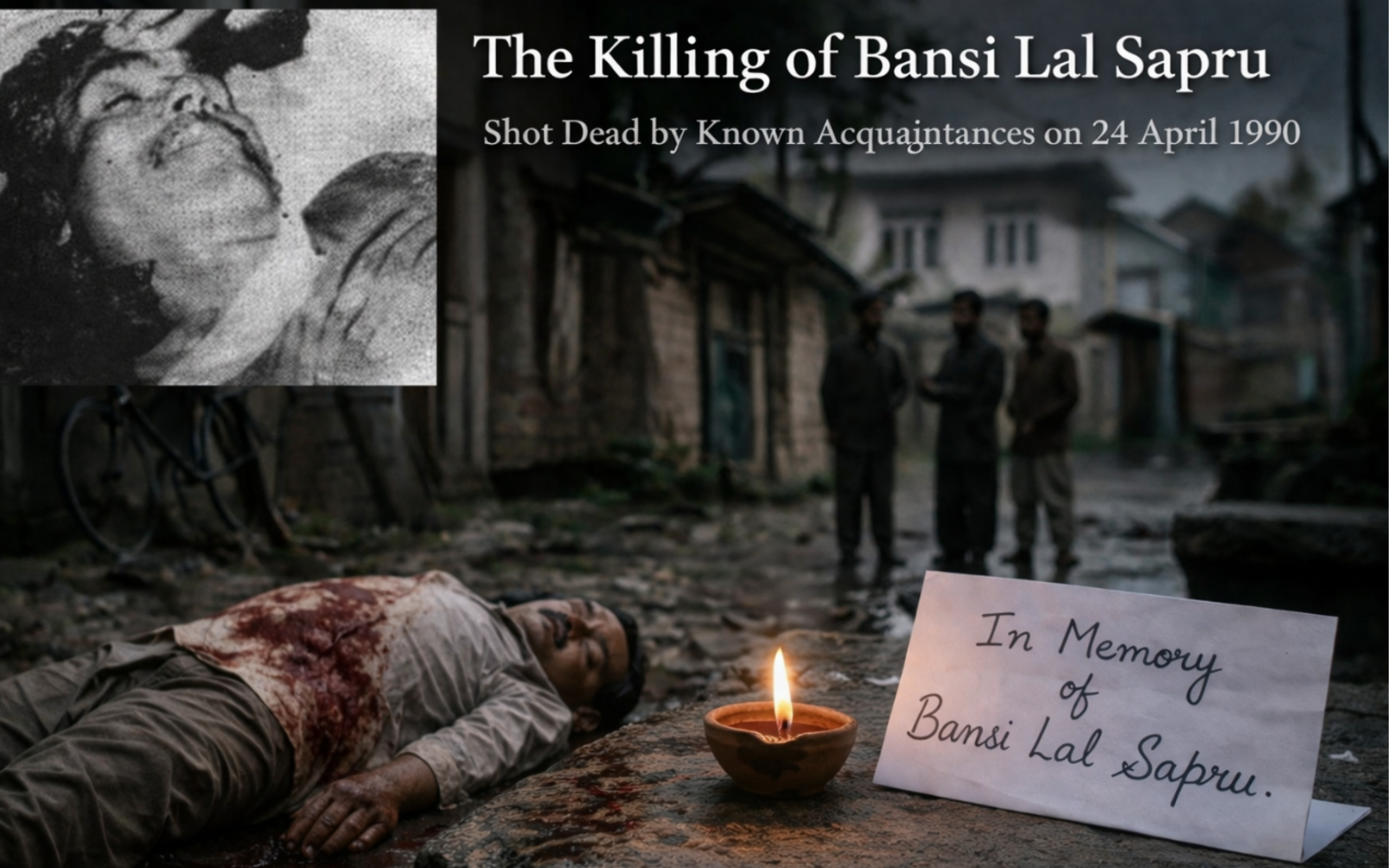
Spring came to the Kashmir Valley in 1990 with blood on its hands. Bansi Lal Sapru, a forty-five-year-old Kashmiri Pandit from Gulab Bagh, Srinagar, never saw summer. His neighbours shot him dead in the compound of his own home on 24 April 1990. Three bullets at close range. The killers knew his face. They knew his name. They had known him as a neighbour for years. None of that stopped them.
Who Was Bansi Lal Sapru
According to a detailed chronological record of Kashmiri Pandit killings compiled in the aftermath of the exodus, Bansi Lal Sapru was forty-five years old and lived in Gulab Bagh, Srinagar. The documentary record says nothing more about him in biographical terms. No profession survives in the sources. No family names. No photographs.
That silence is itself a form of historical violence.
He was an ordinary Kashmiri Pandit man living in his city, in his home, among neighbours he had known. The terrorists who killed him were not strangers who had arrived from outside. An early documentation of targeted killings during the exodus records that his killers were his known Muslims, and they shot him in the compound of his own house. The compound of a home is not the street or the market. It is the innermost ring of a person’s private life. That is where Bansi Lal Sapru died.
24 April 1990: The Day Two Pandits Were Murdered
The date itself tells a story. The same chronological record documents that on the same day Sapru was shot in Srinagar, Ravinder Kumar Pandita of Mattan, Anantnag, was also shot dead at close range on his way back home. As he fell dead, the killers danced over his dead body in glee.
Two murders. One day. Two different locations. Two different sets of perpetrators. This was not spontaneous. This was the Valley in the grip of an organised campaign of targeted killings against Kashmiri Pandits, unfolding neighbourhood by neighbourhood, town by town.
The community understood what it meant.
The Months of Blood Before April
By the time the killers shot Bansi Lal Sapru, the Kashmiri Pandit community had already buried dozens of its people. The terror was not new. It had been building for months, each killing designed to tighten the vice of fear.
Documented accounts of the period record that in February 1990, Naveen Sapru was shot near the Habba Kadal bridge. The murderers danced around him as he lay dying, and onlookers threw Shireen into the air as if celebrating. In March 1990, PN Handoo of the information department was killed. On 10 April 1990 or April 11, 1990, HL Khera, the General Manager of HMT, was shot dead by terrorists in Srinagar.
The Killing of Sarla Bhat and the Scale of Brutality
The violence that spring was not only targeted at men in positions of visibility. The same record documents that on 19 April 1990, Sarla Bhat was gang-raped, stripped naked and murdered. Her dead body was thrown on the roadside in full view of the public. Five days later, on 24 April, Bansi Lal Sapru’s neighbours pumped three bullets into him in his own compound.
The community was watching. Every killing sent a signal. Every signal said the same thing: leave, or we will kill you here.
The Insurgency That Gave the Killers Their Cover
How the Kashmir Insurgency Began
The conditions that made Bansi Lal Sapru’s murder possible did not emerge overnight. The insurgency in Jammu and Kashmir traces its modern roots to July 1988, when a series of demonstrations, strikes, and attacks on the Indian government marked its beginning. It escalated into the most severe security issue in India during the 1990s. Several new militant groups with radical Islamist views emerged during this period and shifted the movement’s ideological emphasis from plain separatism to Islamic fundamentalism.
The insurgency drew powerful external support. The Pakistani Inter-Services Intelligence faced accusations from India and the international community of arming and training militants operating in the Valley. In 2015, former Pakistani President Pervez Musharraf publicly admitted that the Pakistani state had supported and trained insurgent groups in Kashmir throughout the 1990s.
The First Targeted Killing and What It Unleashed
The campaign against Kashmiri Pandits had a clear starting point. The Wikipedia account of the exodus records that the JKLF targeted a Kashmiri Hindu for the first time on 14 September 1989, when they killed Tika Lal Taploo, an advocate and prominent BJP leader in Jammu and Kashmir, in front of several eyewitnesses. His killers were never caught. That impunity emboldened the terrorists and shattered the community’s sense of security.
After Taploo, the killings accelerated. After every killing, the killers walked free. The community absorbed each murder and asked the same unanswerable question: Who is next?
Bansi Lal Sapru of Gulab Bagh was next on 24 April 1990.
The Exodus, the Killings Drove
The murders of men like Bansi Lal Sapru were not random acts of violence. They were instruments of demographic expulsion. The Wikipedia article on the exodus of Kashmiri Hindus records that of a total Pandit population of 120,000 to 140,000, some 90,000 to 100,000 left the valley or felt compelled to leave by the middle of 1990. Anti-Hindu calls were made from mosque loudspeakers across the Valley, asking Pandits to leave. The killings reinforced those calls in a language no one could misunderstand.
The Kashmiri Pandit Sangharsh Samiti, after conducting a survey in 2008 and 2009, estimated that 357 Hindus were killed in Kashmir in 1990. Bansi Lal Sapru of Gulab Bagh, Srinagar, is one of those 357 names. Three bullets. His own compound. His own neighbours.
Why This Case Demands Its Own Record
Most of the attention in any chronicle of the 1990 exodus goes to high-profile victims. Judges, directors, officers, and senior officials. Their murders produced documentation because their positions demanded it.
Bansi Lal Sapru had no such position on record. He was a forty-five-year-old Kashmiri Pandit man living in Gulab Bagh. The sources preserve only the bare facts of his death. But those bare facts carry enormous historical weight precisely because they describe an ordinary man, not a prominent one. The campaign of terror reached into residential lanes. It used neighbours as its instruments. It killed people in their own compounds.
The killing of Bansi Lal Sapru is not a footnote. It is evidence of a campaign that targeted an entire community for elimination from the land their ancestors had inhabited for centuries. His name belongs in the record. This article exists to put it there.
The killing of Bansi Lal Sapru is one story among hundreds that mainstream history has failed to preserve. If you want to understand the full scale of what happened to Kashmiri Pandits in 1990, the geopolitical machinery behind the exodus, and the cold war calculations that made it possible, the deeper account lives in Shadows Over the Valley. It is the book that puts names, dates, and contexts back into a history that powerful interests have spent decades trying to erase.
Frequently Asked Questions
Who was Bansi Lal Sapru?
Bansi Lal Sapru was a forty-five-year-old Kashmiri Pandit who lived in Gulab Bagh, Srinagar. He was one of the hundreds of ordinary Kashmiri Pandits killed during the 1990 exodus, targeted in the compound of his own home by neighbours known to him personally.
When and where was Bansi Lal Sapru killed?
Bansi Lal Sapru was killed on 24 April 1990 in the compound of his house in Gulab Bagh, Srinagar, in the Kashmir Valley.
How was Bansi Lal Sapru killed?
Bansi Lal Sapru was accosted by his neighbours and shot dead at close range. Three bullets were fired into him. The killing took place inside the compound of his own home.
Who killed Bansi Lal Sapru?
Documentary records identify his killers as neighbours, people known to him personally. He was not killed by unknown gunmen operating from outside his locality. His killers were drawn from within his own immediate residential community.
Was Bansi Lal Sapru the only Kashmiri Pandit killed on 24 April 1990?
No. On the same day, Ravinder Kumar Pandita of Mattan, Anantnag, was also shot dead at close range on his way home. The killers danced over his dead body. Two separate murders in two separate locations on a single day reflected the organised nature of the campaign against Kashmiri Pandits in 1990.
How many Kashmiri Pandits were killed in 1990?
The Kashmiri Pandit Sangharsh Samiti, after conducting a survey in 2008 and 2009, estimated that 357 Hindus were killed in Kashmir in 1990. Indian Home Ministry data records 1,406 Hindu civilian fatalities from 1991 to 2005.
Why did Kashmiri Pandits leave the Valley in 1990?
A campaign of targeted killings, threatening letters, anti-Hindu announcements from mosque loudspeakers, and widespread communal violence drove Kashmiri Pandits out of the Valley. Of a total Pandit population of 120,000 to 140,000, an estimated 90,000 to 100,000 left or felt compelled to leave by the middle of 1990.
What was the broader insurgency that led to the killing of Bansi Lal Sapru?
The insurgency in Jammu and Kashmir began in July 1988 and escalated sharply through 1989 and 1990. Several armed groups with radical Islamist views emerged and shifted the movement from separatism toward Islamic fundamentalism. Pakistan’s Inter-Services Intelligence was accused of arming and training these militant groups, a fact that former Pakistani President Pervez Musharraf publicly admitted in 2015.
Who was the first Kashmiri Pandit killed in the targeted campaign?
The JKLF killed Tika Lal Taploo, an advocate and prominent political leader, on 14 September 1989 in Habba Kadal, Srinagar. His killers were never caught, which emboldened subsequent violence against the Pandit community.
Why is the killing of Bansi Lal Sapru historically significant?
His case demonstrates that the campaign of terror in 1990 was not directed only at prominent officials or public figures. It reached into ordinary residential neighbourhoods and used local neighbours as instruments of violence. Sapru was an ordinary man killed in his own home by people he knew, making his case evidence of the systematic, ground-level nature of the ethnic cleansing of Kashmiri Pandits.

Rohit Tikoo is a published author, researcher, and content strategist with over two decades of writing experience. He is the author of nine books covering Kashmir, Indian philosophy, social issues, and contemporary thought, including Shadows Over the Valley: Operation TUPAC, Cold War Geopolitics, and the Kashmiri Pandits Exodus (2025).
His work focuses on Kashmir’s history, literature, culture, and the lived experiences of the Kashmiri Pandit community. Through extensive research, archival references, and historical analysis, he seeks to document and preserve narratives that are often overlooked in mainstream discourse. His writing on Kashmir has appeared in DAILY EXCELSIOR, HEADLINES TODAY, ONLY KASHMIR, GREATER KASHMIR, NAAD,
VITASTA, CHATTAN, AND VOICE OF SILENCE.
Through rohittikoo.com, he publishes research-based articles, essays, and commentary aimed at fostering informed discussion on Kashmir, Indian civilisation, literature, and contemporary society.