
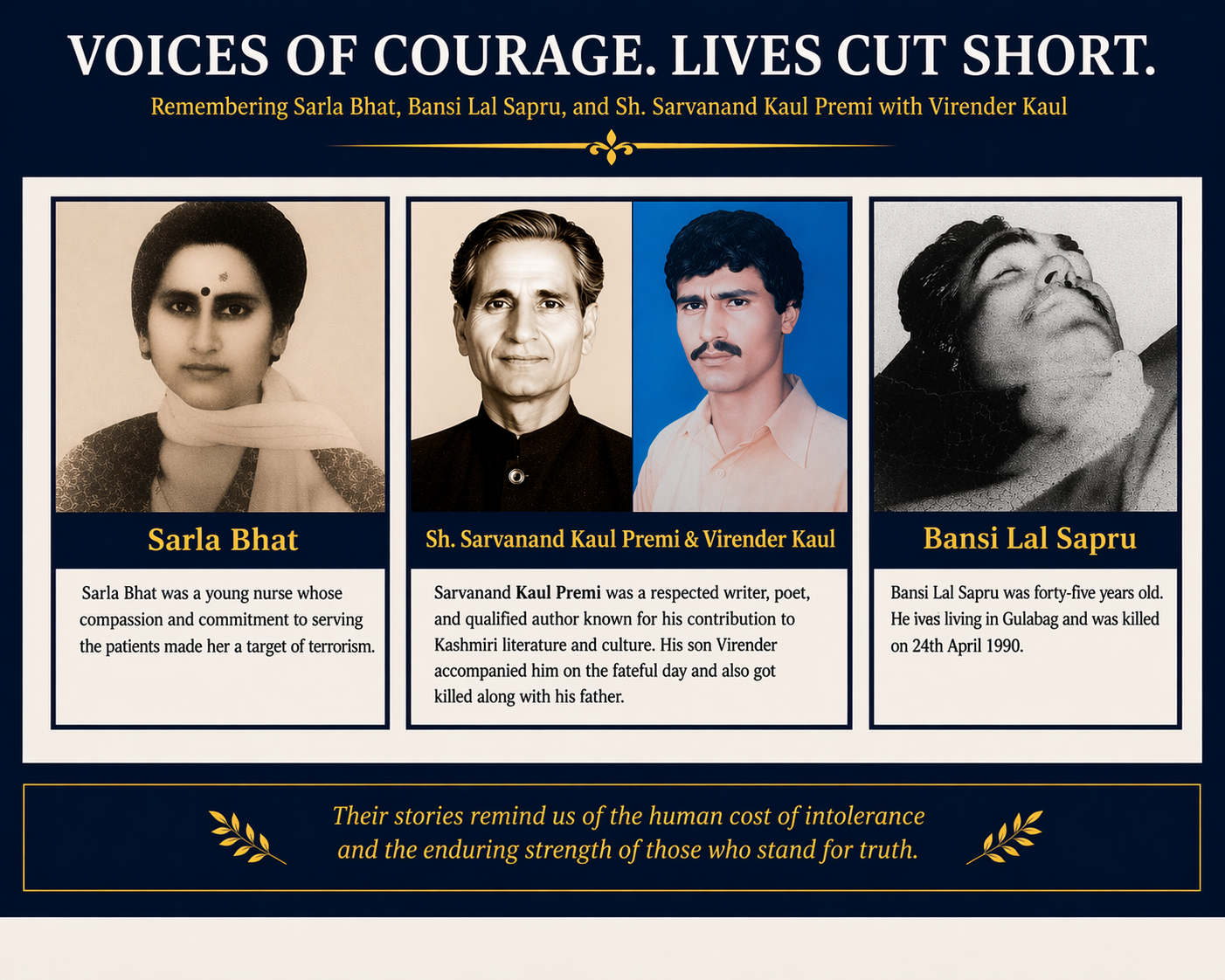
April 1990 Killings in Kashmir marked a grim phase of targeted violence, where individuals were singled out and killed in a climate of fear and silence. This article documents verified names and case profiles, including Bansi Lal Sapru, Sarla Bhat, BHL Khera, and Sh. Sarvanand Kaul Premi with his son Virender Kaul, to present a clear and factual account of lives lost during that period
April 1990 did not claim its victims all at once. It took them one by one, methodically and without mercy, across the calendar. To the outside world, Kashmir is merely a collection of postcards. The world sees only frozen frames: snow-dusted peaks, lakes that mirror the sky, and forests as still as ancient prayers. It labels the land ‘paradise’ and simply looks away.
But those who know Kashmir see a deeper truth. They know its real beauty does not live in the scenery. Instead, it lives in the soul, the simplicity, and the humanity of its people. This spirit is called Kashmiriyat.
It was a bond that held everyone together. It thrived in shared courtyards and common dreams.
Then came the winter of 1990, and the dream was shattered. In an instant, the warmth of Kashmiriyat grew cold. Sudden violence replaced the old peace. Neighbours became strangers, and the harmony of centuries vanished in a single season. The postcards remained, but the soul of the land was gone.
The transition from Kashmiriyat to 1990 is so painful.
When the innocent are murdered, and the perpetrators go unpunished, a shadow falls over the very idea of fairness.
By the winter of 1989 and into early 1990, the Valley had already begun to change in ways that could not be unseen.
Names appeared on lists. Loudspeakers carried threats through the night air. Tika Lal Taploo was shot dead outside his home in September 1989. Justice Neelkanth Ganjoo was killed in broad daylight in November.
Then came Prem Nath Bhat, Satish Tikoo, and others, one after another, like a slow and deliberate erasure.
By April 1990, Thousands of Kashmiri Pandit families had already left. They had read the warnings written in blood on the walls of their own neighbourhoods and made the impossible choice to go.
But some stayed. They stayed because they believed in Kashmiriyat. They stayed because they could not imagine that the valley they had called home for over five thousand years would truly cast them out. They stayed, and they paid for that belief with their lives.April 1990 Killings in Kashmir: Names and Case Profiles
Here is the story of April 1990 Killings in Kashmir
Bansi Lal Sapru: Shot Dead in His Own Compound
24 April 1990, Gulab Bagh, Srinagar
Bansi Lal Sapru was forty-five years old. He lived in Gulab Bagh, Srinagar, in a neighbourhood where people knew each other’s names, borrowed each other’s salt, and shared the same festivals year after year.
On 24 April 1990, he was shot dead inside his own compound. The men who killed him were not strangers from some distant front. They were believed to be his neighbours.
There is a particular cruelty in that fact that no historical summary can fully absorb. A man does not fortify himself against his neighbours. He does not calculate the risk of stepping into his own courtyard. The compound of a home is the last space where a person should feel safe, and it was precisely that space that was turned into the site of his murder.
Sarla Bhat: The Nurse Who Was Made an Example
Abducted 18 April 1990 — Body Found 19 April 1990, Srinagar
Sarla Bhat was twenty-seven years old. She was a nurse at the Sher-e-Kashmir Institute of Medical Sciences in Soura . She was a young woman whose working life was built around healing others.
On 18 April 1990, armed militants from the Jammu and Kashmir Liberation Front abducted her from the Habba Khatoon hostel at SKIMS. She was subjected to prolonged torture and gang-rape. Her body was discovered the following morning on a street in Srinagar. A note found with her remains branded her a police informant , a label that militants used routinely to justify the murder of civilians.
The men who killed her understood exactly what they were doing. To target a healthcare professional, a woman whose identity was defined by neutrality and service, was to send a message to every Kashmiri Pandit who remained: no occupation, no innocence, no civic role would protect them.
For thirty-five years, her case existed primarily in the memory of a displaced community and the records of the Nigeen Police Station as FIR No. 56/1990. In August 2025, the State Investigation Agency reopened the investigation, conducting raids at eight locations in Srinagar linked to the JKLF. It was an overdue acknowledgement that justice, even when it arrives in fragments, must still be pursued.
H.L. Khera: A Factory Manager and a Valley in Flames
Abducted 6 April 1990 — Body Found 10 April 1990, Srinagar
On the morning of 6 April 1990, Kashmir was already burning. Thousands of Kashmiri Pandits had fled their homes. Militants moved openly through the streets. And within hours of sunrise, H.L. Khera was taken.
H.l. Khera was the General Manager of HMT — the Hindustan Machine Tools Watch Factory in Srinagar. He held one of the most important industrial positions in the Valley. He ran a public-sector plant that provided livelihoods for hundreds of Kashmiri workers. He was not a politician. He was not a security officer. He was an engineer and administrator who ran a factory that made watches.
At approximately 09:40 that morning, Khera was travelling to the factory in his official car when he was intercepted at Qamarwari Chowk. Armed men, exploiting a traffic congestion point, forced entry into his vehicle. The Jammu Kashmir Students Liberation Front conducted the operation, the student wing of the JKLF, led by the militant commander Hilal Beg.
That same afternoon, Dr Mushir-ul-Haq, the Vice-Chancellor of Kashmir University, and his personal secretary, Abdul Gani Zargar, were abducted as they left the university campus. The coordination of these three kidnappings in a single day was not incidental. It was a demonstration of reach — a deliberate strike against the intellectual and industrial leadership that remained in the Valley.
The demands centred on the release of three militants: Nissar Ahmed Jogi, Ghulam Nabi Bhat, and Fiyaz Ahmed Wani. The militants had extracted such concessions before: in December 1989, five prisoners had been released in exchange for Rubaiya Sayeed. They believed the tactic would work again.
It did not. On 10 April 1990, the bullet-riddled body of H.L. Khera was found on a road in front of Srinagar’s fire station in the Batmaloo area, at approximately 2:15 in the afternoon. Mushir-ul-Haq and Zargar were also killed.
The killing of Khera marked the end of an era for state-sponsored industrialisation in Kashmir. HMT Srinagar, which had been envisioned as an engine of regional growth, became, in the months that followed, what one account described as a deserted alien land. The exodus of its officers and technical leadership left a vacuum that prevailing security conditions made impossible to fill. The de-industrialisation of the Valley that followed was as much demographic as it was economic.
The case was transferred to the CBI in 1990. In 2009, a Special TADA Court in Jammu acquitted all seven accused, ruling that the prosecution had failed to establish guilt beyond a reasonable doubt. The CBI appealed. In March 2025, a bench of Justices Abhay S. Oka and Ujjal Bhuyan of the Supreme Court dismissed those appeals and upheld the acquittals. This ruling stood as a final, if painful, accounting of what the 1990 investigations had failed to preserve.
Pt. Sarwanand Koul ‘Premi’: The Poet Who Chose Peace and Paid for It
Abducted 28 April 1990, Soaf Shali, Kokernag — Body Found 1 May 1990
Of all the lives taken in April 1990, the killing of Sarwanand Koul Premi carries a particular weight, because the men who killed him knew exactly who he was.
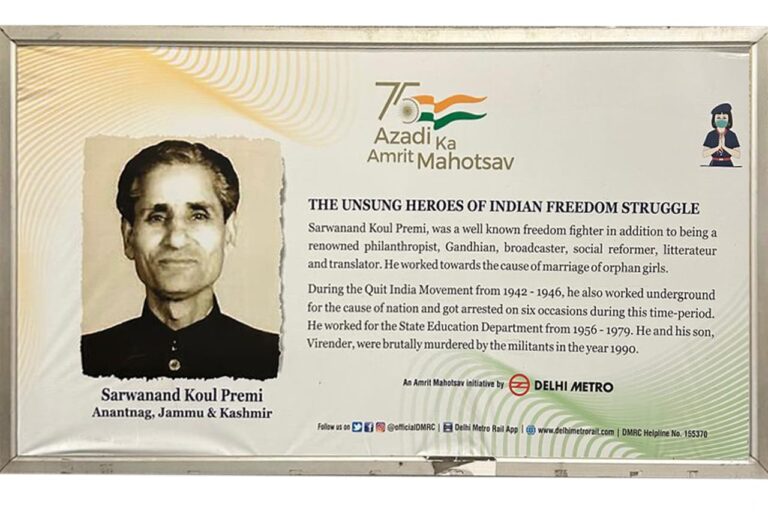
He was born on 2 November 1924 in Soaf Shali, a village near Kokernag in Anantnag district, into a family steeped in spirituality and learning. His father, Gopi Nath, was a deeply religious man; sadhus frequented the family home, and the atmosphere of scholarship and devotion profoundly shaped the young Sarwanand. He went on to become a poet, author, translator, journalist, and social activist — a man who had spent his entire life building bridges between communities rather than walls.
He had met Mahatma Gandhi. The British had arrested him during the freedom struggle. He had encountered the great poet Mahjoor, under whose guidance his own voice as a Kashmiri poet found its full form. He had translated Rabindranath Tagore’s Gitanjali into Kashmiri, and the Bhagavad Gita and the Ramayana into Kashmiri and Urdu. He had spent decades working not for any faction or political banner, but for the idea that Kashmir’s different communities could live as one.
In 1986, when communal violence erupted in the Valley, it was Premi who stood in the middle and appealed for calm. He reminded both communities of the bonds they shared. He was, in the truest sense, a man who had given his life to the cause of Kashmiriyat.
On the night of 28 April, darkness arrived in Soaf Shali earlier than expected. The power to the area was cut deliberately by a group of armed extremists who had already decided what the night would hold.
They knocked on Sarwanand Premi’s door under the pretext of asking for an address — the oldest and most ordinary of pretexts, the kind that a man who has spent his life welcoming people into his home would not think twice about answering.
Once inside, they showed themselves for what they were. The family was herded into a single room while the house was stripped bare — gold, jewellery, Pashmina shawls, even the clothes that had been set aside for a relative’s wedding.
Then they came to the library. That room where Premi had spent decades in conversation with Tagore and the Gita and Mahjoor, where manuscripts had been slowly growing into books, where a life of the mind had been quietly and persistently lived. They ransacked it too, and took what they could carry of a man’s life’s work.
When the looting was done, they told him they needed him to come with them — just briefly, to meet their commander. He would be brought back safely, they said. It was the kind of promise that means its opposite, and Virendra felt it. He was Premi’s younger son, and he refused to let his father walk out of that door alone.
The men accepted this without argument, which should have been the clearest warning of all.
Neither of them came back. Their bodies were found days later, hanging from a tree. Their arms and legs had been broken. Their eyes had been damaged. The men who killed a poet who had given Tagore’s words to the Kashmiri language made certain, in the particular sadism of their cruelty, that his end bore no resemblance to anything his life had stood for.
Virendra was a young man. He left behind a wife and a child of eighteen months who would grow up knowing his father only through what others chose to remember and record.
Sarwanand Koul Premi has since been honoured posthumously by the Jammu and Kashmir government, the Delhi BJP, and the Delhi Metro, which installed a plaque in his memory at Barakhamba Metro Station. A higher secondary school in Soaf Shali carries his name. His elder son, Rajinder Kaul Premi, has spent nearly three decades navigating courts, human rights commissions, and bureaucratic indifference — fighting not only for justice but for the simple survival of his father’s literary legacy in a world that has been slow to protect it.
The honours are real, and they are deserved. But they sit beside an absence that no plaque can fill — the absence of a man who chose, his whole life, to build rather than to burn, and was killed by those who could not forgive him for it.
The Month of Packing
April 1990 was not only the month of killing. It was the month of packing.
Suitcases were filled not with hope, but with photographs, old letters, a child’s school report, and a grandmother’s ring. The first exodus of Kashmiri Pandits was not a military operation or an organised relocation. It was a slow, panicked retreat from homes that had become crime scenes, from a valley that had stopped feeling like a valley and begun to feel like a trap.
Parents bundled children into trucks and buses that smelt of sweat and collective dread. Older people, who had walked those same streets for decades, sat on Bus stations clutching shawls and the names of their dead like talismans. An army did not empty the Valley; it was emptied by terror, one family at a time, in the silence between one knock on the door and the next.
Why April Still Bleeds
Thirty-six years later, the question is no longer only about the dead. It is about the living.
The children of those who fled in 1990 are now adults. Some have never seen the house their grandparents called home. Some know the name of their ancestral village only from an old ration card tucked inside a file. April of 1990 belongs to every family that was told to choose between identity and survival — and found that the choice had already been made for them.
Yet the cruelty of that April is that it refuses to stay in the past. Every documentary, every film, every honest account of those killings is met with denial, erasure, or indifference. The killers, in most cases, were never named in any public record. Their identities live only in the fearful corners of survivors’ memories.
To remember is not to reopen wounds. It is to refuse the slow violence of forgetting — to insist that the dead had names, that the names had faces, and that the faces belonged to people who deserved to grow old.
FAQs: April 1990 Killings in Kashmir
Q1. What were the April 1990 killings in Kashmir?
The April 1990 killings in Kashmir refer to a series of targeted murders and abductions of Kashmiri Pandits carried out by armed militants during one of the most violent phases of the insurgency. Unlike random communal violence, these killings were systematic and deliberate — individuals were identified, tracked, and eliminated. The victims included a nurse, a factory manager, a poet, and ordinary civilians, each chosen to send a specific message of terror to the remaining Pandit community.
Q2. Who was Bansi Lal Sapru, and how was he killed?
Bansi Lal Sapru was a forty-five-year-old resident of Gulab Bagh, Srinagar. On 24 April 1990, he was shot dead inside the compound of his own home. Those believed responsible were not unknown assailants from outside — they were reportedly his own neighbours. His killing represents one of the most chilling aspects of the 1990 violence: the collapse of the neighbourhood bonds that had defined Kashmiri social life for generations.
Q3. Who was Sarla Bhat, and what happened to her?
Sarla Bhat was a twenty-seven-year-old nurse employed at the Sher-e-Kashmir Institute of Medical Sciences (SKIMS) in Soura. On 18 April 1990, she was abducted by armed militants of the Jammu and Kashmir Liberation Front (JKLF) from the Habba Khatoon hostel at SKIMS. She was subjected to prolonged torture and gang-rape, and her body was found the following morning on a Srinagar street. A note branding her a police informant was placed with her remains — a label routinely used by militants to justify civilian murders. Her case was registered as FIR No. 56/1990 at Nigeen Police Station. In August 2025, the State Investigation Agency reopened the investigation and conducted raids at eight locations in Srinagar linked to the JKLF.
Q4. Who was H.L. Khera, and what was the significance of his abduction?
H.L. Khera was the General Manager of the HMT Watch Factory in Srinagar — one of the Valley’s most significant public-sector industrial establishments. On 6 April 1990, he was intercepted at Qamarwari Chowk while travelling to the factory and abducted by members of the Jammu Kashmir Students Liberation Front, the student wing of the JKLF, led by militant commander Hilal Beg. That same day, Dr Mushir-ul-Haq, Vice-Chancellor of Kashmir University, and his personal secretary Abdul Gani Zargar were also abducted. All three were killed when the government refused to meet the militants’ demand for the release of imprisoned JKLF operatives. Khera’s body was found on 10 April 1990 near Srinagar’s fire station in Batmaloo. His killing effectively ended the HMT factory’s operational future and accelerated the de-industrialisation of the Valley.
The case was transferred to the Central Bureau of Investigation (CBI) in 1990. In 2009, a Special TADA Court in Jammu acquitted all seven accused on the grounds that the prosecution had not established guilt beyond reasonable doubt. The CBI appealed. In March 2025, a bench of Justices Abhay S. Oka and Ujjal Bhuyan of the Supreme Court of India dismissed those appeals and upheld all acquittals — closing the judicial chapter on one of 1990’s most prominent abduction-murders without any convictions.
Q6. Who was Pt. Sarwanand Koul Premi?
Pt. Sarwanand Koul Premi (born 2 November 1924, Soaf Shali, Kokernag) was a poet, author, translator, journalist, and social activist who dedicated his life to communal harmony in Kashmir. He had participated in India’s independence movement, been arrested by the British, met Mahatma Gandhi, and trained under the legendary Kashmiri poet Mahjoor. His literary translations included Rabindranath Tagore’s Gitanjali, the Bhagavad Gita, and the Ramayana into Kashmiri and Urdu. In 1986, during communal violence in the Valley, he personally appealed for peace between communities. He was, by any measure, one of Kashmiriyat’s most articulate living champions.
Q7. How were Sarwanand Kaul Premi and his son killed?
On the night of 28 April 1990, armed extremists entered Sarwanand Kaul Premi’s home in Soaf Shali under the pretext of asking for an address. They looted the house — taking gold, jewellery, Pashmina shawls, and manuscripts from his personal library — and then forced Premi to accompany them to meet their commander, claiming he would be returned safely. His younger son Virendra refused to let his father leave alone and went with him. Neither returned. Their bodies were found on 1 May 1990, hanging from a tree. Both had suffered broken limbs and damage to their eyes. Virendra left behind a wife and an eighteen-month-old child.
Q8. Has Sarwanand Kaul Premi been officially honoured?
Yes. Sarwanand Kaul Premi has been honoured posthumously by the Jammu and Kashmir government, the Delhi BJP, and the Delhi Metro, which installed a memorial plaque at Barakhamba Metro Station. A higher secondary school in Soaf Shali has been named after him. His elder son, Rajinder Kaul Premi, has spent nearly three decades pursuing justice through courts and human rights commissions while also working to preserve his father’s literary legacy.
Q9. Why did some Kashmiri Pandits stay in the Valley even as others fled in early 1990?
Many who stayed did so out of a profound belief in Kashmiriyat — the centuries-old ethos of shared living that had bound Kashmiri communities across faiths. They could not reconcile the threats around them with the valley they had known for over five thousand years. Several of the April 1990 victims, including Sarwanand Koul Premi, had actively worked to preserve inter-community peace. Their decision to stay was an act of faith in that shared identity — a faith that cost them their lives.
Q10. What was the scale of the Kashmiri Pandit exodus by April 1990?
By April 1990, thousands of Kashmiri Pandit families had already left the Valley. The exodus was not an organised relocation but a panicked flight driven by targeted killings, threatening loudspeaker announcements, and lists of names circulated by militants. Families packed photographs, letters, and personal heirlooms into suitcases and boarded trains in conditions of collective fear. Between 1989 and 2005, official records document over 1,623 Kashmiri Pandit deaths. The community’s share of Kashmir’s population collapsed from 15 per cent in 1947 to 0.01 per cent by the 2011 Census.
Q11. Why does April 1990 continue to matter today?
April 1990 matters because the violence it represents remains officially unresolved in most individual cases. The killers of most victims were never named in public records. Most families received no justice through the courts. The children of those who fled are now adults who know their ancestral villages only through old documents and family memory. The article argues that remembering these killings is not about perpetuating grief — it is about resisting the erasure of documented history and insisting that each victim was a named individual with a life, a community, and a right to be remembered accurately.

Rohit Tikoo is a published author, researcher, and content strategist with over two decades of writing experience. He is the author of nine books covering Kashmir, Indian philosophy, social issues, and contemporary thought, including Shadows Over the Valley: Operation TUPAC, Cold War Geopolitics, and the Kashmiri Pandits Exodus (2025).
His work focuses on Kashmir’s history, literature, culture, and the lived experiences of the Kashmiri Pandit community. Through extensive research, archival references, and historical analysis, he seeks to document and preserve narratives that are often overlooked in mainstream discourse. His writing on Kashmir has appeared in DAILY EXCELSIOR, HEADLINES TODAY, ONLY KASHMIR, GREATER KASHMIR, NAAD,
VITASTA, CHATTAN, AND VOICE OF SILENCE.
Through rohittikoo.com, he publishes research-based articles, essays, and commentary aimed at fostering informed discussion on Kashmir, Indian civilisation, literature, and contemporary society.