
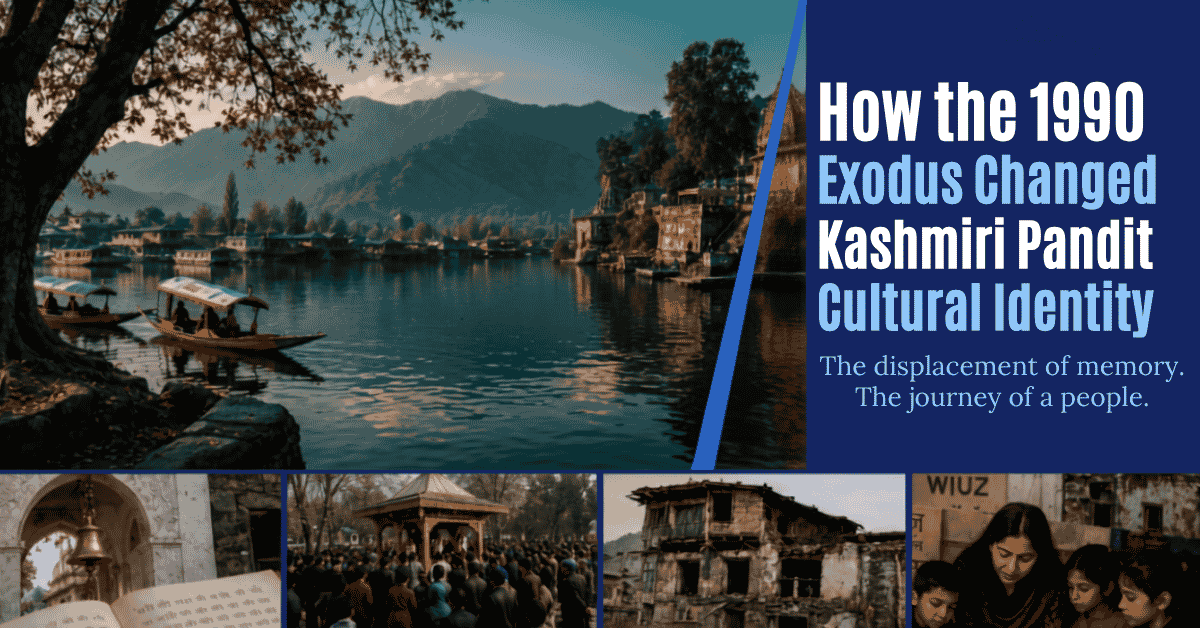
The chinar trees still stand where they always have. The Vitasta River continues to flow through the valley. Ancient prayers can still be heard echoing from the temples. However, a profound shift occurred in 1990. It wasn’t merely the movement of people; it was the very displacement of memory. In this article, we will discuss how the 1990 Exodus changed Kashmiri Pandit Cultural Identity
We did not just live in Kashmir; we were its heartbeat, its voice, and its steady strength. Our identity was tied entirely to the land. You could see this connection in the shrines we visited, the festivals we celebrated, the language we spoke at home, and the stories we shared in our courtyards. Kashmir was far more than just a spot on a map; it was a deep mix of faith, family, and history.
And then, in 1990, that continuity was broken.
I vividly recall the resonance of the temple bells at Ganpatyar, the pilgrimages to Hari Parbat, and climbing the steep steps to Shankaracharya Temple. I remember gatherings where elders debated everything from local politics to abstract philosophy while children played nearby. The natural, effortless flow of Kashmiri, spoken seamlessly across domestic settings, bustling markets, and social circles, is permanently etched in my mind.
For us, Herath was never just Shivratri as people know it in the rest of India; it belonged completely to us. In the same way, our yearly trip to Kheer Bhawani meant much more than a religious pilgrimage, as it brought together family, faith, and close community ties. You can read a detailed account of these Kashmiri Pandit festivals and lost rituals to understand how deeply they anchored our daily lives.
Bhajans, Kashir leelas, everyday proverbs, and old customs flowed naturally from parents to children. Back then, no one ever worried if our language would survive. We never imagined a day when our children would have to learn Kashmiri through YouTube reels.
Identity was not something we actively guarded. It was simply who we were. The exodus changed everything.
When Culture Lost Its Natural Home
Much has been written about the political events of 1990, yet the deeper wound was cultural. The mohallas of Habba Kadal, Rainawari, Fateh Kadal, and Barbar Shah were more than just residential sectors; they were cultural classrooms where traditions were organically transmitted.
When we departed from Kashmir, we left behind the artisans who crafted clay pots for Herath, the women who sang the traditional wanwun at our weddings, and the Kul-Gurus who performed rituals for our births. We abandoned a complete cultural ecosystem. The relationships, customs, rituals, and daily interactions that had upheld our identity for centuries were abruptly severed. What had once survived naturally now depended entirely on conscious memory and deliberate effort.
For the first time in our history, we were forced to become the active guardians of our own culture.
The Language That Carried Our Memory
Language, perhaps more than any other cultural marker, registers the profound impact of exile. Before the exodus, Kashmiri was the ambient soundtrack of daily life. It was spoken at home, shouted in the markets, and woven into the folklore told by grandparents.
Exile reconfigured that reality.
We carried the Kashmiri language with us into refugee camps, cramped rented apartments, and unfamiliar cities throughout India, using it as a linguistic anchor to the world we had left behind. However, as our children grew up in environments dominated by Hindi and English, a subtle shift occurred. Kashmiri remained the language we spoke to them, but they increasingly replied in the language of their new surroundings. This was not a rejection of their roots, but the inevitable reality of diaspora.
Over time, we realised that language carried far more than words. It carried humour, nuanced grief, proverbs, folk wisdom, and distinct ways of seeing the world. Every language contains a unique repository of cultural memory; when that language weakens, a portion of that memory fades. Today, young Kashmiri Pandits are actively working to revive their ancestral tongue. Their growing interest is a powerful reminder that cultural continuity can persist despite the violent interruptions of exile.
Understanding Our Journey Through Melvin Seeman’s Five Dimensions
The trauma of our displacement can be profoundly understood through the framework of sociologist Melvin Seeman, who identified five distinct dimensions of alienation.
1. Powerlessness
Many of us did not leave by choice; we were driven out by circumstance. Families who had resided in the Valley for generations abruptly abandoned homes, belongings, careers, and ancestry. Decisions determining our survival were stripped from our hands. This feeling of powerlessness did not evaporate upon reaching Jammu or Delhi; it lingered in the indignities of refugee life, the elusive promise of return, and the exhausting struggle to rebuild from scratch.
2. Meaninglessness
For generations, we contributed to Kashmir’s philosophy, literature, government, and education. The exodus forced us to face the truth: despite our centuries of roots in Kashmir, we became refugees from our own homeland. For decades, our community has documented this reality in memoirs, books, and conversations. We are not looking for political answers; we are searching for the meaning behind this sudden separation.
3. Normlessness
Life before exile followed predictable social patterns. Festivals united neighbourhoods, elders guided the community, and customs provided social stability. Exile broke these norms. Teachers, business owners, and civil servants restarted their lives in unfamiliar surroundings. Families who once lived close together are scattered across different places, fracturing the social structure.
4. Isolation
Exile brought a deep, ambient loneliness. We were isolated not only from our physical homes but from the cultural atmosphere that validated who we were. Outside Kashmir, our identity was no longer understood implicitly—it had to be explained, contextualised, and defended. Furthermore, a temporal isolation emerged: as the decades passed, the Kashmir of our memories remained frozen, while the actual physical Valley continued to change, making the gap between memory and reality increasingly difficult to bridge.
5. Self-Estrangement
Perhaps the most complex psychological challenge lies in the younger generation’s relationship with a homeland they have inherited entirely through second-hand memory. They know Hari Parbat, Shankaracharya, and Ganpatyar through photographs, family anecdotes, and rare digital clips. Their connection is genuine, yet it is fundamentally abstract. It creates a unique diaspora challenge: how do we keep future generations anchored to a culture whose foundational geography lies outside their daily lived reality?
Yet Exile Also Strengthened Us
History frequently produces unintended ironies. While exile disrupted the practical structures of Kashmiri Pandit life, it simultaneously heightened our collective consciousness of who we are.
Traditions that once seemed ordinary acquired sacred significance. Festivals became urgent opportunities to reconnect, and a robust network of writers, scholars, and digital creators emerged to document histories that earlier generations had taken for granted. Paradoxically, many of us became far more conscious of our Kashmiri identity after leaving the Valley than we ever were while living there.
Memory as a Homeland
| The Lived Homeland (Pre-1990) | The Inherited Homeland (Post-1990) |
| Physical immersion in the Valley’s seasons. | Textual and oral transmission via storytelling. |
| Effortless, organic language acquisition. | Conscious preservation through digital media. |
| Cultural continuity sustained by geography. | Cultural identity sustained purely by memory. |
For the younger generation, Kashmir exists primarily as an emotional landscape inherited from others. They know the spring blossoms, the winter snows, and the courtyard friendships exclusively through the lore of their parents and grandparents. These narratives serve as an essential intergenerational bridge. They allow those who have never set foot in the Valley to claim a homeland, transforming memory into a portable sanctuary that carries history and belonging across time and distance.
Conclusion
The 1990 exodus permanently altered the landscape of Kashmiri Pandit cultural identity. It transformed our heritage from something that existed effortlessly within its natural environment into something that demands relentless, conscious preservation.
The temples remain. The Vitasta continues to flow. The chinars still stand. Yet the umbilical cord between a people and their geography was profoundly severed. What exile could not destroy, however, was our absolute refusal to forget.
The displacement of memory was one of the cruellest consequences of the exodus, yet memory ultimately became our greatest shield. As long as we continue to speak, write, and celebrate what we have inherited, the cultural identity of Kashmiri Pandits will endure, not merely as a melancholic elegy to the past, but as a living, breathing legacy for generations to come.

Rohit Tikoo is a published author, researcher, and content strategist with over two decades of writing experience. He is the author of nine books covering Kashmir, Indian philosophy, social issues, and contemporary thought, including Shadows Over the Valley: Operation TUPAC, Cold War Geopolitics, and the Kashmiri Pandits Exodus (2025).
His work focuses on Kashmir’s history, literature, culture, and the lived experiences of the Kashmiri Pandit community. Through extensive research, archival references, and historical analysis, he seeks to document and preserve narratives that are often overlooked in mainstream discourse. His writing on Kashmir has appeared in DAILY EXCELSIOR, HEADLINES TODAY, ONLY KASHMIR, GREATER KASHMIR, NAAD,
VITASTA, CHATTAN, AND VOICE OF SILENCE.
Through rohittikoo.com, he publishes research-based articles, essays, and commentary aimed at fostering informed discussion on Kashmir, Indian civilisation, literature, and contemporary society.