
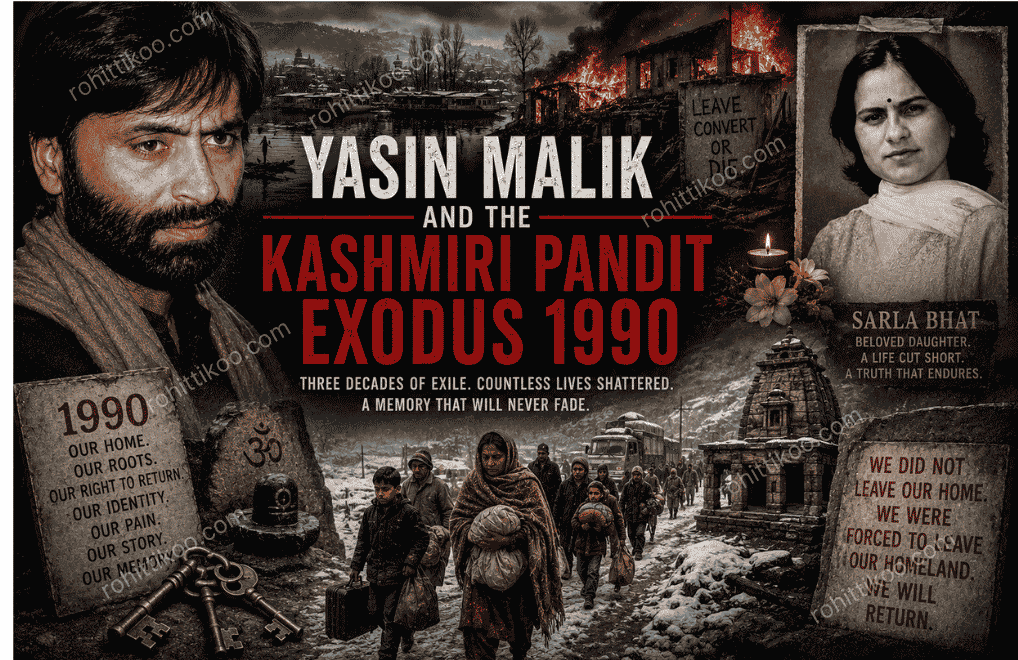
Three decades after the Kashmir insurgency began, Yasin Malik remains one of its most contested figures. To some, he is a separatist leader who abandoned violence. To Kashmiri Pandits, his name remains inseparable from an era of terror, exile, and unanswered questions.
In this article, we comprehensively examine the relationship between Yasin Malik and the Kashmiri Pandit Exodus.
We will explore his alleged role in the radicalisation of Kashmiri youth, the kidnapping of Rubaiya Sayeed, the killing of Indian Air Force personnel, and the charges against him in the Sarla Bhat murder case.
Together, these events created an atmosphere of terror that compelled thousands of Kashmiri Pandit families to abandon their ancestral homes and begin a life of exile.
Ami pana so’dras navi ches laman
Kati bozi Dvay myon meyti diyi taar
Ameyn takeyn poniy zan shemaan
Zuv chum braman gara gatshaha
With a rope of loose-spun thread, I am towing my boat upon the sea. Would that God heard my prayer and brought me safe across. Like water in cups of unbaked clay, I run to waste. Would God I were to reach my home.
These timeless verses of Lal Ded, the fourteenth-century Kashmiri mystic, speak of a fragile journey, uncertainty, and the yearning to return home.
Our women sang it.
Our women sang it while their houses burned behind them in January 1990. Our wemen is singing it now yearning to return.
we do not need a historian’s footnote to tell us who unleashed terror upon our homeland. We lived through it.
Yes, home.
Our home.
A land where our civilisation had endured for centuries.
A land that was torn apart by a campaign of terror carried out by radical Islamist militants.
Our people were threatened, hunted, and driven into exile. The flames that consumed our homes sought to erase our history, believing that if a people could be uprooted, they could also be forgotten.
Among the names that came to symbolise those violent years, none looms larger than Yasin Malik.
To many outside Kashmir, he is remembered as a separatist leader who claimed to have renounced violence in 1994. For countless Kashmiri Pandits, however, his name remains inseparable from one of the darkest chapters in our community’s history.
Who Is Yasin Malik?
Yasin Malik (born 3 April 1966, Srinagar) is a Kashmiri separatist leader and former militant who advocates the separation of the entire former princely state of Jammu and Kashmir from both India and Pakistan. He is the chairman of the Jammu and Kashmir Liberation Front (JKLF), the first militant outfit to openly pursue armed insurgency in the Kashmir Valley for an independent Kashmir.
After renouncing violence in 1994, Malik adopted a so called Gandhian non-violent approach and became a key figure in backchannel diplomacy between India and Pakistan. In May 2022, he pleaded guilty to charges of criminal conspiracy and waging war against the state and was sentenced to life imprisonment in a terror-funding case.
Early Life and Radicalisation
Yasin Malik was born in the densely populated Maisuma locality of Srinagar, often described as one of the most volatile areas of the city. His father, Ghulam Qadir Malik (1937–2012), died in May 2012 due to a cardiac arrest while Yasin was visiting Pakistan.
He has three sisters, including Amina Malik, who has been active in advocating for better prisoner rights for him at Tihar Jail.
Malik claims that as a young boy, he witnessed violence by security forces on the streets. In 1980, after an altercation between the army and taxi drivers, he reportedly became more rebellious.
He formed a small group called the Tala Party, which printed and distributed political materials, disrupted gatherings, and attempted to disrupt a 1983 cricket match between India and the West Indies in Sher-i-Kashmir Stadium.
The group also protested against the execution of Maqbool Bhat, a Kashmiri militant leader. Malik was arrested and detained for four months during this period.
After his release in 1986, the Tala Party was renamed the Islamic Students League (ISL), with Malik as its general secretary. The ISL became an important youth movement in Srinagar, with members including Ashfaq Majeed Wani, Javed Mir, and Abdul Hameed Sheikh. These youths were influenced by Maulvi Mohammad Yusuf Shah (later Syed Salahuddin), the Jamaat-e-Islami district leader in Srinagar, whose sermons attracted many young people.
1987 Elections and Political Mobilisation
In the run-up to the 1987 Jammu and Kashmir Legislative Assembly elections, the ISL joined the Muslim United Front (MUF), a coalition of pro-self-determination and pro-independence groups. The ISL did not contest any seats because it did not believe in the Indian constitution, but it campaigned for MUF candidates across Srinagar.
Malik campaigned for Mohammad Yusuf Shah, the Jamaat candidate from Amirakadal, Srinagar. As vote counting began, Shah appeared to be winning by a large margin, but the National Conference candidate, Ghulam Mohiuddin Shah, was declared the winner. Both Shah and Malik were arrested by the Jammu and Kashmir Police and detained until the end of 1987 without formal charges, court appearance, or trial.
The 1987 election is widely regarded by scholars as a major trigger for the Kashmir insurgency due to allegations of rigging and booth-capturing by the National Conference–Congress alliance, allegedly in connivance with the Government of India. However, Malik disputes this narrative, stating that armed militancy existed before 1987 and that the rigged elections were not the sole cause.
Militant Phase and the JKLF
After his release from prison, Malik crossed into Pakistan-administered Kashmir to receive arms training at camps linked to the Inter-Services Intelligence (ISI) and the JKLF. The ISI had struck a deal with the JKLF in 1986 to support an insurgency in Indian-administered Kashmir, reportedly as a short-term move to spur the Jamaat-e-Islami Kashmir into action.
Returning to the Kashmir Valley, Malik became a core member of the JKLF, declaring the goal of independence for the entire former princely state of Jammu and Kashmir, including territories under both India and Pakistan. He, along with Hamid Sheikh, Ashfaq Wani, and Javed Mir, formed the so-called “HAJY” group—the core of JKLF militants returning with arms and training.
The JKLF’s call for independence received an enthusiastic response in the Valley. The group waged a guerrilla war against Indian security forces, carried out kidnappings, and targeted government and security officials. One of the most prominent incidents was the 1989 kidnapping of Rubaiya Sayeed, daughter of then Home Minister Mufti Mohammad Sayeed. Though Malik denies direct involvement, the episode significantly boosted his profile.
By 1990, Pakistan’s support for the JKLF declined as the pro-Pakistan Islamist group Hizbul Mujahideen, backed by the Jamaat-e-Islami Kashmir and the Pakistani military, gained prominence. Pakistan cut off JKLF funding in early 1990. In March 1990, Ashfaq Wani was killed in a battle with Indian forces. In August 1990, Yasin Malik was captured, wounded and imprisoned until May 1994.
By 1992, most JKLF militants had been killed or captured, and the group was losing ground to pro-Pakistan guerrilla outfits like Hizbul Mujahideen. Further infiltration by pan-Islamist fighters from Pakistan changed the character of the insurgency.
Renunciation of Violence and Political Turn
After being released on bail in May 1994, Malik declared an indefinite ceasefire for the JKLF. Independent journalists reported that around 300 JKLF activists were killed after this point, while Malik claims that the JKLF still lost about 100 activists to Indian operations. Hizb-ul-Mujahideen members often informed on JKLF activists’ whereabouts, enabling Indian security forces to target them.
Malik formally renounced violence and adopted a Gandhian, non-violent struggle for independence. He advocated a “democratic approach” involving the “true representatives” of Jammu and Kashmir, and called for tripartite negotiations between India, Pakistan, and Kashmiri representatives covering the entire state. The Indian government did not accept this framework.
In spring 1995, Malik protested the holding of Legislative Assembly elections in Kashmir, threatening to immolate himself. He argued that the Indian government was “thrusting this election process” on Kashmiris as a display of democracy without addressing the core political issue.
Malik’s non-violent stance was not accepted by the JKLF leadership in Pakistan-administered Kashmir. At the end of 1995, Amanullah Khan, the founding chairman of JKLF, removed Malik as president. Malik responded by expelling Khan from the chairmanship, resulting in a split of the JKLF into two factions: one led by Malik and another by Amanullah Khan. Victoria Schofield notes that the Pakistani government reportedly recognised Malik as the leader of JKLF, complicating the situation further.
Diplomatic Engagements and Backchannel Contacts
Malik has held one-on-one meetings with the presidents and prime ministers of both India and Pakistan, as well as with other world leaders. From the mid-1990s until around 2014, he was a regular presence in Delhi, attending elite gatherings and interacting with policymakers and civil society figures.
His alleged role as a “bridge” between India and Pakistan became more prominent in later disclosures. In August/September 2025 Malik filed an affidavit in a Delhi court claiming that successive Indian governments saw him as a conduit for backchannel diplomacy, including with state-backed terrorist outfits in Pakistan.
Key claims in his affidavit include:
- A five-hour meeting with Rashtriya Swayamsevak (RSS) leaders in 2001 at the India International Centre, facilitated by the Centre for Dialogue and Reconciliation.
- A 2006 meeting with Lashkar-e-Taiba (LeT) founder Hafiz Saeed in Pakistan, allegedly conducted under instruction from Indian intelligence as part of a backchannel effort following the 2005 earthquake. Malik claimed that then-Prime Minister Manmohan Singh thanked him for it.
These disclosures have been highly controversial. Some see them as evidence of complex backchannel ties between India and certain militant groups; others view them as self-serving attempts to reshape his legacy.
Legal Cases and Imprisonment
Charges for 1990 Attack on IAF Personnel
In March 2020, Malik and six accomplices were charged under the Terrorist and Disruptive Activities (Prevention) Act (TADA), the Arms Act 1959, and the Ranbir Penal Code for an attack on 40 Indian Air Force (IAF) personnel in Rawalpora, Srinagar, on 25 January 1990. During that attack, four IAF personnel died. Malik was also facing trial related to the kidnapping of Rubaiya Sayeed and the subsequent exchange of five militants.
2017 Terror-Funding Case
In 2017, the National Investigation Agency (NIA) registered a case of terror funding against various separatist leaders, naming Malik and four others in a charge sheet filed in 2019. The agency alleged that they received funds from Pakistan to carry out terrorist activities and stone-pelting during the Kashmir unrest, particularly in 2010 and 2016.
In March 2022, a Delhi court reviewed the evidence and ordered framing of charges against Malik and others under the Unlawful Activities (Prevention) Act (UAPA) and the Indian Penal Code. The court observed prima facie evidence that the accused were direct recipients of terror funds, mainly from Pakistan, and found a criminal conspiracy in organising large-scale protests resulting in violence and arson. The court found sufficient evidence under sections 38 and 39 of UAPA (association with a terrorist organisation and inviting support for it) in relation to Lashkar-e-Taiba.
On 10 May 2022, Malik pleaded guilty to the charges. He did not appoint a lawyer and appeared for himself; the court appointed an amicus curiae to explain the charges and consequences to him. Malik confirmed that he did not want to contest the charges and was ready to face the outcome.
On 25 May 2022, an NIA court convicted Malik of conspiracy and waging war against the state. He was sentenced to two life imprisonments and five 10-year prison terms, all to be served concurrently. Legal experts noted that Malik could appeal the sentence in the Delhi High Court but not his conviction.
His wife, Mushaal, appealed to the UN, UNHCR, and international powers, calling the case a “war crime” and asking for intervention. Pakistan’s foreign ministry condemned the sentencing as a “sham trial” and described it as an attempt to deprive Kashmiris of their “true leadership”.
Recent Allegations: Kashmiri Pandit Killings
In June 2026, a special investigation agency (SIA) of the Jammu and Kashmir police reportedly accused Malik of commanding the 1990 killing of Sarla Bhat, a Kashmiri Pandit nurse. The SIA had earlier raided the houses of several JKLF members, including Malik, in 2025 in connection with this investigation.
According to journalist Ahmed Ali Fayyaz, Bhat’s killing coincided with Malik’s hospitalisation at the Sher-i-Kashmir Institute of Medical Sciences (SKIMS), where Bhat worked as a nurse. A senior police official suggested that Bhat was framed as an informant because she was a Kashmiri Pandit, following the arrest of a JKLF-affiliated employee at SKIMS.
Malik denies direct involvement in the killing of Kashmiri Pandits around 1990 and claims these allegations are part of a campaign against him. These accusations have added a new layer of controversy to his legacy, polarising opinions further.
Personal Life
In 2005, Malik met Pakistani artist Mushaal Hussein Mullick during a tour of Pakistan. They married in Rawalpindi on 22 February 2009. Their daughter, Raziyah Sultana, was born in March 2012. Mushaal and Raziyah currently reside in Islamabad.
Mushaal is a graduate of the London School of Economics and comes from an affluent Pakistani family. Her mother, Rehana Hussein Mullick, was secretary general of the PML-N Women’s Wing; her father, M. A. Hussein Mullick (d. 2002), was an international economist who headed the University of Bonn’s economics department and was the first Pakistani member of a Nobel Prize jury. Her brother, Haider Ali Hussein Mullick, is a foreign policy analyst in Washington, D.C., and a lecturer at the Naval Postgraduate School; her sister, Sabien Hussein Mullick, is a social worker.
Malik completed his graduation from Sri Pratap College (S.P. College) in Srinagar. He states that much of his knowledge was acquired through self-study while he served time in various jails. He is known to admire the poetry of Allama Iqbal and the writings of Imam Ghazali.
Public Perception and Legacy
Yasin Malik remains one of the most polarising figures in the Kashmir conflict. Supporters view him as a symbol of Kashmiri resistance who renounced violence and pursued a non-violent path for independence. Critics, including some in India, see him as a former militant who was involved in terrorism and killings, and now as a figure who allegedly played both sides—engaging with Indian intelligence while maintaining ties with militant groups in Pakistan.
His 2025 affidavit and the 2026 accusations regarding Kashmiri Pandit killings have reignited debates about his role in the early years of the insurgency and about India’s alleged backchannel dealings with militant leaders. Whether these disclosures reshape his legacy or fade as self-serving narratives remains uncertain.
Key Facts (Summary)
- Born: 3 April 1966, Srinagar, Jammu and Kashmir, India
- Organisation: Chairman of Jammu and Kashmir Liberation Front (JKLF)
- Militant phase: Active in JKLF from the late 1980s; renounced violence in 1994
- Political stance: Advocates independent Kashmir, separate from both India and Pakistan
- Legal status: Convicted in 2022 in a terror-funding case; sentenced to life imprisonment
- Recent controversies: Alleged involvement in the 1990 killing of Kashmiri Pandit Sarla Bhat; claims of being used in backchannel diplomacy by the governments.
Timeline: Yasin Malik’s Journey from Militant Leader to Life Imprisonment
Key legal rulings and political transitions
Late 1980s – Early Militancy and Entering Armed Insurgency
- 1986 – After release from an earlier detention, Malik helps form the Islamic Students League (ISL), a youth movement in Srinagar aligned with pro-independence and anti-India politics.
- 1987 – ISL campaigns for the Muslim United Front (MUF) in the 1987 Jammu and Kashmir Assembly elections. Alleged rigging of the elections is widely seen as a catalyst for the Valley’s insurgency; many MUF activists, including Malik, are arrested in the aftermath.
- Post-1987 – Malik crosses into Pakistan-administered Kashmir for arms training under JKLF and ISI-linked camps. He returns to the Valley in 1989 as a core JKLF militant, part of the “HAJY” group (Hamid Sheikh, Ashfaq Wani, Javed Mir, Yasin Malik).
1989–1994: JKLF Militancy and Capture
- 1989 – JKLF launches armed insurgency advocating an independent Kashmir. Malik is a prominent leader in Rawalpora, Srinagar. The Rubaiya Sayeed kidnapping in December 1989 (though Malik denies direct involvement) significantly raised his profile.
- 1990 – Ashfaq Wani is killed in March. In August, Yasin Malik was captured, wounded and imprisoned. By 1990–1992, heavy Indian security operations and Pakistan’s shift of support toward Hizbul Mujahideen weakened JKLF militarily.
- May 1994 – After years in custody, Malik is released on bail. He immediately declares an indefinite ceasefire for JKLF militants and renounces violence, adopting a Gandhian non-violent path.
1994–2000: Political Transition and Non-Violent Campaigns
- 1994–1995 – Malik promotes a “democratic approach” to Kashmir, calling for tripartite negotiations (India, Pakistan, Kashmiri representatives) over the entire former state. He publicly protests assembly elections in Kashmir, arguing they are imposed without addressing the core political issue.
- 1995 – JKLF leadership in Pakistan-administered Kashmir removes Malik as president. Malik expelled the leadership, splitting JKLF into two factions: Yasin Malik-led JKLF and Amanullah Khan-led JKLF. Reportedly, Pakistan recognises Malik’s faction, further complicating his status.
- Late 1990s–2000s – Malik becomes a regular presence in Delhi, meeting Indian and Pakistani leaders, attending elite forums, and arguing for dialogue and non-violent struggle. He is seen as a “bridge” figure in backchannel diplomacy, though official positions remain ambiguous.
2000–2010: Arrests, Campaigns, and Rise in Controversy
- October 1999 – First major post-ceasefire arrest: Malik is detained under the Public Safety Act (PSA).
- March 26, 2002 – Arrested again under the Prevention of Terrorism Act (POTA) and held for almost a year.
- May 2007 – Malik and JKLF launch the “Safar-i-Azadi” (Journey of Freedom) campaign, covering around 3,500 towns and villages in Kashmir to promote an anti-Indian, pro-independence stance.
- 2005–2009 – During visits to Pakistan, Malik meets Pakistani artist Mushaal Hussein Mullick; they marry in 2009 in Rawalpindi. Their daughter, Raziyah, was born in 2012.
- 2010–2011 – During renewed unrest in Kashmir, Malik is associated with JKLF’s role in organising protests. Reports suggest he was among those accused of mobilising and funding stone-throwing and violent demonstrations.
2012–2018: Backchannel Diplomacy Allegations and Political Shifts
- February 2013 – Malik shares a dais with Lashkar-e-Taiba chief Hafiz Muhammad Saeed during a protest in Islamabad. Many Muslim groups and commentators condemn the act as consolidating his image as a militant-funder figure.
- January 2016 – Malik writes a letter to Pakistan Prime Minister Nawaz Sharif opposing the merger of Gilgit-Baltistan with Pakistan, reaffirming his stance that the entire former princely state (including GB) should be independent.
- 2017 – The National Investigation Agency (NIA) registers a terror-funding case against several separatist leaders, naming Yasin Malik and four others in a charge sheet filed in 2019. The agency alleges they received funds from Pakistan to support terrorist activities and stone-pelting, particularly in 2010 and 2016.
- 2019 – Following the suspension of JKLF activities and its ban in 2019, Malik was arrested in connection with the terror-funding case.
2019–2022: Key Legal Cases and Convictions
2019 Arrest in Terror-Funding Case
- April 10, 2019 – NIA arrests Yasin Malik in Delhi under the Unlawful Activities (Prevention) Act (UAPA) and related sections of the Indian Penal Code, in connection with the 2017 terror-funding case.
1990 IAF Personnel Attack Case
- March 2020 – In a case related to the 1990 attack on 40 IAF personnel in Rawalpora, Srinagar (where four IAF personnel died), Malik and six others pleaded “not guilty.” They are charged under TADA, the Arms Act, and Ranbir Penal Code for criminal conspiracy, murder attempt, and related offences.
2022: Framing of Charges and Conviction in Terror-Funding Case
- March 2022 – A Delhi court reviews evidence in the terror-funding case and orders framing of charges against Malik and others under stringent provisions of UAPA and the Indian Penal Code. The court finds prima facie evidence that the accused were direct recipients of terror funds, mainly from Pakistan, and involved in a criminal conspiracy to organise protests resulting in violence and arson. It identifies sufficient evidence under Sections 38 and 39 of UAPA (association and support to a terrorist organisation) in relation to Lashkar-e-Taiba.
- May 10, 2022 – Malik pleads guilty to all charges, including those under UAPA, before the NIA court in Delhi. He appears without a lawyer; the court appoints an amicus curiae to explain the charges and consequences to him.
- May 19, 2022 – The Special NIA Judge Praveen Singh convicts Malik of:
- Waging war against the Government of India (Section 121 of UAPA / corresponding IPC provisions).
- Criminal conspiracy and sedition under the IPC.
- Raising funds for terrorist acts (Section 17 of UAPA).
- Other offences under Sections 13, 38, and 39 of UAPA.
May 25, 2022: Life Imprisonment
- May 25, 2022 – The NIA court sentences Malik to:
- Two life imprisonment terms (for waging war and funding terrorism).
- Five 10-year prison terms (for related UAPA offences).
All sentences are to be served concurrently, meaning he will effectively serve one life term.
Legal experts note that Malik can appeal the sentence in the Delhi High Court, but cannot challenge the conviction itself.
2022–2026: Post-Conviction Politics and New Allegations
- 2022–2023 – Malik remains in Tihar Jail. His wife Mushaal and sister Amina campaign internationally and domestically, appealing to the UN and human rights bodies, describing the case as a “war crime” and seeking intervention. Pakistan’s foreign ministry condemns the sentencing as a “sham trial” and an attempt to deprive Kashmiris of their “true leadership”.
- 2025– In 2025, Malik filed an affidavit in a Delhi court claiming that successive Indian governments had used him as a channel for backchannel diplomacy, including contacts with figures in Pakistan. He also alleged meetings with RSS leaders in 2001 and with Hafiz Saeed in 2006 under the direction of Indian intelligence.
- If true, this is not diplomacy; it is deception disguised as strategy.
- If true, it reveals a state willing to outsource its own contradictions to a man it later condemned.
- If true, the scandal is not just Malik’s past, but the machinery that used him.If those claims are true, they would raise deeply troubling questions about the nature, extent, and moral cost of such statecraft
Summary of Key Legal Rulings and Transitions
- 1994 – Ceasefire declared; renunciation of violence; transition to non-violent politics.
- 1999–2002 – Arrests under PSA and POTA; continued underground political activity.
- 2017–2019 – NIA registers and pursues terror-funding case; arrest in 2019.
- 2020 – Charges framed in 1990 IAF attack case; Malik pleads “not guilty” in that case.
- 2022 – Conviction in a terror-funding case; life imprisonment sentenced concurrently.
- 2025–2026 – Affidavit claims of backchannel diplomacy and new allegations regarding Kashmiri Pandit killings, reigniting debate over his legacy and the nature of his political role.
This timeline captures the major political and legal phases in Yasin Malik’s journey: from militant leader of JKLF, to non-violent separatist politician, to convicted figure sentenced to life imprisonment, and finally to a contested symbol in India–Pakistan–Kashmir diplomacy and internal Kashmiri politics.
History will continue to debate his politics. Courts will continue to examine evidence. Scholars will continue to interpret the insurgency through different lenses. Yet for those who left Kashmir carrying little more than a few belongings and the keys to homes they never returned to, some truths are preserved not in archives but in memory.
Justice, when delayed for decades, cannot restore what was lost. It cannot rebuild abandoned homes, revive extinguished lives, or return a generation that grew up in exile. What it can do is acknowledge suffering, establish accountability where the law permits, and ensure that history is neither forgotten nor rewritten.
Lal Ded once prayed for a safe journey home.
For millions, her words remain poetry.
For Kashmiri Pandits, it became prophecy.
Ameyn takeyn poniy zan shemaan
Zuv chum braman gara gatshaha
We are all yearning to go back.
Rohit Tikoo is a published author, researcher, and content strategist with over two decades of writing experience. He is the author of nine books covering Kashmir, Indian philosophy, social issues, and contemporary thought, including Shadows Over the Valley: Operation TUPAC, Cold War Geopolitics, and the Kashmiri Pandits Exodus (2025).
His work focuses on Kashmir’s history, literature, culture, and the lived experiences of the Kashmiri Pandit community. Through extensive research, archival references, and historical analysis, he seeks to document and preserve narratives that are often overlooked in mainstream discourse. His writing on Kashmir has appeared in DAILY EXCELSIOR, HEADLINES TODAY, ONLY KASHMIR, GREATER KASHMIR, NAAD,
VITASTA, CHATTAN, AND VOICE OF SILENCE.
Through rohittikoo.com, he publishes research-based articles, essays, and commentary aimed at fostering informed discussion on Kashmir, Indian civilisation, literature, and contemporary society.