
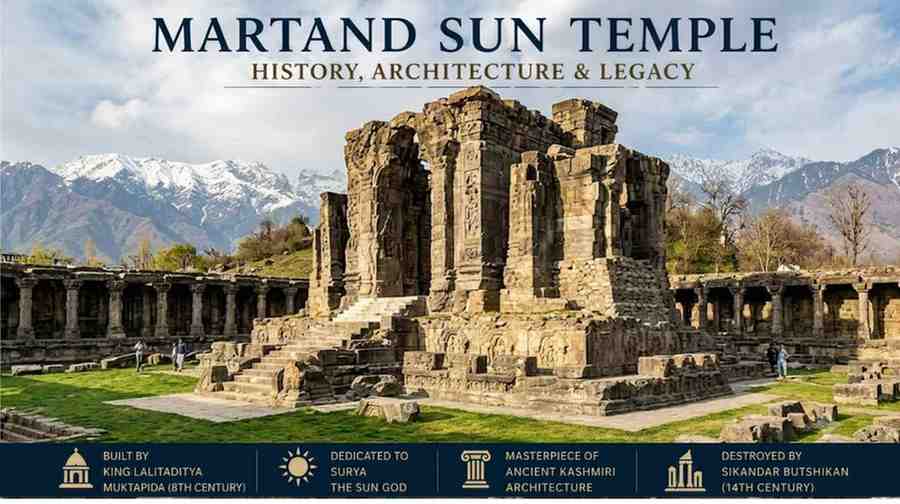
Once the grandest Hindu temple in Kashmir, the Martand Sun Temple stood as a symbol of power, faith and architectural brilliance. Why was this magnificent monument reduced to ruins, and what does its story reveal about Kashmir’s forgotten past?
Let’s Explore.
Few historic places are as breathtaking as the Martand Sun Temple in Kashmir.
Built more than 1,300 years ago on a high plateau in Anantnag, its tall stone ruins still look out over the beautiful valley below. The temple is believed to be destroyed by Sikandar butshikan
Built during the reign of King Lalitaditya Muktapida of the Karkota dynasty in the eighth century CE, the temple was dedicated to Martand, one of the Vedic names of Surya, the Sun God. It represented far more than a place of worship.
The monument reflected the political confidence, artistic sophistication and cultural achievements of a kingdom that had become one of the most influential centres of learning and statecraft in early medieval India.
For historians and archaeologists, the Martand Sun Temple offers invaluable insight into Kashmir’s architectural and religious traditions. For many Kashmiri Pandits, it also holds deep cultural and emotional significance. It stands as a reminder of a civilisation that produced remarkable philosophers, scholars, poets and rulers, and whose legacy continues to shape the identity of the community despite the upheavals of the modern era.
Unlike many online articles that focus solely on legends or the temple’s destruction, this guide examines the Martand Sun Temple through historical evidence, archaeological research and respected scholarship. Where historians disagree, those differing interpretations are presented clearly, allowing readers to distinguish established fact from later tradition.
Whether you are interested in Kashmir’s history, India’s architectural heritage or the enduring legacy of one of its greatest monuments, the story of the Martand Sun Temple deserves to be understood in its full historical context.
Quick Facts About the Martand Sun Temple
| Feature | Details |
|---|---|
| Location | Martand (near Mattan), Anantnag district, Jammu and Kashmir |
| Built By | King Lalitaditya Muktapida |
| Dynasty | Karkota Dynasty |
| Construction Period | Eighth century CE |
| Primary Deity | Surya (Martand), the Sun God |
| Architectural Style | Classical Kashmiri temple architecture |
| Current Status | Protected Monument under the Archaeological Survey of India |
| Nearest City | Anantnag |
| Distance from Srinagar | Approximately 60 km |
What Is the Martand Sun Temple?
The Martand Sun Temple is one of the most significant archaeological monuments in Kashmir and among the finest examples of early medieval Hindu temple architecture in India. Dedicated to Surya, the temple was commissioned during the reign of King Lalitaditya Muktapida, one of the greatest rulers of the Karkota dynasty.
Although now in ruins, the temple continues to impress visitors with its monumental scale, carefully planned layout and exceptional stone craftsmanship. Historians regard it as a masterpiece of Kashmiri architecture, combining indigenous building traditions with artistic influences that reached the valley through trade, diplomacy and cultural exchange.
Beyond its architectural importance, the temple reflects the prosperity and confidence of eighth-century Kashmir, a period when the valley emerged as an important centre of religion, philosophy, literature and political power.
Who built the Martand Sun Temple?
The Martand Sun Temple was built by King Lalitaditya Muktapida of the Karkota dynasty during the eighth century CE. Dedicated to Surya, the Hindu Sun God, it is considered one of the greatest architectural achievements of ancient Kashmir and is now protected by the Archaeological Survey of India.
The Meaning of “Martand”
The name Martand comes from the Sanskrit word Mārtaṇḍa, one of the many names of Surya, the Sun God.
The term appears in ancient Vedic literature, where it is associated with the life-giving energy of the sun. According to Hindu tradition, Martand is also linked to Aditi, the mother of the Adityas, the solar deities. Over time, the name became closely associated with Surya and was adopted for temples dedicated to solar worship.
The choice of this name was significant. Across ancient India, the sun symbolised power, prosperity and righteous kingship. By dedicating one of his grandest monuments to Martand, Lalitaditya reinforced both his religious devotion and the authority of his empire.
Where Is the Martand Sun Temple?
The Martand Sun Temple is located near the town of Mattan in the Anantnag district of Jammu and Kashmir, approximately 60 kilometres south-east of Srinagar.
Its setting is one of the temple’s defining features. Built on a high plateau overlooking the Kashmir Valley, the complex commands sweeping views of fertile plains, mountain ranges and surrounding settlements. Even today, the location creates a sense of grandeur that complements the scale of the monument itself.
The site was almost certainly selected with careful consideration. Ancient temple builders often combined religious symbolism with practical planning, choosing locations that enhanced both the spiritual experience and the visual impact of important monuments.
Why Was the Temple Built on This Site?
The location of the Martand Sun Temple was not chosen by chance. Several factors made the plateau an ideal setting for one of Kashmir’s most important religious monuments.
A Sacred Landscape
The region around present-day Mattan has long been associated with sacred springs and pilgrimage traditions. Water has always played a central role in Hindu ritual practice, making the area particularly suitable for an important temple complex.
A Monument That Dominated the Valley
From its elevated position, the temple overlooks much of the surrounding landscape. In early medieval India, monumental architecture served not only religious purposes but also projected the prestige and stability of royal authority.
Anyone approaching the region would have seen the temple rising above the valley, reinforcing the power and cultural confidence of the Karkota rulers.
Connection with the Rising Sun
As a temple dedicated to Surya, its orientation towards the east carried obvious symbolic significance. Morning sunlight would have illuminated the sanctuary, reflecting the central role of the Sun God in daily worship.
While popular accounts sometimes claim that the temple was engineered to align precisely with astronomical events, current archaeological evidence does not conclusively support all such assertions. The temple’s eastern orientation, however, is entirely consistent with its religious purpose.
Why the Martand Sun Temple Matters to Kashmiri Pandits
For many Kashmiri Pandits, the Martand Sun Temple represents far more than an ancient monument. It stands as one of the most visible reminders of Kashmir’s pre-Islamic civilisation and its long tradition of scholarship, spirituality and artistic excellence.
The temple belongs to a wider network of historic sites that includes Sharada Peeth, Avantipur and other centres associated with Kashmir’s rich intellectual heritage.Together, these monuments reflect an era when the valley was internationally recognised for Sanskrit learning, philosophy, literature and temple architecture.
Following the displacement of the Kashmiri Pandit community in 1990, Martand assumed an even deeper symbolic importance. For many families living away from their ancestral homeland, the temple became a powerful representation of cultural continuity and historical memory. Photographs of its ruins frequently appear in books, documentaries, community publications and cultural events that seek to preserve Kashmir’s ancient heritage for future generations.
At the same time, the Martand Sun Temple is part of India’s shared cultural inheritance. Its historical significance extends beyond any one community, attracting historians, archaeologists, architects and visitors from around the world. Preserving the monument is therefore not only about safeguarding a remarkable temple but also about protecting one of the most important chapters in Kashmir’s civilisational history.
Why the Martand Sun Temple Is Historically Important
The importance of the Martand Sun Temple extends well beyond its architectural beauty.
It is significant because it:
- Represents the artistic and political achievements of the Karkota dynasty.
- Demonstrates the sophistication of early medieval Kashmiri architecture.
- Reflects the importance of solar worship in ancient Kashmir.
- Serves as a key archaeological source for understanding Kashmir’s cultural history.
- Continues to hold cultural and spiritual significance for many Kashmiri Pandits.
- Remains one of the most recognisable symbols of Kashmir’s ancient heritage.
For more than thirteen centuries, the Martand Sun Temple has stood as a silent witness to Kashmir’s changing history. Despite invasions, political transitions and the passage of time, its ruins continue to inspire admiration and remind visitors of the remarkable civilisation that once flourished in the valley.
The Golden Age of Kashmir
To understand why the Martand Sun Temple was built, it is essential to understand the age that produced it.
The eighth century marked one of the most prosperous and influential periods in Kashmir’s history. Under the Karkota dynasty, the kingdom evolved from a regional power into a flourishing centre of administration, commerce, scholarship and artistic achievement.
This period witnessed the construction of monumental temples, the growth of Sanskrit learning and the expansion of Kashmir’s influence across northern India and parts of Central Asia.
Unlike many medieval kingdoms that focused solely on military conquest, the Karkota rulers invested heavily in public works, religious institutions and architecture. Their patronage transformed Kashmir into one of the most sophisticated cultural centres of the early medieval world.
It was during this remarkable period that the Martand Sun Temple was conceived.
The Rise of the Karkota Dynasty
The Karkota dynasty emerged during the seventh century CE and gradually established itself as the dominant power in Kashmir. The dynasty inherited a kingdom with strong cultural traditions and strategic importance, but it was under Lalitaditya Muktapida that Kashmir reached the height of its political and cultural influence.
Historical accounts, particularly Kalhana’s Rajatarangini, describe Lalitaditya as an ambitious ruler who expanded his authority far beyond the Kashmir Valley. Although some details of his military campaigns remain debated among historians, there is little doubt that his reign represented a period of exceptional prosperity and royal confidence.
This confidence is reflected most clearly in the scale of the Martand Sun Temple. Constructing such an enormous stone monument required not only wealth but also a stable administration, skilled craftsmen and access to extensive resources.
The temple therefore stands as tangible evidence of the Karkota Empire’s achievements.
Lalitaditya Muktapida: The Visionary Behind Martand
Among Kashmir’s many rulers, Lalitaditya Muktapida occupies a unique place.
He is remembered not only as a successful military leader but also as one of the greatest patrons of architecture, religion and culture in the valley’s history. His reign, generally dated between c. 724 and 760 CE, coincided with an era of remarkable economic growth and artistic innovation.
Kalhana’s Rajatarangini portrays Lalitaditya as a king of extraordinary ambition whose influence extended across much of northern India and beyond. Modern historians treat some of these accounts with caution, recognising that medieval chronicles often celebrated royal achievements in dramatic terms. Nevertheless, archaeological evidence confirms that Lalitaditya commissioned several important building projects, including the Martand Sun Temple and the city of Parihaspora.
These surviving monuments demonstrate that his architectural vision was every bit as remarkable as the literary tradition suggests
Why Did Lalitaditya Build the Martand Sun Temple?
No contemporary inscription survives explaining Lalitaditya’s exact reasons for constructing the temple. However, historians identify several factors that likely influenced his decision.
A Royal Expression of Power
Across ancient India, monumental temples served as visible expressions of royal authority. They demonstrated a ruler’s ability to mobilise skilled artisans, organise vast resources and sponsor major religious institutions.
The Martand Sun Temple projected exactly this message.
Its monumental scale would have impressed both local subjects and visiting dignitaries, reinforcing the prestige of the Karkota kingdom.
Religious Devotion
The temple’s dedication to Surya reflected the importance of solar worship within Hindu tradition.
Although Shaivism and Vaishnavism flourished in Kashmir during this period, the worship of Surya also occupied an important place within the broader religious landscape. By dedicating such a magnificent monument to the Sun God, Lalitaditya aligned himself with a deity often associated with righteous kingship, prosperity and cosmic order.
Celebrating a Flourishing Kingdom
The eighth century was a period of relative prosperity for Kashmir.
Trade routes connected the valley with Central Asia, the Indian plains and Tibet. Economic stability enabled rulers to invest in ambitious architectural projects that celebrated both religious devotion and political success.
The Martand Sun Temple should therefore be understood not as an isolated monument but as part of a wider programme of royal patronage that reflected the confidence of an expanding kingdom.
Kashmir as a Centre of Learning
The Martand Sun Temple emerged during a period when Kashmir had established itself as one of South Asia’s leading centres of intellectual life.
Scholars travelled to the valley to study Sanskrit grammar, philosophy, literature, theology and the arts. Over subsequent centuries, Kashmir produced influential thinkers such as Abhinavagupta, whose works on aesthetics and Kashmir Shaivism remain highly regarded today.
Although Abhinavagupta lived later than Lalitaditya, the intellectual traditions that flourished during the Karkota period helped create the cultural environment in which such scholarship became possible.
Temples played an important role in this world. They were not simply places of worship but centres where learning, philosophy and religious discussion often intersected.
The Martand complex likely formed part of this broader cultural landscape.
Architecture as a Reflection of Civilisation
When modern visitors stand among the ruins of the Martand Sun Temple, they often focus on its impressive stone walls and towering arches.
Yet the monument represents much more than exceptional engineering.
Its construction required:
- Master architects capable of designing complex stone structures.
- Skilled masons experienced in precision carving.
- Engineers familiar with drainage and foundation techniques.
- Organised labour working over several years.
- Royal administrators responsible for planning and financing the project.
In other words, the temple reflects the strength of an entire civilisation rather than the achievement of a single ruler.
This is one reason why historians regard the Martand Sun Temple as one of the defining monuments of ancient Kashmir.
The Temple in the Context of Kashmiri Heritage
For Kashmiri Pandits, the Karkota period occupies an important place in the historical memory of the community.
It represents an era during which Kashmir produced outstanding contributions to philosophy, Sanskrit literature, theology and temple architecture. The Martand Sun Temple stands as one of the most visible surviving symbols of that legacy.
While historical monuments belong to humanity as a whole, communities often develop deep cultural connections with places that reflect their ancestral traditions. For many Kashmiri Pandits, Martand is one such place.
Its significance lies not only in its religious origins but also in what it represents: continuity with a rich civilisational past that has shaped the identity of generations of Kashmiris.
What the Rajatarangini Tells Us
Much of what we know about Lalitaditya’s reign comes from Kalhana’s Rajatarangini, the 12th-century Sanskrit chronicle that remains the principal historical source for early medieval Kashmir.
Kalhana praises Lalitaditya as one of Kashmir’s greatest rulers and attributes numerous public works and architectural projects to his reign. Although the Rajatarangini does not provide a detailed architectural description of the Martand Sun Temple, it places Lalitaditya within the broader historical context that made such monumental construction possible.
Modern historians compare Kalhana’s narrative with archaeological evidence, inscriptions and architectural studies. This combination of literary and material evidence provides a more balanced understanding of the period than either source could offer alone
Architecture of the Martand Sun Temple
The enduring appeal of the Martand Sun Temple lies not only in its history but also in its extraordinary architecture. Even in its ruined state, the complex demonstrates a level of planning, craftsmanship and artistic vision that places it among the finest surviving monuments of early medieval India.
Unlike many Hindu temples of the same period, Martand does not conform entirely to the architectural traditions of northern or southern India. Instead, it developed a distinctive Kashmiri style that absorbed influences from the Gupta Empire, Gandhara and the wider regions with which Kashmir maintained political and commercial contact.
This fusion of artistic traditions has fascinated historians and architects for more than a century.
A Temple Unlike Any Other
The Martand Sun Temple occupies a rectangular walled enclosure measuring approximately 67 metres by 43 metres. At the centre stood the main shrine, surrounded by a spacious courtyard enclosed by an elegant colonnade of smaller chambers.
Although centuries of damage have left much of the complex in ruins, enough survives to demonstrate the sophistication of its original design.
The temple was carefully planned around three principal elements:
- The central sanctuary, dedicated to Surya.
- A large rectangular courtyard for worshippers and ceremonial gatherings.
- A surrounding peristyle consisting of numerous arched cells integrated into the enclosing wall.
This arrangement created a sense of balance, symmetry and grandeur that distinguished Martand from many contemporary temples elsewhere in India.
The Main Sanctuary
The central shrine formed the spiritual and architectural heart of the complex.
Constructed from finely dressed limestone blocks, the sanctuary stood on a raised platform, emphasising both its sacred importance and visual prominence within the enclosure.
Although the roof no longer survives, architectural studies suggest that it rose considerably above the surrounding structures, making it visible from across the valley.
The entrance to the sanctuary featured elaborately carved stone doorways that reflected the exceptional skill of Kashmiri craftsmen.
Inside stood the principal image of Surya, where priests performed daily rituals and offerings.
No original idol survives today, and its exact appearance remains unknown.
The Grand Courtyard
Visitors entering the temple would first have encountered an expansive open courtyard.
This large ceremonial space served several important functions.
It accommodated pilgrims during religious festivals, allowed processions to move through the complex and created a dramatic visual approach to the main sanctuary.
Unlike enclosed temple interiors found elsewhere, the open design allowed worshippers to experience the surrounding landscape while remaining within the sacred precinct.
The interaction between architecture, sky and mountains remains one of Martand’s defining characteristics.
The Colonnaded Peristyle
Perhaps the temple’s most distinctive architectural feature is its surrounding colonnade.
The enclosing wall incorporated 84 smaller chambers, each opening onto the courtyard through elegant stone arches.
Scholars continue to debate their precise function.
Possible explanations include:
- Shrines dedicated to subsidiary deities.
- Accommodation for priests.
- Spaces for ritual preparation.
- Storage of ceremonial objects.
- Meditation chambers.
No definitive archaeological evidence confirms a single interpretation, and different historians have proposed different functions.
Regardless of their original purpose, these chambers contributed significantly to the monument’s impressive scale and architectural rhythm.
Stone Construction and Engineering
One of the most remarkable aspects of the Martand Sun Temple is the quality of its masonry.
Rather than relying heavily on mortar, the builders shaped large limestone blocks with extraordinary precision. Many of these stones continue to fit tightly together despite more than thirteen centuries of weathering.
This precision reflects:
- Advanced knowledge of stone cutting.
- Careful structural planning.
- Skilled craftsmanship.
- Strong engineering principles.
The temple’s survival, despite earthquakes, harsh winters and centuries of exposure, is a testament to the durability of its construction techniques.
Architectural Influences
The Martand Sun Temple is often described as uniquely Kashmiri, yet its design reveals influences from several architectural traditions.
Rather than copying a single style, Kashmiri architects adapted ideas from different regions while creating a distinctive local identity.
Gupta Influence
Many decorative features resemble those found in temples of the Gupta period.
These include:
- Balanced proportions.
- Classical entrance designs.
- Refined stone carvings.
- Harmonious geometric planning.
The Gupta artistic tradition profoundly influenced temple architecture across northern India, and Kashmir was no exception.
Gandharan Influence
Kashmir’s long-standing connections with Gandhara introduced artistic ideas that differed from those of the Indian plains.
Some scholars identify Gandharan influence in:
- The treatment of architectural façades.
- Decorative stone detailing.
- Certain proportions within the structure.
Given Kashmir’s position on important trade routes, such cultural exchange is hardly surprising.
Classical and Western Influences
Perhaps the most debated aspect of Martand’s architecture is the suggestion that some elements reflect broader classical traditions.
Several historians have observed similarities between portions of the temple and architectural forms seen in Roman, Byzantine and Greco-Bactrian buildings.
These comparisons generally focus on:
- Monumental entrance forms.
- Column proportions.
- The treatment of arches.
- Overall spatial composition.
This does not imply that the temple was directly copied from Mediterranean architecture.
Rather, it reflects the complex network of artistic influences that reached Kashmir through centuries of trade and cultural interaction along Central Asian routes.
What Makes Kashmiri Temple Architecture Unique?
Although influenced by neighbouring traditions, Kashmir developed an architectural style unlike any other region of India.
Several characteristics distinguish Kashmiri temples.
| Feature | Kashmiri Style |
|---|---|
| Building Material | Finely dressed limestone |
| Roof Design | Steeply pitched roofs adapted to snowfall |
| Entrances | Monumental and deeply recessed |
| Courtyards | Large enclosed ceremonial spaces |
| Setting | Elevated landscapes with dramatic views |
| Decoration | Elegant rather than heavily ornamented |
These adaptations reflected both environmental conditions and local artistic preferences.
Heavy snowfall required different roof designs from those found in central or southern India, while the mountainous landscape encouraged dramatic placement of important monuments.
The Temple and the Himalayan Landscape
One of the most remarkable aspects of Martand is the way architecture and nature complement one another.
The builders did not simply construct a temple on an empty site.
They integrated the monument into the surrounding landscape.
From the courtyard, visitors can see:
- The Kashmir Valley stretching below.
- Snow-covered Himalayan peaks.
- Agricultural fields.
- Ancient settlements.
- Seasonal changes that transform the scenery throughout the year.
This visual relationship between sacred architecture and the natural world reflects an important principle of ancient Indian temple planning.
The temple was intended to harmonise with creation rather than dominate it.
Why Historians Admire the Martand Sun Temple
Architectural historians consistently rank the Martand Sun Temple among India’s most significant medieval monuments.
Their admiration rests on several factors:
- Exceptional engineering.
- Monumental scale.
- Distinctive Kashmiri architectural identity.
- Sophisticated planning.
- Artistic originality.
- Outstanding landscape setting.
Although many temples in India survive in better condition, relatively few combine all these qualities in such a dramatic setting.
For this reason, Martand remains one of the defining achievements of early medieval architecture.
A Living Legacy in Stone
Today, visitors encounter only fragments of the original complex.
The roof has disappeared.
The principal idol no longer survives.
Many decorative elements have been lost.
Yet the temple continues to inspire awe.
Its surviving columns, gateways and sanctuary walls still communicate the ambition of the craftsmen who designed it and the ruler who commissioned it.
For many Kashmiri Pandits, these ruins are more than archaeological remains. They symbolise a civilisation whose contributions to philosophy, literature, architecture and spirituality continue to shape Kashmir’s cultural identity.
Even in silence, the stones of Martand tell a story of artistic excellence that has endured for over thirteen centuries.
Religious Significance of the Martand Sun Temple
The Martand Sun Temple was more than an architectural achievement. It was one of the most important centres of Surya worship in ancient Kashmir and reflected the religious diversity that characterised the valley during the early medieval period.
Although Kashmir later became renowned as the birthplace of Kashmir Shaivism, the region has historically accommodated multiple religious traditions. Shaivism, Vaishnavism, Buddhism and the worship of Surya all flourished at different times, often under the patronage of the same rulers.
The construction of a grand temple dedicated to the Sun God illustrates the importance that solar worship held during the reign of Lalitaditya Muktapida and the Karkota dynasty.
Surya Worship in Ancient India
The worship of the Sun is among the oldest religious traditions in the Indian subcontinent.
References to Surya appear throughout the Rigveda, one of Hinduism’s oldest sacred texts, where the deity is praised as the source of light, life and cosmic order. Over time, Surya came to symbolise:
- Truth and righteousness.
- Vitality and health.
- Kingship and royal authority.
- The rhythm of nature.
- The victory of light over darkness.
Unlike many deities associated with specific regions, Surya was revered across much of the Indian subcontinent. Several important Sun temples were constructed over the centuries, including those at Modhera in Gujarat and Konark in Odisha. The Martand Sun Temple stands among this distinguished group and is widely regarded as the earliest of these monumental Sun temples.
Why Did Lalitaditya Choose Surya?
Although no contemporary inscription records Lalitaditya’s personal reasons for dedicating the temple to Surya, historians have proposed several plausible explanations.
A Symbol of Kingship
In many ancient civilisations, the Sun represented the ideal qualities of a ruler.
It provided light equally to all, sustained agriculture and symbolised stability and order. By associating himself with Surya, Lalitaditya projected the image of a ruler whose authority was both righteous and divinely sanctioned.
This symbolism was common in early medieval India, where kings often expressed their legitimacy through religious patronage.
A Reflection of Prosperity
The eighth century was a period of considerable political stability and economic prosperity in Kashmir.
Agriculture, trade and craftsmanship flourished under the Karkota dynasty. Since the Sun was closely associated with fertility and abundance, dedicating the kingdom’s grandest temple to Surya may also have reflected gratitude for the prosperity enjoyed during Lalitaditya’s reign.
Daily Worship at the Temple
No detailed ritual manual for the Martand Sun Temple has survived. However, historians can reconstruct aspects of its religious life by studying Hindu temple traditions, contemporary texts and the architectural layout of the complex.
A typical day at the temple would likely have begun before sunrise.
Priests would have prepared the sanctuary by cleaning the sacred space, arranging ritual offerings and performing the first prayers of the day. As the morning sun illuminated the temple, devotees gathered to offer flowers, water, incense and prayers to Surya.
Common elements of worship probably included:
- Chanting of Vedic hymns dedicated to Surya.
- Offering of flowers and sacred water.
- Lighting of lamps.
- Recitation of Sanskrit prayers.
- Ritual circumambulation of the shrine.
- Distribution of blessed offerings to worshippers.
These practices remain part of Surya worship in many Hindu temples today, although the specific rituals at Martand cannot be reconstructed in every detail.
The Role of Priests
Like other major temples of early medieval India, the Martand Sun Temple would have required a well-organised priesthood.
Priests were responsible for:
- Conducting daily worship.
- Maintaining ritual purity within the temple.
- Performing religious ceremonies during festivals.
- Guiding pilgrims.
- Preserving sacred traditions.
Large temples often functioned as administrative institutions as well as places of worship. They managed donations, supervised temple lands and coordinated the work of artisans and support staff.
While direct evidence for Martand’s administrative structure is limited, it almost certainly operated in a similar manner to other important temples of the period.
Festivals at the Martand Sun Temple
Although no surviving source describes the temple’s complete festival calendar, several occasions associated with Surya worship were likely observed.
Among them may have been:
Makara Sankranti
Celebrated when the Sun begins its northward journey, Makara Sankranti has long been one of the most important festivals associated with Surya across India.
Ratha Saptami
Often regarded as Surya’s symbolic birthday, Ratha Saptami celebrates the life-giving power of the Sun and remains an important festival in many Sun temples.
Seasonal Harvest Festivals
Given Kashmir’s agricultural economy, festivals linked to changing seasons and successful harvests may also have formed part of the temple’s religious life.
While these associations are historically plausible, no surviving evidence confirms exactly which festivals were celebrated at Martand. It is therefore important not to assume that practices at other Sun temples were identical to those followed in Kashmir.
A Centre of Pilgrimage
The scale and prominence of the Martand Sun Temple strongly suggest that it attracted pilgrims from across the Kashmir Valley and perhaps beyond.
Major temples often served several purposes simultaneously.
They functioned as:
- Religious centres.
- Meeting places.
- Cultural landmarks.
- Centres of charitable activity.
- Destinations for pilgrims travelling through the kingdom.
The temple’s commanding location overlooking the valley would have enhanced its visibility, making it one of the most recognisable landmarks in medieval Kashmir.
Temples as Centres of Learning
Ancient Indian temples were not solely places of worship.
Many also supported scholarship, philosophy and the preservation of sacred knowledge.
Although there is no direct evidence that the Martand Sun Temple housed a formal educational institution, the broader cultural environment of eighth-century Kashmir makes it likely that priests and scholars associated with the temple contributed to the region’s intellectual life.
The Karkota period witnessed significant developments in Sanskrit learning, theology and philosophy. Temples formed an integral part of this wider cultural ecosystem by preserving religious texts, supporting scholars and encouraging intellectual exchange.
The Martand Sun Temple in Kashmiri Pandit Tradition
For many Kashmiri Pandits, the Martand Sun Temple represents an enduring link with Kashmir’s ancient religious traditions.
While regular worship at the temple ceased centuries ago, its memory has remained alive through historical writings, oral traditions and cultural remembrance.
In recent decades, the temple has also become an important destination for members of the Kashmiri Pandit diaspora who visit the valley. For many families, standing among the ruins is a deeply personal experience that connects them with the history of their ancestors and the broader civilisational legacy of Kashmir.
This contemporary significance should be understood as part of the temple’s evolving cultural history rather than evidence of uninterrupted ritual practice.
A Monument That Continues to Inspire
Although the sounds of Vedic chants no longer echo through its colonnades, the Martand Sun Temple continues to fulfil an important role.
For historians, it preserves invaluable evidence of early medieval Kashmir.
For archaeologists, it demonstrates exceptional architectural achievement.
For visitors, it offers one of the most spectacular views in the Kashmir Valley.
And for many Kashmiri Pandits, it remains a powerful symbol of an ancient heritage that continues to endure despite the many changes that have shaped Kashmir over the centuries.
Did You Know?
- The Martand Sun Temple is among the earliest monumental Sun temples in the Indian subcontinent.
- It predates the famous Konark Sun Temple in Odisha by several centuries.
- The temple’s elevated location provides one of the finest panoramic views of the Kashmir Valley.
- Despite extensive damage, the surviving stonework continues to demonstrate the extraordinary craftsmanship of early medieval Kashmiri builders.
The Destruction of the Martand Sun Temple by Sikandar Butshikan
The story of the Martand Sun Temple cannot be told without acknowledging its destruction, an event that marked one of the darkest chapters in Kashmir’s civilisational history.
After standing for more than six centuries as a symbol of Kashmir’s religious, cultural and architectural achievements, the temple was destroyed during the reign of Sultan Sikandar Shah (1389–1413), who is remembered in history as Sikandar Butshikan. The title Butshikan, derived from Persian, literally means “breaker of idols”, a name by which he became known in later historical tradition because of his association with the destruction of Hindu temples and images in Kashmir.
According to medieval chronicles, including Jonaraja’s continuation of the Rajatarangini and later Persian works such as the Baharistan-i-Shahi, Sikandar pursued policies that led to the destruction of numerous Hindu temples across the valley. Among the most significant of these was the Martand Sun Temple, which had stood since the reign of King Lalitaditya Muktapida as one of the grandest expressions of Kashmir’s Hindu civilisation.
The destruction of Martand was not merely the demolition of a religious structure. It represented the loss of one of the greatest architectural achievements of ancient India and the symbolic dismantling of a cultural tradition that had flourished in Kashmir for centuries. The temple had been a centre of worship, learning and royal patronage, reflecting an age when Kashmir was renowned for its contributions to Sanskrit scholarship, philosophy, temple architecture and the arts.
For the Kashmiri Pandit community, the destruction of the Martand Sun Temple remains deeply significant. It symbolises the systematic decline of many of the institutions that had sustained Kashmir’s ancient Hindu heritage. The ruins that survive today are therefore viewed not only as archaeological remains but also as enduring witnesses to a civilisation that once stood at the forefront of intellectual and cultural life in the Himalayas.
Despite the destruction, the temple was never erased from memory. Its surviving walls, imposing colonnades and commanding setting continue to remind visitors of the grandeur of the Karkota Empire and the resilience of Kashmir’s ancient heritage. For generations of Kashmiri Pandits, Martand has remained an enduring symbol of identity, continuity and the determination to preserve the memory of a remarkable civilisation.
Frequently Asked Questions (FAQs)
Who built the Martand Sun Temple?
The Martand Sun Temple was built by King Lalitaditya Muktapida of the Karkota dynasty during the eighth century CE. Dedicated to Surya (Martand), the Hindu Sun God, it is regarded as one of the finest examples of ancient Kashmiri architecture and a testament to the prosperity of Kashmir during Lalitaditya’s reign.
Where is the Martand Sun Temple located?
The Martand Sun Temple is situated near Mattan in the Anantnag district of Jammu and Kashmir, approximately 60 kilometres south-east of Srinagar. Built on a plateau overlooking the Kashmir Valley, the temple offers panoramic views of the surrounding mountains and countryside.
Why is the Martand Sun Temple famous?
The Martand Sun Temple is famous for its remarkable architecture, historical significance and association with King Lalitaditya Muktapida. It is considered one of the greatest surviving monuments of ancient Kashmir and remains an enduring symbol of the region’s rich cultural and architectural heritage.
What does the name “Martand” mean?
Martand is one of the Sanskrit names of Surya, the Hindu Sun God. The word appears in Vedic literature and is associated with the life-giving power of the sun. The temple was therefore dedicated to Surya and served as one of the most important centres of solar worship in ancient Kashmir.
Which dynasty built the Martand Sun Temple?
The temple was constructed during the reign of the Karkota dynasty, which ruled Kashmir between the seventh and ninth centuries CE. Under the leadership of Lalitaditya Muktapida, the dynasty transformed Kashmir into a flourishing centre of architecture, trade, scholarship and culture.
Who destroyed the Martand Sun Temple?
Most historians attribute the destruction of the Martand Sun Temple to Sultan Sikandar Shah (1389–1413), who came to be known as Sikandar Butshikan, meaning “breaker of idols.” Medieval chronicles associate his reign with the destruction of several Hindu temples in Kashmir, including the Martand Sun Temple.
Why was Sikandar called Butshikan?
The title Butshikan comes from Persian and literally means “breaker of idols.” It became associated with Sultan Sikandar Shah because medieval historical sources describe him as having ordered the destruction of numerous Hindu temples and religious images during his reign.
Is the Martand Sun Temple mentioned in the Rajatarangini?
Yes. Kalhana’s Rajatarangini records the reign of Lalitaditya Muktapida, under whom the temple was built. Later continuations of the Rajatarangini, particularly those by Jonaraja, provide valuable information about the political and religious changes that took place in Kashmir after the Karkota period.
Why is the Martand Sun Temple important to Kashmiri Pandits?
For many Kashmiri Pandits, the Martand Sun Temple represents one of the most significant symbols of Kashmir’s ancient Hindu civilisation. It reflects a period when the valley was renowned for its temples, Sanskrit scholarship, philosophy and artistic achievements. Today, the ruins continue to serve as a powerful reminder of the community’s historical and cultural heritage.
Can visitors explore the Martand Sun Temple today?
Yes. The Martand Sun Temple is a protected monument maintained by the Archaeological Survey of India (ASI) and is open to visitors. The site attracts historians, archaeologists, photographers, pilgrims and tourists who wish to experience one of Kashmir’s most iconic historical landmarks.
What is unique about the architecture of the Martand Sun Temple?
The Martand Sun Temple combines classical Kashmiri architecture with influences from Gupta, Gandharan and other regional traditions. Its grand colonnades, central sanctuary, finely dressed limestone masonry and commanding location make it one of the most distinctive temple complexes in India.
Is the Martand Sun Temple older than the Konark Sun Temple?
Yes. The Martand Sun Temple was built in the eighth century CE, making it several centuries older than the Konark Sun Temple in Odisha, which was constructed during the thirteenth century.
What is the best time to visit the Martand Sun Temple?
The ideal time to visit the Martand Sun Temple is between April and October, when the weather is pleasant and the surrounding Kashmir Valley is at its most scenic. Early mornings and late afternoons offer the best light for photography and uninterrupted views of the temple ruins.
Why is the Martand Sun Temple considered an architectural masterpiece?
The Martand Sun Temple is regarded as an architectural masterpiece because of its monumental scale, sophisticated planning, precision stone masonry and harmonious integration with the surrounding landscape. It represents the pinnacle of early medieval Kashmiri temple architecture and remains one of the most impressive surviving monuments from the Karkota period.
Why should the Martand Sun Temple be preserved?
The Martand Sun Temple is an irreplaceable part of India’s cultural and historical heritage. Preserving its ruins helps protect the architectural achievements of ancient Kashmir, honours the legacy of the Karkota dynasty and ensures that future generations can appreciate one of the subcontinent’s greatest monuments. For many Kashmiri Pandits, its preservation also safeguards a tangible link to their ancestral homeland and civilisational heritage.

Rohit Tikoo is a published author, researcher, and content strategist with over two decades of writing experience. He is the author of nine books covering Kashmir, Indian philosophy, social issues, and contemporary thought, including Shadows Over the Valley: Operation TUPAC, Cold War Geopolitics, and the Kashmiri Pandits Exodus (2025).
His work focuses on Kashmir’s history, literature, culture, and the lived experiences of the Kashmiri Pandit community. Through extensive research, archival references, and historical analysis, he seeks to document and preserve narratives that are often overlooked in mainstream discourse. His writing on Kashmir has appeared in DAILY EXCELSIOR, HEADLINES TODAY, ONLY KASHMIR, GREATER KASHMIR, NAAD,
VITASTA, CHATTAN, AND VOICE OF SILENCE.
Through rohittikoo.com, he publishes research-based articles, essays, and commentary aimed at fostering informed discussion on Kashmir, Indian civilisation, literature, and contemporary society.