
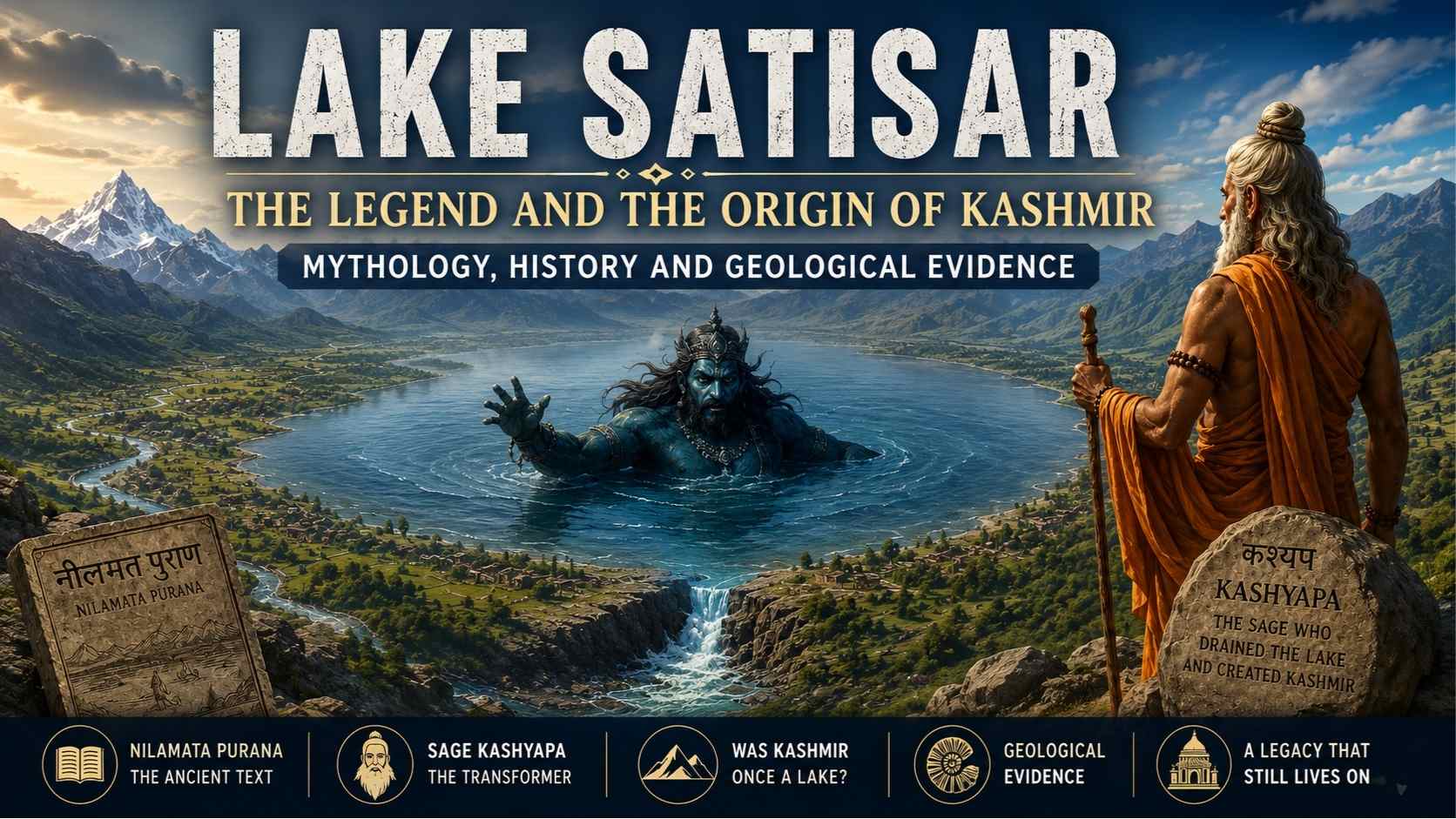
Lake Satisar is the legendary lake described in the Nilamata Purana as once covering the entire Kashmir Valley. According to Hindu tradition, Sage Kashyapa, also called Rishi Kashyapa, drained the lake with the help of the gods, defeated the water-born demon Jalodbhava, and made the valley fit for human settlement.
What makes this story especially fascinating is that modern geology also suggests the Kashmir Valley was once covered by a vast prehistoric lake. While mythology and science tell different stories about how the lake disappeared, both point to a time when Kashmir was entirely underwater.
The legend is also closely linked to the origin of the name Kashmir, which many traditional accounts derive from Kashyapa, crediting the sage with giving the valley both its identity and its earliest inhabitants
Kashmir’s Story Begins with a Lake
Every civilisation has a story that explains how its homeland came into being. For Kashmir, that story begins not with kings or kingdoms, but with water.
Long before orchards covered the valley floor and long before Srinagar emerged as its cultural heart, Hindu tradition describes Kashmir as an immense lake enclosed by the Himalayas. Known as Satisar, this vast body of water was believed to have covered the entire valley until Sage Kashyapa, aided by the gods, released its waters and made the land suitable for human settlement.
The narrative has endured for well over a thousand years because it occupies an unusual position in Indian tradition. It is simultaneously a sacred legend, a regional origin story and a cultural memory preserved in some of Kashmir’s oldest Sanskrit texts.
More remarkably, modern geological research has established that the Kashmir Valley was indeed occupied by a large freshwater lake during prehistoric times. While science explains the valley’s formation through tectonic activity and river erosion rather than divine intervention, both traditions begin with the same striking premise.
This convergence has attracted the attention of historians, geologists, archaeologists and scholars of religion alike. The legend cannot be treated as geological evidence, nor can geology validate its supernatural elements. Yet the broad correspondence between an ancient literary tradition and the physical history of the valley makes Lake Satisar one of the most compelling origin narratives in South Asia.
The Meaning of Satisar
The name Satisar derives from two Sanskrit words.
| Sanskrit | Meaning |
|---|---|
| Sati | Goddess Sati, the first consort of Lord Shiva |
| Sara (Sar) | Lake |
The name, therefore, translates as “The Lake of Sati.”
Within Hindu tradition, the association is deeply significant. Goddess Sati has long been linked with the Himalayan region, and the lake was regarded as a sacred landscape long before it became associated with the legend of Sage Kashyapa. It was not simply a geographical feature but a place imbued with divine presence, forming part of the spiritual geography of ancient Kashmir.
The Nilamata Purana: Kashmir’s Earliest Cultural Record
The earliest detailed account of Lake Satisar appears in the Nilamata Purana, a Sanskrit text devoted exclusively to Kashmir. Most scholars date its compilation between the sixth and eighth centuries CE, although many of the traditions preserved within it almost certainly originated centuries earlier through oral transmission.
Unlike the major Puranas that deal with universal cosmology or pan-Indian mythology, the Nilamata Purana is regional in scope. It records Kashmir’s rivers, mountains, sacred springs, festivals, rituals and local customs while explaining how the valley acquired its religious identity. For historians, it is one of the most valuable sources for understanding early Kashmir. For devotees, it remains an important sacred text. Digital manuscripts and scholarly resources are available through the Muktabodha Digital Library and the Muktabodha Indological Research Institute.
Rather than separating religion from geography, the text presents the landscape itself as sacred. Mountains, rivers and lakes are woven into a single narrative that explains both the physical and spiritual origins of the valley.
Kashmir Before Human Settlement
According to the Nilamata Purana, Kashmir did not begin as a fertile valley surrounded by snow-covered mountains. It existed as a vast inland lake enclosed by towering mountain ranges that prevented its waters from escaping.
Fed by countless streams flowing from glaciers and high-altitude snowfields, the lake dominated the entire basin. The surrounding slopes were covered with forests, while mist rising from the water gave the landscape an otherworldly appearance that later generations associated with gods, sages and celestial beings.
This description belongs to sacred literature, yet it is strikingly consistent with what geologists know about the valley’s distant past.
Modern geology identifies Kashmir as an intermontane basin, enclosed between the Great Himalayas and the Pir Panjal Range. During the Late Pliocene and Pleistocene epochs, tectonic uplift altered regional drainage patterns, allowing water to accumulate within the basin and form a large freshwater lake. The extensive Karewa deposits, which blanket significant parts of the valley today, preserve sediments that were laid down in this ancient lacustrine environment. Geological surveys published by the Geological Survey of India describe these deposits as some of the most important evidence for Kashmir’s prehistoric lake history.
The similarities between the ancient narrative and the geological record do not establish that one proves the other. They do, however, explain why the legend continues to attract scholarly attention.
Sage Kashyapa and the Birth of Kashmir
No figure is more closely associated with Kashmir’s origins than Sage Kashyapa.
Throughout Hindu literature, Kashyapa occupies an exceptional position. He is counted among the Prajapatis, the progenitors entrusted with populating creation, and his name appears in the Vedas, the Mahabharata and numerous Puranas. Many dynasties, communities and mythological lineages trace their ancestry to him.
His role in Kashmir, however, is unlike any other.
According to the Nilamata Purana, Kashyapa travelled through the Himalayan region while Lake Satisar still covered the valley. There, he encountered a land rendered uninhabitable by the presence of Jalodbhava, a powerful demon whose strength depended entirely upon the surrounding waters.
The demon’s name reflects his origin.
- Jala means water.
- Udbhava means born from.
Jalodbhava was therefore understood as “the one born from the waters.”
Protected by the immense lake, he prevented sages from living peacefully and made human settlement impossible. The legend transforms the lake into more than a physical landscape. It becomes a symbol of untamed power, capable of sustaining life while simultaneously concealing destructive forces beneath its surface.
Kashyapa’s Appeal to the Gods
Unable to overcome Jalodbhava through ordinary means, Kashyapa turned to spiritual discipline.
The Nilamata Purana describes him undertaking prolonged penance until his austerities attracted the attention of Brahma, Vishnu and Shiva. The gods recognised that the demon’s invincibility depended entirely upon the existence of Lake Satisar. As long as the valley remained submerged, Jalodbhava could not be defeated.
The solution was not to wage war against the demon.
It was to transform the landscape itself.
According to tradition, the mountains were opened at Varahamula, identified with present-day Baramulla, allowing the trapped waters to escape. As the lake drained, fertile land emerged across the valley floor. Deprived of his watery refuge, Jalodbhava was defeated, and Kashmir became suitable for human habitation.
Several centuries later, Kalhana’s Rajatarangini preserved variations of this foundational narrative while incorporating it into a broader history of Kashmir’s rulers. Sir Aurel Stein’s classic English translation, available through the Internet Archive, remains one of the most widely consulted editions of the chronicle.
For believers, the draining of Satisar marks the sacred beginning of Kashmir.
For historians, it represents one of India’s oldest and most influential regional origin traditions.
For geologists, it mirrors a landscape that genuinely evolved from a water-filled basin into the fertile valley that exists today, although through natural processes operating over millions of years rather than divine intervention.
That convergence between sacred memory and scientific evidence is what continues to distinguish the legend of Lake Satisar from countless other origin stories.

Rohit Tikoo is a published author, researcher, and content strategist with over two decades of writing experience. He is the author of nine books covering Kashmir, Indian philosophy, social issues, and contemporary thought, including Shadows Over the Valley: Operation TUPAC, Cold War Geopolitics, and the Kashmiri Pandits Exodus (2025).
His work focuses on Kashmir’s history, literature, culture, and the lived experiences of the Kashmiri Pandit community. Through extensive research, archival references, and historical analysis, he seeks to document and preserve narratives that are often overlooked in mainstream discourse. His writing on Kashmir has appeared in DAILY EXCELSIOR, HEADLINES TODAY, ONLY KASHMIR, GREATER KASHMIR, NAAD,
VITASTA, CHATTAN, AND VOICE OF SILENCE.
Through rohittikoo.com, he publishes research-based articles, essays, and commentary aimed at fostering informed discussion on Kashmir, Indian civilisation, literature, and contemporary society.