
Last verified: 30 August 2026
Editorial and legal note. The SIA Kashmir cases discussed in this article are examined strictly based on the available public record. An FIR, investigation, search, charge sheet or petition records allegations or investigative actions.
The Word at the End of the File
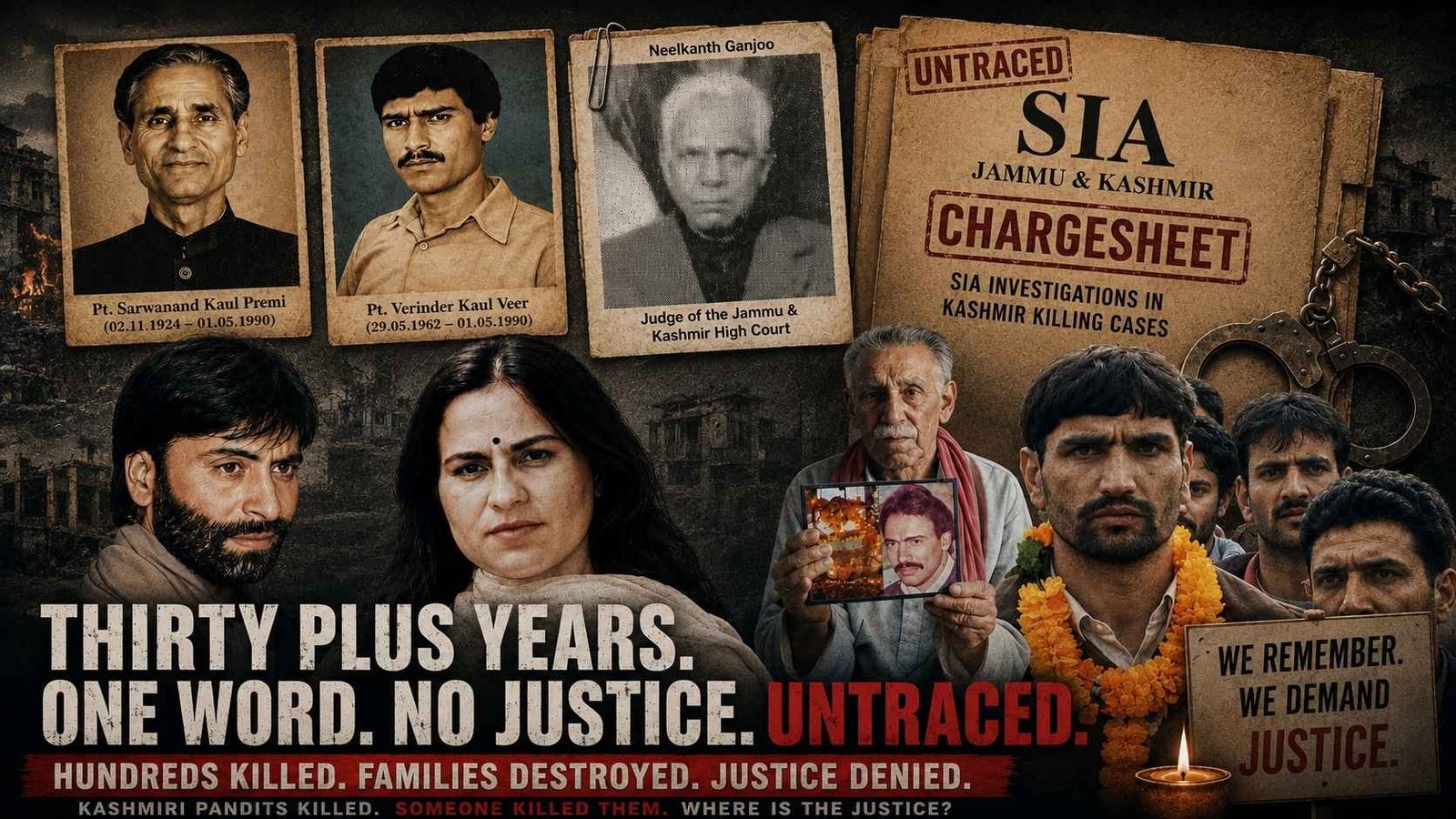
There is a word that Kashmiri Pandit families have been forced to encounter for far too long.
Untraced.
For more than three decades, hundreds of Kashmiri Pandits were killed. They did not kill themselves. They did not disappear from their own lives by choice. People killed them.
And yet, for generation after generation, families have been left waiting for the most basic answer that a civilised justice system owes to the family of a murdered citizen:
Who killed him?
That question should never have required three decades to answer.
It should never have been buried beneath the weight of official files, procedural delays, changing governments, investigations that went nowhere, prosecutions that failed to bring cases to their conclusion, or judicial proceedings that ultimately left families staring at the same terrible absence of justice.
A Kashmiri Pandit was murdered.
A family lost someone it loved.
A crime was committed.
And the State had a duty to find the perpetrators and bring them to justice.
That duty has not disappeared with the passage of time.
The Kashmiri Pandit community has already paid the price in blood, displacement, broken homes, shattered families and a generation raised with memories of those who never returned. What the community has too often been denied is the one thing that should have followed a murder: justice.
Governments may change. Administrations may change. Investigating agencies may change. Prosecutors may change. Judges may change. Decades may pass.
But the murder does not change.
Neither does the identity of the victim.
Neither does the grief of the family.
And neither does the State’s responsibility to pursue justice.
This is where the story of Kashmiri Pandit killings becomes impossible to reduce to statistics or historical footnotes. Every untraced case represents a human life that was taken and a family that was left without the justice it was entitled to expect from the Republic of India.
The question, therefore, is not merely why these cases were difficult to investigate after so many years.
The harder question is:
Why, after more than thirty years, are there still Kashmiri Pandit families waiting for justice for murders that were committed against their loved ones?
Where were the governments when these cases needed sustained institutional attention?
Where was the investigative urgency?
Where was the prosecution?
And where, ultimately, was the justice that the victims and their families were promised by the Constitution and the rule of law?
A justice system cannot ask a grieving family to wait indefinitely and then treat the passage of time as the reason justice has become impossible.
Justice delayed is justice denied.
For Kashmiri Pandits, that is not a slogan. It is the lived reality of families who have waited through decades for answers.
This article examines some of the cases that have returned to public attention through the investigations of the State Investigation Agency and, above all, the murder of Satish Tickoo, whose killing remains emblematic of the unresolved demand for justice among Kashmiri Pandits.
The question running through these files is brutally simple:
A Kashmiri Pandit was killed. Someone killed him. What happened to the pursuit of justice?
The SIA has prioritised five legacy cases: Tika Lal Taploo, Neelkanth Ganjoo, Sarla Bhat, Sarwanand Kaul Premi and his son Virender, and the Wandhama massacre, with dedicated teams of six to ten officers on each. Only one has produced a charge sheet, the killing of the nurse Sarla Bhat, filed on 29 June 2026 and naming five accused. The murder of Satish Tickoo is not on that list. It has moved only through his family’s own litigation in the Srinagar courts, and no order in it has been publicly reported since a hearing listed for 4 May 2023. There has been no conviction, and no acquittal, in any of them.
The five cases at a glance
| Case | Year | Victims | Status on 30 August 2026 |
|---|---|---|---|
| Neelkanth Ganjoo | 1989 | Retired judge, shot 4 November | Reopened by the SIA on 7 August 2023 with a public appeal for witnesses. No charge sheet reported. |
| Sarla Bhat | 1990 | SKIMS staff nurse, aged 27 | FIR 56/1990, Nageen PS. Transferred to the SIA on 18 March 2024. Searches August 2025. A 737-page charge sheet filed 29 June 2026 naming five accused. No cognisance reported. |
| Sarvanand Kaul Premi and Virender Kaul | 1990 | Poet and translator, and his son, aged 27 | FIR 45/1990, PS Dooru. Nine locations searched on 12 August 2026. No living accused named, no charge sheet reported. |
| Tika Lal Taploo | 1989 | Lawyer and BJP leader, shot in September | Under active SIA investigation as of August 2026. No charge sheet reported. |
| Wandhama massacre | 1998 | 23 Kashmiri Pandits, including nine women and four children | FIR 22/1998, Ganderbal PS, closed as untraceable on 15 June 1998. Reopening announced 26 August 2026. No named suspect. |
And, outside that list entirely:
| Case | Year | Victim | Status on 30 August 2026 |
|---|---|---|---|
| Satish Tickoo | 1990 | Businessman, shot on 2 February at Habba Kadal, Srinagar | Not an SIA case. A criminal revision petition brought by his brother is pending in the Srinagar Sessions Court. Last confirmed listing 4 May 2023. |
Six rows, six different distances from a courtroom.
Why the SIA is reopening old files
The agency doing this work is young. The Jammu and Kashmir State Investigation Agency was constituted on Monday 1 November 2021, on the model of the National Investigation Agency, and the chief of the CID wing serves as its ex officio director. The Home Department order mandated it to probe terror offences and cases registered under the Unlawful Activities (Prevention) Act, and required station house officers to inform the SIA immediately on the registration of a terror case. Its founding order also made it the nodal agency for terror investigations not referred to the NIA, and for coordinating with the NIA and other central agencies.
One clause is doing the heavy lifting here, and it is the quietest one. The Director General of Police can transfer a case to the SIA at any stage of an investigation. Not only a live case. Any case. A file that has sat in a district police station since 1990 can be lifted out of it by an administrative order and handed to a dedicated team. That is exactly what happened to the Sarla Bhat file on 18 March 2024, on the orders of the DGP.
Note also what these reopenings are not. Where an FIR number has been reported, the case rides on the original record rather than a new complaint: FIR 45/1990 at PS Dooru, FIR 56/1990 at Nageen, FIR 22/1998 at Ganderbal. That is precisely why further investigation was possible. Untraced is a police classification, not an acquittal or a discharge, so no judicial finding stood in the way of examining new leads.
Why this route, and not the courts
Because the courts had already said no.
On 24 July 2017, a Supreme Court bench of Chief Justice J.S. Khehar and Justice D.Y. Chandrachud dismissed a public interest petition by the organisation Roots in Kashmir seeking an investigation into more than 700 killings. ‘No evidence will be available after 27 years,’ the bench said. ‘What happened is heart-wrenching, but we can’t pass orders now.’ It added: ‘You sat over it for the last 27 years. Now tell us where the evidence will come from?’ ThePrint records that the court declined to reopen 215 cases that year.
Roots in Kashmir returned with a curative petition challenging a Supreme Court order of 27 April 2017. That too was dismissed, in December 2022, the bench holding that ‘in our opinion, no case can be made out within parameters indicated’. The court declined to intervene again in 2022 when approached over the Taploo killing.
So the approach changed. Not a blanket reinvestigation ordered by a court, but cases taken one at a time by the police, where something of the evidence survived.
The scale is contested
A 2008 survey by the Jammu and Kashmir police of its own cases recorded 209 Kashmiri Pandits killed, with 109 of those murders falling in 1989 and 1990. Kashmir Times, citing the same survey, reports that 140 cases were registered and charge sheets were filed in only 24. ThePrint puts it a third way: more than 200 killed, around 140 cases registered, and in 115 of them the perpetrators never identified.
Data placed before Parliament in 2017, also cited by Kashmir Times, is bleaker still. Of 174 registered cases of killing, 30 had been challaned and 142 were reported as untraced. There had been a conviction in one.
One conviction. That is the base rate against which every announcement of a reopened file should be read. Kashmiri Pandits themselves put the number of dead far higher, closer to a thousand, and that disagreement has never been resolved.
The words that decide everything
Most of the confusion around these cases is a vocabulary problem. Headlines flatten a dozen distinct legal events into one word, and a search becomes a conviction in the retelling.
- Search. Officers enter premises and seize material, usually under warrant. It proves nothing about guilt.
- Investigation. Evidence gathering. Reopening an untraced file means further investigation on the original FIR.
- Charge sheet. The final police report placing an accusation before a court. Across all six cases here, one exists.
- Cognisance and framing of charges. The court taking that report on file, then settling what each accused must answer. A trial begins only after that, and no report consulted here records either step in the Sarla Bhat case.
- Trial, conviction, acquittal. None has occurred in any of these cases.
- Bail. Release pending trial. It is not acquittal.
- Dismissal in default. A case thrown out because a party or counsel did not appear. Nothing is decided on the merits.
August 2023: the judge, and the first file to be opened again
The sequence begins with a man who had been dead for more than thirty-three years.
Justice Neelkanth Ganjoo was a retired judge. He had sentenced the JKLF founder Maqbool Bhat to death for the murder of the police inspector Amar Chand, and Bhat was executed in 1984. On 4 November 1989, Justice Ganjoo was shot dead by JKLF militants. The exposure that killed him was that he had done his job on the bench two decades earlier.
Nothing happened for a very long time. Then, on Monday 7 August 2023, the SIA reopened the case, and did so in the most public way available to it: by asking the people of Kashmir for help.
The agency appealed to anyone ‘familiar with the facts or circumstances’ of the killing, sought accounts with a ‘direct or indirect bearing’ on it, and said its object was to unearth the larger criminal conspiracy behind the assassination. It promised that ‘the identity of all such persons shall be kept completely hidden and protected, besides all useful and relevant information shall be suitably rewarded’.
Read that carefully, because it tells you what these investigations actually are. Thirty-three years on, the state was not announcing a breakthrough. It was advertising for witnesses.
The reinvestigation of the Ganjoo case was, according to IANS, the first case from the 1989 to 1990 killings to be reopened by the Government of India. Everything that follows came after it.
2024 to 2026: Sarla Bhat, and the only charge sheet
Sarla Bhat was twenty-seven. She came from Qazibagh in Anantnag, and she was a staff nurse at the Sher-i-Kashmir Institute of Medical Sciences at Soura, living in the hospital hostel.
The case was registered as FIR 56/1990 at Nageen police station, against unidentified militants, under sections 302 and 120B of the Penal Code with section 3(2) of TADA. Then it went into cold storage.
What the charge sheet alleges
The prosecution case begins with a police raid. On 8 April 1990, officers raided Narwara. Several JKLF militants were arrested, and Yasin Malik allegedly sustained injuries while escaping. The JKLF, the SIA says, then accused Sarla Bhat of having informed on them. The agency’s position is that this accusation was a pretext for an already planned targeted killing, and it calls the informer allegation a fabricated pretext.
She was abducted from the vicinity of SKIMS on 18 April 1990, tortured, and shot dead with an automatic rifle at Omer Colony, Malbagh, in Srinagar. Her body was found at Mallabagh with multiple bullet wounds and a handwritten note. ThePrint’s ground report gives its wording: ‘This girl has been killed by JKLF for being a mukhbir to the CID’, with two JKLF signatures on it.
The dates are not settled. One report gives 14 April. Her own family places the abduction on 12 April and commemorates 12 to 14 April every year, because the exact date of her death remains unknown to them.
A family that cannot fix the date of a death has been failed twice.
What the charge sheet does not allege
Several outlets have headlined this as a rape and murder case. The charge sheet contains no allegation of rape, and the 1990 police record was one of murder.
Her family’s position is more specific still. ThePrint’s ground report records that the post-mortem ruled out rape while confirming brutal torture, including cigarette burns on her wrists and neck. The same report records the family’s distress at a persistent online confusion between Sarla Bhat’s killing and that of another Kashmiri Pandit woman, with incorrect photographs circulating as a result.
Remembering her accurately is part of remembering her at all. This article keeps the two cases apart for that reason.
The charge sheet, in precise terms
The file was transferred to the SIA on 18 March 2024 on the orders of the DGP. Searches followed in August 2025, including eight locations across Srinagar district and the residence of Yasin Malik, and an earlier round in central Kashmir that took in the home of the former JKLF leader Peer Noorul Haq Shah. The agency called the searches strategic and said they had recovered incriminating evidence ‘which could help uncover the broader terrorist conspiracy’.
Investigators then did the slow work. They traced witnesses now in their eighties, and one officer said it took almost a year to find the eyewitnesses and persuade them to testify. Statements were recorded from protected witnesses under sections 161 and 164 of the Code of Criminal Procedure. ThePrint reported that fresh ballistic examination had found all three cartridges recovered from the scene were fired from the same firearm used by JKLF operatives.
On 29 June 2026, the SIA filed a 737-page charge sheet before the Court of the Additional Sessions Judge (TADA and POTA), the Special Judge designated under the NIA Act at Srinagar. It invokes sections 364, 341, 302 read with 34, 201 and 120-B of the Penal Code (reported as the Indian Penal Code by ThePrint and as the Ranbir Penal Code by Republic World), sections 3(2), 3(3), 4 and 6 of TADA 1987, and sections 7 and 27 of the Arms Act 1959.
Five men are named. Mohammad Yasin Malik, then JKLF chief commander, as the alleged principal conspirator, in judicial custody in a different matter. Khurshid Ahmad Chalkoo, the alleged shooter, is absconding and believed to be in Pakistan-occupied territory. Abdul Hamid Sheikh, Mohammad Yousuf Sofi alias Idrees, and Ghulam Mohammad Taploo, all dead.
‘The investigation has conclusively established that the killing of Bhat was not an isolated act of violence but part of a larger terrorist conspiracy orchestrated under the command and control of the Jammu and Kashmir Liberation Front,’ the agency said. It called the filing ‘a historic milestone in the pursuit of justice for victims of terrorism’, and added: ‘No matter how many years have elapsed, those responsible for terrorist atrocities will continue to remain answerable before the law.’
Yasin Malik is already serving a life sentence imposed on 25 May 2022 by Special Judge Praveen Singh of the special NIA court, on two counts: section 121 of the Indian Penal Code, for waging war against the Government of India, and section 17 of the UAPA, for raising funds for a terrorist act. That is a separate case.
The defence
The JKLF rejects the charge sheet outright. Its spokesman says ‘the JKLF, in general, and Muhammad Yasin Malik, in particular, has nothing to do with the gruesome murder case of Sarla Bhat’, and offers an alibi: that Malik jumped from a five-storey building on 8 April 1990, that he ‘was not able even to move from his bed due to his worst health condition’, and that ‘his head injury, which caused his facial paralysis, was so severe that it took him over two months to stand up’. The organisation also says it ran its own inquiry and had reached close to a culprit from outside the party but could not carry it forward because of raids on its leadership.
Set the two accounts side by side, and they agree on one thing only. Something happened to Yasin Malik on 8 April 1990. The prosecution says he was injured escaping a police raid and that Sarla Bhat died ten days later because of what followed. The defence says he was injured falling from a building and could not get out of bed. A court has ruled on neither.
As of 30 August 2026, no report records cognisance, framing of charges, a hearing date, a trial, a conviction or an acquittal.
Our earlier report covers the raids that led to the charge sheet in more detail.
August 2026: the poet, his son, and the houses of a dead man’s family
Sarvanand Kaul Premi, whose name is also transliterated as Sarwanand Koul Premi across the reporting, was born in Anantnag in 1924. He was a poet and a translator who put the Bhagavad Gita, the Ramayana and Rabindranath Tagore’s Gitanjali into Kashmiri. He had been a Quit India man, arrested six times, and in 1946 Mahatma Gandhi sent him a framed poem.
He was living at Soaf Shali, at Kokernag in Anantnag district, when armed militants took him from his house on the night of 29 April 1990, along with his son Virender, who was twenty-seven. Their tortured bodies were found hanging from a tree on 1 May 1990.
The case was registered as FIR 45/1990 at Police Station Dooru. There it stayed, with the Anantnag district police, until it too went to the SIA.
On 12 August 2026, the agency searched nine locations. The accounts of where differ: Outlook reported nine locations across Anantnag district and the Bagh-e-Bahu area of Jammu, while Daily Excelsior reported six places in Rajouri district, two in Jammu and one in Baramulla.
Daily Excelsior is more specific about why. It reports that the searches centred on the family of a man named Sher Khan, of Gambhir Mugalan in Rajouri, described as a dreaded terrorist who was himself killed at Bhata in Doda district within a couple of years of the 1990 killings. ‘Today’s raids were conducted at the houses of family members of Sher Khan to get clues about him,’ the agency is quoted as saying. Documents and electronic gadgets were seized for examination.
Consider the shape of that. The man the SIA is chasing has been dead for more than thirty years. It is searching his relatives’ houses, in a district a long way from Anantnag, for paper.
A police officer quoted by ThePrint offered the official gloss: ‘many crucial and previously undisclosed details in this 1990 case have now been uncovered decades later through the painstaking efforts of the SIA’. Officials described the searches as a significant development intended to ‘uncover the circumstances surrounding the killings and bring the probe to a decisive end’.
None of the reporting names a living accused, and none records a charge sheet.
The family has meanwhile spent decades knocking on non-judicial doors. In April 2024, the National Human Rights Commission directed the Jammu and Kashmir chief secretary to deal with the issue of the slain poet’s family with a humane approach.
Tika Lal Taploo: the earliest killing, still without a charge sheet
Tika Lal Taploo was a lawyer and a BJP leader, shot dead in September 1989, before Ganjoo and before all of the rest. Sources differ on the day: Daily Excelsior gives 13 September 1989, ThePrint gives 14 September.
His is among the files the SIA is now working. In August 2026, Daily Excelsior reported that after the Sarla Bhat and Premi cases, the agency had accelerated its work on the Ganjoo, Taploo and Wandhama killings. A source told the paper: ‘There has been a significant breakthrough in some of the cases which have been reopened after three to three and a half decades.’ Organiser reported that the agency had ‘succeeded in identifying terrorists, Over Ground Workers (OGWs) and others involved’.
No charge sheet has been reported.
August 2026: Wandhama, and a boy of fourteen
On the night of 25 January 1998, the eve of Republic Day, armed men in army fatigues entered a house in Wandhama village in Ganderbal district on the pretext of having tea, and opened fire on the family and their neighbours.
Twenty-three people were killed: ten men, nine women and four children, drawn from four Kashmiri Pandit families who had not migrated. Five of the dead were relatives visiting from Jammu.
One person survived. Vinod Kumar, known as Ashu, was fourteen.
Who did it has never been legally determined
This is where the record turns genuinely murky, and it should be stated plainly rather than settled by preference.
FIR 22/1998 was registered at Ganderbal police station under sections 30, 436 and 295 of the Ranbir Penal Code with sections 7 and 27 of the Arms Act. Farooq Abdullah blamed Lashkar-e-Taiba. The police later pointed to Harkat-ul-Ansar. A letter from a group calling itself Intikaam-ul-Muslimoon claimed responsibility.
The local militant most often blamed is Hamid Gada, known as Bombar Khan, described as a Hizb commander, who was himself shot dead by the Rashtriya Rifles on 13 March 2000.
In 2012, the police told the state Human Rights Commission that an injured Harkat-ul-Ansar militant had confessed that the twenty-three Kashmiri Pandits were killed by twenty-one militants acting under the orders of a man he named as Captain Shair Khan. No identities were disclosed publicly.
Twenty-eight years after the killings, on 26 August 2026, the SIA announced that it had reopened the investigation, saying it was acting to ‘re-launch probes into unresolved terror incidents involving the targeted killings of the minority Kashmiri Pandit community and to heal decades-old scars’. A senior official told The Tribune the case was among those ‘being reopened to take the older cases to their logical conclusion and ensure justice for the victims’.
There is no named suspect on the public record, no arrest and no charge sheet. Our account of the night itself is in the Wandhama massacre.
Satish Tickoo: the case a family is fighting on its own
This is the point most often got wrong, so state it flatly. Satish Tickoo, whose name also appears as Satish Tikoo, is not among the SIA’s prioritised cases. He appears in none of the published lists of the reopened files.
He was a Kashmiri Pandit businessman, killed on 2 February 1990 in the Habba Kadal locality of Srinagar. His case belongs in this account anyway, because it shows what the alternative route to a courtroom looks like when the state is not the one walking it.
What the family is actually asking for
The litigation is narrow and technical, and that is exactly what makes it revealing.
On 19 July 2021 the victim’s brother, Maharaj Krishan Tickoo, filed an application under section 156(3) of the Code of Criminal Procedure before a magistrate, seeking completion of the investigation and the filing of a charge sheet.
He was not asking a court to convict anybody. He was asking it to make the police finish the file.
On 1 September 2021 the application was dismissed in default, for the non-appearance of counsel. The petitioner’s case is that this was not neglect: counsel told the court staff that adequate security arrangements, required under a Ministry of Home Affairs notification made on Supreme Court orders, had not been provided by the CRPF, and sought an adjournment rather than proceed without protection.
Nothing was decided about the murder. A thirty-one-year-old case died over an attendance dispute.
A criminal revision petition followed, before the Sessions Court at Srinagar, seeking to set aside the order of 1 September 2021 and restore the application to where it stood before the magistrate.
The hearing record then reads as a study in attrition. The petition was reported on 31 March 2022, with the next hearing set for 16 April. ‘I hope that with the commencement of hearing on this case, the family of the late Satish Kumar Tickoo will get justice,’ said the family’s advocate, Utsav Bains, at the time. In May 2022, a hearing was adjourned because the petitioner and counsel did not appear, and Bains said he intended to ask the High Court of Jammu and Kashmir and Ladakh to transfer the case, citing security. The police denied failing to provide it. On 31 March 2023, the sessions court listed the revision for 4 May.
Then the trail stops. No source consulted here records any order on or after 4 May 2023.
Set that beside the SIA files, and the contrast is the point. When the state takes a case up, nine houses are searched in a morning, and witnesses in their eighties are traced over a year. When a family has to do it alone, the years go on procedure.
In August 2026, Rakesh Handu, a social and political activist and a close friend of Satish Tickoo, publicly sought a fast-track trial. ‘Justice delayed is genocide denied,’ he said.
Bitta Karate’s legal position, stated precisely
Precision here protects everyone, the victim’s memory included.
Farooq Ahmed Dar, known as Bitta Karate, was arrested in Srinagar in June 1990 by the Border Security Force and detained under the Public Safety Act, with more than nineteen cases registered against him. He spent about sixteen years in custody without a conviction.
In 2006 he was released on indefinite bail. The reasoning of Judge N.D. Wani is worth quoting in full, because it is the single most damning line in this entire history: ‘The court is aware of the fact that the allegations against the accused are of a serious nature and carry a punishment of death sentence or life imprisonment, but the fact is that the prosecution has shown total disinterest in arguing the case.’
Bail is not acquittal. He was later re-arrested by the National Investigation Agency in a terror-financing case, and is held in Tihar Jail. That matter is unrelated to the killing of Satish Tickoo.
On that killing, the position is unambiguous. He is an accused. He has never been tried or convicted for it, and no charge sheet in the case appears on the public record.
His recorded claims are reported variously. Rahul Pandita’s account records an interview after his arrest in which he confessed to killing around twenty people, most of them Kashmiri Pandits, and identified Satish Tickoo as his first victim. A 1991 interview is reported as a claim of more than twenty. He later retracted, and after his 2006 release, questioned by journalists, ‘a nervous Karate kept on repeating that he hadn’t killed anyone and that it was for the judiciary to decide whether he is guilty or not’.
The retraction must travel with the quotation, every time. Whether the video is admissible, and what weight it carries, is for a court and not for a headline.
Evidence problems after thirty-six years
The 2017 Supreme Court question still hangs over all of this: where will the evidence come from?
The documented answer is uncomfortable. In the Sarla Bhat case, a report on the interrogation of one militant has gone missing, and weapons seized in April 1990 were never subjected to ballistic analysis at the time. Suspects are dead. Witnesses are in their eighties. In one instance, an entire case file went missing, so the SIA could not take it over at all.
One officer put the reason plainly: in the 1990s, cases were registered, but no probes were carried out. Another summed up the Sarla Bhat investigation: ‘This was a tough investigation. Several suspects dead, limited evidence, but the teams worked hard to take it to a logical conclusion.’
Open, in an assessment published on 25 August 2026, set out the structural obstacles: deteriorated crime scenes and physical evidence, displaced witnesses and degraded memories, dead suspects, suspects outside Indian jurisdiction, and testimony given so long after the event that it needs corroboration which no longer exists. Indian law sets no limitation period on murder, which is why a 1990 killing can be charged in 2026 at all. The evidentiary burden is another matter entirely.
The Tickoo case failed differently. That failure was procedural, not evidentiary: an application died in default over a security dispute that the police contradicted on the record. Two failures, two different remedies. One needs forensics. The other needed a lawyer in a courtroom.
The cases nobody has reopened
Two massacres are missing from the list, and between them they show how these prosecutions fail after the investigation stage.
At Sangrampora in March 1997, Kashmiri Pandit villagers were shot; Kashmir Life’s reconstruction of that night names eight men, one of whom survived. That account records what became of the case in a single sentence: ‘Police registered the FIR, investigated it and finally closed the case saying the culprits are untraced.’ The survivor, Ashok Kumar Pandit, is reported to have changed his statement more than once and to have stopped speaking about it. Our account of the Sangrampora massacre covers the night itself.
At Nadimarg in Pulwama district on 23 March 2003, twenty-four Kashmiri Pandits were killed and, by Outlook’s account, fifty-two others were injured. That case did reach a court, and then stopped there. The trial stalled because witnesses had moved out of the Valley and could not be produced. The prosecution asked to examine them on commission, the trial court refused, and the High Court initially dismissed the appeal. In 2022, the High Court revisited its own order and directed that the witnesses be examined by video link and the matter concluded quickly. Our account of the Nadimarg massacre sets out the killings.
Nadimarg is the warning. It is a case with named accused, a live prosecution and a High Court pushing it along, and it has been in and out of court for more than two decades because the people who saw it happen no longer live where it happened.
Two readings of the same police operation
The reopening is read very differently on either side of this argument, and both readings belong in the record.
Among Kashmiri Pandit commentators, the response has been welcoming and impatient at once. Writing in The Sunday Guardian on 4 July 2026, Vivek Gumaste called the SIA’s action ‘a welcome step in the right direction’ and ‘a case of better late than never’.
The families are less generous. Sarla Bhat’s uncle, Moti Lal, put the question that thirty-five years earns you the right to ask: ‘How come you all have woken up now? Where were you for the last 35 years?’
From the other direction, the objection is that the selection is political. A Kashmir Times editorial of 12 August 2025 argued that ‘the selective reopening of these cases appears to serve political rather than judicial purposes’, called it a ‘selective theatre’ that ‘promises much but delivers little’, and held that ‘when cases of delays in justice become tools to serve political convenience rather than truth-seeking, it is not just a case of denying justice, it is one of perverting justice’. Kashmir Media Service reported on 23 August 2026 that the renewed investigations ‘have raised concerns among Kashmiris over the continued use of old cases to subject people to searches, questioning, surveillance and arrests’.
Both things can be true of the same police operation. A search that a victim’s family experiences as the first movement in thirty-six years is experienced by the household being searched as a raid. And an agency that reopens five files out of a hundred and forty invites, fairly, the question of who chose those five.
What to watch next
Announcements are cheap. These specific events would change the legal position.
- Cognisance and charges in the Sarla Bhat case, and which provisions survive against which accused.
- A production warrant for Yasin Malik, and proclamation proceedings against the absconding accused.
- Sarwanad Premi and his son charge sheet, and whether anyone living is named in it.
- Wandhama’s attribution, and whether the 2012 account of twenty-one militants is ever tested or the identities disclosed.
- The Satish Tickoo revision, meaning any order after the 4 May 2023 listing, and whether the case is transferred to the SIA as its supporters demand.
- Whether the list grows. Five reopened files against 115 cases in which no perpetrator was ever identified is a very small proportion, and every other bereaved family sits on the wrong side of that ratio.
The measure of this
A retired judge whose file was reopened by newspaper advertisement. A nurse whose family still cannot fix the date of her death, and whose case has now produced 737 pages before a designated court. A poet and his son, found hanging from a tree, with the agency searching a dead man’s relatives for documents. A lawyer shot in September 1989, still without a charge sheet. Twenty-three villagers, untraced since June 1998, in an investigation reopened four days before this article was verified. And a businessman shot at Habba Kadal, whose brother’s application to make the police finish the job was thrown out because counsel did not appear.
No convictions. No acquittals. One charge sheet.
The reopenings are worth something real. Court-authorised searches, protected witness statements under section 164 and fresh ballistics are genuine investigative work, not gestures. But for thirty-six years the word attached to too many of these files was untraced, and by the 2017 parliamentary count it still attaches to 142 of them.
Justice here will not be measured by how many files were opened. It will be measured by whether a judge, in open court, tests the evidence and says what happened.
Until then, keep the names exact, keep the stages straight, and keep asking for the next date.
Frequently asked questions
Which Kashmiri Pandit cases has the SIA reopened?
Five, in this order: Justice Neelkanth Ganjoo, reopened on 7 August 2023; Sarla Bhat, transferred to the agency on 18 March 2024; Sarvanand Kaul Premi and his son Virender, searched in August 2026; Tika Lal Taploo, under active investigation in August 2026; and the 1998 Wandhama massacre, reopened on 26 August 2026.
Which case was reopened first?
The killing of Justice Neelkanth Ganjoo. The SIA reopened it on 7 August 2023 with a public appeal for information, and according to IANS, it was the first case from the 1989 to 1990 killings to be reopened by the Government of India.
Has anyone been convicted in any of these cases?
No, and there has been no acquittal either, as of 30 August 2026. One charge sheet exists, in the Sarla Bhat case. Data placed before Parliament in 2017 recorded a conviction in one of 174 registered cases of killing.
Is Yasin Malik on trial for Sarla Bhat’s murder?
Not yet. A charge sheet naming him as the alleged principal conspirator was filed on 29 June 2026. A court must take cognisance and frame charges before any trial begins, and no report consulted here records either step.
Was Sarla Bhat raped?
The charge sheet contains no allegation of rape, and the 1990 police record was one of murder. Her family says the post-mortem ruled out rape while confirming brutal torture, including cigarette burns. Her family has also complained about a persistent online confusion of her case with that of another Kashmiri Pandit woman, including the circulation of wrong photographs.
Who is named in the Sarla Bhat charge sheet?
Five men: Mohammad Yasin Malik as alleged principal conspirator, in custody in a different case; Khurshid Ahmad Chalkoo as the alleged shooter, absconding and believed to be in Pakistan-occupied territory; and three deceased men, Abdul Hamid Sheikh, Mohammad Yousuf Sofi alias Idrees and Ghulam Mohammad Taploo.
What are the FIR numbers in these cases?
Sarla Bhat is FIR 56/1990 at Nageen police station, Srinagar. Sarvanand Kaul Premi and Virender Kaul is FIR 45/1990 at Police Station Dooru, Anantnag. Wandhama is FIR 22/1998 at Ganderbal police station. No FIR number for the Satish Tickoo case appears in any report consulted here.
Who carried out the Wandhama massacre?
No court has determined that. The 1998 FIR was followed by competing attributions: Farooq Abdullah blamed Lashkar-e-Taiba, the police later pointed to Harkat-ul-Ansar, and a group calling itself Intikaam-ul-Muslimoon claimed responsibility by letter. The local militant most often blamed, Hamid Gada alias Bombar Khan, described as a Hizb commander, was killed on 13 March 2000.
Did anyone survive Wandhama?
One eyewitness was Vinod Kumar, known as Ashu, who was fourteen at the time.
Why is the Satish Tickoo case not with the SIA?
It does not appear in any published list of the agency’s reopened cases. In August 2026, Rakesh Handu, a social and political activist and a close friend of the victim, publicly sought a fast-track trial in the case.
What exactly is pending in the Satish Tickoo case?
A criminal revision petition before the Srinagar Sessions Court, seeking to set aside the order of 1 September 2021 which dismissed in default an application filed on 19 July 2021 by his brother, Maharaj Krishan Tickoo, under section 156(3) of the Code of Criminal Procedure. That application asked the magistrate to have the investigation completed and a charge sheet filed. The last confirmed listing was 4 May 2023, and no order on or after that date has been publicly reported.
Has Bitta Karate ever been convicted of murder?
No. Farooq Ahmed Dar spent about sixteen years in custody without conviction and was released on indefinite bail in 2006, the judge recording that ‘the prosecution has shown total disinterest in arguing the case’. Bail is not acquittal, and he has never been tried for the killing of Satish Tickoo.
What about his recorded confession?
He made recorded claims about killing Kashmiri Pandits, reported as around twenty and as more than twenty in different accounts, and later retracted them. After his 2006 release, he told journalists he had killed nobody and that it was for the judiciary to decide.
Can a murder from 1990 still be prosecuted in India?
Yes. Indian law sets no limitation period for murder, so elapsed time does not bar a prosecution. The obstacles are evidentiary rather than procedural: degraded crime scenes, displaced witnesses, dead suspects and suspects beyond Indian jurisdiction.
Why did the Supreme Court refuse to order an investigation?
In July 2017, a bench of Chief Justice J.S. Khehar and Justice D.Y. Chandrachud dismissed a petition by Roots in Kashmir on the ground that evidence would not be available after 27 years, telling the petitioners they had ‘sat over it for the last 27 years’. A curative petition was dismissed in December 2022.
Is the SIA the same as the NIA?
No. The State Investigation Agency is a Jammu and Kashmir police body, constituted on 1 November 2021, whose ex officio director is the chief of the CID wing. It is the nodal agency for terror investigations not referred to the National Investigation Agency, which is a central body, and for coordinating with the NIA.
Sources
- Ananya Bhardwaj, ‘Old files, new leads: How J&K’s SIA is probing decades-old unsolved killings of Kashmiri Pandits’, ThePrint, 27 August 2026. https://theprint.in/india/old-files-new-leads-how-jks-sia-is-probing-decades-old-unsolved-killings-of-kashmiri-pandits/3025597/
- Ananya Bhardwaj, ‘Dead suspects, scarce evidence and a 35-year wait: J&K cops to file chargesheet in Sarla Bhat murder’, ThePrint, 28 June 2026. https://theprint.in/india/dead-suspects-scarce-evidence-a-35-year-wait-jk-cops-to-file-chargesheet-in-sarla-bhat-murder/2971613/
- ’36 yrs after Sarla Bhat murder, Yasin Malik named main accused in J&K SIA chargesheet’, ThePrint, 29 June 2026. https://theprint.in/india/36-yrs-after-sarla-bhat-murder-yasin-malik-named-main-accused-in-jk-sia-chargesheet/2972973/
- Sagrika Kissu, ‘A handwritten note, 2 signatures, only dead ends: Sarla Bhat murder is no easy case’, ThePrint, 17 August 2025. https://theprint.in/ground-reports/a-handwritten-note-2-signatures-only-dead-ends-in-kashmir-sarla-bhat-murder-is-no-easy-case/2722566/
- ’36 years later, probe into 1990 killing of Kashmiri Pandit writer Sarwanand Premi, son picks up pace’, ThePrint, 12 August 2026. https://theprint.in/india/36-years-later-probe-into-1990-killing-of-kashmiri-pandit-writer-sarwanand-premi-son-picks-up-pace/3012361/
- ‘SIA files 737-page chargesheet naming Yasin Malik in 1990 Sarla Bhat killing case’, Republic World, 29 June 2026. https://www.republicworld.com/india/sia-files-737page-chargesheet-naming-yasin-malik-in-1990-sarla-bhat-killing-case-2026-06-29-130497
- ‘Sarla Bhat murder case: SIA files 737-page chargesheet against Yasin Malik’, Organiser, 29 June 2026. https://organiser.org/2026/06/29/360273/bharat/sarla-bhat-murder-case-sia-files-737-page-chargesheet-against-yaseen-malik-jklf-targeted-kashmiri-hindus/
- ‘Sarla Bhat murder: SIA charges Yasin Malik, 4 others after 35 yrs’, Greater Kashmir, 30 June 2026. https://www.greaterkashmir.com/security/sarla-bhat-murder-sia-charges-yasin-malik-4-others-after-35-yrs-12118575
- ‘SIA Kashmir files 737-page chargesheet in the 1990 abduction, torture and killing of SKIMS nurse Sarla Bhat’, PGurus, 29 June 2026. https://www.pgurus.com/sia-kashmir-files-737-page-chargesheet-in-the-1990-abduction-torture-and-killing-of-skims-nurse-sarla-bhat-35-year-old-terror-case-reaches-a-historic-milestone/
- ‘Yasin Malik faces trial in Sarla Bhat rape-murder case 35 years after brutal crime’, WION, 29 June 2026. https://www.wionews.com/india-news/yasin-malik-faces-trial-in-sarla-bhat-rape-murder-case-35-years-after-brutal-crime-instilled-fear-in-kashmiri-pandits-triggered-exodus-1782752930044
- ‘JKLF rejects charges linking Yasin Malik to Sarla Bhat murder, alleges political victimisation ‘, Daily Parliament Times, 1 July 2026. https://www.dailyparliamenttimes.com/2026/07/01/jklf-rejects-charges-linking-yasin-malik-to-sarla-bhat-murder-alleges-political-victimization/
- ‘SIA names Yasin Malik, 4 others in Sarla Bhat murder case’, Daily Excelsior, 30 June 2026. https://www.dailyexcelsior.com/sia-names-yasin-malik-4-others-in-sarla-bhat-murder-case/
- ‘SIA raids 9 places of slain terrorist Sher Khan of Rajouri in Premi, son’s killings’, Daily Excelsior, 13 August 2026. https://www.dailyexcelsior.com/sia-raids-9-places-of-slain-terrorist-sher-khan-of-rajouri-in-premi-sons-killings/
- ‘After Sarla Bhat, Premi cases: SIA speeds up probe in Ganju, Taploo, Wandhama killings’, Daily Excelsior, 23 August 2026. https://www.dailyexcelsior.com/after-sarla-bhat-premi-cases-sia-speeds-up-probe-in-ganju-taploo-wandhama-killings/
- ‘1990 Kashmiri Hindus killings case in J&K: SIA Kashmir conducts raids across the state’, Organiser, 12 August 2026. https://organiser.org/2026/08/12/374799/bharat/1990-kashmiri-hindus-killings-case-in-jk-sia-kashmir-conducts-raids-across-the-state/
- ‘SIA pursuing leads in cold cases like Wandhama massacre’, Organiser, 24 August 2026. https://organiser.org/2026/08/24/376680/bharat/jk-sia-pursuing-leads-in-cold-cases-like-wandhama-massacre-killings-of-judge-neel-kanth-ganju-tika-lal-thaploo/
- ‘J&K SIA searches nine places in 1990 Kashmiri Pandit killing probe’, Outlook India, 12 August 2026. https://www.outlookindia.com/national/jk-sia-searches-nine-places-in-1990-kashmiri-pandit-killing-probe
- ‘1990 killing of Pandit poet: SIA conducts raids at 9 locations in J&K’, Brighter Kashmir, 13 August 2026. https://brighterkashmir.com/1990-killing-of-pandit-poet-sia-conducts-raids-at-9-locations-in-jk
- ‘SIA conducts raids in Srinagar over 1990 killing of KP woman’, The Tribune, 13 August 2025. https://www.tribuneindia.com/news/j-k/sia-conducts-raids-in-srinagar-over-1990-killing-of-kp-woman
- ‘Killing of Kashmiri Pandit woman in 1990: SIA carries out raids in central Kashmir’, The Tribune, 12 August 2025. https://www.tribuneindia.com/news/j-k/killing-of-kashmiri-pandit-woman-in-1990-sia-carries-out-raids-in-central-kashmir
- ‘Nearly 3 decades on, SIA reopens Wandhama massacre investigation’, The Tribune, 25 August 2026. https://www.tribuneindia.com/news/j-k/nearly-3-decades-on-sia-reopens-wandhama-massacre-investigation/
- ‘Explainer: As 1998 Wandhama massacre probe reopens’, The Tribune, 29 August 2026. https://www.tribuneindia.com/news/explainers/explainer-as-1998-wandhama-massacre-probe-reopens/
- ‘Nearly 3 decades on, SIA reopens probe into Wandhama massacre of 23 Kashmiri Pandits’, The Kashmir Images, 26 August 2026. https://thekashmirimages.com/2026/08/26/nearly-3-decades-on-sia-reopens-probe-into-wandhama-massacre-of-23-kashmiri-pandits/
- ‘SIA reopens probe into Wandhama massacre of 23 Kashmiri Pandits’, The Northlines, 26 August 2026. https://thenorthlines.com/sia-reopens-probe-into-wandhama-massacre-of-23-kashmiri-pandits/
- Bilal Handoo, ’21 years later, Wandhama massacre’s untraceable closure still evokes conflicting memories’, Free Press Kashmir, 28 January 2019. https://freepresskashmir.news/2019/01/28/21-years-later-wandhama-massacres-untraceable-closure-still-evokes-conflicting-memories/
- ‘1989 J&K judge murder probe reopened’, The Tribune, 8 August 2023. https://www.tribuneindia.com/news/j-k/1989-jk-judge-murder-probe-reopened-2
- ‘SIA reopens inquiry into murder of Neelkanth Ganjoo three decades after he was killed in Kashmir by JKLF ultras’, The Tribune, 8 August 2023. https://www.tribuneindia.com/news/j-k/sia-reopens-inquiry-into-murder-of-neelkanth-ganjoo-3-decades-after-he-was-killed-in-kashmir-by-jklf-ultras-533035
- ‘J&K: SIA seeks information on assassination of retired judge Neelkanth Ganjoo in 1989’, NewsClick, 8 August 2023. https://www.newsclick.in/jk-sia-seeks-information-assassination-retired-judge-neelkanth-ganjoo-1989
- ‘J-K: After 34 years, SIA reopens Justice Neelkanth Ganjoo murder case to unearth larger criminal conspiracy’, India TV News, 8 August 2023. https://www.indiatvnews.com/jammu-and-kashmir/jammu-and-kashmir-state-investigation-agency-reopens-justice-neelkanth-ganjoo-murder-case-to-unearth-criminal-conspiracy-2023-08-08-885523
- ‘On lines of NIA, J&K forms SIA to probe terror cases’, The Tribune, 3 November 2021. https://www.tribuneindia.com/news/j-k/on-lines-of-nia-jk-forms-sia-to-probe-terror-cases-333545
- ‘Jammu and Kashmir gets new state investigation agency for terror-related cases’, Scroll.in, 2 November 2021. https://scroll.in/latest/1009584/jammu-and-kashmir-gets-new-state-investigation-agency-for-terror-related-cases
- ‘Killing of Satish Tickoo in 1990: Sessions Court lists revision plea on May 4’, Greater Kashmir, 31 March 2023. https://www.greaterkashmir.com/srinagar/killing-of-satish-tickoo-in-1990-sessions-court-lists-revision-plea-on-may-4/
- ‘Plea seeks trial against Bitta Karate for murder’, The Tribune, 1 April 2023. https://www.tribuneindia.com/news/j-k/plea-seeks-trial-against-bitta-karate-for-murder-493006
- ‘Opening of murder trial against Bitta Karate: Srinagar court lists May 4 as next date of hearing’, The Tribune, 31 March 2023. https://www.tribuneindia.com/news/j-k/opening-of-murder-trial-against-bitta-karate-srinagar-court-lists-may-4-as-next-date-of-hearing-492945
- ‘Court adjourns murder case against Bitta Karate’, The Tribune, 23 May 2022. https://www.tribuneindia.com/news/j-k/court-adjourns-murder-case-against-bitta-karate-397383
- ‘Retrial plea against Bitta Karate in Kashmiri Hindu Satish Tickoo murder case adjourned citing security concerns’, LawBeat, 23 May 2022. https://lawbeat.in/top-stories/retrial-plea-against-bitta-karate-kashmiri-hindu-satish-tickoo-murder-case-adjourned
- ‘Criminal petition filed against jailed separatist Bitta Karate over Kashmiri Pandit Satish Tickoo’s killing’, ETV Bharat, 31 March 2022. https://www.etvbharat.com/english/bharat/criminal-petition-filed-against-jailed-separatist-bitta-karate-over-kashmiri-pandit-satish-tickoos-killing/na20220331113818338
- ‘Handu seeks fast-track trial in Satish Tickoo murder case’, Rising Kashmir, 23 August 2026. https://risingkashmir.com/jammu-and-kashmir/handu-seeks-fast-track-trial-in-satish-tickoo-murder-case-12420557
- Rahul Pandita, ‘The two Farooq Ahmed Dars of Kashmir’, Open, 1 June 2017. https://openthemagazine.com/features/politics-features/the-two-farooq-ahmed-dars-of-kashmir
- ‘Butcher of Kashmiri Pandits: who is Bitta Karate?’, BnB Legal. https://bnblegal.com/article/butcher-of-kashmiri-pandits-who-is-bitta-karate/
- ‘Separatist Yasin Malik gets life in jail for terror funding’, The Tribune, 26 May 2022. https://www.tribuneindia.com/news/j-k/separatist-yasin-malik-gets-life-in-jail-for-terror-funding-398075
- ‘Apex court dismisses PIL on killing of 700 Pandits in 1990’, The Tribune, 25 July 2017. https://www.tribuneindia.com/news/archive/j-k/apex-court-dismisses-pil-on-killing-of-700-pandits-in-1990-441597
- ‘Setback for Kashmiri Pandit community as Supreme Court dismisses curative petition for SIT probe into 1989-90 genocide’, India Legal, 8 December 2022. https://indialegallive.com/constitutional-law-news/supreme-court-news/big-setback-kashmiri-pandit-community-supreme-court-dismisses-curative-petition/
- ‘Wandhama Massacre Reopened: Can 1998 Kashmiri Pandit Killings and Other Old Cases Still Stand Up in Court?’, Open, 25 August 2026. https://openthemagazine.com/india/wandhama-massacre-reopened-can-1998-kashmiri-pandit-killings-and-other-old-cases-still-stand-up-in-court
- ‘The Sarla Bhat case reopening: closure or political theatre?’, Kashmir Times, 12 August 2025. https://kashmirtimes.com/opinion/editorial/the-sarla-bhat-case-reopening-closure-or-political-theatre
- Vivek Gumaste, ‘Lest we forget the ethnic cleansing of Kashmiri Hindus’, The Sunday Guardian, 4 July 2026. https://sundayguardianlive.com/opinion/lest-we-forget-the-ethnic-cleansing-of-kashmiri-hindus-227221/
- Deepika Bhan, ‘FairPoint: Sarla Bhat’s case rekindles hope for Kashmir’s forgotten victims’, IANS, 5 July 2026. https://www.prokerala.com/news/articles/a1784048.html
- ‘NHRC directs J&K chief secretary to deal with the issue of slain poet’s family with a humane approach’, Deccan Herald, 19 April 2024. https://www.deccanherald.com/india/jammu-and-kashmir/nhrc-directs-jk-chief-secretary-to-deal-with-the-issue-of-slain-poets-family-with-a-humane-approach-2985956
- Sanjay Pandita, ‘Life and legacy of Sarwanand Koul Premi’, Free Press Kashmir, 20 February 2025. https://freepresskashmir.news/2025/02/20/life-and-legacy-of-sarwanand-koul-premi/
- Umar Mukhtar, ‘Massacring a village’, Kashmir Life, 22 March 2018. https://kashmirlife.net/massacring-a-village-issue-51-vol-09-168855/
- ‘Nadimarg Pandits massacre: Jammu and Kashmir High Court orders resumption of trial’, Outlook India, 29 October 2022. https://www.outlookindia.com/national/nadimarg-pandits-massacre-jammu-and-kashmir-high-court-orders-resumption-of-trial-news-233441
- ‘As Kashmir’s Hindus face targeted killings, hundreds flee valley’, Al Jazeera, 2 June 2022. https://www.aljazeera.com/news/2022/6/2/as-kashmir-hindus-face-targeted-killings-hundreds-flee-valley
- ‘Kashmiris face renewed harassment amid intensified raids as India opens decades-old cases’, Kashmir Media Service, 23 August 2026. https://kmsnews.org/kms/2026/08/23/kashmiris-face-renewed-harassment-amid-intensified-raids-as-india-opens-decades-old-cases.html
Rohit Tikoo is a published author, researcher, and content strategist with over two decades of writing experience. He is the author of nine books covering Kashmir, Indian philosophy, social issues, and contemporary thought, including Shadows Over the Valley: Operation TUPAC, Cold War Geopolitics, and the Kashmiri Pandits Exodus (2025).
His work focuses on Kashmir’s history, literature, culture, and the lived experiences of the Kashmiri Pandit community. Through extensive research, archival references, and historical analysis, he seeks to document and preserve narratives that are often overlooked in mainstream discourse. His writing on Kashmir has appeared in DAILY EXCELSIOR, HEADLINES TODAY, ONLY KASHMIR, GREATER KASHMIR, NAAD,
VITASTA, CHATTAN, AND VOICE OF SILENCE.
Through rohittikoo.com, he publishes research-based articles, essays, and commentary aimed at fostering informed discussion on Kashmir, Indian civilisation, literature, and contemporary society.