Bhushan Lal Raina was 29 years old and worked at the Sher-i-Kashmir Institute of Medical Sciences (SKIMS) in Soura. He lived in Ompora, Budgam, with his elderly mother and was soon to be married. He had no political affiliations and no connection to militancy of any kind. He was preparing to leave the Valley, as so many of his community had already done.
He had planned to depart on the morning of April 29, 1990. His bags were packed. The decision had been made. On the evening of April 28, a group of militants entered his home and killed him. His murder was not a random act of violence. It was part of a systematic campaign to signal to Kashmiri Pandits that they no longer had a place in the Valley. Decades later, his name remains absent from most mainstream accounts of 1990.
To understand what happened to Bhushan Lal Raina, it is necessary to go back seven months. His death did not begin on April 28. It began on a street in Srinagar, seventy steps from a courthouse gate, in September 1989.
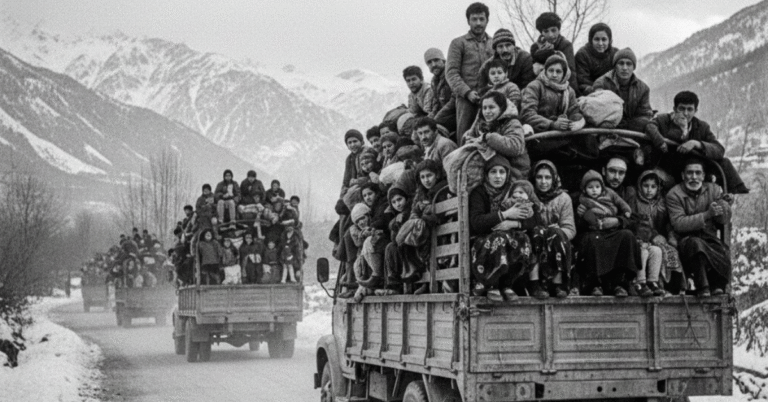
For a detailed account of the broader exodus his killing was part of, see The Kashmiri Pandit Exodus of 1990: The Untold Story.
A Community Marked for Terror: September 1989 to January 1990
The Seventy Steps of Tika Lal Taploo
Tika Lal Taploo was 59 years old, a practising lawyer and one of the most respected figures among Kashmiri Pandits. On the morning of September 14, 1989, he stepped out of his home in Bhan Mohalla and began his walk toward the High Court. The lane was quiet, the kind of ordinary Srinagar morning he had walked through hundreds of times. He had covered barely seventy steps when three men stepped out from a blind turn, their faces covered.
They fired multiple rounds. Taploo died on the spot.
According to The Print’s documented account of the assassination, the killers belonged to the Jammu Kashmir Liberation Front (JKLF). They were never caught. That impunity was the real message. It told every Kashmiri Pandit family watching that the state’s protection had ceased to function.
A Pattern of Targeted Violence (September 1989 to February 1990)
Taploo’s assassination was not a lone event. It was the opening of a sequence. Over the following months, the violence moved with deliberate precision from the politically prominent to the professionally visible:
- November 4, 1989: Judge Neelkanth Ganjoo, who as Sessions Judge had sentenced JKLF founder Maqbool Bhat to death, was shot dead in broad daylight near the Srinagar High Court.
- 2 February 1990: Satish Tikoo, a young Hindu social worker, was murdered near his house in Habba Kadal. JKLF operative Bitta Karate later confessed to this and numerous other killings on video.
- 13 February 1990: Lassa Kaul, Station Director of Srinagar Doordarshan, was assassinated while visiting his frail parents.
The Night the Machinery Collapsed: 19 January 1990
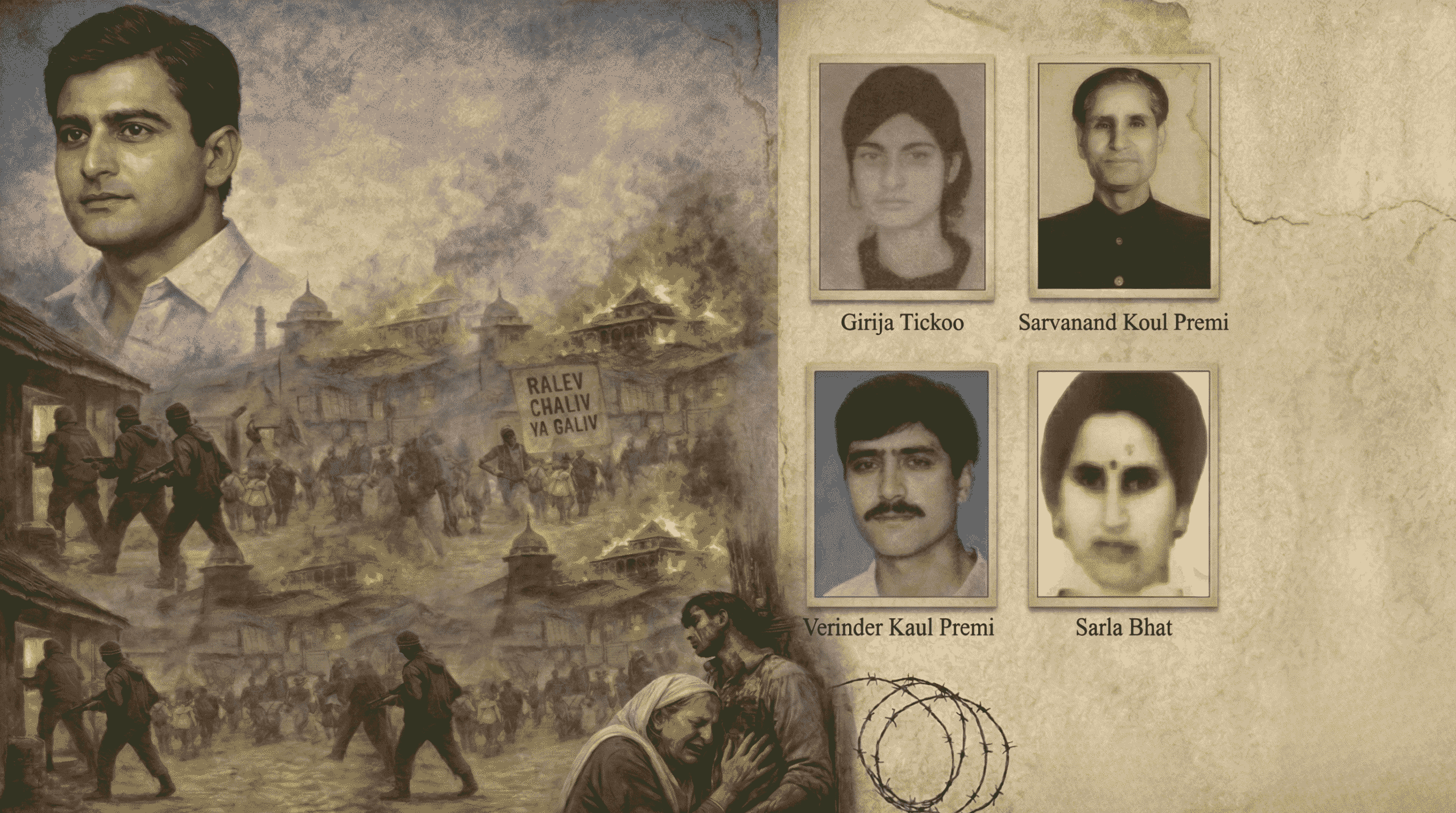
By January 1990, the institutional machinery of Kashmir had effectively dissolved. On the night of 19 January 1990, loudspeakers mounted on mosque rooftops across the Valley began blaring slogans. The sound carried through the cold air into every lane and courtyard. The message was explicit: Raliv, Tchaliv, ya Galiv. Convert, leave, or perish.
Kashmiri Pandit families heard those words through the walls of their homes. Some left that same night, carrying what they could. Others waited, hoping the situation would settle. It did not.
As Rising Kashmir has documented in its analysis of that night, what followed was ethnic cleansing by intimidation: militant violence combined with social breakdown and the collapse of institutional protection at every level. The scale of the resulting displacement is recorded below.
| Source | Finding | Nature of data |
| J&K State Government (reported via Al Jazeera) | 219 Kashmiri Pandits killed between 1989 and 2004 | Official state records |
| Kashmiri Pandit Sangharsh Samiti (KPSS) field survey 2008-09 | 302 community members killed in 1990 alone; 75% of all Pandit killings between 1990 and 2011 concentrated in that first year | Community field survey |
| Panun Kashmir (cited by EFSAS) | Approximately 1,341 Kashmiri Pandits killed by armed insurgents from 1990 onwards, including disappeared persons whose identities were never formally established | Displaced community records |
| KPSS data, analysed by Digital Indian | Of 75,243 Kashmiri Pandit families in the Valley in January 1990, approximately 70,000 had fled by 1992 | Displacement estimate |
| Alexander Evans, political scientist (cited in Sage Publications) | 150,000 to 200,000 Pandits left in the first months of 1990 alone | Peer-reviewed estimate |
Sources: Al Jazeera (J&K government records); KPSS 2008-09 field survey via Swarajya Magazine; EFSAS Study Paper; Digital Indian; Sage Publications Journal of the Kashmiri Diaspora.
Lets try to understand the brutal killing of Bhushan Lal Raina
April 28, 1990: Ompora, Budgam
Bhushan Lal Raina had made his decision. He spent the evening of April 28 packing his belongings. His bags sat near the door. His aged mother moved around the small house with him. The morning departure was set.
According to the Hindu Manifesto’s martyr records for Kashmiri Pandit victims of 1990, a group of militants forced their way into the house that evening. His mother saw them and fell to her knees immediately. She told them her son was about to be married. She placed herself in front of him. Kill me, she said. Spare him.
They did not listen.
Using a sharp, pointed iron rod, they pierced his skull. They dragged him outside into the dark, stripped off his clothes, and nailed him to a tree. He was killed slowly, while he begged to be shot.
No arrests have ever been recorded. No one has ever been held to account. He was 29 years old.
The manner of his killing was not incidental. The iron rod, the dragging, the stripping, the display outside his own home: each of these was a choice. The act was structured to be seen, to be heard, to travel by word of mouth through the neighbourhood. It was a message to the Pandit families who still remained nearby, those who had convinced themselves that keeping quiet and staying indoors might be enough. It was not. The killing told them directly: there was no posture of compliance that would make them safe.
The Scale of What Was Happening
The figures for how many Kashmiri Pandits were killed and displaced in 1990 are disputed across institutions, and it is worth being precise about that rather than selecting whichever number makes the sharpest rhetorical point.
The Jammu and Kashmir government stated in official records, as reported by Al Jazeera, that 219 community members were killed between 1989 and 2004. The Kashmiri Pandit Sangharsh Samiti (KPSS), working from its own field survey conducted in 2008 and 2009, arrived at significantly higher numbers. The KPSS survey, documented by Swarajya Magazine, counted 302 community members killed in 1990 alone, with 75% of all Pandit killings between 1990 and 2011 concentrated in that single first year. The European Foundation for South Asian Studies (EFSAS) notes that Panun Kashmir, a political organisation of the displaced Pandits, published a list of approximately 1,341 Kashmiri Pandits killed by armed insurgents from 1990 onwards, including disappeared persons whose identities were never formally established.
On displacement: Digital Indian’s analysis of KPSS data records that of 75,243 Kashmiri Pandit families living in the Valley in January 1990, approximately 70,000 had fled by 1992. Political scientist Alexander Evans, cited in peer-reviewed research published by Sage Publications, estimates that between 150,000 and 200,000 Pandits left in the first months of 1990 alone. They arrived in Jammu and Delhi in the summer heat, in camps that were, at first, little more than tents pitched on open ground. Some families spent years in those camps. Some never left.
The Killings Did Not Stop With Bhushal Lal Raina
Three days after Bhushan Lal Raina was killed, militants came for Sarwanand Koul Premi.
Premi Ji was 65 years old, a poet and scholar who had spent his entire working life writing about communal harmony in Kashmir. He had produced more than two dozen books, including a Kashmiri translation of the Bhagavad Gita and of Rabindranath Tagore’s Gitanjali. His work had crossed every religious and linguistic line the Valley had to offer. None of it saved him.
On the evening of April 30, 1990, three armed men entered his home. They demanded valuables: gold, jewellery, cash, shawls. Then they asked Premi to come with them, telling the family he would be brought back shortly. His son Virender, sensing what the assurance was worth, insisted on going along. The men allowed it. Father and son walked out of the house together.
Their bodies were found on May 1. They bore the marks of prolonged torture: broken limbs, uprooted hair, skin that had been burnt and torn. In the decades since, the family has repeatedly asked authorities to reopen the case and transfer it to the CBI. No response has ever come.
Women were not exempt. Girija Tickoo worked as a laboratory assistant at a government school in Trehgam. She had fled to Jammu with her family when the situation in the Valley deteriorated. At some point, she received a phone call telling her that conditions had improved and that she could return to collect her pending salary. Trusting that call, she made the journey back.
She was abducted, taken to an undisclosed location, and killed. Her remains were found by the roadside.
The pattern across these cases is consistent. The victims were a laboratory assistant, a poet, a hospital worker. None of them held positions of power. None of them were participants in any political or armed conflict. They were targeted for who they were, not for what they had done.
What Impunity Produces
The failure to arrest Taploo’s killers in September 1989 was not an administrative lapse. It was a signal, and every Pandit family in the Valley read it correctly. No killing in the months that followed led to an arrest of consequence. No killing led to a conviction. This is not background detail. It is the central fact of the entire episode.
A community was driven from its homeland not only because of what was done to its members, but because nothing was done about what was done to its members. For those carrying out the violence, impunity was not a system failure. It was the system functioning as designed.
The J&K State government’s figure of fewer than 200 Pandit deaths has been criticised as a deliberate attempt to minimise the scale of the violence. The National Human Rights Commission (NHRC) of India, while considering appeals by Kashmiri Pandits, stated that they had been subjected to killing “akin to genocide.” Independent researchers and legal scholars have also examined the events against the framework of the UN Genocide Convention of 1948, which defines genocide by the intent to destroy a group in whole or in part, not by a numerical threshold. Whether that legal definition applies here remains debated. What is not debated is the scale, the pattern, and the absence of accountability.
Sage Publications’ Journal of the Kashmiri Diaspora notes that the mass displacement of Kashmiri Pandits remains under-recorded and unresolved more than three decades later, leaving the community feeling excluded from the historical record, with most cases still carrying no accountability.
Legacy
Bhushan Lal Raina was one day away from leaving. His bags were packed. His mother was in the house with him. He had a marriage ahead of him and a life outside the Valley that he had not had the chance to begin.
He never left on April 29.
His name does not appear in most mainstream historical accounts of the Kashmiri Pandit exodus. No film was made about him. No plaque marks the house in Ompora. He exists now in martyr lists and compiled testimony archives, kept alive by diaspora communities and civil society organisations because no official body was ever required to keep them.
That may be the hardest thing to sit with about what happened in Kashmir in 1990. The killings were systematic. The displacement was near total. Then came a third act, quieter than the other two but no less damaging: the forgetting. The institutional and historical forgetting of what was done, to whom, and by whom.
Bhushan Lal Raina was 29 years old. He worked at a hospital. He was about to be married. He was killed slowly, nailed to a tree outside his own home, while he begged for a quicker death.
He deserves to be remembered by name.
For further reading on the events of 1990 and the history of the Kashmiri Pandit community, visit rohittikoo.com/books.
Sources
Primary source
- Hindu Manifesto Martyr Records
Statistical and contextual sources
- Swarajya Magazine: KPSS Field Survey 2008-09
- Al Jazeera: J&K government records on Pandit killings
- EFSAS: Study Paper on the Exodus of Kashmiri Pandits
- Sage Publications: Journal of the Kashmiri Diaspora
- Digital Indian: Kashmiri Pandit displacement data
- The Print: How the killing of Tika Lal Taploo led to the exodus of Pandits from the Valley
- Rising Kashmir: 19 January 1990 analysis
- UN Genocide Convention of 1948
Subject-specific sources
- Jammu Kashmir Now: Sarwanand Koul Premi
- Jammu Kashmir Now: Girija Tickoo
- Indiabloom: Premi family statement
About the Author
Rohit Tikoo is an independent researcher and long-form writer specialising in the history of Kashmir, with a particular focus on the Kashmiri Pandit exodus of 1990. His work is grounded in documented evidence, survivor testimony, and institutional data, aiming to bridge gaps between recorded history and lived experience.
His writing explores themes of ethnic displacement, targeted violence, and historical accountability, with a commitment to precision over rhetoric.
Areas of Focus
- Kashmiri Pandit exodus and demographic shifts
- Political violence and insurgency in Kashmir
- Documentation of underreported historical events
- Analysis of institutional response and accountability
- Website: https://rohittikoo.com
- Publications: https://rohittikoo.com/books
- LinkedIn: https://www.linkedin.com/in/rohit-tikoo/
- Twitter (X): https://x.com/RohitTikoo03
- Godreads: https://www.goodreads.com/author/show/21079373.Rohit_Tikoo