
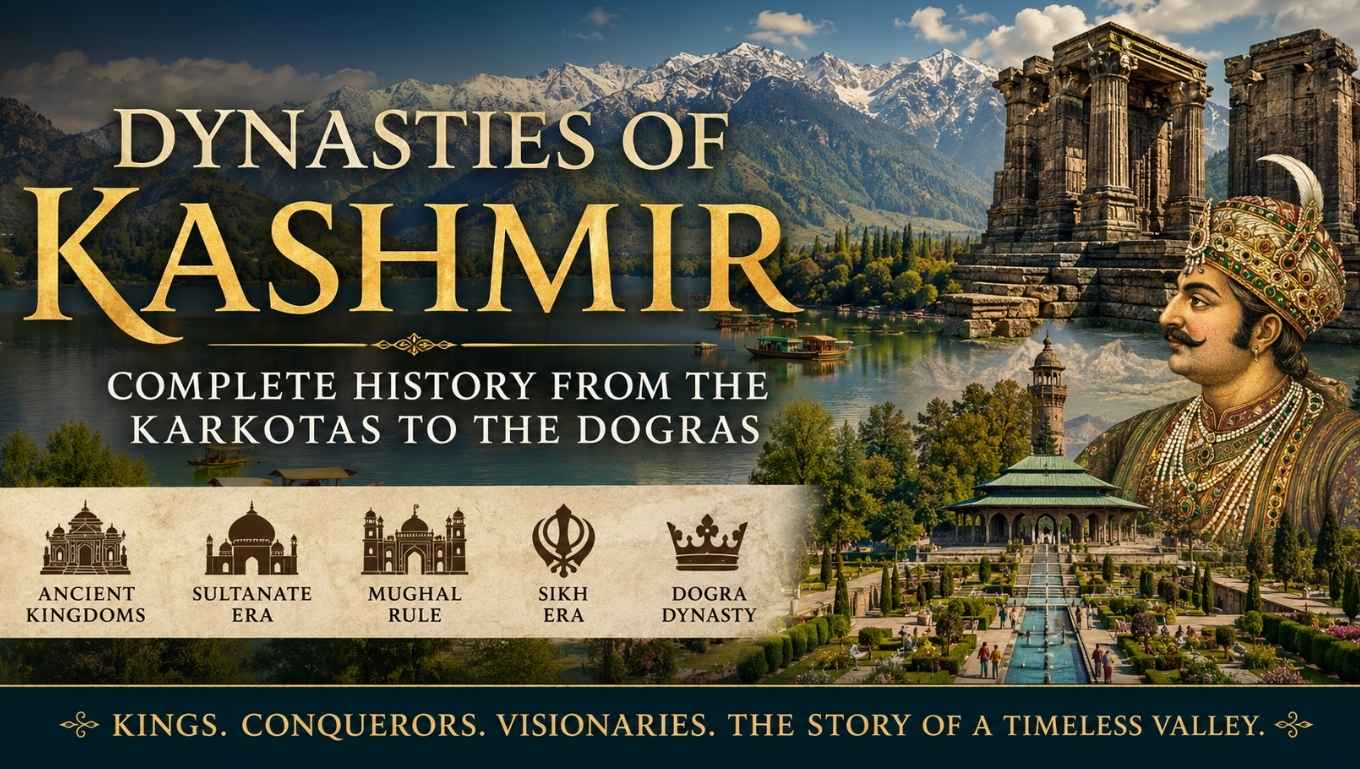
Agar firdaus bar roo-e zameen ast, Hameen ast-o hameen ast-o hameen ast.
“If there is paradise on the face of the earth, it is this, it is this, it is this.”
The couplet is traditionally credited to the 13th-century poet Amir Khusrau, and popular memory says it was Emperor Jahangir who later repeated the line when he stood before the Kashmir Valley and could find no better words for what he saw. (Scholars still argue over who actually wrote it; some point instead to the Persian poet Urfi Shirazi, but the sentiment has belonged to Kashmir for centuries, regardless of whose pen it started with.)
That single verse explains more about the Dynasties of Kashmir than any list of dates could. It explains why emperors who already owned half of Asia still travelled weeks over mountain passes just to sit beside a lake. It explains why Jahangir did not simply admire Kashmir. He tried to rebuild it, terrace by terrace, fountain by fountain, into the very paradise the poets kept describing. That obsession gave the world the Mughal gardens of Srinagar, and it is one thread in a far longer story.
Kashmir is not just a valley. It is a memory that refuses to fade.
Tucked between the peaks of the Himalayas and fed by the Jhelum River, the Kashmir Valley has carried human civilisation for over two thousand years. It was never a quiet mountain backwater. It was a stage. Kings fought here. Poets wrote here. Temples rose here, and empires fell here.
This article walks through the great ruling houses of Kashmir. We move from the half-legendary early kings, through Hindu golden ages, into Muslim sultanates, and on to Mughal, Afghan, Sikh, and Dogra rule. Each dynasty added its own layer to the valley’s story.
Together, these dynasties shaped Kashmir’s civilisation through periods of remarkable cultural achievement, political upheaval, religious transformation, and repeated struggles for survival. For the Kashmiri Pandit community, this history is not merely the story of kings and kingdoms but of an ancient civilisation that endured both extraordinary patronage and devastating persecution
Why the Rajatarangini Still Matters
Before we meet the kings, we must meet the man who wrote most of them into history.
In the 12th century, a Kashmiri scholar named Kalhana wrote the Rajatarangini, or “River of Kings.” It is a Sanskrit chronicle of Kashmir’s rulers, and it is one of the few genuine works of historical writing to survive from ancient and medieval India.
Kalhana blended fact with legend, especially for the earliest kings. But he also did something rare for his time. He checked old texts, inscriptions, and monuments before he wrote. Because of his effort, we know far more about Kashmir’s past than we know about most other regions of the subcontinent from the same era.
Legend, Ashoka, and the Buddhist Centuries
Kashmir’s earliest history sits somewhere between myth and memory. Tradition holds that the valley was once a vast lake called Satisar, drained by the sage Kashyapa, who is said to have given the land its name. Kalhana’s earliest kings, the Gonanda line, are almost impossible to verify. Their stories mix royal tradition with divine legend.
But these tales matter. They show that Kashmir had a long tradition of kingship long before it entered the mainstream of Indian history.
By the time of the Mauryan Empire, that entry had happened. The emperor Ashoka is credited with founding Srinagari near modern Srinagar and spreading Buddhism throughout the valley. Later, under the Kushan rulers, particularly Kanishka, Kashmir became a serious centre of Buddhist learning. Tradition even places the Fourth Buddhist Council here.
The Karkota Dynasty (c. 625–855 CE): Kashmir’s First Golden Age
The Karkota dynasty was Kashmir’s first firmly historical ruling house, and it produced one of the great kings of early medieval India.
Lalitaditya Muktapida: The Warrior King
Lalitaditya Muktapida ruled for roughly 36 years, sometime around 724 to 760 CE. He was a formidable military leader. His campaigns pushed deep into northern India and, according to the Rajatarangini, as far as Central Asia. Kalhana calls him a world conqueror. Modern historians are more cautious, but they still rank him among the most powerful rulers Kashmir ever produced. Some scholars have called him the “Alexander of Kashmiri history.”
The Martand Sun Temple
Lalitaditya was also a builder. His greatest legacy is the Martand Sun Temple, dedicated to the sun god Surya. Even in ruins today, its massive stone columns hint at the scale of his ambition. The design blended Kashmiri tradition with Gupta and Gandharan influences, creating something the valley had never seen before.
He founded new towns, supported scholars, and let Hinduism and Buddhism flourish side by side. His reign showed the world what Kashmir could become when strict rule met genuine cultural investment.
According to the Rajatarangini, Lalitaditya died far from home, on a campaign somewhere in the cold deserts of Central Asia. His empire could not survive without him, but his temple still stands as proof that he was here.
The Utpala Dynasty (c. 855–1003 CE): The Engineer Who Saved a Valley
After the Karkotas faded, the Utpala dynasty took the throne. Its founder, Avantivarman (r. 855–883 CE), is remembered less for conquest and more for something rarer in royal history: competent government.
Suyya: The Engineer Who Tamed the Jhelum
Kashmir at the time was drowning, quite literally. The Jhelum River flooded constantly, ruining crops and causing famine. Avantivarman’s answer came in the unlikely form of Suyya, an eccentric man the court initially mocked. Suyya asked the king for pots full of gold coins instead of an army of workers. When Avantivarman granted the request, Suyya sailed along the Jhelum and threw the coins into the water, drawing crowds who dived in to collect them and, in doing so, cleared the riverbed of the boulders choking it.
It sounds like folklore, and Kalhana tells it with real flair. But the results were not folklore. Suyya went on to widen and deepen the Jhelum, raise embankments, and reclaim vast tracts of waterlogged land. Grain prices are said to have collapsed from famine levels to a fraction of their former cost. In his honour, the town of Sopore, once Suyyapura, still carries his name.
Avantivarman built his own legacy too, founding the town of Avantipora and constructing the Avantiswami Temple to Vishnu. His court supported poets and scholars, and Kashmir’s reputation as a centre of Sanskrit learning grew stronger.
The Utpala line that followed him was not as fortunate. Later rulers faced court intrigue, weak leadership, and rising instability, as powerful nobles chipped away at royal authority.
The Lohara Dynasty (c. 1003–1320 CE): Queen Didda and a Long Twilight
The Lohara dynasty ruled Kashmir for more than three centuries, one of the longest reigns of any ruling house in the region. It was also one of the most turbulent.
Queen Didda: The Lame Queen Who Ruled Unopposed
Its most remarkable figure is not, strictly speaking, a Lohara king at all. Queen Didda, born around 924 CE, was the daughter of the ruler of Lohara and a granddaughter of the Hindu Shahi king of Kabul. She married into the Kashmiri throne, and though she lived with a physical disability that affected her legs, it never once slowed her political instincts.
When her husband died in 958 CE, Didda became regent for her young son. Nobles who assumed a disabled woman would be an easy target learned otherwise. She purged rivals, outmanoeuvred factions, and by 980 CE ruled Kashmir outright in her own name, taking the title Maharajadhiraja, King of Kings. She minted coins bearing her own name and is credited with commissioning dozens of temples during her reign. Historians have compared her to Catherine the Great for her sheer political nerve. When Didda died in 1003 CE, her nephew Samgramaraja succeeded her, and it is his line that historians formally call the Lohara dynasty.
This era matters for one more reason. It was during the Lohara period that Kalhana sat down to write the Rajatarangini itself, giving us an unusually vivid, if not always flattering, picture of court life, rebellion, and royal ambition in medieval Kashmir.
By the dynasty’s later years, heavy taxation and constant infighting among nobles had worn the state down. Central authority was crumbling, and Kashmir stood exposed.
The Shah Mir Dynasty (1339–1561): Kashmir’s First Muslim Rulers
By the early fourteenth century, political instability had weakened the Lohara kingdom. Amid this uncertainty, Shah Mir emerged as the founder of Kashmir’s first Muslim dynasty in 1339, bringing an end to centuries of Hindu rule. The establishment of the Shah Mir Sultanate marked one of the most profound turning points in Kashmiri history. Over the following centuries, the valley witnessed sweeping political, religious, and social changes that permanently transformed its civilisational identity.
The Shah Mir period cannot be viewed as a single, uniform era. Some rulers governed with moderation, while others pursued policies that resulted in widespread destruction of temples, forced conversions, religious persecution, and the displacement of sections of the indigenous Hindu population. These developments profoundly affected the Kashmiri Pandit community and remain central to its historical memory.
Sikandar Butshikan: The Most Controversial Sultan of Kashmir
Not every ruler of the Shah Mir dynasty is remembered the same way. Among them, Sultan Sikandar Shah (1389–1413 CE) occupies a uniquely controversial place in Kashmir’s history. He is widely remembered as Sikandar Butshikan, meaning “Destroyer of Idols,” a title that reflects his association with the destruction of Hindu temples and the suppression of pre-Islamic religious traditions.
Contemporary Persian chronicles, later historical accounts, and Kashmiri tradition describe his reign as one marked by religious intolerance. Several important Hindu temples, including the magnificent Martand Sun Temple, are believed to have been damaged or destroyed during this period. Many historical sources also record forced conversions, the imposition of restrictions on Hindu religious practices, and the migration of sections of the Kashmiri Pandit community from the valley.
While historians continue to debate the extent of every event attributed to Sikandar, there is broad agreement that his reign marked one of the most difficult periods for Kashmir’s indigenous Hindu population. For Kashmiri Pandits, the era of Sikandar Butshikan remains a defining chapter of cultural loss, religious persecution, and the destruction of an ancient civilisational heritage.
Zain-ul-Abidin, or Bud Shah: Kashmir’s Second Golden Age
No ruler from this line is remembered with more warmth than Zain-ul-Abidin (r. 1420–1470 CE), affectionately called Bud Shah, the Great King. His reign is often described as Kashmir’s second golden age, and the evidence supports the praise.
He reversed the policies of religious persecution pursued by his predecessors. He abolished the jizya tax on non-Muslims, prohibited cow slaughter out of respect for Hindu sentiment, rebuilt several desecrated temples, and encouraged Kashmiri Pandits who had fled the valley during earlier persecutions to return. His court welcomed scholars and poets from diverse backgrounds, and he was proficient in Sanskrit, Persian, and Tibetan. He also commissioned Persian translations of important Sanskrit texts, including Kalhana’s Rajatarangini.
Shawls, Papier-Mâché, and Kashmir’s Craft Economy
Bud Shah’s other great legacy sits in Kashmir’s workshops rather than its libraries. He invited craftsmen from Samarkand and Central Asia to train local artisans. Under his patronage, Kashmir developed the shawl-weaving, papier-mâché, carpet-weaving, and woodwork industries that still define its handicraft economy today. He is also credited with establishing Kashmir’s first paper industry, one of the earliest in India.
Under Bud Shah, Kashmir enjoyed a peace and cultural richness rarely matched before or since.
The Chak Dynasty (1561–1586): The Last Native Kings
After the Shah Mir dynasty weakened, the Chak dynasty, of Dardic origin from the Gurez region, seized power in 1561 under Ghazi Shah Chak. Fiercely independent and deeply rooted in Kashmir, the Chaks became the last native rulers to govern the valley before its annexation by the Mughal Empire.
Unlike many regional kingdoms that submitted to Akbar’s expanding empire, the Chaks resisted repeatedly. Their knowledge of Kashmir’s rugged terrain and determined military leadership enabled them to repel several Mughal expeditions despite being heavily outnumbered. For years, Kashmir remained one of the few regions beyond Akbar’s direct control, frustrating the Mughal emperor’s ambition to bring the entire subcontinent under his rule.
Yousuf Shah Chak and Habba Khatoon
The dynasty’s final ruler, Yousuf Shah Chak, remains one of the most tragic figures in Kashmiri history. His wife, the celebrated poet Habba Khatoon, is said to have warned him not to trust Emperor Akbar’s invitation for negotiations, fearing it was a political trap. Ignoring her advice, Yousuf travelled to meet the Mughal court under assurances of safe conduct.
Her fears proved justified. Akbar had Yousuf Shah arrested and imprisoned instead of negotiating with him. He was eventually exiled to Bihar, where he spent the remainder of his life and died far from his homeland, never seeing Kashmir again. His capture effectively ended organised resistance under his leadership.
Habba Khatoon was left devastated by her husband’s imprisonment and exile. According to Kashmiri tradition, she wandered through the valley composing sorrowful verses that expressed her grief, separation, and longing. Her poetry has survived for centuries and remains among the finest works of Kashmiri literature, making her an enduring symbol of love, loss, and the tragedy that accompanied the end of Kashmir’s independence.
Although Yousuf Shah’s son, Yaqub Shah Chak, continued the struggle against the Mughal armies, he could not overcome the empire’s overwhelming military strength. In 1586, Akbar finally annexed Kashmir, ending nearly four millennia of indigenous rule. Thereafter, the valley was governed by successive external empires, beginning with the Mughals, marking a decisive turning point in Kashmir’s political and cultural history.
The Mughal Period (1586–1752): Gardens Built for Emperors
Under the Mughals, Kashmir became a favourite retreat from the summer heat of the plains. The emperors fell for the valley’s beauty, and they expressed that affection through architecture.
The Aesthetic Behind the Gardens
That affection had a very specific shape. Mughal aesthetic taste, inherited from Persian and Timurid tradition, was built around the idea of the chahar bagh, or fourfold garden, a design meant to recreate the paradise described in the Quran, with four flowing channels of water dividing the space into perfect quadrants. Kashmir, with its lakes, springs, and mountain slopes, gave the Mughals something Delhi and Agra could never offer: real running water and a real backdrop of snow-capped peaks to build that paradise against.
Shalimar Bagh and Nishat Bagh
Shalimar Bagh was laid out around 1619 by Jahangir for his wife Nur Jahan, with its polished stone channel and terraced pavilions climbing gently up from the shore of Dal Lake. Nishat Bagh followed in 1634, commissioned by Nur Jahan’s brother Asaf Khan, with twelve terraces said to represent the signs of the zodiac, each one stepping down toward the water in a cascade of fountains and chinar trees. Every element, the symmetry, the sound of moving water, the framing of the mountains beyond, was chosen deliberately. Nothing in a Mughal garden was accidental. It was a landscape used as theology.
The most lasting legacy of this period is that string of gardens along Dal Lake. Their terraced lawns, fountains, and flowing water channels remain among Kashmir’s most visited attractions today. Jahangir adored the valley so deeply that popular tradition credits him with declaring, of Kashmir, that if paradise existed anywhere on earth, it was here, the very sentiment poets had already been reaching for a couplet at a time.
The cost of this affection was political. Kashmir was now governed from distant Delhi, and it lost its place as an independent centre of power.
Beneath the architectural splendour, Mughal rule also came at a political and cultural cost. Kashmir ceased to be an independent kingdom and was governed from distant imperial capitals. While emperors such as Jahangir admired the valley’s beauty, later Mughal policies, particularly during the reign of Aurangzeb, witnessed renewed restrictions on non-Muslim communities in parts of the empire. Kashmiri Pandits periodically faced religious discrimination and official pressures, reminding them that imperial patronage could change with the ruler on the throne.
The Afghan Period (1752–1819): The Harshest Chapter
The Mughal Empire’s decline opened the door for a new conqueror. In 1752, Ahmad Shah Durrani of Afghanistan annexed Kashmir, bringing the valley under the rule of the Durrani Empire. What followed over the next sixty-seven years is remembered by many historians and in Kashmiri tradition as one of the bleakest periods in the valley’s history.
Unlike the Mughals, who largely viewed Kashmir as an imperial retreat, many Afghan governors treated it as a province to be exploited. Successive governors imposed crushing taxes on land, agriculture, trade, and even necessities. Arbitrary punishments, forced labour, extortion, and administrative corruption became commonplace. Contemporary chronicles describe a population living in constant fear, uncertain of what fresh demands or punishments a new governor might impose.
The Ordeal of the Kashmiri Pandits
For the Kashmiri Pandit community, Afghan rule became synonymous with persecution and insecurity. Historical accounts describe repeated instances of religious discrimination, heavy taxation, restrictions on public religious life, and harassment by local officials. Many Pandit families concealed their wealth, abandoned ancestral homes, or sought safety outside the valley to escape arbitrary persecution.
Although not every Afghan governor ruled with the same severity, the cumulative effect of nearly seven decades of oppressive administration left an enduring scar on the collective memory of the Kashmiri Pandits. The period is remembered not merely for economic hardship but for the erosion of personal security, religious freedom, and social stability.
Pandit Birbal Dhar and the Appeal to Maharaja Ranjit Singh
By the beginning of the nineteenth century, conditions had become intolerable for many residents of the valley. Among those determined to end Afghan rule was Pandit Birbal Dhar, a respected Kashmiri statesman. Realising that internal resistance stood little chance against the Afghan administration, he secretly left Kashmir and travelled to Lahore to seek military assistance from Maharaja Ranjit Singh, the ruler of the Sikh Empire.
According to Kashmiri tradition and several historical accounts, Birbal Dhar’s mission involved extraordinary personal sacrifice. His family remained behind in Kashmir and faced severe reprisals after his escape. His wife is remembered for choosing death rather than falling into Afghan hands, while other members of his household endured imprisonment and persecution. Their sacrifice became a powerful symbol of the desperate conditions prevailing under Afghan rule.
Ranjit Singh, who had already expanded the Sikh Empire across much of Punjab, recognised both the strategic and humanitarian importance of Kashmir. Accepting Birbal Dhar’s appeal, he ordered a military campaign against the Afghan governors. In 1819, Sikh forces defeated the Afghans at the Battle of Shopian, ending nearly seven decades of Durrani rule.
For the Kashmiri Pandit community, the victory represented far more than a change of rulers. It marked the end of an era remembered for oppression and fear and the beginning of a period of relative religious security under the Sikh Empire.
The Sikh Period (1819–1846): A Brief New Order
By the early nineteenth century, nearly seven decades of Afghan rule had left Kashmir exhausted. Heavy taxation, arbitrary punishments, and religious persecution had devastated the valley, with Kashmiri Pandits suffering repeated discrimination and insecurity. Appeals for relief eventually reached Maharaja Ranjit Singh, the founder of the Sikh Empire, whose expanding kingdom had already established itself as the dominant power in north-western India.
In 1819, following the Battle of Shopian, Sikh forces under the command of Misr Diwan Chand decisively defeated the Afghan governor Jabbar Khan, bringing an end to Durrani rule in Kashmir. For many Kashmiris, particularly the Kashmiri Pandit community, the victory marked the end of one of the darkest chapters in the valley’s history
Relief for the Kashmiri Pandits
Maharaja Ranjit Singh’s conquest was welcomed by many Kashmiri Pandits, who had endured decades of persecution under successive Afghan governors. Sikh rule restored a measure of religious security, allowing Hindu festivals and temple worship to continue without the systematic intimidation that had characterised much of the Afghan period. Although the Sikh administration retained a heavy system of taxation and was by no means free from administrative shortcomings, it ended the climate of fear that had forced many Kashmiri Pandits to live under constant uncertainty.
Historical accounts also record that several Kashmiri Pandits served in the Sikh administration and found opportunities in public service under the new regime. While the Sikh rulers governed Kashmir primarily for strategic and economic reasons, their victory was nevertheless seen by many Kashmiri Pandits as the restoration of dignity after decades of oppression.
A Short but Significant Chapter
Sikh rule lasted less than three decades, yet its historical importance extends far beyond its duration. It ended Afghan domination, stabilised the valley after years of turmoil, and paved the way for the rise of the Dogra dynasty under Maharaja Gulab Singh. For the Kashmiri Pandit community, the Sikh conquest remains a defining turning point, remembered as the moment when one of the most oppressive eras in Kashmir’s history finally came to an end.
The Dogra Dynasty (1846–1947): A Kingdom Bought and Sold
The final ruling house of Kashmir was the Dogra dynasty, and it began with one of the most striking documents in the region’s history.
The Treaty of Amritsar
After defeating the Sikhs in the First Anglo-Sikh War, the British East India Company signed the Treaty of Amritsar on 16 March 1846. Under its terms, Maharaja Gulab Singh, a Dogra ruler from Jammu, paid the British 75 lakh Nanakshahi rupees for the hill territory between the Indus and Ravi rivers, including the Kashmir Valley. In return, Gulab Singh and his heirs were recognised as independent rulers of the newly created princely state of Jammu and Kashmir, uniting Jammu, the Kashmir Valley, Ladakh, and Gilgit under one crown. No Kashmiri had a say in the arrangement, and the transaction has been remembered bitterly in the valley ever since.
The Dogra maharajas ruled this state for a full century. They built infrastructure and expanded administration, but their rule is also remembered for heavy taxation and unequal treatment of ordinary subjects.
1947 and the Instrument of Accession
The dynasty’s story ends in 1947, during the partition of British India. The last Dogra ruler, Maharaja Hari Singh, faced a choice between joining India or Pakistan. Following an invasion of the state, he signed the Instrument of Accession to India in October 1947. That decision closed the book on centuries of dynastic rule in Kashmir and opened a new, far more turbulent chapter in its modern political history.
What These Dynasties Left Behind
Strip away the kings and the battles, and what remains? A civilisation that shaped how South Asia thinks, prays, and creates.
Kashmir became a genuine meeting point of traditions. Hindu, Buddhist, and Islamic influences all found room here, and each left its mark. The valley gave rise to Kashmir Shaivism, a profound school of philosophy, and its Buddhist scholarship once reached as far as Tibet and China.
The physical legacy is just as visible. The ruins of Martand and Avantipora still stand. The Mughal gardens still bloom along Dal Lake. The mosques and shrines of the sultanate period still shape Srinagar’s skyline. And the craft traditions that Bud Shah nurtured, shawls, carpets, papier-mâché, and woodwork, still support Kashmiri families today.
Frequently Asked Questions
Which dynasty is considered the golden age of Kashmir?
Historians usually point to two periods. The Karkota dynasty under Lalitaditya Muktapida (8th century CE) is called Kashmir’s first golden age, known for military power and the Martand Sun Temple. The reign of Zain-ul-Abidin, or Bud Shah, in the 15th century is often called Kashmir’s second golden age, remembered for religious tolerance and craft traditions.
Who wrote the Rajatarangini?
The 12th-century Kashmiri scholar Kalhana wrote the Rajatarangini, a Sanskrit chronicle that remains the single most important source for early Kashmiri history.
Who was the last independent ruler of Kashmir?
Yousuf Shah Chak, of the Chak dynasty, is generally regarded as the last independent ruler of Kashmir before Mughal Emperor Akbar annexed the valley in 1586.
How did Kashmir become part of the Dogra kingdom?
Under the Treaty of Amritsar, signed on 16 March 1846, the British East India Company transferred the Kashmir Valley and surrounding hill territories to Maharaja Gulab Singh in return for a payment of 75 lakh Nanakshahi rupees, creating the princely state of Jammu and Kashmir.
A Land That Remembers
Kings rise. Kings fall. Kashmir remains.
From Lalitaditya’s temples to Suyya’s rivers, from Didda’s iron will to Bud Shah’s looms, from Mughal gardens to a treaty signed in Amritsar, every ruler who ever sat on Kashmir’s throne left something behind that outlived them.

Rohit Tikoo is a published author, researcher, and content strategist with over two decades of writing experience. He is the author of nine books covering Kashmir, Indian philosophy, social issues, and contemporary thought, including Shadows Over the Valley: Operation TUPAC, Cold War Geopolitics, and the Kashmiri Pandits Exodus (2025).
His work focuses on Kashmir’s history, literature, culture, and the lived experiences of the Kashmiri Pandit community. Through extensive research, archival references, and historical analysis, he seeks to document and preserve narratives that are often overlooked in mainstream discourse. His writing on Kashmir has appeared in DAILY EXCELSIOR, HEADLINES TODAY, ONLY KASHMIR, GREATER KASHMIR, NAAD,
VITASTA, CHATTAN, AND VOICE OF SILENCE.
Through rohittikoo.com, he publishes research-based articles, essays, and commentary aimed at fostering informed discussion on Kashmir, Indian civilisation, literature, and contemporary society.