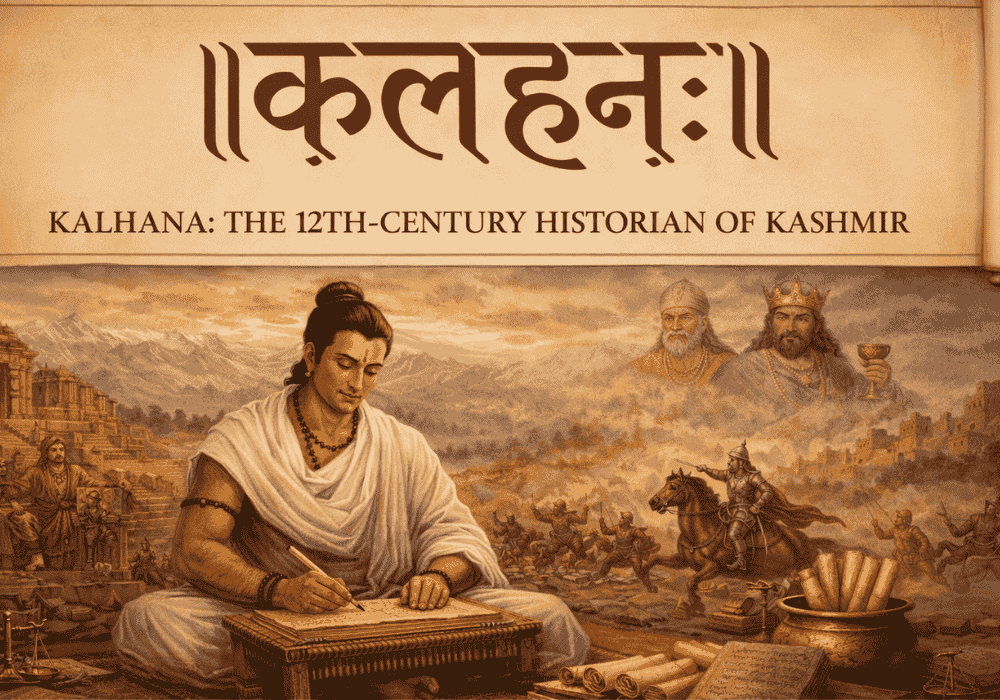
Kalhana was Kashmir’s first and greatest historian. He wrote without royal patronage, without flattery, and without the political obligations that corrupted nearly every other chronicle of his era.
What he left behind was the Rajatarangini, a work that nine centuries of scholarship have not managed to replace.
Royal courts used it to glorify ruling kings and hide the failures of those before them. Court poets were rewarded for praise. Naturally, this shaped what was written.
Kingdoms rose and fell, but the writing followed a pattern. It stayed grand, biased, and often unreliable.
Kalhana: Kashmir’s First and Greatest Historian refused to play that game.
His great work, the Rajatarangini, was completed around 1148–50 CE during the reign of King Jayasimha. It stands apart from almost everything written in India before it.
Kalhana set out to record the rulers of Kashmir from ancient legends to his own time. He did this with care. He checked sources. He weighed accounts. He aimed for balance in judgment. This approach feels surprisingly modern.
Scholars still debate whether he should be called India’s first historian. The answer depends on how one defines history. Other traditions of careful record-keeping did exist.
Yet few disagree on one point. The Rajatarangini is among the earliest and most refined works of systematic history in the subcontinent. Even after nine centuries, it remains essential for understanding Kashmir’s ancient and medieval past.
The Kashmir That Shaped Him
To understand what Kalhana achieved, one must first reckon with the world he inhabited. Twelfth-century Kashmir was not a stable or comfortable place to observe politics from a distance.
The throne of Kashmir changed hands often.
Kings rose on ambition and fell to betrayal, defeat, or incompetence.
In the years around Kalhana’s life, many rulers drained their own treasuries. They weakened their administration. They turned a fertile political landscape into a battleground of rival factions.
Kalhana did not learn this chaos from old texts. He lived through it. He saw leaders rise and fall in quick succession. He witnessed the human cost of each change in power.
This experience gave him something rare. He understood power as it truly works, stripped of myth and illusion.
Yet this same Kashmir was also a centre of learning. Despite political unrest, its cultural life remained vibrant.
The valley had become one of the leading hubs of Sanskrit scholarship in the subcontinent. Poets, philosophers, and theologians gathered there from across India.
Temples were more than places of worship. They preserved inscriptions, records, and collective memory.
Kalhana grew up in this world of knowledge. He had access to language, texts, and archives that many others did not.
He lived where learning mattered. And he treated it with the seriousness it deserved.
The Man: Family, Independence, and Intellectual Formation
Kalhana was born into a Brahmin family with close ties to power.
His father, Champaka, served as a danapati, a governor under King Harsha of Kashmir.
This was not a minor role. It placed the family near the workings of the state and, just as important, near its records.
Such proximity could have shaped Kalhana into a typical court writer. He could have depended on royal patronage and praised whoever held the throne.
He chose otherwise.
Kalhana did not attach himself to any court as a salaried poet. He remained independent. That choice shaped everything he later wrote.
In the medieval world, patronage mattered. A poet who relied on a king could not afford honesty. Every account passed through the ruler’s vanity before it reached the page.
Kalhana had no such constraint. His independence removed that filter. He wrote what he believed had happened. And he wrote it plainly.
His education followed the classical path of his time. He was trained deeply in Sanskrit literature and canonical texts.
But he went further than most scholars. He did not treat earlier works as an unquestionable authority. He questioned them. He compared them. He tested them.
He read earlier texts alongside temple inscriptions, royal records, and oral traditions. Then he asked a simple but powerful question. Which accounts agree, and why do some not?
This habit of cross-checking sources set him apart. It is what separates a historian from a mere chronicler.
Kalhana practised it with rare discipline.
The Rajatarangini: Structure, Method, and Scope
The title Kalhana chose, Rajatarangini or “River of Kings,” reveals his vision.
History, like a river, flows without pause. Each reign rises like a wave and then fades, while the current continues.
The metaphor is elegant. But the structure behind it is precise and practical.
Kalhana divided the work into eight books, which he called tarangas, or waves. The early books deal with the ancient and legendary origins of Kashmiri kingship. Even here, Kalhana sometimes questions the truth of what he records.
As the narrative moves forward, legend gives way to evidence. By the later books, which cover rulers closer to his own time, the writing becomes detailed and reliable.
Modern scholars rely heavily on these sections, especially those covering the 9th to 12th centuries. They treat them as primary historical sources.
The Rajatarangini contains about 7,826 verses in Sanskrit. It is a large work. But its importance lies not in its size, but in its method.
Kalhana did not rely on a single source. He worked carefully and deliberately.
He consulted earlier texts, temple inscriptions, and royal records. He also drew from oral traditions passed down through generations.
Then he compared them. He looked for agreement. He examined contradictions. He formed conclusions he could defend.
When evidence was weak, he said so. When legend replaced fact, he marked the difference.
This method feels strikingly modern. Kalhana understood that every source carries bias. He knew the historian’s task is not to ignore that bias, but to work through it with care.
Writing With a Conscience: Objectivity as a Literary Act
What makes Kalhana truly unusual is not just his method, but his moral stance.
He judged kings plainly. He named both success and failure. He did not let praise or dislike distort his judgment.
Good rulers received credit. Those who maintained order, protected their people, and governed with fairness were recognised in the Rajatarangini. Kalhana recorded their achievements with care and balance.
But he offered no protection to bad rulers. Kings who exploited their subjects, wasted resources, or chased personal ambition at the cost of stability were exposed. Kalhana wrote about their failures directly. His clarity must have unsettled many of his contemporaries.
This balance did not mean indifference. Kalhana cared deeply about governance and its impact on people.
His work carries a clear moral thread. Leaders who used power responsibly earned respect. Those who abused it were remembered for that abuse.
What he refused to do was bend the truth. Neither personal feeling nor external pressure shaped his record.
His writing style supported this approach. It was elevated, yet clear.
Sanskrit poetry of that time could become dense and difficult, filled with ornament and layered meanings. Kalhana avoided that trap. He used the richness of the language without losing clarity.
His verses move with purpose. They carry both narrative and emotion, while keeping facts intact.
The result is rare. A work that stands as both literature and history, without compromising either
The Rajatarangini’s Central Preoccupations
Across all eight waves of the text, a few themes recur.
The first is the nature of kingship. Kalhana did not treat monarchy as a divine right. He saw it as a responsibility.
A good king, in his view, maintained peace, delivered justice, and managed resources with care. He treated his people as citizens, not as tools for personal ambition. Such rulers created stability and earned respect.
A bad king did the opposite. He brought suffering, disorder, and, in time, his own downfall. Kalhana did not explain this through theory. He showed it through real events and real rulers.
Another theme is the cost of greed and injustice. Kalhana did not preach. He observed.
Again and again, the pattern repeats. Rulers who chose plunder over governance created instability. That instability eventually consumed them. The pattern was so consistent that Kalhana seemed to treat it almost like a law of history.
He also looked beyond the throne. His work pays attention to the wider life of Kashmir.
He wrote about religious institutions and the role of temples, not just as sacred spaces but as centres of social and civic life. He noted how different groups interacted. He observed how ordinary people lived, or suffered, under changing rulers.
The Rajatarangini is not just political history. It is the history of a place and its people, with kings as the thread that holds the story together.
What Scholars Make of Kalhana Today
Modern historians value the Rajatarangini for a simple reason. It does exactly what Kalhana intended. It offers a structured, source-based account of Kashmir’s past, written by someone who understood the difference between evidence and legend.
At the same time, its limits are clear. They must be stated plainly.
The early sections deal with legendary kings whose reigns stretch back thousands of years. These cannot be treated as reliable history in the modern sense. Kalhana included them because they formed part of Kashmir’s cultural memory. Even then, he approached them with caution.
As the narrative moves closer to his own time, the reliability improves. The later books are far more detailed. They offer cross-checked accounts and specific events that historians can work with more confidently.
Because of this, Kalhana’s work remains central to the study of Kashmir’s past. Scholars return to the Rajatarangini again and again.
They use it as a primary source. They study it as an example of a method. They see in it a reminder that the desire to record history honestly is not new.
Today, universities across South Asia and beyond include the text in courses on Indian history and Sanskrit literature. Its influence is strongest in fields focused on Kashmir and the medieval period, but its importance extends beyond them.
Why Kalhana Still Matters
The Rajatarangini endures because the questions Kalhana asked still matter.
How should we judge leaders? What do we owe to the truth? Can a historian remain honest when power demands silence or praise?
Kalhana answered these questions through action, not theory.
In 12th-century Kashmir, amid political unrest, he chose to write without royal support. He checked his sources. He recorded both success and failure. He named rulers and described the consequences of their actions. He did not seek approval.
Nine centuries later, the work still stands. The courts that could have censored it are gone. The kings he praised or criticised no longer matter.
What remains is the text itself. It shows that history can belong to truth, not power.
This is not an easy position to hold.
The fact that Kalhana held it and produced a work that continues to shape the study of Kashmir’s past secures his place among the most important thinkers in the subcontinent’s intellectual history.