
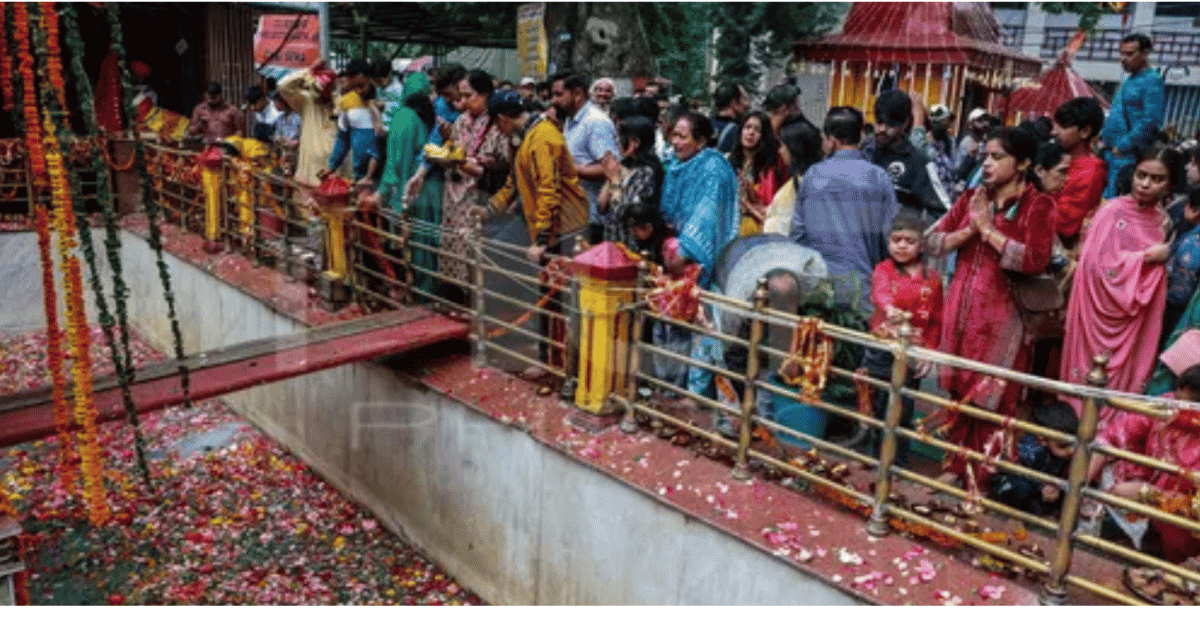
As devotees gather today for the Kheer Bhawani Festival 2026, I find myself unable to begin with history, dates, or rituals.
I must begin where every Kashmiri Pandit heart begins.
At the feet of the Mother
When villages emptied, your name remained. When hope flickered, your name remained.
Maej Daya Kar. Mata Nazar Kar. Maej Daya Kar.
Before I write a single word about history, about temples, about the turning of sacred waters, I must begin here. At the feet of the Mother.
Mata Ragnya Devi, You who sit at the heart of Tulmulla, wreathed in the scent of chinars and the prayers of ten thousand displaced children, I offer this article as a garland of words at Your lotus feet. You have watched over us across centuries. You watched when the chinar leaves burned in winter. You watched when we left, weeping, dragging our children and our memories through the mountain passes. And You watch still, because You have never abandoned us, even when we thought the valley had.
We come to You not with power or pride. We come as Your children. Broken in ways that cannot be named. Whole only in the memory of Your name.
Maej Daya Kar.
What is the Kheer Bhawani Festival?
The Kheer Bhawani festival is the most sacred annual gathering in the Kashmiri Pandit calendar. It is observed on Jyeshtha Ashtami, the eighth day of the bright fortnight of the Hindu month of Jyeshtha, when we offer milk and rice pudding, called kheer, to Mata Ragnya Devi at her principal shrine in Tulmulla, Ganderbal district, Kashmir.
But to call it merely a festival is to misunderstand what it means to us.
For the Kashmiri Pandit community, Kheer Bhawani is not a religious date to be observed and then forgotten until next year. It is a homecoming. It is the one morning in twelve months when the thread connecting us to our homeland pulls taut and we follow it without question. Thousands of us travel from Jammu, from Delhi, from Mumbai, from Pune, and from cities across the world to stand once again beneath the ancient chinars of Tulmulla and look upon the sacred spring where the mother speaks to her children in the language of colour and grace.
In 2026, this sacred day falls on 22 June and is being celebrated today.
Who Is Mata Ragnya Devi?
Mata Ragnya Devi is our presiding goddess at Kheer Bhawani, revered as a form of Shakti within the Kashmir Shaiva tradition. But those words, however accurate, do not contain her. She is not a theological category to us. She is our Mother.
Her name carries the Sanskrit root raga within it, a root that holds three meanings simultaneously: colour, love, and musical mode. She who is named Ragnya is therefore She Who is Coloured by Divine Love. She is the Mother drenched in the raga of unconditional compassion, the raga that does not weigh a child’s worthiness before opening its arms. Her very name is a complete theology. She does not demand. She receives.
In our oral tradition, Mata Ragnya Devi is believed to have migrated across the Kashmir Valley herself, moving from shrine to shrine before settling at Tulmulla. She chose her home. She chose to be near these waters, beneath these spreading chinars, at a place where the earth holds her presence in a way that no words have yet satisfactorily described.
The goddess is known among us as Ragnya, as Ragniya, and as Kheer Bhawani, this last name taking the form of the offering most dear to her.
The Sacred Temple at Tulmulla
The principal shrine of Mata Ragnya Devi stands at Tulmulla in Ganderbal district, roughly twenty kilometres northeast of Srinagar. The temple complex is built around a natural spring. This spring is not merely a feature of the shrine. It is the living heart of it, the place where the Mother makes herself most directly known to us.
The complex includes a sacred tank in which the spring is held. We pour our offerings of milk and kheer directly into this tank, returning to the Mother what she herself has given us, nourishment transformed into devotion. The chinar trees surrounding the compound are among the oldest in Kashmir. Their roots go as deep into this earth as our love for the goddess who dwells here.
The Dogra rulers of Jammu and Kashmir recognised the sacred importance of Tulmulla and contributed to the development of the shrine over the nineteenth and early twentieth centuries. Maharaja Pratap Singh, who reigned from 1885 to 1925, gave particular attention to the upkeep and beautification of the temple premises. Under Dogra patronage, access to the shrine was improved, and the annual mela received the formal recognition it deserved as one of the most significant religious institutions in the valley.
Beyond Tulmulla, our devotion extends to the associated shrines at Tikker in Kupwara, Manzgam in Kulgam, Devsar in Kulgam, and Logripora. Each of these temples holds its own mela on Jyeshtha Ashtami. Each carries its own portion of our community’s memory and love.
Why Is Jyeshtha Ashtami Important?
Jyeshtha Ashtami is the eighth day of the bright half of the month of Jyeshtha in the Hindu lunar calendar, and it is the most auspicious day in the year for the worship of Mata Ragnya Devi.
Our tradition holds that on this day, the goddess is most fully present to her devotees. The offerings we bring carry a sacred potency on Jyeshtha Ashtami that no other day of the year can match. We have understood this for generations and observed it faithfully, at Tulmulla before 1990, in the refugee camps of Jammu after 1990, and now again at the shrine itself as we reclaim our right to stand in our Mother’s presence.
For us, Jyeshtha Ashtami is not written only in almanacks. It is written in our bodies. In the memory of being carried to Tulmulla as children. In the memory of watching our grandmothers prepare kheer in the pre-dawn darkness. In the specific quality of the morning air at that shrine on that particular day. This date belongs to us in a way that no displacement has ever fully managed to take.
Kheer Bhawani Festival 2026 Celebrations
On 22 June 2026, the skies above Tulmulla are being filled once again with the sound of conch shells, bells, and prayers in Kashmiri and Sanskrit.
There is something that happens to us when the month of Jyeshtha arrives. It does not matter where we live. A flat in Noida, a rented room in Jammu, an apartment in New Jersey. Sometime in June, when the heat thickens and the days are long, something stirs inside us that no amount of distance has ever managed to silence. We check the calendar. We call our mothers. We begin making arrangements, because there is kheer to be prepared, a convoy to be joined, and a spring at Tulmulla where Mata Ragnya Devi waits with the patience of a mother who has never once doubted her children will return.
This year, more than 8,500 of us made the journey, organised into convoys, travelling through the Pir Panjal passes before dawn on 22 June. The mountain air was still cool, the sky not yet decided between night and morning. In the buses, our grandmothers held steel tiffins of home-cooked kheer on their laps. Our young men and women sat in the quiet of people who have been anticipating something for a very long time. Our children, some experiencing Tulmulla for the first time, pressed their faces to the windows as the Kashmir Valley opened beneath them.
Some of us came even earlier. Two days before, three days before, because we needed time with the Mother that could not be measured in the hours of a single crowded morning. There is a kind of sitting with her that requires stillness and no queue behind you, and our elders understand this better than anyone.
We came from Jammu, from Delhi, from Mumbai, from Pune. The district administration of Ganderbal and the authorities of Jammu and Kashmir put in place extensive arrangements for our pilgrimage: security along the route, medical facilities at the shrine, and transport coordination for the large convoys. We are grateful. We are also aware that no logistical arrangement can account for what truly draws us here. That force is older than any government.
By the time the morning aarti rang out over the compound, Tulmulla was alive in a way I cannot fully describe to someone who has not stood inside it. The conch shells carried across the cool air. Incense rising in slow threads through the chinar canopy. Our vessels of kheer being passed forward through a crowd where we made way for one another without a word, because we all understood that each of us had waited an equally long year for this moment.
There were tears. There always are, and none of us hides them here.
I think of our elders who stood at the edge of the sacred spring and wept quietly, returning to a conversation with the Mother that exile had interrupted for decades. I think of our young ones, born in cities they were never meant to call home, making this pilgrimage for the first time, going silent in a way their parents recognise. They are feeling something for which they have no name yet. We know that feeling. We carried it for years before language caught up with us.
I think of the families who came carrying framed photographs of those who did not make it back in time. Grandmothers who died just weeks before their last planned return to Tulmulla. We placed those photographs at the temple threshold. Small, private acts inside a vast public gathering. The Mother received them all, as she receives everything brought to her in love.
The spring at Tulmulla was running clear this year.
The Sacred Raga: Colour, Love and the Bond That Never Broke
The name Ragnya carries within it a Sanskrit root that unlocks something essential about who this goddess is to us and what this festival means.
The word raga holds three meanings at once: colour, love, and musical mode. She who is Ragnya is She who is coloured by love. She who exists in the raga of pure devotion. Her name tells us that she is not a distant, demanding deity. She is the Mother who is emotionally bound to her children, who carries our raga within herself, who cannot be indifferent to us any more than love can be indifferent to those it loves.
This triple meaning runs through everything at Tulmulla.
The sacred spring speaks to us through colour. When we stand at its edge, we are looking at the goddess’s raga made visible. The white of the spring in moments of grace. The darkness of the spring in times of grief and warning. Colour is not decoration here. It is communication. The Mother speaks, and the spring is her voice.
The devotional singing that fills the compound during the mela, the bhajans and compositions passed through our families across generations, are expressions of the community’s raga for the goddess. These are songs of longing, of love, of the ache of being separated from what you most belong to. Many of these compositions were carried out of Kashmir in 1990 in the memories of those who sang them, written down later from recollection because no written copy survived the exodus. That they survived at all is because the raga within our people was stronger than the circumstances that tried to silence it.
Lal Ded, the fourteenth-century mystic poetess of Kashmir, whose vakhs form the deepest root of our spiritual literature, wrote from within a tradition that understood the goddess not as an external figure to be appeased but as the raga within consciousness itself, the love and colour and longing that animates the soul from inside. Her vakhs are sung at gatherings of our community to this day, passed from grandmother to grandchild, carrying within them a theology of intimacy between the devotee and the divine that is unique to Kashmir.
And then there is the raga that no classical text has catalogued: the raga of our longing for this place. The love, the grief, the need to return that every Kashmiri Pandit carries when the month of Jyeshtha arrives. This is perhaps the purest form of raga in its original meaning. An attachment so deep it functions as identity. An emotional colour that has tinted everything we have seen and done and written and sung in thirty-five years of exile.
We bring this raga to Tulmulla every Jyeshtha Ashtami. We pour it into the sacred spring along with our milk and kheer. The Mother receives it. She has always received it. It is, after all, a reflection of her own.
The Mystery of the Sacred Spring
The sacred spring at Tulmulla is the soul of the shrine and its most profound gift to us.
The waters of the spring change colour. They have appeared white, red, yellow, dark blue, and black at different times, and each colour carries a message from the Mother to her children. This is not something we interpret from a distance or debate in scholarly terms. It is something we have known and lived for generations.
When the spring runs milk-white, the Mother is content. She is showing us her grace and her pleasure at the devotion her children have brought her. When the waters darken, she is warning us. She is telling us that difficult times lie ahead and that we must hold ourselves and one another with greater care.
The accounts that carry the most weight among us are those from the months before January 1990. Our elders speak of the spring running dark in that period, a darkness more pronounced than any they had witnessed before. The goddess was grieving what was coming. She was communicating her sorrow before the violence reached its peak. She warned us before the world did. We carry this knowledge as both the deepest sorrow and the most profound proof of her love. She did not look away. She did not stay silent. She spoke through the spring, as she has always spoken, in the language of colour and divine feeling.
Every time we stand at the edge of that tank and look into the water, we are listening. We are receiving whatever the Mother has to say to us on that particular morning. This is part of what it means to belong to her, to understand that the spring is not merely water but her living word to us.
Why the Festival Matters to Kashmiri Pandits
We are one of the oldest continuous intellectual and spiritual communities in the Indian subcontinent. Our ancestors produced Kalhana, who wrote the Rajatarangini, the great historical chronicle of Kashmir. Our scholars preserved the texts of Kashmir Shaivism through centuries of political turbulence. Our poets and mystics gave India some of its deepest spiritual literature.
And in January 1990, hundreds of thousands of us were forced to flee our homeland. We left our homes, our orchards, our temples, our libraries, and our graveyards. We left the valley that had shaped everything we were.
What we could not leave was Mata Ragnya Devi. She would not allow it.
Kheer Bhawani matters to us because it is the annual confirmation that our identity has not been extinguished. That the goddess still waits at Tulmulla. That the spring still flows. That we are still her children regardless of where we have been forced to live, regardless of what has been taken from us, regardless of how many years have passed since we last walked freely through our own homeland.
When a young Kashmiri Pandit born in Pune or London or New Jersey pours kheer into the sacred spring for the first time, something happens that is beyond expression in ordinary language. They step into a chain of devotees stretching back further than any record can reach. They understand, perhaps for the first time, what it means to belong somewhere absolutely.
A Tradition That Survived Exile
In the camps of Muthi and Purkhoo on the outskirts of Jammu, during the crushing summers of the early 1990s, we observed Jyeshtha Ashtami with whatever we had.
There was no sacred spring. There were no chinars. There was no Tulmulla. But there were our mothers, who set up small thalis with images of Mata Ragnya Devi in cramped rooms shared with other displaced families. Who cooked kheer in kitchens that had no reliable gas supply and no reliable water? Who lit incense and sang the devotional compositions their own mothers had sung before them, because the goddess does not require a magnificent temple. She requires only a faithful heart.
This is what our survival looked like. Not heroic in any dramatic sense. Quiet, stubborn, grief-soaked, and completely determined.
As travel to Kashmir became possible in subsequent years, we began returning to Tulmulla. First in small groups. Then in larger ones. Then in the convoys of thousands that have become the character of the modern mela. Each return was an act of spiritual reclamation. Each offering poured into the sacred spring was a conversation with the Mother that could not be held anywhere else.
I think of our grandmothers who made their final pilgrimages to Tulmulla in their old age, returning to the shrine they had feared, in their worst moments of despair, they would never see again. I cannot fully know what those moments at the spring felt like for them. But I understand that they were the completion of something that exile had left terribly, painfully incomplete.
Why Kheer Bhawani Means More Than a Festival
Kheer Bhawani is the festival of the self. Of who we are when everything else has been taken.
Identity. When we stand at Tulmulla on Jyeshtha Ashtami, we are not simply offering milk to our goddess. We are offering proof of our continued existence to each other. We are saying across the crowd, across the generations, across the decades of loss: we are still here. We still remember. We still come home.
Memory. Memory is the only homeland that cannot be seized by force. Kheer Bhawani is where we practice the art of remembering together. Where the old accounts are told again to young ears. Where the connection between what we were and what we are is renewed each year with milk and prayer and the sound of conch shells over the chinar grove.
Homecoming. The houses are gone. The neighbours are gone. Much of the world that made the valley home for us no longer exists in the form we carry in our minds. But Tulmulla persists. The spring persists. The chinars persist, their roots as unmoved as the Mother’s love. When we return to this place, we return to the one part of our homeland that has held its shape through every storm.
Faith. Faith is not the belief that everything will be fine. It is the practice of continuing to show up anyway. In our darkest years, when our community debated whether it had a future, Kheer Bhawani continued to be observed. In camps, in rented rooms, in distant cities with no chinars for a thousand miles. Faith persisted because the Mother never left. We could always feel her waiting.
Cultural survival. This does not happen automatically. It requires grandparents who insist on lighting the lamp on Jyeshtha Ashtami even in exile. It requires mothers who cook kheer from memory because no recipe book from Tulmulla survived the exodus. It requires young people who travel from London or Delhi to stand at a spring in Ganderbal because they understand that some things cannot be inherited from a distance. Kheer Bhawani is where our culture refuses to become archaeology.
How Devotees Celebrate the Festival
The celebration begins before the sun rises.
Families who have arrived at Tulmulla the previous evening wake in the early hours to prepare themselves for the morning aarti. The air at this hour is cool from the mountain night and fragrant with dew on the chinar leaves. The sound of bells begins before full light reaches the compound.
The primary offering is kheer, rice pudding made with milk, rice, and sugar, often scented with cardamom and saffron, prepared by hand and carried to the shrine in steel vessels. We pour our kheer and milk directly into the sacred spring. The temple priests manage the flow of devotees with the practised grace of those who have presided over this gathering across many years.
Ritual puja is performed at the inner sanctum where the image of Mata Ragnya Devi is installed. The priests chant Sanskrit mantras and the air fills with the smoke of sandalwood incense. We tie red threads at the designated points within the complex, each thread a private conversation between a devotee and the Mother.
Outside the compound, under the chinars, we spread our mats and sit together. Old friendships are renewed. People who have not seen each other since the previous Jyeshtha Ashtami find one another in the crowd. Food is shared, stories are told. Children who were carried here as infants return as adults and bring their own children. This gathering of our people, this refusal to be scattered beyond recognition, is itself an offering at the Mother’s feet.
The mela continues through the day and into the evening, when the final aarti is performed under lamps and stars, and the chinars hold the last warmth of the June light.
Frequently Asked Questions
Where is Kheer Bhawani Temple located?
The principal Kheer Bhawani temple is located in Tulmulla, Ganderbal district, approximately 20 kilometres northeast of Srinagar in Kashmir. Associated shrines where the festival is also observed are situated at Tikker in Kupwara, Manzgam and Devsar in Kulgam, and Logripora.
Why is Kheer Bhawani famous?
Kheer Bhawani is the most important annual festival of the Kashmiri Pandit community. Thousands of pilgrims travel each year to the sacred spring at Tulmulla to offer milk and kheer to Mata Ragnya Devi on Jyeshtha Ashtami. The festival is also known for the sacred spring at its heart, whose changing colours convey the goddess’s will and divine mood to her devotees.
What is the significance of Jyeshtha Ashtami?
Jyeshtha Ashtami is the eighth day of the bright fortnight of the Hindu month of Jyeshtha. It is the most auspicious day in the year for the worship of Mata Ragnya Devi. Our tradition holds that the goddess is especially present to her devotees on this day and that offerings made at the shrine carry particular sacred potency. For Kashmiri Pandits, this date is written not only in almanacs but in the memory of generations.
Why does the spring change colour?
The sacred spring at Tulmulla changes colour as an expression of the goddess’s divine state. When the waters run milk-white, it is the Mother’s sign of contentment and grace. When the spring darkens, she is communicating a warning to her children. Our community has received and recorded these messages across centuries. Before the exodus of January 1990, our elders witnessed the spring running unusually dark; the Mother’s grief at what was about to befall us made visible in the water.
When was the Kheer Bhawani Festival celebrated in 2026?
Kheer Bhawani Festival 2026 was celebrated on 22 June 2026, corresponding to Jyeshtha Ashtami in the Hindu lunar calendar. More than 8,500 pilgrims travelled from Jammu to Kashmir in organised convoys for the celebrations at Tulmulla and the associated shrines of Tikker, Manzgam, Devsar, and Logripora.
Final Thoughts
I began with a prayer. I will end with one too.
Because everything written here, the history, the sacred spring, the raga within our name and our grief and our devotion, the convoys of pilgrims, the kheer cooked in exile kitchens, the photographs of grandmothers placed at temple thresholds, it all only holds meaning inside one framework. Love. Our love for the Mother. The Mother’s love for us.
We Kashmiri Pandits have been tested in ways that would have broken a less rooted people. We have lost our homes, our neighbours, our graveyards, our libraries. We have raised our children in cities that were never meant to hold them. We have explained ourselves to strangers ten thousand times and still feel unexplained.
But we have not lost Mata Ragnya Devi.
She has not moved from Tulmulla. The spring still flows. The chinars still stand. And on every Jyeshtha Ashtami, we return.
When villages emptied, your name remained. When hope flickered, your name remained. When we were scattered across the plains of India and beyond, Your name remained.
It remains today. It will remain tomorrow. It will remain as long as a single Kashmiri Pandit heart beats anywhere on this earth.
Maej Daya Kar. Mata Nazar Kar. Maej Daya Kar.
We are your children. We have come home.
The faith that fills Tulmulla every Jyeshtha Ashtami is inseparable from the civilisation that built it. Ours is a community that produced Kalhana, the twelfth-century historian whose pen gave Kashmir its most enduring voice. If this article has stirred something in you, carry that feeling into the story of the chronicle that recorded our world before the storms came. Read: Rajatarangini by Kalhana: Kashmir’s Chronicle of Kings

Rohit Tikoo is a published author, researcher, and content strategist with over two decades of writing experience. He is the author of nine books covering Kashmir, Indian philosophy, social issues, and contemporary thought, including Shadows Over the Valley: Operation TUPAC, Cold War Geopolitics, and the Kashmiri Pandits Exodus (2025).
His work focuses on Kashmir’s history, literature, culture, and the lived experiences of the Kashmiri Pandit community. Through extensive research, archival references, and historical analysis, he seeks to document and preserve narratives that are often overlooked in mainstream discourse. His writing on Kashmir has appeared in DAILY EXCELSIOR, HEADLINES TODAY, ONLY KASHMIR, GREATER KASHMIR, NAAD,
VITASTA, CHATTAN, AND VOICE OF SILENCE.
Through rohittikoo.com, he publishes research-based articles, essays, and commentary aimed at fostering informed discussion on Kashmir, Indian civilisation, literature, and contemporary society.