
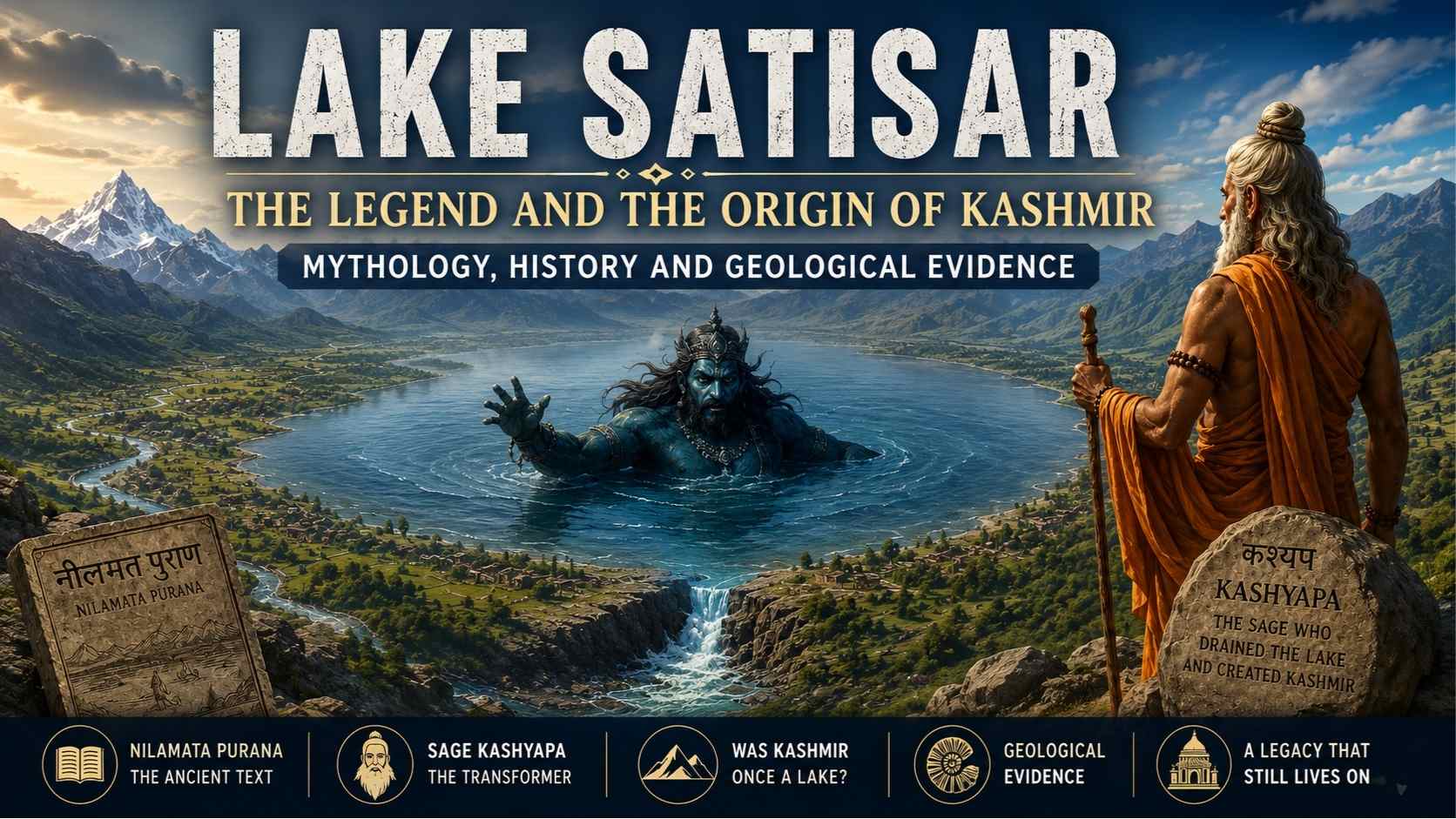
Lake Satisar: The Ancient Lake That Shaped Kashmir’s Origins

Lake Satisar is the legendary lake described in the Nilamata Purana as once covering the entire Kashmir Valley. According to Hindu tradition, Sage Kashyapa, also called Rishi Kashyapa, drained the lake with the help of the gods, defeated the water-born demon Jalodbhava, and made the valley fit for human settlement.

What makes this story especially fascinating is that modern geology also suggests the Kashmir Valley was once covered by a vast prehistoric lake. While mythology and science tell different stories about how the lake disappeared, both point to a time when Kashmir was entirely underwater.

The legend is also closely linked to the origin of the name Kashmir, which many traditional accounts derive from Kashyapa, crediting the sage with giving the valley both its identity and its earliest inhabitants

Kashmir’s Story Begins with a Lake

Every civilisation has a story that explains how its homeland came into being. For Kashmir, that story begins not with kings or kingdoms, but with water.

Long before orchards covered the valley floor and long before Srinagar emerged as its cultural heart, Hindu tradition describes Kashmir as an immense lake enclosed by the Himalayas. Known as Satisar, this vast body of water was believed to have covered the entire valley until Sage Kashyapa, aided by the gods, released its waters and made the land suitable for human settlement.

The narrative has endured for well over a thousand years because it occupies an unusual position in Indian tradition. It is simultaneously a sacred legend, a regional origin story and a cultural memory preserved in some of Kashmir’s oldest Sanskrit texts.

More remarkably, modern geological research has established that the Kashmir Valley was indeed occupied by a large freshwater lake during prehistoric times. While science explains the valley’s formation through tectonic activity and river erosion rather than divine intervention, both traditions begin with the same striking premise.

This convergence has attracted the attention of historians, geologists, archaeologists and scholars of religion alike. The legend cannot be treated as geological evidence, nor can geology validate its supernatural elements. Yet the broad correspondence between an ancient literary tradition and the physical history of the valley makes Lake Satisar one of the most compelling origin narratives in South Asia.

The Meaning of Satisar

The name Satisar derives from two Sanskrit words.

Sanskrit Meaning
Sati Goddess Sati, the first consort of Lord Shiva
Sara (Sar) Lake

The name, therefore, translates as “The Lake of Sati.”

Within Hindu tradition, the association is deeply significant. Goddess Sati has long been linked with the Himalayan region, and the lake was regarded as a sacred landscape long before it became associated with the legend of Sage Kashyapa. It was not simply a geographical feature but a place imbued with divine presence, forming part of the spiritual geography of ancient Kashmir.

The Nilamata Purana: Kashmir’s Earliest Cultural Record

The earliest detailed account of Lake Satisar appears in the Nilamata Purana, a Sanskrit text devoted exclusively to Kashmir. Most scholars date its compilation between the sixth and eighth centuries CE, although many of the traditions preserved within it almost certainly originated centuries earlier through oral transmission.

Unlike the major Puranas that deal with universal cosmology or pan-Indian mythology, the Nilamata Purana is regional in scope. It records Kashmir’s rivers, mountains, sacred springs, festivals, rituals and local customs while explaining how the valley acquired its religious identity. For historians, it is one of the most valuable sources for understanding early Kashmir. For devotees, it remains an important sacred text. Digital manuscripts and scholarly resources are available through the Muktabodha Digital Library and the Muktabodha Indological Research Institute.

Rather than separating religion from geography, the text presents the landscape itself as sacred. Mountains, rivers and lakes are woven into a single narrative that explains both the physical and spiritual origins of the valley.

Kashmir Before Human Settlement

According to the Nilamata Purana, Kashmir did not begin as a fertile valley surrounded by snow-covered mountains. It existed as a vast inland lake enclosed by towering mountain ranges that prevented its waters from escaping.

Fed by countless streams flowing from glaciers and high-altitude snowfields, the lake dominated the entire basin. The surrounding slopes were covered with forests, while mist rising from the water gave the landscape an otherworldly appearance that later generations associated with gods, sages and celestial beings.

This description belongs to sacred literature, yet it is strikingly consistent with what geologists know about the valley’s distant past.

Modern geology identifies Kashmir as an intermontane basin, enclosed between the Great Himalayas and the Pir Panjal Range. During the Late Pliocene and Pleistocene epochs, tectonic uplift altered regional drainage patterns, allowing water to accumulate within the basin and form a large freshwater lake. The extensive Karewa deposits, which blanket significant parts of the valley today, preserve sediments that were laid down in this ancient lacustrine environment. Geological surveys published by the Geological Survey of India describe these deposits as some of the most important evidence for Kashmir’s prehistoric lake history.

The similarities between the ancient narrative and the geological record do not establish that one proves the other. They do, however, explain why the legend continues to attract scholarly attention.

Sage Kashyapa and the Birth of Kashmir

No figure is more closely associated with Kashmir’s origins than Sage Kashyapa.

Throughout Hindu literature, Kashyapa occupies an exceptional position. He is counted among the Prajapatis, the progenitors entrusted with populating creation, and his name appears in the Vedas, the Mahabharata and numerous Puranas. Many dynasties, communities and mythological lineages trace their ancestry to him.

His role in Kashmir, however, is unlike any other.

According to the Nilamata Purana, Kashyapa travelled through the Himalayan region while Lake Satisar still covered the valley. There, he encountered a land rendered uninhabitable by the presence of Jalodbhava, a powerful demon whose strength depended entirely upon the surrounding waters.

The demon’s name reflects his origin.

  • Jala means water.
  • Udbhava means born from.

Jalodbhava was therefore understood as “the one born from the waters.”

Protected by the immense lake, he prevented sages from living peacefully and made human settlement impossible. The legend transforms the lake into more than a physical landscape. It becomes a symbol of untamed power, capable of sustaining life while simultaneously concealing destructive forces beneath its surface.

Kashyapa’s Appeal to the Gods

Unable to overcome Jalodbhava through ordinary means, Kashyapa turned to spiritual discipline.

The Nilamata Purana describes him undertaking prolonged penance until his austerities attracted the attention of Brahma, Vishnu and Shiva. The gods recognised that the demon’s invincibility depended entirely upon the existence of Lake Satisar. As long as the valley remained submerged, Jalodbhava could not be defeated.

The solution was not to wage war against the demon.

It was to transform the landscape itself.

According to tradition, the mountains were opened at Varahamula, identified with present-day Baramulla, allowing the trapped waters to escape. As the lake drained, fertile land emerged across the valley floor. Deprived of his watery refuge, Jalodbhava was defeated, and Kashmir became suitable for human habitation.

Several centuries later, Kalhana’s Rajatarangini preserved variations of this foundational narrative while incorporating it into a broader history of Kashmir’s rulers. Sir Aurel Stein’s classic English translation, available through the Internet Archive, remains one of the most widely consulted editions of the chronicle.

For believers, the draining of Satisar marks the sacred beginning of Kashmir.

For historians, it represents one of India’s oldest and most influential regional origin traditions.

For geologists, it mirrors a landscape that genuinely evolved from a water-filled basin into the fertile valley that exists today, although through natural processes operating over millions of years rather than divine intervention.

That convergence between sacred memory and scientific evidence is what continues to distinguish the legend of Lake Satisar from countless other origin stories.

The Nilamata Purana: The Foundation of Kashmir’s Cultural Memory

No discussion of Lake Satisar can move beyond legend without examining the Nilamata Purana, the earliest surviving text devoted entirely to Kashmir. Historians regard it as one of the most important sources for understanding the valley’s religious traditions, sacred geography and early cultural identity.

Unlike most Puranas, which explore universal Hindu cosmology or the deeds of gods across the Indian subcontinent, the Nilamata Purana focuses on a single region. It records Kashmir’s rivers, mountains, springs, festivals, rituals and local customs while explaining how the valley became a sacred landscape. This regional focus makes it an invaluable resource for historians, Sanskrit scholars and archaeologists alike.

Although scholars generally date its compilation between the sixth and eighth centuries CE, the work almost certainly preserves traditions that circulated orally for centuries before they were written down. Manuscripts and scholarly information about the text are available through the Muktabodha Digital Library and the Muktabodha Indological Research Institute, both of which have become important resources for the study of Sanskrit literature.

Rather than presenting geography as a collection of physical landmarks, the Nilamata Purana treats the landscape itself as sacred. Rivers possess divine origins, mountains carry spiritual significance, and lakes become stages upon which cosmic events unfold. This perspective shaped the way generations of Kashmiris understood their homeland.

A Valley Hidden Beneath Water

The Nilamata Purana describes a Kashmir that bore little resemblance to the valley known today.

Instead of fertile plains crossed by the Jhelum River, the region existed as an immense lake enclosed by mountain ranges. The surrounding peaks trapped the waters within the basin, creating an inland lake that dominated the landscape.

Within this vast expanse lived Jalodbhava, the water-born demon whose presence prevented sages and ordinary people from settling the valley. As long as the lake remained, civilisation could not take root.

Modern readers sometimes approach this passage as a simple battle between good and evil. The text suggests something more layered. Water represents life, yet it also conceals danger. The same natural force capable of sustaining existence can become destructive when left unchecked. Similar symbolism appears throughout Hindu literature, where balance, rather than abundance alone, determines whether nature nurtures or destroys.

The Nilamata Purana does not distinguish between geography, theology and history in the way modern scholarship does. Instead, it combines them into a unified narrative that explains not only how the landscape came into being, but why it became sacred.

Kashyapa’s Intervention

According to the text, sages who had suffered under Jalodbhava’s oppression appealed to Sage Kashyapa for help.

Kashyapa did not respond with military strength. He undertook prolonged austerities and meditation, seeking divine assistance through penance. His devotion eventually reached Brahma, Vishnu and Shiva, who recognised that the problem could not be solved while Jalodbhava remained protected by the waters of Satisar.

The solution lay in changing the landscape itself.

The gods opened a passage through the surrounding mountains, allowing the waters to escape. Once the lake drained, the demon lost his refuge and was defeated. Only then could the valley support human settlement.

This sequence distinguishes the Kashmir tradition from many other heroic myths. Victory is achieved not through conquest alone but through wisdom, patience and the restoration of natural order. Kashyapa succeeds because he removes the conditions that made tyranny possible.

Reading the Legend Beyond Its Surface

For believers, the draining of Satisar remains an act of divine intervention. Historians and anthropologists, however, often examine the story from a broader cultural perspective.

Rather than asking whether every event occurred exactly as described, they explore why the narrative endured for centuries and what it reveals about the society that preserved it.

Several themes emerge repeatedly.

Symbol Traditional Meaning Historical Interpretation
Lake Satisar Sacred primordial waters Memory of an ancient landscape
Jalodbhava Water-born demon Chaos preventing settlement
Sage Kashyapa Divine sage Restorer of order and civilisation
Draining the lake Divine miracle The transformation that made habitation possible
Birth of Kashmir Sacred creation Emergence of organised society

These interpretations are not mutually exclusive. Sacred narratives often operate on multiple levels, offering spiritual meaning while simultaneously preserving cultural memory. Many historians caution against reducing ancient texts to either literal history or pure fiction. Their value frequently lies somewhere between those extremes.

The Rajatarangini: Where Legend Meets History

Nearly five centuries after the Nilamata Purana, another remarkable work preserved Kashmir’s earliest traditions.

The Rajatarangini, composed by Kalhana in the twelfth century, is widely regarded as one of the earliest historical chronicles produced in Sanskrit literature. Unlike court poets who simply celebrated reigning monarchs, Kalhana attempted to construct a chronological account of Kashmir’s past by comparing earlier texts, inscriptions, genealogies and oral traditions.

His approach was extraordinary for its time.

Modern historians recognise that the earliest chapters blend mythology with historical memory, yet they also acknowledge Kalhana’s effort to distinguish reliable traditions from unsupported legend. That critical method sets the Rajatarangini apart from many medieval chronicles.

Sir Aurel Stein’s English translation, first published in the early twentieth century, remains one of the standard reference editions and is freely available through the Internet Archive. The work continues to serve as an essential source for scholars studying Kashmir’s political and cultural history.

How Kalhana Preserved the Story of Satisar

Kalhana did not dismiss the legend of Lake Satisar as folklore.

Instead, he accepted it as the foundation upon which Kashmir’s later history unfolded. The draining of the lake, the role of Sage Kashyapa and the defeat of Jalodbhava all appear before the narrative turns to the valley’s earliest rulers.

This blending of myth and history was common throughout the ancient world. Greek historians connected cities to heroic founders, Roman writers traced their origins to Aeneas, and many Indian dynasties linked themselves to divine or legendary ancestors. Kashmir followed the same tradition, placing its sacred origin at the beginning of its historical record.

For modern historians, these early chapters are valuable not because they provide literal documentation of prehistoric events, but because they reveal how medieval Kashmiris understood their own past and cultural identity.

Was Kashmir Named After Sage Kashyapa?

One of the oldest traditions surrounding the valley concerns the origin of its name.

Several explanations appear in classical literature.

Some derive Kashmir from Kashyapa-mira, interpreted as the lake of Kashyapa. Others favour Kashyapa-mar, meaning the land drained by Kashyapa, while another tradition refers to Kashyapapura, a settlement established by the sage.

Modern linguists remain divided over the precise etymology. No single explanation has gained universal acceptance, and historical linguistics continues to examine the evolution of the name through Sanskrit and later regional languages.

Even so, the association between Kashmir and Sage Kashyapa has remained deeply embedded in literary, religious and cultural tradition for centuries. Encyclopaedia Britannica and the Indian Culture Portal both discuss the historical development of Kashmir’s identity and the enduring influence of these early narratives.

The Naga Tradition in Kashmir

One feature that distinguishes the Nilamata Purana from many other Sanskrit texts is its emphasis on the Nagas, serpent deities closely associated with springs, lakes and rivers.

In Kashmir’s early religious tradition, Nagas were not simply mythical creatures. They were regarded as guardians of water sources and protectors of the land. Numerous springs throughout the valley were dedicated to them, reflecting an ancient understanding of water as both sacred and life-giving.

The continuity of these traditions is remarkable. Several springs and shrines associated with Naga worship remain places of local reverence today, preserving a connection between Kashmir’s earliest religious practices and its living cultural heritage.

Why These Ancient Texts Still Matter

The Nilamata Purana and the Rajatarangini remain indispensable because they preserve far more than mythology.

They document early place names, sacred geography, seasonal festivals, ritual practices and regional traditions that might otherwise have disappeared from history. Archaeologists, historians, philologists and scholars of religion continue to consult these works because they provide insights unavailable from inscriptions or material remains alone.

Neither text should be treated as a geological report or a modern history book. Each belongs to a literary tradition with its own purpose and conventions.

Taken together, however, they provide the earliest and most detailed account of how Kashmir understood its own beginnings, preserving a cultural memory that has endured for more than a millennium.

Geological Evidence: Was Kashmir Once a Vast Lake?

The story of Lake Satisar has remained relevant not simply because it occupies an important place in Hindu tradition, but because modern geology has confirmed one of its central premises. Long before human settlement, the Kashmir Valley was occupied by a vast freshwater lake.

This does not validate the supernatural elements of the legend, nor does it reduce the Nilamata Purana to a geological record. Instead, it reveals an unusual point of convergence between an ancient cultural tradition and the physical history of the landscape.

Today, geologists reconstruct Kashmir’s past by studying rock formations, sedimentary layers, fossils and tectonic activity. Their methods differ entirely from those of ancient authors, yet both arrive at the same broad conclusion. The valley was once filled with water.

How the Kashmir Valley Was Formed

The Kashmir Valley occupies a unique geographical position within the western Himalayas.

It lies between two major mountain systems.

  • The Great Himalayas to the northeast.
  • The Pir Panjal Range to the southwest.

Together, these mountain chains form what geologists describe as an intermontane basin, a depression enclosed by higher terrain.

The basin itself developed as a consequence of one of Earth’s greatest geological events, the collision between the Indian and Eurasian tectonic plates. That collision, which began around fifty million years ago and continues today, gave rise to the Himalayan mountain system.

As the mountains gradually rose, natural drainage patterns changed. Rivers flowing into the enclosed basin could no longer escape efficiently, allowing water from glaciers, rainfall and snowmelt to accumulate over immense periods. Eventually, much of the valley became occupied by a large freshwater lake.

Research published by the Geological Survey of India identifies this ancient lake as one of the defining stages in the geological evolution of Kashmir.

The Karewa Deposits: Kashmir’s Geological Archive

The strongest evidence for the prehistoric lake lies not in ancient texts but beneath the valley’s surface.

Across Kashmir, elevated terraces known as Karewas preserve thick sequences of sediments that accumulated when the basin remained underwater.

These deposits consist of:

  • Clay
  • Silt
  • Fine sand
  • Gravel
  • Organic matter
  • Fossilised pollen
  • Plant remains

Unlike river sediments deposited by flowing water, Karewas formed under lacustrine conditions, meaning they accumulated on the floor of a long-standing lake.

In several locations, these sedimentary sequences exceed 1,300 metres in thickness, making them among the most significant lake deposits in South Asia.

For geologists, Karewas function as a natural archive.

Each layer records changes in climate, vegetation and hydrology over millions of years. By analysing fossil pollen, mineral composition and sediment structure, researchers have reconstructed ancient environmental conditions with remarkable detail.

These same deposits also support one of Kashmir’s most famous agricultural products. The well-drained Karewa soils provide ideal conditions for saffron cultivation, linking the valley’s geological history directly to its modern economy.

What Are Karewas?

Feature Description
Formation Ancient lake sediments
Composition Clay, silt, sand, gravel and organic material
Geological Age Mainly Late Pliocene to Pleistocene
Scientific Importance Records climate and environmental change
Present-Day Value Supports saffron cultivation and orchards

How Old Was the Ancient Lake?

Popular discussions sometimes create the impression that Lake Satisar disappeared only a few thousand years ago.

Geological evidence tells a very different story.

The principal lacustrine phase began during the Late Pliocene, approximately four million years ago, and continued into the Pleistocene Epoch. During that immense span of time, the lake repeatedly expanded, contracted and changed shape as climate and tectonic activity altered the surrounding landscape.

By comparison, Homo sapiens emerged roughly 300,000 years ago, while settled agriculture developed only within the last 10,000 to 12,000 years.

The geological lake, therefore, predates human civilisation by an extraordinary margin.

This chronology makes it impossible to interpret the legend as a literal eyewitness account of prehistoric events. Historians instead suggest that the narrative reflects later observations of the valley’s distinctive landforms, marshes and sedimentary landscape, transformed into a sacred explanation of Kashmir’s origins.

The Baramulla Gorge and the Draining of the Lake

One of the most intriguing aspects of the Satisar tradition concerns the draining of the lake.

According to the Nilamata Purana, divine intervention opened a passage through the surrounding mountains, allowing the trapped waters to escape.

Modern geology identifies the Baramulla Gorge as the natural outlet through which the Jhelum River leaves the Kashmir Valley.

Over hundreds of thousands of years, river erosion gradually deepened this gorge. As the outlet became lower, water levels within the basin declined until the lake eventually disappeared, exposing the fertile valley floor.

The geological explanation differs fundamentally from the sacred narrative.

The legend describes a single transformative event brought about through divine agency.

Geology describes an immensely slow process driven by erosion, tectonic activity and changing drainage patterns.

Yet both traditions recognise the same geographical reality. Kashmir became habitable only after the waters receded.

That shared observation explains why the legend continues to attract attention from historians and earth scientists alike.

Fossils Preserved Beneath the Valley

The Karewa deposits preserve more than layers of sediment.

They also contain evidence of ecosystems that flourished around the prehistoric lake.

Researchers have recovered:

  • Fossilised pollen
  • Plant remains
  • Freshwater molluscs
  • Microscopic aquatic organisms
  • Ancient soil horizons
  • Vertebrate fossils from several localities

These discoveries allow scientists to reconstruct climatic conditions that prevailed hundreds of thousands, and sometimes millions, of years ago.

Pollen analysis has proved especially valuable. By identifying plant species preserved within successive sedimentary layers, researchers can trace shifts between warmer and colder climatic periods, documenting the advance and retreat of glaciers during the Ice Ages.

For palaeoclimatologists, the Kashmir Valley represents one of South Asia’s most important natural archives for studying long-term environmental change.

Did Ancient Traditions Preserve a Memory of the Lake?

This question continues to generate debate among historians, archaeologists and scholars of religion.

No consensus exists, but three principal interpretations dominate current discussion.

Cultural Memory

Some researchers argue that oral traditions can preserve memories of unusual landscapes for surprisingly long periods. Although no tradition could survive unchanged for millions of years, later communities may have encountered marshes, wetlands or remnants of older lakes and incorporated those observations into sacred narratives.

Observation of the Landscape

Others suggest that no inherited memory was required.

The valley’s geography naturally invites explanation. A broad, flat basin surrounded by steep mountains resembles the floor of an ancient lake. Ancient observers may simply have concluded that such a landscape must once have held water.

Sacred Cosmology

A third interpretation views the Satisar narrative primarily as religious literature.

From this perspective, the story was never intended to explain geological history. Its purpose was to express theological ideas concerning order, creation, divine intervention and the establishment of sacred space.

These explanations are not mutually exclusive. Ancient narratives often combine careful observation of the natural world with symbolism, spiritual belief and cultural memory.

Where Mythology and Geology Converge

Ancient Tradition Geological Understanding
Kashmir was once covered by a vast lake Geological evidence strongly supports a prehistoric freshwater lake
Sage Kashyapa drained the lake Water gradually escaped through natural erosion and tectonic processes
Jalodbhava lived beneath the waters No scientific equivalent
Divine intervention transformed the landscape Geological change occurred over millions of years
Fertile land emerged after the waters receded Lake sediments created productive agricultural soils

The comparison does not place mythology and science in competition.

Each seeks to answer a different question.

The Nilamata Purana explains why the valley became sacred.

Geology explains how the valley evolved through natural processes.

Taken together, they offer a richer understanding of Kashmir than either perspective could provide alone.

From Sacred Legend to Cultural Identity

The story of Lake Satisar does not end with the draining of its waters. In many respects, that event marks the beginning of Kashmir’s cultural history.

According to the Nilamata Purana, once Jalodbhava was defeated and the waters had receded, Sage Kashyapa invited sages, scholars and settlers to inhabit the newly emerged valley. The land that had once been inaccessible became a place where communities could flourish, rituals could be performed, and sacred traditions could take root.

Whether this account is approached as religious belief, cultural memory or literary tradition, it serves the same purpose. It explains how Kashmir became more than a geographical region. It became a sacred landscape with a distinct identity rooted in Hindu tradition.

For centuries, that identity influenced literature, pilgrimage, philosophy and local customs, leaving a legacy that extends far beyond the legend itself.

Sage Kashyapa’s Enduring Legacy

In Hindu tradition, Sage Kashyapa occupies a place that extends well beyond Kashmir.

He appears throughout the Vedas, the Mahabharata and several Puranas as one of the great Prajapatis, entrusted with the continuation of life after creation. Numerous dynasties, communities and mythological beings trace their lineage to him, reflecting his importance within Hindu cosmology.

His association with Kashmir, however, gives him a distinctive role.

Rather than being remembered primarily as a teacher or philosopher, Kashyapa is portrayed as the sage who transformed an inhospitable landscape into a place where civilisation could emerge. The legend credits him not simply with defeating evil but with creating the conditions necessary for human society to thrive.

That symbolism has endured for centuries. Kashyapa represents wisdom applied to the common good, where spiritual discipline leads to lasting transformation rather than personal glory.

Why Kashmir Became Known as Paradise on Earth

Centuries before the Mughal emperor Jahangir is believed to have described Kashmir as “Paradise on Earth,” the valley had already acquired sacred status in Hindu literature.

The Nilamata Purana portrays Kashmir as a land blessed by divine intervention, nourished by rivers, protected by mountains and enriched by countless springs. The valley’s natural beauty reinforced this spiritual reputation, inspiring poets, saints and travellers across successive generations.

Visitors were struck by its remarkable diversity.

Snow-covered peaks rise above dense forests. Alpine meadows give way to fertile plains. Rivers and lakes sustain orchards, saffron fields and wetlands that support an extraordinary range of wildlife.

This combination of dramatic scenery and deep religious tradition helped establish Kashmir as one of the most celebrated cultural landscapes in the Indian subcontinent. Historical overviews published by Encyclopaedia Britannica and the Indian Culture Portal continue to highlight the valley’s unique blend of natural and cultural heritage.

Sacred Geography and Living Tradition

One reason the legend of Lake Satisar has remained influential is that it is closely connected with real places that continue to hold historical and religious significance.

Baramulla

According to tradition, the waters of Satisar escaped through Varahamula, identified with present-day Baramulla.

Modern geology also recognises the Baramulla Gorge as the natural outlet through which the Jhelum River drains the Kashmir Valley. Although mythology attributes this transformation to divine intervention and geology explains it through long-term erosion, both traditions identify the same location as central to the valley’s formation.

The Jhelum River

Known in Sanskrit as Vitasta, the Jhelum occupies an important place in Kashmiri religious literature.

The Nilamata Purana celebrates the river as sacred, while later historical works describe it as the lifeline of the valley’s settlements, agriculture and trade.

Even today, the Jhelum remains central to Kashmir’s economy and ecology, linking the region’s ancient traditions with its modern landscape.

Springs and the Naga Tradition

The Nilamata Purana also emphasises the importance of Nagas, the serpent deities associated with springs, rivers and lakes.

Throughout Kashmir, numerous springs became places of worship because they were believed to be protected by these divine guardians. Many of these sacred sites continue to attract local devotees, illustrating how traditions first recorded more than a millennium ago remain part of the valley’s living heritage.

What Archaeology Reveals

Unlike mythology or geology, archaeology investigates the material evidence left behind by past societies.

Archaeological research cannot verify the existence of Sage Kashyapa or the literal events described in the Nilamata Purana. It does, however, demonstrate that the Kashmir Valley supported organised human communities thousands of years after the prehistoric lake had disappeared.

Among the most significant sites is Burzahom, situated on the outskirts of Srinagar.

Excavations have revealed a thriving Neolithic settlement that flourished between approximately 3000 BCE and 1500 BCE. Archaeologists have uncovered:

  • Pit dwellings were excavated below ground level.
  • Stone tools and polished implements.
  • Pottery used for storage and cooking.
  • Bone tools were crafted for everyday activities.
  • Evidence of domesticated animals.
  • Burials that provide insight into early ritual practices.

These discoveries show that once the valley became habitable, it developed into an important centre of human settlement long before the emergence of recorded history.

Mythology, History and Science

The story of Lake Satisar is often presented as a choice between faith and evidence.

That framing oversimplifies the issue.

Each discipline asks a different question and relies on different forms of evidence.

Perspective Primary Focus
Mythology Spiritual meaning and sacred tradition
Ancient Texts Cultural memory and literary history
Archaeology Material evidence of human settlement
Geology Physical evolution of the Kashmir Valley
Anthropology Oral tradition and cultural continuity

Rather than competing with one another, these disciplines complement each other.

Mythology explains why a landscape became sacred.

History examines how traditions developed over time.

Archaeology reconstructs the lives of the people who later inhabited the valley.

Geology explains the natural processes that shaped the land itself.

Taken together, they offer a more complete understanding of Kashmir’s past than any single approach could provide.

Why the Legend Continues to Matter

More than a thousand years after it was first recorded, the story of Lake Satisar remains relevant because it speaks to several audiences at once.

For devotees, it preserves a sacred account of divine intervention.

For historians, it provides one of the earliest regional origin narratives in South Asia.

For geologists, it echoes a prehistoric landscape whose history can still be traced through rock formations and sedimentary deposits.

For cultural scholars, it illustrates how communities use stories to understand the places they inhabit.

Few origin traditions continue to inspire meaningful discussion across religion, literature, archaeology and Earth science with the same consistency.

That breadth explains why Lake Satisar remains central to conversations about Kashmir’s history, identity and cultural heritage.

Frequently Asked Questions

Was Lake Satisar a real lake?

According to the Nilamata Purana, Lake Satisar once covered the entire Kashmir Valley before Sage Kashyapa drained its waters. Modern geological research confirms that a large prehistoric freshwater lake occupied the valley, although it formed and disappeared through natural geological processes rather than the supernatural events described in the legend.

Who was Sage Kashyapa?

Sage Kashyapa is one of Hinduism’s most revered sages and is recognised as a Prajapati in several sacred texts. In Kashmir’s traditional origin narrative, he is credited with making the valley habitable after securing divine assistance to drain Lake Satisar.

Who was Jalodbhava?

Jalodbhava is the water-born demon described in the Nilamata Purana. The text portrays him as the ruler of Lake Satisar, whose defeat allowed human settlement to begin in the Kashmir Valley.

Does geology support the legend?

Geology supports the existence of a prehistoric lake in the Kashmir Valley, but does not support the supernatural events described in the Nilamata Purana. The correspondence lies in the broad description of an ancient lake rather than in the religious narrative itself.

What are the Karewa deposits?

Karewas are elevated terraces of ancient lake sediments found throughout the Kashmir Valley. They provide some of the strongest geological evidence that a large freshwater lake once occupied the basin and remains important for both scientific research and agriculture.

Is the story of Lake Satisar historical?

Most historians regard the Satisar narrative as a sacred origin tradition rather than a literal historical record. Nevertheless, the Nilamata Purana and the Rajatarangini remain indispensable sources for understanding Kashmir’s cultural memory, religious traditions and early literary history.

📘 Blogs