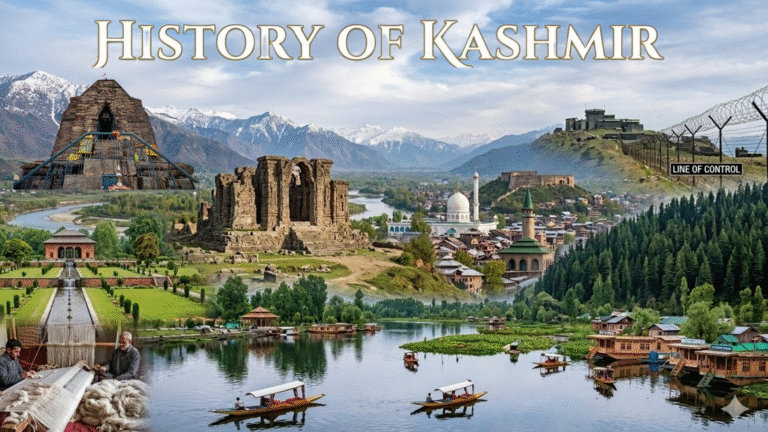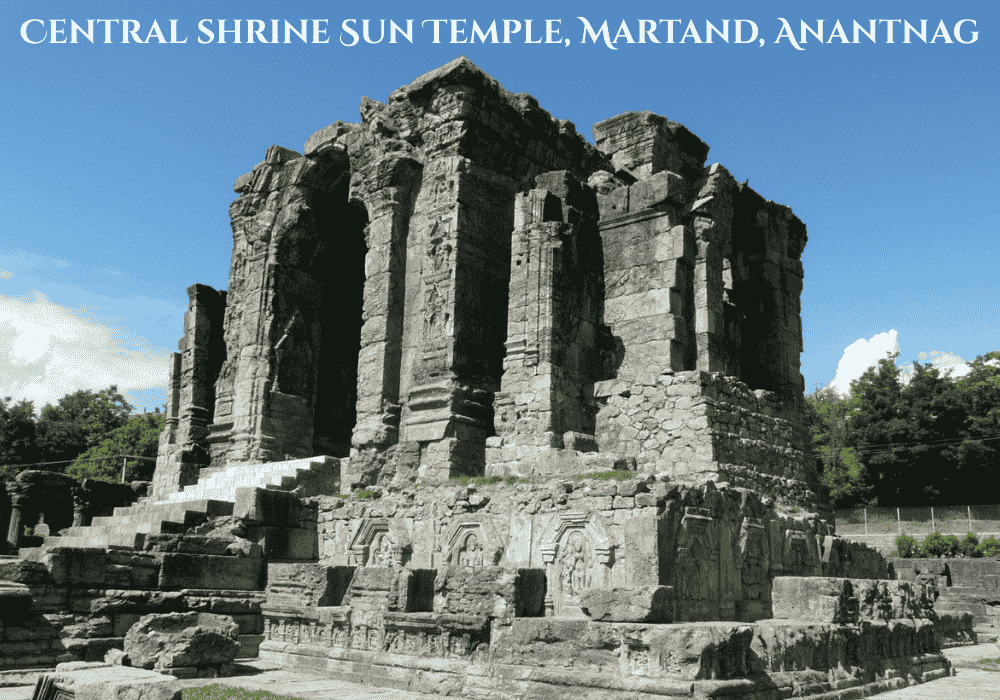
In Anantnag, south Kashmir, 84 carved columns rise from the earth in various states of ruin. The Martand Sun Temple, built in the 8th century, stands on a high escarpment that commands an unbroken view of the Lidder Valley below. In March 2024, the Jammu and Kashmir government announced restoration efforts at this site and proposed installing a statue of the man who built it: Emperor Lalitaditya Muktapida.
That this announcement came more than 1,200 years after his death reflects how long Lalitaditya’s place in recorded memory has gone unacknowledged. He remains the most consequential ruler Kashmir ever produced, and yet he is barely mentioned in standard Indian history textbooks.
What follows is drawn from the historical record he left behind, and from the scholar who preserved it.
Kalhana and the Rajatarangini
Almost everything known about Lalitaditya Lalitaditya Muktapida comes from the Rajatarangini (River of Kings), a Sanskrit chronicle completed in 1148-49 CE by Kalhana, a 12th-century Kashmiri scholar. It is, by any serious reckoning, one of the most remarkable historical documents produced anywhere in the medieval world.
What sets the Rajatarangini apart is not simply that it exists, but how it was written. Kalhana worked without royal patronage. He did not attach himself to any court, and he had no financial incentive to flatter those in power. This independence was rare in his era, and it shaped everything that followed. He cross-referenced temple inscriptions, royal records, earlier chronicles, and oral traditions. Where sources agreed, he recorded the claim with confidence. Where they diverged, he examined the contradiction and chose what the weight of evidence supported. When the evidence was thin, he said so plainly. He praised good rulers and recorded the failures of bad ones with equal candour. This was not a common practice in medieval India, and it is precisely why the Rajatarangini has remained the indispensable foundation of Kashmiri history for nine centuries.
The early sections of the chronicle deal with ancient and legendary kings whose reigns stretch back thousands of years. Kalhana himself approached this material with evident caution. As the narrative moves forward in time, it becomes more detailed and more specific. The later books, which cover rulers closer to Kalhana’s own era, are considered primary historical sources of high reliability by modern scholars, a view that has persisted since Aurel Stein produced his definitive English translation in 1900.
The Tang dynasty records of China offer independent corroboration for the Karkota period. They mention a Kashmiri ruler called “Tianmu” who dispatched a mission to Chang’an in 720 CE. Scholars identify this figure as either Chandrapida or Tarapida, Lalitaditya’s elder brothers, who held the throne before him. Tansen Sen, a historian specialising in Asian relations, examined these exchanges in the Journal of Asian History and concluded that the Karkota kingdom maintained a strategic alliance with Tang China, particularly aimed at countering Tibetan expansion. This finding is consistent with Kalhana’s account of Lalitaditya’s northern campaigns.
Dates and Succession relate to Lalitaditya Muktapida
Lalitaditya was the youngest son of Durlabhaka, also known as Pratapaditya, and Queen Narendraprabha. Kalhana records that Narendraprabha had been previously married to a wealthy foreign merchant before her union with the king. His two elder brothers, Chandrapida and Tarapida, held the throne before him. According to the Rajatarangini, Tarapida’s misrule so unsettled the kingdom that Lalitaditya’s accession was welcomed as a restoration of order.
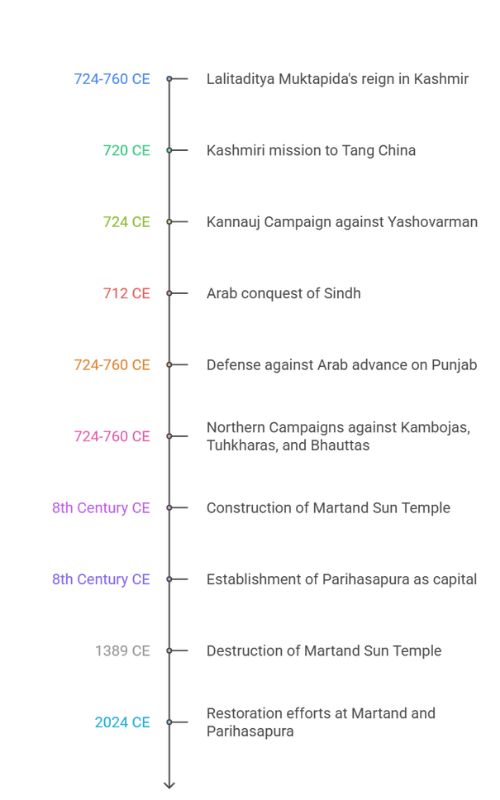
Kalhana assigns him a reign of 36 years, 7 months, and 11 days, placing his rule from 724 to 761 CE. When cross-referenced with Chinese and Arab sources, the scholarly consensus settles his reign at approximately 724-725 to 760 CE. The precise figure matters less than the duration: by any reckoning, Lalitaditya ruled Kashmir longer than any other Karkota monarch.
The Kannauj Campaign
Lalitaditya’s first major military undertaking was directed against Kannauj, then the dominant power in northern India under King Yashovarman. Kalhana records that Lalitaditya defeated Yashovarman decisively and brought his territories under Karkota influence.
The Chachnama, formally known as Fateh-nama Sindh, is a Persian text compiled by Ali Kufi in the 13th century CE, drawing on an earlier Arabic account of the Arab conquest of Sindh. It contains a passage referring to a Kashmiri king described as one “on whose royal threshold the other rulers of Hind had placed their heads, who sways the whole of Hind, even the countries of Makran and Turan.” Some historians have identified this king with Lalitaditya. This identification, however, cannot be sustained on chronological grounds: the passage relates to events surrounding Raja Dahir of Sindh, who was killed by Muhammad bin Qasim in 712 CE, more than a decade before Lalitaditya came to the throne in 724 CE. The reference is more plausibly read as applying to the Karkota dynasty’s general standing at the time, or to one of Lalitaditya’s predecessors.
The Kannauj campaign yielded more than territorial gain. Vakpatiraja, the celebrated Sanskrit poet associated with Yashovarman’s court, appears to have arrived in Kashmir during Lalitaditya’s reign. Skilled craftsmen and artisans from defeated regions were also relocated to Kashmir. This practice of drawing in intellectual and artistic talent from conquered territories became a defining feature of Lalitaditya’s statecraft.
The Arab Front
By the early 8th century, Arab forces under the Umayyad Caliphate had consolidated control over Sindh and were pressing northward towards the Punjab. Muhammad bin Qasim had conquered Sindh in 712 CE, and the Caliphate regarded the Indian subcontinent as a frontier open to further expansion. It was Lalitaditya who checked that advance and prevented Arab forces from overrunning the Punjab.
Romila Thapar, in The Penguin History of Early India, records that Kashmir under Lalitaditya of the Karkota dynasty rose to prominence through gradual expansion and conquest, extending its hold over parts of north-western India and the Punjab, and that Lalitaditya led his armies briefly into the Ganges Plain before turning back the Arab advance on the Punjab.
Al-Biruni, the 11th-century Persian scholar and polymath, mentions a Kashmiri king named “Muttai” who defeated Momin, the governor of Bukhara. The name is a rendering of “Muktapida,” one of Lalitaditya’s formal titles, derived through the Apabhramsha tradition, the family of Middle Indo-Aryan languages spoken across much of the subcontinent, which naturally altered foreign names as they entered common usage.
The Northern Campaigns
Kalhana documents Lalitaditya’s campaigns against the Kambojas in the Hindu Kush region, the Tuhkharas, who were Tocharian peoples of Central Asia, and the Bhauttas, the Tibetans. The Rajatarangini records that the Kambojas’ horse stables were stripped bare and that the Tuhkharas retreated into their mountain ranges.
These campaigns targeted the arteries of long-distance trade. The Silk Road ran through the Hindukush and across Central Asia, connecting India with China, Persia, and the Mediterranean world. Whoever held the passes and the surrounding territories held leverage over the movement of goods, envoys, and intelligence. Lalitaditya’s documented alliance with the Tang dynasty against the Tibetans shows that he understood this larger regional picture with considerable strategic clarity.
Hermann Goetz, drawing on art-historical evidence, concluded that Lalitaditya’s sphere of influence extended from the Hindu Kush mountains in present-day Afghanistan to Assam, Rajasthan, Gujarat, and parts of Central India. Historians generally read this as the outer boundary of Karkota diplomatic and military activity rather than as a record of continuous administrative control over every intervening territory.
The Martand Sun Temple
The Martand Sun Temple is Lalitaditya’s most enduring physical legacy. It was constructed on a high natural terrace above the town of Mattan in south Kashmir, a position chosen with evident purpose: the site commands a sweeping view across the Lidder Valley, and the Shikhara of the Vijeyshawara Shrine near Bijbihara is visible in the distance. The structure follows the distinctive Kashmiri architectural idiom, with a collonaded outer courtyard, a central sanctum, and 84 carved stone pillars. The number 84 carries deep symbolic resonance in Hindu cosmological tradition.
Although Lalitaditya was a worshipper of Surya, the Sun God, his religious patronage was not restricted to a single tradition. The Martand temple incorporates Vaishnava imagery, including three-faced Vishnu figures and Chaturbhuja (four-armed) Vishnu carvings. The Rajatarangini also records that he built Buddhist viharas and made offerings at Shaivite shrines, showing a ruler who cultivated religious legitimacy across communities rather than within a single community.
The temple did not survive the medieval period intact. Sultan Sikandar Shah Miri, who came to power in 1389 CE and whose reign extended into the early 15th century, ordered its systematic destruction. What stands today, the outer courtyard, the remnants of the colonnade, and the scattered fragments of carved stone, is sufficient to convey the scale and ambition of the original construction.
Parihasapura: A New Capital
Lalitaditya established Parihasapura as his royal capital during his reign, siting it on elevated ground near present-day Shadipura, roughly 20 kilometres northwest of Srinagar. The location is known locally as “Kani Shahar” and served as Kashmir’s principal political and ceremonial seat for much of his reign.
Kalhana’s account of the city is precise in its description of the wealth invested in its religious structures. The Muktakeshva temple housed a Vishnu image cast from 84,000 tolas of gold. The Parihaskeshva temple used an equivalent weight of silver. A large copper statue of the Buddha stood within the Buddhist vihara on the grounds.
Aurel Stein’s archaeological survey of the Parihasapura site in the early 20th century identified the physical remains of these structures, confirming that Kalhana’s descriptions were grounded in actual construction and not literary invention.
In addition to Parihasapura, Lalitaditya founded several other settlements:
- Sunishchitapura
- Darpitapura
- Phalapura, near modern Shadipura
- Parnotsa, which is modern Poonch
- Lokapunya, which is modern Lokabhavan
At Hushkapura, now known as Ushkur, he raised the Muktasvamin shrine, installing images of Vishnu in gold and silver, and added a large vihara and stupa to the same complex.
Infrastructure and Administration
The Rajatarangini credits Lalitaditya with substantial works of hydraulic engineering. At Baramulla, accumulations of silt and rock had constricted the Jhelum River. Lalitaditya ordered the channel cleared, which lowered water levels across the valley, drained marshland, and opened new ground for cultivation. He also raised embankments around low-lying areas and built irrigation canals to extend agricultural activity.
Before he set out on his final campaign, Lalitaditya left instructions for the administrators he was leaving behind. Kalhana records them faithfully: guard against civil conflict, keep the forts in repair, stop cultivators from hoarding grain beyond their needs, limit the number of cattle and ploughs so that no one encroaches on a neighbour’s land, and refuse to accommodate nepotism in any officer of the state.
Taken together, these instructions point to a ruler who regarded institutional decay, rather than external military threat, as the greater danger to the continuity of the state he had built.
The Question of Conquests
Kalhana records that Lalitaditya marched into Bengal, the Deccan, and as far as Dwaraka on the western coast. These campaigns fit within the Digvijaya tradition, by which Indian rulers sought not permanent territorial annexation in the modern sense but tribute, formal acknowledgement of suzerainty, and the political standing that came with being recognised as a universal sovereign. Anirudh Kanisetti, a historian of medieval South India, places Lalitaditya’s campaigns squarely within this tradition, noting that the goal was recognition and tribute rather than continuous administrative control.
What the external record independently corroborates is the following: Lalitaditya defeated Yashovarman of Kannauj; he held the Punjab and parts of north-western India; he maintained diplomatic relations with Tang China; he turned back the Arab advance on the subcontinent’s north-western frontier; and he extended Karkota influence into the Hindukush region. These are not small achievements for a ruler of a mountain kingdom.
Death and Succession
Lalitaditya died during a campaign in Central Asia. Kalhana records two accounts of his end. In the first, he took his own life to avoid capture after being cut off from his army in difficult mountain terrain. In the second, he died in a heavy snowstorm in a region called Aryanaka, which scholars have associated with Bactria or Tokharistan, corresponding roughly to parts of present-day Afghanistan and Tajikistan.
His sons succeeded him. Kuvalayapida held the throne from approximately 760 to 761 CE, followed by Vajraditya II. The Karkota dynasty did not long outlast its greatest king. Within a few decades, the Gurjara-Pratihara and Rashtrakuta powers moved into the political vacuum left by Lalitaditya’s empire.
Legacy
The Jammu and Kashmir government’s 2024 restoration programme at Martand and Parihasapura marks a formal act of historical reckoning. The proposed statue at the Martand site would give physical presence to a figure who has been recorded in scattered fragments across languages and centuries.
Hermann Goetz observed that the demands of Lalitaditya’s empire required artists and craftsmen drawn from several distinct traditions, among them Gandharan, Gupta, Chinese, and Syrian-Byzantine. The fusion of these influences produced what became the recognisable style of classical Kashmiri art. In this sense, the diversity of artistic origins is itself a record of imperial reach.
Al-Biruni’s “Muttai” survives as a reference in a Persian scholarly text. The Chachnama records the reputation of a powerful Kashmiri king in the period of Arab expansion. The Tang dynasty annals note the Karkota embassy at Chang’an. These fragments of external testimony, taken alongside Kalhana’s chronicle and the physical remains at Martand and Parihasapura, form the evidential foundation for reconstructing Lalitaditya’s reign.
He defended the subcontinent’s north-western frontier against Arab expansion, extended Kashmiri authority far beyond the Valley, and left behind a body of architecture that continues to represent the high point of Kashmir’s ancient built heritage. The extent of his campaigns in every direction will remain a subject of scholarly discussion, but the scale of his achievement is not in question.
The restoration work now underway will not return Martand to its 8th-century form. What it can do is keep the site intelligible to those who come after. And the statue, if it is eventually installed, will affix a name and a face to the ruler whom Al-Biruni recorded, whom Kalhana documented with the rigour and independence that distinguished him as Kashmir’s greatest historian, and whom the mainstream of Indian historical writing has, until recently, largely passed over.
Frequently Asked Questions (FAQs)
Who was Lalitaditya Muktapida?
Lalitaditya Muktapida was an 8th-century ruler of the Karkota dynasty in Kashmir. He is known for expanding his kingdom across northern India and Central Asia and for his strong military and administrative leadership.
What is Lalitaditya Muktapida famous for?
He is famous for defeating Yashovarman of Kannauj, resisting Arab expansion into north-western India, and building the Martand Sun Temple. His reign marked the peak of Kashmir’s political and cultural influence.
What is the Martand Sun Temple?
The Martand Sun Temple is an 8th-century temple built by Lalitaditya in present-day Anantnag, Kashmir. It is one of the finest examples of ancient Kashmiri architecture and reflects the region’s artistic excellence.
How do we know about Lalitaditya’s history?
Most information comes from the Rajatarangini, written by Kalhana in the 12th century. Additional references come from Chinese records, Persian accounts, and archaeological findings.
Did Lalitaditya defeat Arab forces?
Yes, historical sources indicate that Lalitaditya played a key role in checking Arab expansion into the Punjab region during the early 8th century.
How large was Lalitaditya’s empire?
His influence extended from Kashmir to parts of Central Asia and across northern India. However, not all regions were directly governed, as some acknowledged his supremacy through tribute.
What was Parihasapura?
Parihasapura was Lalitaditya’s capital city near present-day Srinagar. It was known for its grand temples, including structures made with gold and silver.
How did Lalitaditya Muktapida die?
According to Kalhana, Lalitaditya died during a campaign in Central Asia. Accounts differ, with some suggesting death due to extreme weather and others indicating he may have taken his own life to avoid capture.
Why is Lalitaditya not widely known today?
Despite his achievements, Lalitaditya is not widely covered in mainstream history textbooks. Much of his history survives in regional chronicles like the Rajatarangini.
References
- Stein, Marc Aurel. Kalhana’s Rajatarangini. 1900.
- Sen, Tansen. “Kashmir, Tang China, and Muktapida Lalitaditya’s Ascendancy Over the Southern Hindukush Region.” Journal of Asian History. 2004.
- Goetz, Hermann. Studies in the History and Art of Kashmir and the Indian Himalaya. Harrassowitz. 1969.
- Thapar, Romila. The Penguin History of Early India. Penguin Books. 2002.
- Ali Kufi. Chachnama (Fateh-nama Sindh). 13th-century CE Persian text.
- Kanisetti, Anirudh. Lords of the Deccan. Juggernaut Books. 2022.
- Hindustan Times. “J&K govt initiates efforts to restore 8th-century Martand Sun temple.” March 2024.
- The Indian Antiquary. Vol. 2. 1873.
- Wakhlu, Somnath. The Rich Heritage of Jammu and Kashmir.
- Curly Tales. “Parihaspora Archaeological Site In Kashmir To Be Promoted As A Heritage Destination.” March 2025.