
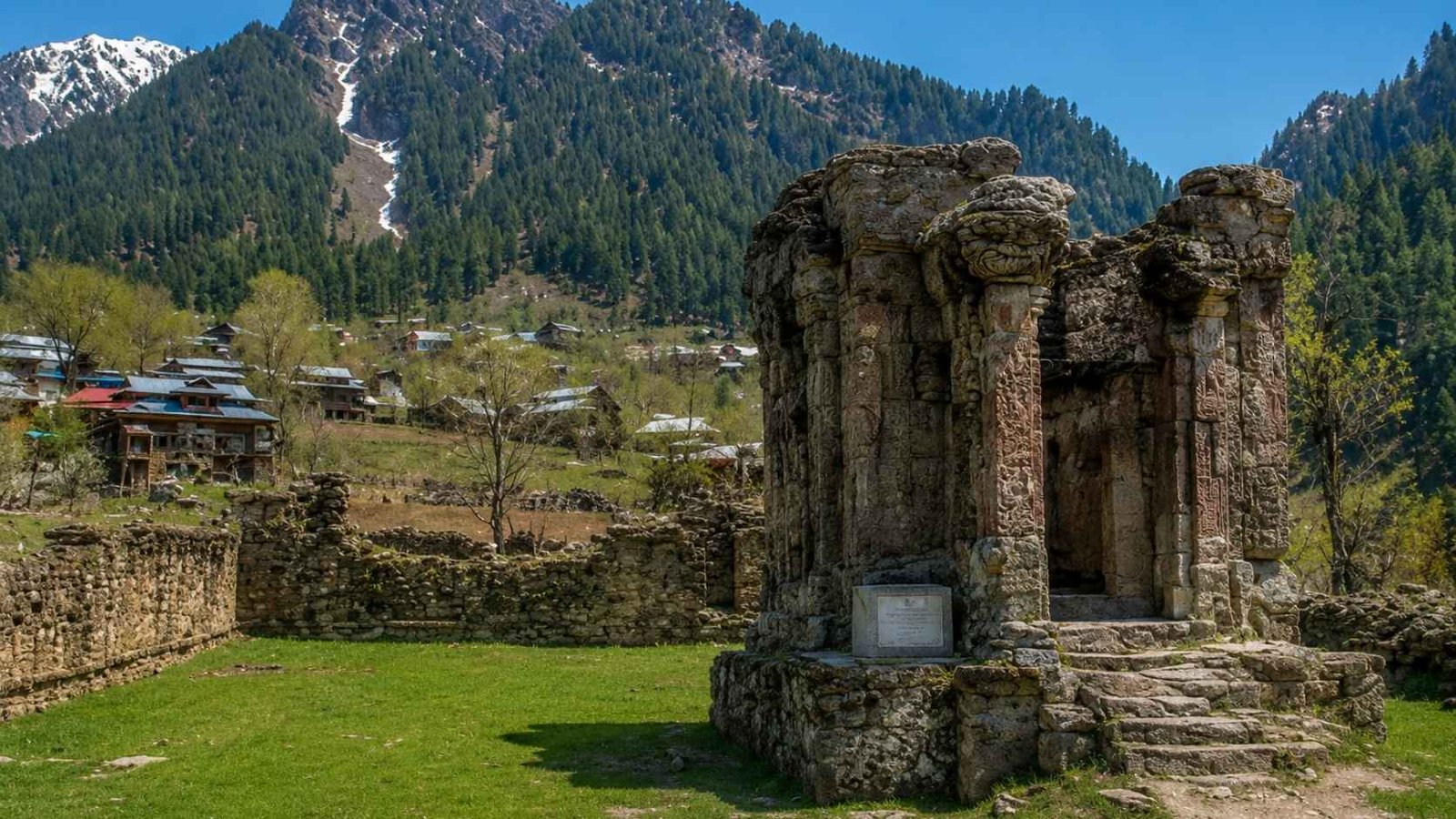
Sharda Peeth is a ruined Hindu temple and ancient centre of learning in the Neelum Valley of Pakistan‑administered Azad Jammu and Kashmir, revered as one of the 18 Maha Shakti Peethas and historically among the subcontinent’s most important temple‑universities.
For Kashmiri Pandits it is one of the three holiest shrines along with Martand Sun Temple and Amarnath, and remains a powerful symbol of cultural identity, scholarship and spiritual heritage.
Namaste śārade devi kāśmirapuravāsini ।
tvāmaham prārthaye nityam vidyādānam ca dehi me ॥1॥yā śraddhā dhāraņā medhā vāgdevi vidhivallabhā |bhaktajihvāgrasadana Samadigunadayini
- “Salutations to Goddess Sharada, who resides in Kashmir. I pray to you every day. Bless me with the gift of knowledge.”
- “O Goddess Sharada, You are faith, concentration, intelligence, and the Goddess of speech, beloved of Lord Brahma. You dwell upon the tongues of Your devotees, blessing them with eloquence, wisdom, and every noble virtue equally.”
For centuries, Hindu children, especially Kashmiri Pandits, began their pursuit of learning with this humble invocation to Goddess Sharada, the embodiment of wisdom, knowledge, and enlightenment. It is more than a prayer. It is an acknowledgement that true learning begins with humility.
Yet few who recite these words today know that the goddess they invoke once had a magnificent temple and one of the Indian subcontinent’s greatest centres of learning in Kashmir itself.
Ten kilometres. That is all that stands between millions of Kashmiri Pandits and Sharda Peeth, the ancient temple-university that shaped our civilisation, inspired scholars across Asia, and became the spiritual heart of an entire community.
Once compared with Nalanda and Takshashila, it now lies in ruins across the border in Pakistan-administered Kashmir, inaccessible to the very people who have revered it for centuries.
Ten kilometres of the Line of Control stand between Kashmiri Pandits and Sharda Peeth, the ruined shrine and one-time seat of learning in the Neelum Valley of Pakistan-administered Kashmir. Most of my readers outside the community will not have heard of it.
Every Kashmiri Pandit child has. We were told, before we were told almost anything else about our own history, that our people once produced a university that rivalled Nalanda and Takshashila, and that it stood in our own valley, teaching Sanskrit grammar and Shaiva philosophy to scholars who had walked in from Tibet, Bengal, Persia and Greece.
We were also told, in the same breath, that we can no longer go there.
What Sharda Peeth was
Sharada Peeth sits in the village of Shardi, on the banks of the Neelum river, in the valley of Mount Harmukh, a peak Kashmiri Pandits believe to be the abode of Shiva.
It lies roughly 150 kilometres from Muzaffarabad and 130 kilometres from Srinagar, barely 10 kilometres from the LoC. The name translates simply as “the seat of Sharada,” Sharada being the Kashmiri name for Saraswati, the goddess of learning.
Hindus count it among the 18 Maha Shakti Peethas, the sites where, according to tradition, a part of the goddess Sati’s body fell as Shiva carried her across the earth in his grief. At Sharda, it is believed to be her right hand.
For Kashmiri Pandits specifically, it is one of the three holiest pilgrimage sites, alongside the Martand Sun Temple and the Amarnath cave, both of which I have written about on this site. But Sharda carried a weight the other two never did. It was not only a temple. It was a university.
Between the 6th and 12th centuries CE, Sharda Peeth functioned as one of the foremost temple universities of the Indian subcontinent.
Its library was said to have drawn scholars from as far as Bengal by the 8th century. By the 11th century, the Central Asian polymath Al-Biruni was already naming it among the subcontinent’s most famous Hindu temples in his chronicle of India, alongside Somnath and the Multan Sun Temple. He had never set foot in Kashmir himself. He did not need to. Sharda’s reputation had already travelled that far without him.
Kalhana, the 12th-century Kashmiri historian whose Rajatarangini remains our single most important chronicle of ancient Kashmir, wrote of Sharda Peeth as a site of established pilgrimage, describing Saraswati appearing there in the form of a swan.
Kalhana himself is widely believed to have studied at Sharda. So, tradition holds, did Abhinavagupta, the towering 10th-century philosopher of Kashmir Shaivism. So did Vatesvara, the mathematician who worked out trigonometric identities in the 10th century, centuries before European mathematics caught up. The Bakhshali manuscript, one of the earliest surviving works of Indian algebra, traces its intellectual lineage back to this same institution.
And then there is Adi Shankaracharya. The 14th century hagiography Madhaviya Shankara Vijayam describes a temple with four doors, one for each direction, and a Sarvajna Peetham, a Throne of Omniscience, that only a scholar who had proven his mastery from each cardinal direction could ascend.
Three doors had already opened to scholars from the north, east and west. No one from the south had managed it. Shankara, arriving from Kerala, is said to have debated and defeated the resident scholars of Nyaya philosophy, Buddhism and Jainism at Sharda’s southern gate before the goddess herself questioned his purity and then permitted him to ascend the throne. Whether or not you take the legend literally, the fact that South Indian Brahmin communities still ritually prostrate towards Kashmir before a child’s first lesson tells you how deep this story runs in Hindu memory.
Saraswat Brahmins in Karnataka, to this day, take seven steps towards Kashmir during the Yagnopavit ceremony before turning back. They are turning towards Sharda.
A living pilgrimage, not a ruin, until 1947
I want to be clear about something, because most articles on Sharda Peeth skip straight from ancient glory to modern ruin as though nothing happened in between. It did not lie abandoned for a thousand years. Under Dogra rule, Maharaja Gulab Singh repaired the temple and set aside a monthly stipend for the Gautheng Brahmins who held hereditary guardianship over it.
A thriving settlement of Kashmiri Pandit priests, traders and pilgrims lived around the shrine well into the 20th century. An annual fair was held at Shardi village, and Kashmiri Pandit families travelled there via Kupwara to bathe at the confluence of the Neelum river and the Madhumati stream, a ritual believed to mirror the sage Shandilya’s journey to the goddess and to cleanse the pilgrim of sin.
Manuscripts were placed before Sharda’s idol on covered platters, and if the goddess left the pages undisturbed, that was her blessing.
This was not folklore to my grandparents’ generation. This was a living pilgrimage.
Then came 1947 and the Indo-Pakistani war that followed Partition. The Karachi Agreement divided the former princely state of Jammu and Kashmir along what would become the Line of Control. Shardi fell on the Pakistani side. Overnight, a temple that Kashmiri Pandit families had walked to for centuries became part of foreign territory.
The Kashmiri saint Swami Nand Lal Ji moved some of the temple’s stone idols out to Tikker in Kupwara that same year. Some were later shifted again to Devibal in Baramulla. The Kashmiri Pandit community of Shardi migrated en masse into Indian-administered Jammu and Kashmir, and the pilgrimage that had survived Mughal indifference and Afghan neglect did not survive the drawing of a border.
Ask any Kashmiri Pandit family with roots in that belt what Partition cost them, and Sharda will come up before their houses do.
Ruin, restriction, and an earthquake that finished the job
What remains of the temple today is largely what the British archaeologist Aurel Stein documented in the late 19th century: walls standing to about 20 feet, pillars to roughly 16 feet, a compound approached by a stone staircase on its western side, trefoil arches carved in high relief along three sides of the cella. The interior holds a large stone slab, some six feet by seven, which is believed to cover the spring where the goddess revealed herself to Shandilya. Kashmiri Pandit tradition holds that a goddess’s spring should never be looked at directly. The slab remains.
Access has only worsened over time. Indian citizens require a No Objection Certificate to travel to Azad Kashmir at all, let alone to a site ten kilometres from an active LoC in what is, by any description, a sensitive military zone. In 2007, a group of Kashmiri Pandits who had secured permission to visit Azad Kashmir were specifically denied entry to the temple. The 2005 Kashmir earthquake, which devastated large parts of the region on both sides of the border, further damaged the structure, and restoration on the Pakistani side since then has, by most heritage accounts, been minimal.
Today’s visitors to the Neelum Valley, when they come at all, mostly pass the ruins by. They come for the scenery. Few even realise a university once stood there that some scholars place on par with Nalanda.
Why the Kartarpur Corridor changed the conversation
Here is where the story becomes current, and where I have a stake in it beyond the historian’s interest.
In 2019, Pakistan opened the Kartarpur Corridor, allowing Sikh pilgrims from India visa-free access to Gurdwara Darbar Sahib, the site associated with Guru Nanak’s final years, without needing to cross into Pakistan proper in the conventional sense. It worked. It is still working. And the moment it opened, Kashmiri Pandit organisations asked an obvious question: if Islamabad can build this for Sikh pilgrims, why not for us?
That March, Pakistani media reported that the government had approved a plan for a Kartarpur-style corridor to Sharda Peeth. Kashmiri Pandit groups and Indian politicians, including then Jammu and Kashmir chief minister Mehbooba Mufti, welcomed it publicly. Within days, Pakistani officials walked the reports back, stating that no formal decision had actually been taken. Six years on, that remains, broadly, where things stand. Proposed. Discussed. Never delivered.
That has not stopped the demand from growing louder, or from becoming more organised. The Save Sharda Committee, led by Ravinder Pandita, has spent years building a coalition across all four Shankaracharya mutts of India, the Sringeri, Puri, Dwarka and Jyotirmath peethams, to speak on this with one voice.
In February 2019, all four mutts passed a joint resolution demanding the reopening of the Sharda pilgrimage. In March 2023, Union Home Minister Amit Shah stated in public remarks that Ravinder Pandita had asked the government for a Kartarpur-style corridor for Sharda yatra, and that the government would attempt to move in that direction. That same month, Shah virtually inaugurated the Maa Sharda Devi temple at Teetwal, in Kupwara district, barely 40 kilometres from the original Sharda Peeth and visibly within sight of the mountains that hide it.
The Teetwal temple’s murti, a panchaloha idol, was carried there in a yatra that began at the Sringeri mutt in Karnataka and travelled through Bengaluru, Mumbai, Pune, Ahmedabad, Jaipur, Delhi, Chandigarh, Amritsar and Jammu before reaching Kupwara. Diwali lights were lit at Teetwal in 2023 for the first time since Independence.
The demand has not gone quiet since. On 28 November 2025, the Sringeri Shankaracharya, Jagadguru Vidhushekhara Bharati, addressed a large gathering of Kashmiri Pandits at Bani Dham Gaushala in Gurgaon, on the concluding day of a twenty-day visit to Delhi NCR, and stated plainly that the struggle for Sharda Peeth would continue. He performed Pushp Archana at the site of a proposed Sharda temple on a hillock facing the Gaushala. Ravinder Pandita used the occasion to renew his appeal, urging all four mutts to jointly petition the Prime Minister for formal movement on the corridor.
As of this year, that petition has not produced a corridor. Heritage observers point out, correctly, that any large-scale cross-border movement through a militarily sensitive stretch of the LoC faces real security constraints on both sides, and that India-Pakistan trust on any Kashmir-linked initiative has rarely survived long enough to be built. Some conservationists have shifted their energy accordingly, towards digital documentation and virtual tours of the site, and towards reviving the Sharada script itself for Kashmiri and Sanskrit scholarship, work that does not require a single visa.
What I think this actually is
I am not going to pretend to you that a corridor is close. It is not. Every serious account of the negotiations, going back to 2019, ends the same way: proposed, welcomed, stalled.
But I want you to notice what has not stalled. The Teetwal temple still stands, and today its lamps are lit every Diwali. The four mutts have, perhaps for the first time on any issue concerning the Kashmiri Pandits, spoken in one united voice. A Shankaracharya travelled all the way from Karnataka to a gaushala in Gurgaon to stand before my community and declare that this struggle is far from over.
None of that is insignificant.
A people who lost their university in the turmoil of war have spent seventy-eight years refusing to let its memory fade into silence. That, in itself, is an act of civilisational resilience.
That, to me, is the real story of Sharda Peeth. Not the ruins. Not even the corridor. The refusal.
Namaste śārade devi kāśmirapuravāsini ।
tvāmaham prārthaye nityam vidyādānam ca dehi me ॥1॥
I bow to the Goddess Sharada, who dwells in Kashmir.
Key Facts on Sharda Peeth
Location and Setting
-
Place: Sharda village, Neelum Valley, Azad Jammu and Kashmir (Pakistan‑administered).
-
Coordinates: 34°47′31″N, 74°11′24″E.
-
Altitude: about 1,981 m (6,499 ft) above sea level, on the banks of the Neelum River.
-
Proximity to LoC: about 10 km from the Line of Control, roughly 150 km from Muzaffarabad and about 130 km from Srinagar.
Its position in a scenic but strategically sensitive border zone has shaped both its decline as a pilgrimage site and the modern debate over a cross‑border corridor.
Historical Origins: What Is Known and What Is Not
Dating and Patronage
-
No definitive inscription: The exact founding date and patron are unknown. Scholars rely on architectural comparison and textual references.
-
Architectural dating: Most specialists place the standing structure between the 8th and 11th centuries CE, within the classical Kashmiri stone‑temple tradition.
-
Attribution theories:
-
Some link it to Lalitaditya Muktapida (r. 724–760 CE) of the Karkota dynasty because of stylistic parallels with the Martand Sun Temple.
-
Other traditions suggest earlier phases (even the Kushan era or mythic antiquity), but these lack firm archaeological corroboration.
-
Textual Evidence
-
Nilamata Purana (6th to 8th century CE): Describes the sacred geography of the Neelum Valley and the fall of Sati’s right hand here, establishing the site’s Shakti Peetha status.
-
Al‑Biruni (11th century): Records a revered shrine with a wooden image of Sharada, placing it among the most famous Hindu temples of the subcontinent.
-
Kalhana’s Rajatarangini (12th century): Mentions Sharada as a site of popular veneration and political significance.
-
Later accounts: Jonaraja (15th century) and Abu’l‑Fazl’s Ain‑i‑Akbari (16th century) note continued reverence and even report a local belief that the temple “shook” on certain lunar days.
Sharda Peeth as a Centre of Learning
Between roughly the 6th and 12th centuries CE, Sharda Peeth functioned as a major temple‑university alongside its role as a shrine.
-
Reputation: It attracted scholars from distant regions (traditions cite Greece, Mesopotamia, Central Asia, Tibet and China), and was famed for its library and intellectual debates across schools such as Shaivism, Shaktism, Vedism and Buddhism.
-
Curriculum (traditional accounts): Vedas, Upanishads, Puranas, grammar, philosophy (Nyaya, Vaisheshika, Sankhya, Yoga, Mimamsa, Vedanta), Kashmir Shaivism, astronomy, mathematics, medicine and music.
-
Named scholars and visitors:
-
Adi Shankara is said to have undergone the Sarvajna Peetham (Throne of Omniscience) test here, opening the southern door.
-
Kalhana, Abhinavagupta, Utpaladeva and mathematician Vaṭeśvara are associated with the broader Kashmiri scholarly milieu connected to Sharada.
-
Buddhist translator Kumārajīva is reported to have studied in Kashmir. Some traditions connect him to Sharda’s intellectual orbit.
-
Note: While popular narratives speak of “5,000 resident scholars” and a vast library, contemporary scholarship treats such figures as traditional claims. The site’s academic prestige is well attested, but precise enrollment and library size lack hard archaeological proof.
The Sharada Script and “Sharada Desh”
-
The Sharada script, used historically for Sanskrit and Kashmiri, derives its name from this institution.
-
Because of the temple‑university’s influence, Kashmir acquired the epithet “Sharada Desh” (Land of Sharada).
Religious Significance for Kashmiri Pandits
-
Maha Shakti Peetha: Hindus believe Sati’s right hand fell here. The presiding deity is Sharada, a Kashmiri form of Saraswati embodying learning, knowledge and speech.
-
Tripartite goddess: Kashmiri Pandit tradition describes Sharada as a threefold embodiment: Sharada (learning), Saraswati (knowledge), Vagdevi (power of speech).
-
Pilgrimage rituals: Historically, scholars placed manuscripts before the goddess seeking blessings. An annual fair was held at Shardi village, with pilgrims bathing at the confluence of the Neelum and the Madhumati stream, believed to cleanse sins.
-
Post‑1947 adaptations: After Partition and the 1947–48 war, many Pandits migrated. Substitute shrines and local “Sharda” observances emerged in Srinagar, Bandipore, Gush and elsewhere.
The Sharda Corridor: Proposal, Status and Challenges
What Is Proposed?
A Kartarpur‑style corridor would enable Indian Hindu pilgrims (especially Kashmiri Pandits) to visit Sharda Peeth from India with simplified permits, without requiring a full visa regime.
Key Milestones (as reported)
-
2019: Pakistani media reported that Islamabad had approved a proposal for a Sharda corridor. Officials were to survey the area and report to the prime minister.
-
2023: Indian Home Minister Amit Shah e‑inaugurated the Mata Sharda Devi Temple in Teetwal (Kupwara), about 40 km from the original site, renewing calls for a corridor.
-
Ongoing: Kashmiri Pandit organisations (for example Save Sharda Committee) and political leaders continue to press India and Pakistan for access and conservation. Bilateral talks have discussed it within the broader Kashmir dialogue.
Why It Matters
-
Religious access: Restores a core pilgrimage for Kashmiri Pandits cut off since 1947–48.
-
Heritage diplomacy: Could serve as a confidence‑building measure, akin to Kartarpur, promoting people‑to‑people contact.
-
Cultural memory: Reinforces continuity with Kashmir’s scholarly and spiritual past centred on Sharada.
Obstacles and Sensitivities
-
Security: The site is about 10 km from the LoC. Both sides cite security and infiltration risks.
-
Political trust: Broader Kashmir tensions, human‑rights concerns and reciprocity demands (for example access for Kashmiri Muslims to Indian shrines like Hazratbal) complicate negotiations.
-
Conservation capacity: Any corridor would require coordinated conservation, crowd management and environmental safeguards in a fragile valley.
Practical Notes for Researchers and Pilgrims
-
Access: Indian nationals generally require special permits or NOCs from Pakistan. Permissions are rarely granted due to LoC sensitivities.
-
Best season: April to October offers clearer weather and road access in Neelum Valley.
-
Substitute sites in India: After 1947, idols and rituals were relocated to places like Tikker (Kupwara) and Devibal (Baramulla). New temples (for example, Teetwal) serve as focal points for renewed devotion.
-

Rohit Tikoo is a published author, researcher, and content strategist with over two decades of writing experience. He is the author of nine books covering Kashmir, Indian philosophy, social issues, and contemporary thought, including Shadows Over the Valley: Operation TUPAC, Cold War Geopolitics, and the Kashmiri Pandits Exodus (2025).
His work focuses on Kashmir’s history, literature, culture, and the lived experiences of the Kashmiri Pandit community. Through extensive research, archival references, and historical analysis, he seeks to document and preserve narratives that are often overlooked in mainstream discourse. His writing on Kashmir has appeared in DAILY EXCELSIOR, HEADLINES TODAY, ONLY KASHMIR, GREATER KASHMIR, NAAD,
VITASTA, CHATTAN, AND VOICE OF SILENCE.
Through rohittikoo.com, he publishes research-based articles, essays, and commentary aimed at fostering informed discussion on Kashmir, Indian civilisation, literature, and contemporary society.