
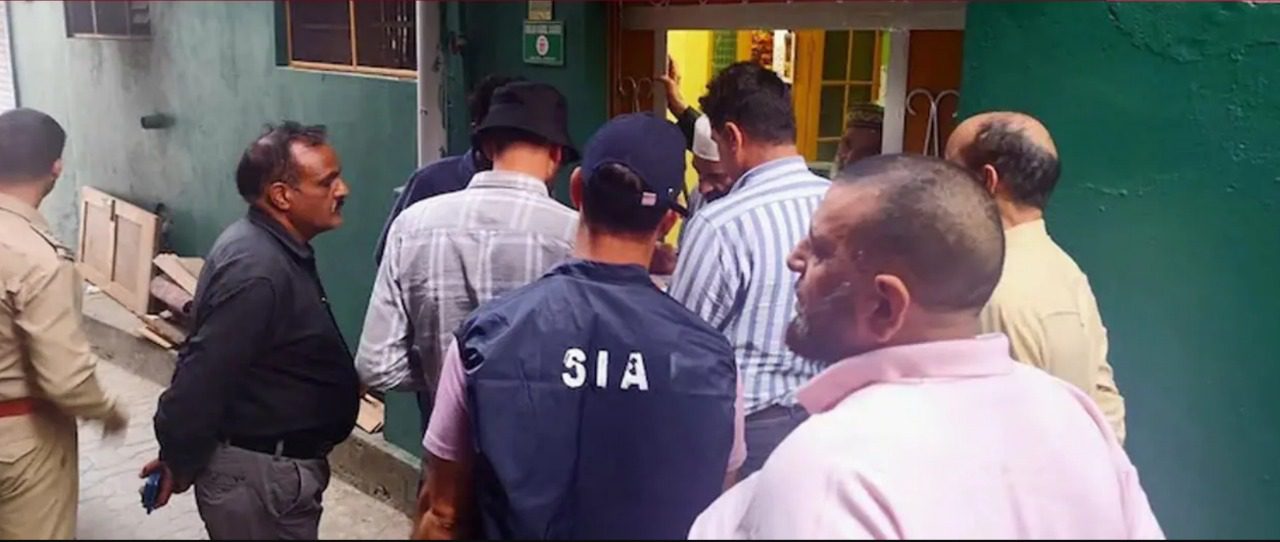
In a historic milestone for the pursuit of justice in Jammu and Kashmir, the State Investigation Agency (SIA) has filed a 737-page chargesheet against the banned JKLF chief Yasin Malik and four accomplices in the Sarla Bhat Case
This definitive legal breakthrough stands as one of the most significant advancements in legacy terror investigations. It directly follows the momentum generated when the SIA launched eight simultaneous, coordinated pre-dawn operations in Srinagar. Those strategic raids targeted individuals suspected of direct involvement in the 1990 abduction, torture, and murder of Kashmiri Pandit nurse Sarla Bhat.
The Sarla Bhat Case has haunted the Kashmiri Pandit community for more than three decades. Her killing was one of the most brutal acts of the early insurgency period. Members and associates of the Jammu and Kashmir Liberation Front (JKLF) planned and executed the crime.
For years, the investigation stalled due to widespread fear and institutional neglect. The SIA officially took over the probe in March 2024. This latest breakthrough represents the most decisive victory for the rule of law since the day her body was discovered.
Complete List of SIA Raids and Targets in the Sarla Bhat Case
The enforcement targets were meticulously selected based on deep investigative links to the JKLF. Many of these individuals maintained documented connections to the notorious HAJY Group, a specialised terror faction that terrorised the Kashmir valley during the onset of the displacement era.
The targets subjected to the extensive SIA raids include:
- Javaid Ahmad Mir, alias Nalka from Chamardori Zainakadal
- Peer Noor ul Haq Shah, alias Air Marshal from Illahi Bagh Bachpora
- Reyaz Kabir Sheikh from Danderkah Batamaloo
- Bashir Ahmad Gojri from Kadikadal Soklipora
- Feroz Ahmad Khan, alias Jan Mohammad from Sazgaripora
- Kaiser Ahmad Tiploo, alias Raj Tiploo from Al Hamza Colony, Ahmadnagar
- Ghulam Mohammad Taploo from Tiploo Mohalla, Anchar
Each raid signalled to the ecosystem of militancy that the passage of time cannot wash away criminal culpability.
The following are the people who have been charge-sheeted along with Yasin Malik are as follows
- Khursheed Ahmad Chalkoo (Absconding, believed to be in PoJK)
- Abdul Hamid Sheikh (Deceased)
- Mohammad Yousuf Sofi alias Idrees (Deceased)
- Ghulam Mohammad Taploo (Deceased)
737-Page Chargesheet filed by SIA in Sarla Bhat Case
The initial raids did not merely recover passing clues. Investigators seized crucial historical documents, digital storage devices, and personal correspondence. Forensic experts and ballistic analysts spent months connecting these items to legacy files, oral testimonies, and protected witness accounts.
This meticulous process culminated in the voluminous chargesheet submitted before the Special TADA/POTA and NIA Court in Srinagar. The SIA has formalised charges establishing offences under the Ranbir Penal Code (RPC), the Terrorist and Disruptive Activities (Prevention) Act (TADA), and the Indian Arms Act.
A Powerful Institutional Message:
The filing of the chargesheet in the Sarla Bhat Case after nearly 35 years sends a powerful and unequivocal message that time can never become a shield for terrorism. No matter how many years have elapsed, those responsible for terrorist atrocities will continue to remain answerable before the law.
The HAJY Group: Architects of Targeted Violence
Understanding the structural execution of the Sarla Bhat Case requires examining her killers. The HAJY Group was a calculated terror cell within the JKLF designed to alter the demography of Kashmir through systemic violence.
The faction derived its name from the initials of its four primary leaders: Hamid Sheikh, Ashfaq Majeed Wani, Javed Mir, and Yasin Malik. The SIA investigation explicitly names Yasin Malik, then the Chief Commander of the JKLF, as a key mastermind who planned and directed the execution of the crime. While Yasin Malik is currently serving a life sentence in Delhi’s Tihar Jail for separate convictions, other named conspirators like Khurshid Ahmad Chalkoo are believed to have fled to Pakistan-administered areas, prompting immediate proclamation proceedings.
A Systematic Campaign of Intimidation
The group did not pick targets at random. Instead, they focused heavily on pillars of civil society to collapse administrative morale:
- Healthcare professionals and nurses like Sarla Bhat
- Judicial officers, lawyers, and judges
- Educators, writers, and regional intellectuals
- Government workers and state administrators
By targeting these functional professionals, the JKLF sent a clear message to the minority community that basic safety had ceased to exist. Between 1988 and 1990, the HAJY Group orchestrated abductions for political leverage, bombed public infrastructure, and built a climate where survival dictated flight.
Who Was Sarla Bhat?
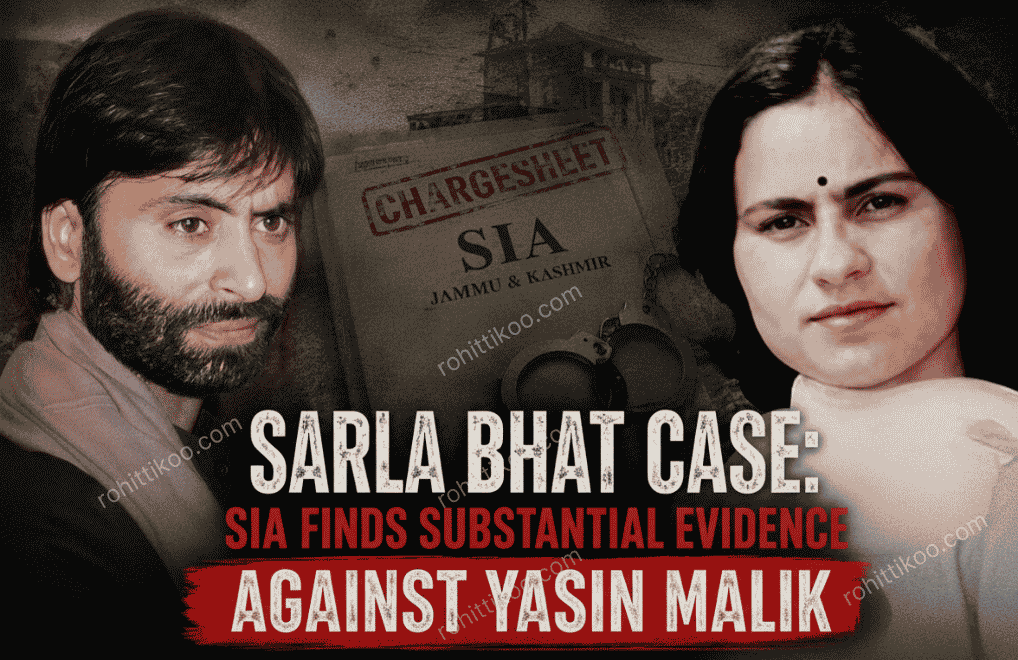
Sarla Bhat was a nurse, a devoted daughter, and a figure of quiet resilience. Born in Anantnag, she came from a modest Kashmiri Pandit family that placed great value on education, dignity, and service.
In my earlier article on Sarla Bhat, I have updated all the available information about her ordeal.
Explore the Sarla Bhat case here
Duty at SKIMS Soura Amid Mounting Threats
After completing her training, Sarla joined the Sher-i-Kashmir Institute of Medical Sciences (SKIMS) in Srinagar as a staff nurse. Her colleagues remember her as a highly disciplined and fearless professional. Even as radical threats intensified across the Valley and fellow community members began leaving their homes out of fear, Sarla refused to abandon her post at the hospital. She remained dedicated to her patients, unable to comprehend that her own colleagues and neighbours would soon be part of the ecosystem that betrayed her.
The Abduction from the Campus
On 14 April 1990, armed JKLF terrorists infiltrated the area near the SKIMS campus. The militants targeted Sarla specifically, identifying her by name before abducting her at gunpoint. Because local law enforcement was heavily compromised and under siege during this chaotic period, reporting the crime proved nearly impossible, leaving her family without immediate institutional recourse.
Days of Torture and the Final Act
For four days, Sarla was held captive and subjected to severe physical torture and systemic assault. The SIA chargesheet notes that medical and forensic records show extensive injuries, confirming that her suffering was leveraged as an act of calculated intimidation aimed at terrorising the wider community.
On 18 April 1990, her bullet-riddled body was abandoned in the Omer Colony area of Malbagh, Srinagar. Beside her body, the terrorists left a handwritten note falsely branding her a police informer to create a veneer of justification for their barbarism.
The Humiliation Continued After Death
The violence against Sarla Bhat did not end with her murder. According to her cousin-brother, who later recounted the events in an interview with News18 J&K, the family endured further trauma during her cremation in Kashmir. As the last rites were being performed, a mob of more than 200 people reportedly descended upon the cremation ground, trampling over her ashes and disrupting the solemn funeral rituals.
Her cousin-brother recalled that members of the mob ridiculed the grieving Kashmiri Pandit family, taunting them with remarks such as, “Why haven’t you left Kashmir yet? Are you still here?” The disruption was so severe that the family managed to collect only a single handful of Sarla Bhat’s ashes, barely enough to perform the essential Hindu funeral rites. The incident was not merely an act of violence, but an assault on the family’s religious beliefs and the dignity accorded to the deceased.
The persecution continued even after the cremation. According to her cousin-brother’s account, Sarla Bhat’s house was bombed the following day, further intensifying the campaign of fear and intimidation against the bereaved family. These events illustrate that the brutality extended beyond her murder, encompassing the desecration of her final rites and an attack on the family’s home, leaving an enduring scar on those who survived.
Uncovering the Deep Roots of Local Complicity
The core reason justice took 35 years to be served is the extensive local support network that shielded the perpetrators. The SIA investigation reveals that the JKLF did not operate in a vacuum. The killers relied on local enablers who tracked Sarla’s hospital schedules, shared her movements, and actively misdirected initial law enforcement inquiries.
For decades, potential witnesses chose silence due to a combination of terror and complicity. Former political administrations frequently treated the displaced Kashmiri Pandit community as a minor political consideration rather than citizens entitled to swift justice. By securing protected witness testimonies and utilising authenticated archival records, including historical television interviews of JKLF operatives, the SIA has successfully bypassed this wall of silence.
Global Parallels in Legacy Justice
The revival of the Sarla Bhat case highlights that modern legal frameworks are increasingly refusing to allow time to erase accountability for severe human rights violations:
- Holocaust Investigations: European courts have successfully prosecuted Nazi war criminals well into the 21st century, establishing that legacy atrocities carry no expiration date.
- Argentina’s Truth Trials: The prosecution of military junta leaders decades after the dictatorship of 1976 to 1983 demonstrated that democratic stability requires confronting historical crimes.
- Rwanda’s Accountability Models: The dual focus on high-level tribunal trials and local community courts ensured that the structural planners of the 1994 genocide faced full legal exposure over a sustained timeline.
What Follows the Filing of the Chargesheet?
With the 737-page chargesheet formally presented before the designated NIA court, the case enters a critical trial phase:
- Proclamation and Trial Matrix: The prosecution will push forward with legal proceedings against the jailed JKLF leadership while initiating formal fugitive tracking for absconding accused like Khurshid Ahmad Chalkoo.
- Witness Protection Protocols: Maintaining the absolute safety of protected witnesses will be paramount to ensure that the oral testimonies holding the case together are presented securely in court without fear of retaliation.
- Systemic Precedent: Following the reopening of the Neelkanth Ganjoo murder case, the progress in the Sarla Bhat trial cements a broader structural framework for the reopening of legacy terror cases in the region.
Justice for Sarla Bhat serves as a crucial test for the institutions of Indian democracy. While her parents passed away during the long decades of waiting, the formal presentation of substantial evidence against Yasin Malik ensures that the true history of the Valley is preserved, proving that the rule of law can outlast the reign of fear.
FAQs Regarding the Sarla Bhat Case
Who is named as the primary accused in the Sarla Bhat murder Case?
Banned JKLF chief Yasin Malik has been named by the SIA as the primary accused and mastermind behind the planning and execution of the 1990 abduction and murder.
What are the specific details of the latest SIA chargesheet?
The SIA filed a comprehensive 737-page chargesheet in June 2026 before a Special TADA/POTA/NIA Court in Srinagar, utilising oral testimonies, forensic analysis, ballistic reports, medical evidence, and authenticated media records.
Who were the other individuals named by the SIA in the conspiracy?
The chargesheet names five individuals: Yasin Malik, Khurshid Ahmad Chalkoo, Abdul Hamid Sheikh, Mohammad Yousuf Sofi alias Idrees, and Ghulam Mohammad Taploo. Three of these individuals are deceased, while Chalkoo remains at large.
What was the role of the HAJY group in this case?
The HAJY group was the core militant faction within the JKLF led by Hamid Sheikh, Ashfaq Majeed Wani, Javed Mir, and Yasin Malik. They systematically targeted minority professionals to destabilise the civil administration in 1990.
Can a case be legally prosecuted after a 35-year delay in India?
Yes. Under Indian criminal law, serious offences such as terrorism, conspiracy, and murder possess no statute of limitations, allowing the state to file charges whenever conclusive evidence is uncovered.
Last updated: 01 July, 2026
Rohit Tikoo is a published author, researcher, and content strategist with over two decades of writing experience. He is the author of nine books covering Kashmir, Indian philosophy, social issues, and contemporary thought, including Shadows Over the Valley: Operation TUPAC, Cold War Geopolitics, and the Kashmiri Pandits Exodus (2025).
His work focuses on Kashmir’s history, literature, culture, and the lived experiences of the Kashmiri Pandit community. Through extensive research, archival references, and historical analysis, he seeks to document and preserve narratives that are often overlooked in mainstream discourse. His writing on Kashmir has appeared in DAILY EXCELSIOR, HEADLINES TODAY, ONLY KASHMIR, GREATER KASHMIR, NAAD,
VITASTA, CHATTAN, AND VOICE OF SILENCE.
Through rohittikoo.com, he publishes research-based articles, essays, and commentary aimed at fostering informed discussion on Kashmir, Indian civilisation, literature, and contemporary society.