
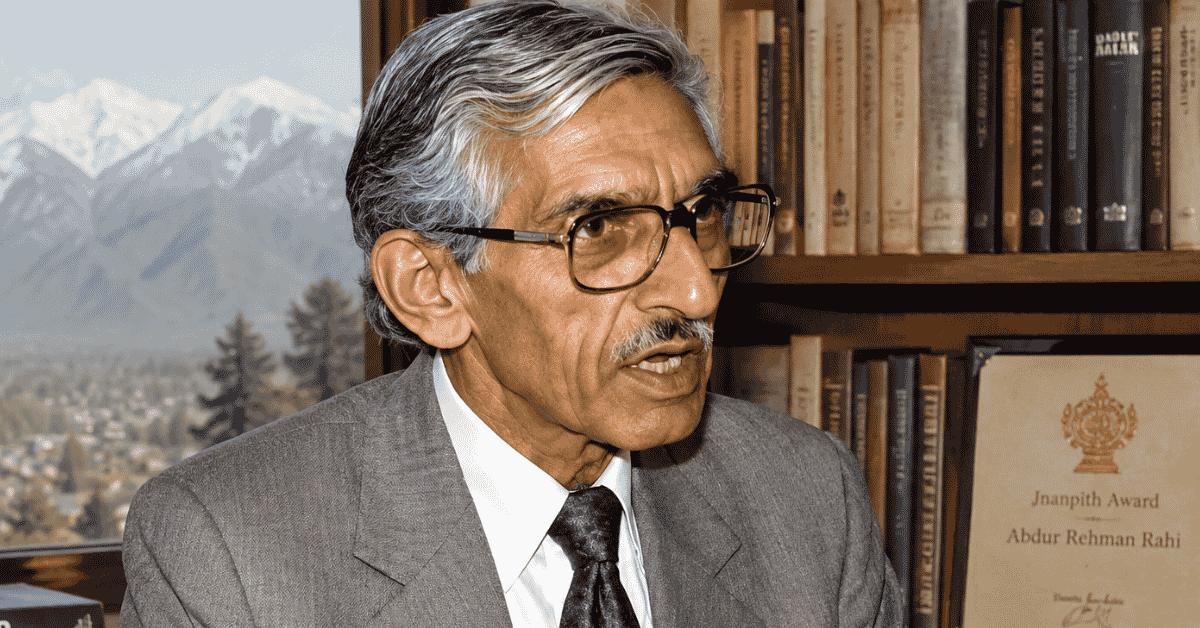
Abdur Rahman Rahi was a Kashmiri poet, teacher, and translator. He is best known for being the first writer from Kashmir to win the Jnanpith Award, the highest literary honour in India. His work changed the way people write in the Kashmiri language.
He shifted the focus away from old folklore and religious mysticism toward modern, complex ideas about human life.
If you want to understand modern Kashmiri literature, you must start with Rehman Rahi. He did not work alone. He was part of a trio of visionaries who collectively reshaped Kashmiri poetry. Along with Ghulam Ahmad Mahjoor and Dinanath Nadim, Rahi helped move the language into the modern era.
Mahjoor brought new romantic and nationalistic energy. Nadim introduced bold free verse and progressive themes, and Rehman Rahi added intellectual depth and a critical structure to the language. Together, they transformed Kashmiri from a language of folk songs into a medium for complex modern thought.
Early Life and Background
Rehman Rahi was born on 6 May 1925 in Srinagar, Kashmir. His early life was very different from his later success. He started his working life as a clerk in the Public Works Department.
This job gave him insight into the daily struggles that ordinary people faced. He kept this perspective throughout his life, even after he became a famous academic.
He did not stop at being a clerk. He pursued higher education while balancing his work. He earned his Master of Arts degrees in Persian and English from the University of Kashmir. These studies were crucial. They allowed him to look at literature outside of his own culture. He read Western writers and philosophers, and he brought those new ways of thinking back into his own language.
How He Changed Kashmiri Poetry
Before the shift led by Rahi and his peers, much of the poetry in Kashmir relied on traditional, established formats. While these forms were beautiful, many writers felt they could not express the realities of the modern world. Rahi decided to change this.
He looked at global literary movements. He studied the work of T.S. Eliot, Albert Camus, and Jean-Paul Sartre. He took their ideas about existence, doubt, and the human mind and translated them into the Kashmiri context.
Moving Beyond Tradition
Rahi stopped using the standard, rhythmic patterns that everyone else was using. He introduced the stream of consciousness technique to his readers. This meant he wrote in a way that mimicked how a human mind actually works, with thoughts jumping from one topic to another. It was a difficult style for some, but it made Kashmiri literature relevant to the modern age.
He wanted his readers to think. He did not provide easy answers. He made poetry that required focus and engagement. This shift helped prove that Kashmiri was a language capable of handling complex philosophical discussions.
Key Works
Rahi wrote many books, but a few stand out as essential reading for anyone interested in his style. These works defined his career and earned him national recognition.
Nawroz-i-Saba (1958)
This collection was a breakthrough for Rahi. It helped him win the Sahitya Akademi Award in 1961. With this book, he showed that he had mastered the traditional forms while introducing new, sharper themes. It was the moment that the rest of India began to take note of his talent.
Kahwat (1980)
Rahi was a critic as well as a poet. In Kahwat, he wrote about the theory of literature. This book provided a guide for how to critique and understand Kashmiri writing. It was a turning point for Kashmiri academic studies because it provided a set of rules and standards for local writers to follow.
Siyah Rood Jaeren Manz (1997)
This collection, which translates to “In Black Drizzle,” is arguably his most important work. It is a dense, thoughtful book that deals with memory, pain, and the nature of loss. It is not an easy read, but it is a powerful one. This book was the primary reason he was awarded the Jnanpith Award.
Awards and Recognition
Rehman Rahi was decorated with the highest honours, reflecting his immense contribution to the Kashmiri language and Indian education.
-
Sahitya Akademi Award (1961), for Nawroz-i-Saba. The youngest Indian writer to receive it at that time.
Sahitya Akademi Fellowship (2000). Given by India’s National Academy of Letters in recognition of a lifetime’s contribution, not a single work.
Padma Shri (2000), from the Government of India, for literature and education.
Jnanpith Award (2007, for the year 2004), for Siyah Rood Jaeren Manz. Presented by then Prime Minister Dr Manmohan Singh on 6 November 2008. First Kashmiri writer in history to receive this distinction.
When Rehman Rahi received the Jnanpith Award, he expressed a complex mix of professional joy and personal sorrow regarding the state of his homeland. After receiving the honour, he stated:
“It is the recognition of the language of our speech and thought. I am happy and sad today. Happy, because I was honoured. Sad, because my people continue to be in distress.”
Academic Influence and Legacy
Rahi spent a significant part of his life as a professor. He played a key role in starting the Department of Kashmiri at the University of Kashmir. Before this, the language was often overlooked in academic settings.
By creating this department, he ensured that students would have a place to study their mother tongue. He trained many scholars who are now teaching and writing themselves. His legacy is not just in his own books, but in the entire generation of Kashmiri writers he mentored.
He passed away on 9 January 2023 at the age of 97. Even after his death, his influence remains. He proved that a writer does not have to leave their home to have a global impact.
Frequently Asked Questions
Who was Rehman Rahi?
Rehman Rahi was a famous Kashmiri poet, professor, and critic. He was the first person to receive the Jnanpith Award for writing in the Kashmiri language.
What is the Jnanpith Award?
The Jnanpith Award is the highest literary honour given to authors in India. It recognises excellence in literature.
When did Rehman Rahi win the Jnanpith Award?
He was awarded the Jnanpith Award for the year 2004. The official ceremony was held in 2007.
How did Rehman Rahi modernise Kashmiri literature?
He introduced Western modernism and existentialist themes into Kashmiri poetry. He moved away from traditional folk patterns and helped the language express complex, abstract thoughts.
What is his most famous book?
Siyah Rood Jaeren Manz (In Black Drizzle) is widely considered his most important work. It showcases his mature poetic voice.
Conclusion
Rehman Rahi showed the world that Kashmiri is a vibrant, modern language. He lived a life of quiet study and constant creation. He refused to follow the crowd and instead built his own path.
If you want to understand the modern history of the Kashmir valley, reading his work is a good place to start. His poems do not just describe the landscape. They describe the inner world of the people who live there.
Are you interested in reading more about poets who changed their languages?
If you found this overview of Rehman Rahi helpful, you might enjoy exploring other writers from the Indian subcontinent who modernised their regional languages. We cover various literary figures and their history. Please share your thoughts or let us know if there is a specific poet you would like us to cover next. Your feedback helps us provide the information you need.

Rohit Tikoo is a published author, researcher, and content strategist with over two decades of writing experience. He is the author of nine books covering Kashmir, Indian philosophy, social issues, and contemporary thought, including Shadows Over the Valley: Operation TUPAC, Cold War Geopolitics, and the Kashmiri Pandits Exodus (2025).
His work focuses on Kashmir’s history, literature, culture, and the lived experiences of the Kashmiri Pandit community. Through extensive research, archival references, and historical analysis, he seeks to document and preserve narratives that are often overlooked in mainstream discourse. His writing on Kashmir has appeared in DAILY EXCELSIOR, HEADLINES TODAY, ONLY KASHMIR, GREATER KASHMIR, NAAD,
VITASTA, CHATTAN, AND VOICE OF SILENCE.
Through rohittikoo.com, he publishes research-based articles, essays, and commentary aimed at fostering informed discussion on Kashmir, Indian civilisation, literature, and contemporary society.