
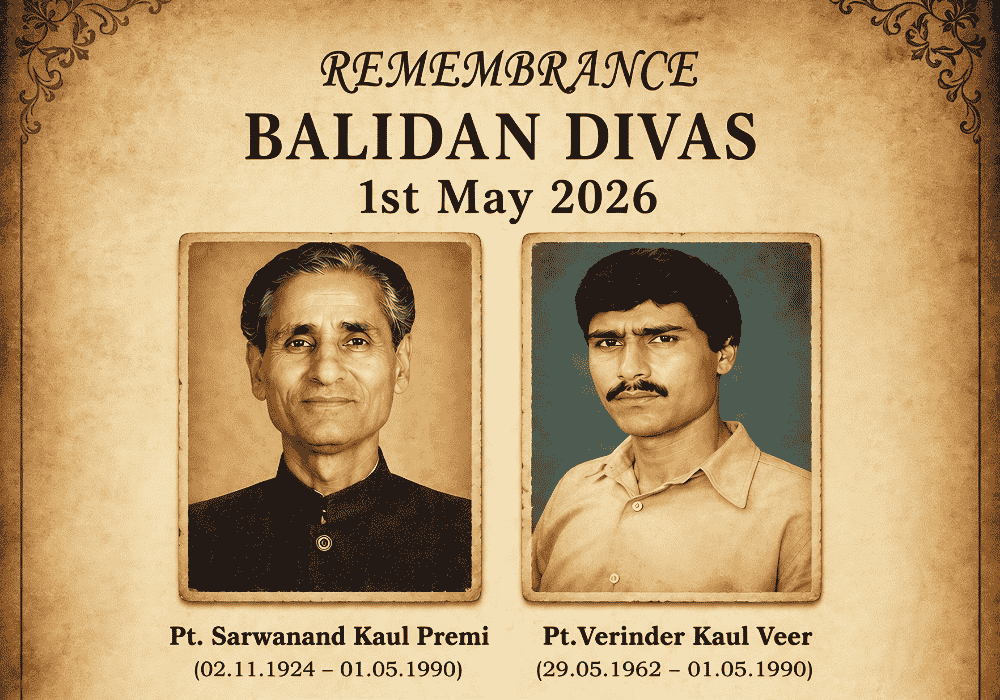
Author’s Preface
This article was not written from a distance. It was written ahead of the 36th martyrdom anniversary of Sarwanand Kaul Premi and his son, Virender Kaul, at the family’s request. They wanted someone who understood the historical weight of what they had endured, and who would write it with the seriousness it deserved. I consider it both a privilege and an obligation to have done so.
I have spent more than a decade researching and writing about the Kashmiri Pandit exodus of 1990. My book, Shadows Over the Valley: Operation TUPAC, Cold War Geopolitics, and the Kashmiri Pandits Exodus, examines the political and geopolitical forces that converged to produce that catastrophe. But no book of geopolitics can fully carry what a single family experienced on the night of 28 April 1990, when armed men came to a door in Soaf Shali and took a father and son into the dark.
The challenge of writing about Sarwanand Kaul Premi is not a shortage of material. It is the opposite. He was a freedom fighter, a scholar of six languages, a poet who received his pen name from Ghulam Ahmad Mahjoor, a translator of Tagore and the Gita, a broadcaster, a social reformer, and a man who literally stood between two communities during the riots of 1986. To compress such a life into a single article is to accept that something will always remain unsaid.
What I have tried to do here is honour the full arc of that life, not merely its violent end. The killing of Sarwanand Kaul Premi and Virender Kaul on 1 May 1990 was an atrocity. But the atrocity makes sense only against the backdrop of everything those two men were before the men with guns arrived. I have tried to hold both truths together.
I am grateful to Rajinder Kaul for his time, his trust, and his patience. He has spent thirty-six years fighting for justice on behalf of his father and brother. That fight has not yet ended. I hope this article, and its publication here on my website, contributes, in some small measure, to the greater effort to ensure that these two lives are not reduced to a footnote.
This article is written for today, 1 May, the date on which the bodies of Sarwanand Kaul Premi and Virender Kaul were discovered. It is the date the community observes as the anniversary of their martyrdom. It is a date that should be remembered.
Rohit Tikoo
1 May 2026
Hazaron saal nargis apni be-noori pe roti hai, Badi mushkil se hota hai chaman mein didavar paida.
(For a thousand years, the narcissus weeps its own blindness; with great difficulty, a man of true vision is born into the garden.)
— Mirza Ghalib
Sarwanand Kaul Premi was one such rare visionary.
Thirty-six years ago, terrorism cruelly took him and his son, Virender Kaul, from us. Their lives were extinguished not just for being taken, but for their unwavering convictions, their refusal to abandon their homeland, and their choice of dignity over fear.
Sarwanand Kaul Premi Ji was more than a scholar. He was a bridge between the sacred traditions of Hindus and Muslims, carrying wisdom across communities with grace and understanding.
Sarwanand Kaul Premi Ji was a towering intellectual figure and a living embodiment of Kashmir’s composite culture, whose life’s work served as a crucial bridge between Hindu and Muslim traditions. His profound knowledge of Sanskrit, Persian, and Kashmiri allowed him to explore in depth the philosophical and spiritual commonalities shared by the two communities.
Premi Ji carried the wisdom of both traditions across cultural and religious divides with remarkable grace, deep respect, and genuine understanding. He worked on preserving and interpreting both Islamic and Hindu spiritual literature. Through his writings, poetry, and scholarship, he demonstrated the syncretic values of Kashmiriyat. He tirelessly advocated for harmony and mutual respect in a region that has often seen conflict. His legacy is one of intellectual integrity and a fervent commitment to peace through cross-cultural understanding.
Today, we do not merely remember a father and son. We remember courage rooted in truth, and a legacy that violence could not erase. The attempt was to extinguish a light, but thirty-six years later, that light still endures.
Premi was that rare flower in the garden. His fragrance has not faded. It lives on in memory, in words, and in the quiet strength of a people who refuse to forget.
28 April 1990: The Night of the Kidnapping of Sarwanand Kaul Premi and his son Verinder Kaul
By early 1990, an armed insurgency had driven most of the Kashmiri Pandit community out of the valley. Targeted killings, threats, and the broadcasting of names over mosque loudspeakers had made the message unmistakable. Most of Premi’s community had already left.
He stayed. He remained in Soaf Shali, in his ancestral home, in the house that held his library, his manuscripts, and the work of a lifetime.
This was not passivity. For a man of Premi’s convictions, to stay was itself a statement. He had spent his life building bridges between communities. Leaving would have been a repudiation of everything he had argued and lived. The house in Soaf Shali was not just a home. It was a repository of the shared culture he believed in.
On the night of 28 April 1990, armed extremists arrived at his door. They first cut the local power supply, plunging the area into darkness. Then they forced their way in.
The family had finished dinner and retired for the night. The intruders gathered them together and offered a pretext: they claimed to be looking for someone called Ghulam Rasool. Then they looted the house systematically. They took gold, jewellery, Pashmina shawls, and clothes bought for an upcoming family wedding.
They entered Premi’s library and took literary manuscripts and works in progress. Decades of intellectual labour left the house that night, along with the stolen jewellery. The loss of those manuscripts is a wound that no posthumous honour can repair. Whatever remained unpublished in that library is gone.
Then came the demand: Sarwanand Kaul Premi must come with them to meet their Commander. They would return him safely, they said.
His younger son, Virender Kaul, refused to let his father go alone. He insisted on going with him. The extremists agreed. Father and son walked out into the darkness of 28 April 1990 and did not come back.
1 May 1990: Hanging bodies of Sarwanand Kaul Prmi and Verinder Kaul Found
The family waited. Days passed with no word. Then, on 1 May 1990, the police came to the house. Before they said anything, they asked the family to eat something first.
Sarwanand Kaul Premi and his son, Virender Kaul, had been found. Both were dead. Police found their bodies hanging from a tree. Their arms and legs had been broken. Their eyes had been gouged. The killers had been methodical in their cruelty.
Virender Kaul left behind a young widow and an infant son, 18 months old.
Ravinder Kaul, the youngest son, worked in the news section of All India Radio in New Delhi. He could not return for his father’s cremation. His employment with state broadcasting had placed him in danger from the same extremists. The violence reached even into the family’s right to mourn.
The Kashmiri Pandit community observes the martyrdom anniversary of Sarwanand Kaul Premi and Virender Kaul on 1 May, the date on which their bodies were found, and the date that marks the end of one of the most distinguished literary and patriotic lives the valley ever produced.
Early Life: A Home Where Faith and Learning Lived Together
Sarwanand Kaul Premi was born on 2 November 1924, during the holy month of Kartik, on Krishna Paksha Navami, in the village of Soaf Shali near Kokernag in the Anantnag District of Jammu and Kashmir. He was the second of five children of Gopinath Kaul, who was the first matriculate in his village. His mother was Omravati Koul. The family traced its lineage to Rainawari in Srinagar before settling in the Kokernag region.
Gopinath Kaul was a man of deep spiritual discipline. His home drew sadhus and seekers who passed through that part of the valley. The young Sarwanand grew up surrounded by devotion, scripture, and learned conversation. For a child in that household, literature and prayer were never two separate things. Premi carried that truth for the rest of his life.
His mother died when he was four years old. His aunt Gunwati raised him from that point, providing the stability and care his early years needed. His father remained his intellectual and spiritual guide, a figure he regarded not merely as a parent but as a guru.
That childhood, marked by early loss, deep piety, and constant contact with learned men, shaped a man who was rare in any era: a serious scholar who also served others, a poet who also organised communities, a man of books who also walked the street.
The Freedom Fighter: Khadi, Gandhi, and the Courage to Stand
After graduating, Sarwanand Kaul Premi joined the Khadi Bhandar at the Gandhi Ashram. The decision was not merely economic. In the 1940s, Khadi was the independence movement’s daily act of defiance against British rule. Working inside the Ashram meant working inside the living structure of the freedom struggle.
Through the Ashram, Premi became active in India’s independence movement. Gandhi’s philosophy of non-violence, self-reliance, and moral courage deeply shaped him. During the Quit India Movement from 1942 to 1946, he worked underground for the national cause and faced arrest for his participation.
His courage caught the attention of the Father of the Nation himself. In 1946, Mahatma Gandhi personally invited the 22-year-old Premi for a meeting. At that meeting, Gandhi presented him with a photoframe containing one of his own Hindi poems, Aav chalen ek saath chalen (Come, let us walk together). It was an act of recognition from Bapu to a young freedom fighter from Kashmir, and Premi’s family treasured it for the rest of their lives.
The bitterest irony of his story is this: the man Gandhi welcomed as a comrade in India’s freedom would, forty-four years after independence, be kidnapped from his home in the dark and killed.
The Scholar of Languages: Six Tongues in the Service of One Valley
Sarwanand Kaul Premi was no ordinary literary figure. He had command over Hindi, Urdu, Kashmiri, Persian, English, and Sanskrit. That range of linguistic ability placed him in an exceptionally small class of scholars in the Kashmir of his era.
In a region where language has always been political, where the tongue you speak signals the community you belong to, a man who moved freely across six languages was making a quiet, daily argument for the irrelevance of those walls.
He served the State Education Department from 1956 to 1979, spending more than two decades ensuring young people across the valley had access to learning. He was also a broadcaster at a time when radio was the primary means through which ideas reached ordinary people across India.
When he retired from the Education Department, his literary output accelerated rather than slowed. The volume and range of what he produced after retirement stand as proof that public service and creative life do not compete. They can, in the right person, strengthen each other.
The Poet: Mahjoor Gave Him the Name, Poetry Gave Him the Voice
While serving in the freedom movement and later in the Education Department, Premi wrote. He showed his work to no one at first. Someone close to him recognised the quality of what he was keeping to himself and persuaded him to seek the judgment of a far greater authority.
That authority was Ghulam Ahmad Mahjoor, the towering figure of modern Kashmiri literature. Mahjoor did not merely encourage the young writer. He challenged him, guided him, and gave him the epithet Premi, meaning the devoted lover, for his love of poetry. The pen name by which the world knows this freedom fighter and scholar was itself a gift from the greatest Kashmiri poet of the modern era.
Mahjoor and Premi shared the deepest kind of Guru-Shishya bond, one built on direct transmission of craft and sensibility from teacher to student. The poem that emerged from this mentorship, Roodha Jehri (Rain Spell), announced Premi as a fully formed literary voice. Kashmiri literature was richer from that day forward.
The Translator: He Carried Tagore, the Gita, and the Ramayana into Kashmiri
The truest measure of Sarwanand Kaul Premi’s mind is a single fact: he translated Rabindranath Tagore’s Gitanjali into Kashmiri.
Gitanjali, the Nobel Prize-winning collection of devotional poems, is a work of compressed spiritual intensity. Carrying it faithfully into Kashmiri required more than fluency in both languages. It required a deep understanding of two distinct cultural worlds: the devotional Vaishnavism of Bengal on one side, and the Shaiva mystical tradition of Kashmir on the other. Premi navigated both with fidelity.
He did not stop there. He translated the Bhagavad Gita into both Kashmiri and Urdu, making one of India’s foundational texts accessible to readers who might otherwise never have encountered it. He produced a Kashmiri rendering of the Ramayana. His original works include the collections Kalami Premi and Bhakti Kusum, a biography of Mirza Kak, and devotional writings on Mathura Devi, Rupa Bhawani, and Paanchader. In total, he published more than three dozen books.
He also worked actively as a social reformer, dedicating personal effort to the cause of marriage for orphaned Muslim girls. This was not a gesture. It reflected a worldview that saw no walls between communities where human need existed.
Each translated page was, in its own way, an argument: that no tradition needs to remain foreign to any reader, and that literature builds the only bridges that survive political upheaval.
The Bridge-Builder: He Stood Between Two Communities in 1986
By the mid-1980s, Kashmir was changing rapidly. Political instability and the use of religious rhetoric by certain factions to consolidate power created conditions that tipped into communal violence.
The 1986 riots in South Kashmir remain among the most underreported episodes in the valley’s modern history. Temples were desecrated and destroyed, particularly in Anantnag. Extremists looted Hindu properties and imposed economic boycotts. The panic that followed pushed significant numbers of Kashmiri Pandits out of their homes months before the mass exodus of January 1990.
What is rarely noted in mainstream accounts of this period is that the riots of 1986 served as a rehearsal. The networks, the methods, and the targets of 1990 were first tested in those earlier months. Premi understood this. He saw where things were heading even as he refused to abandon his belief that the two communities could step back from the edge.
Premi stepped into that space. During Maha Shivratri, when Hindus observed the festival, and Muslims had begun withholding essential commodities in retaliation, he walked directly between the two communities. He spoke of the bonds between Kashmiri Hindus and Muslims, bonds built across centuries of shared life under the same mountains, beside the same rivers, in the same valleys. He called both sides back to Kashmiriyat, the tradition of tolerance and coexistence that had long defined life in the valley.
His words carried weight because his life gave them credibility. A man who had translated the Bhagavad Gita and helped orphaned Muslim girls build futures was no partisan voice. He was someone both communities had reason to trust.
The violence of 1990 showed that even such men cannot always hold the line against organised hatred.
Recognition and Honours received by Sarwanand Kaul Premi.
Official recognition of Premi’s life and work came only years after his death. It arrived in the manner that institutional acknowledgement often does. It came too late to protect the man but not too late to note, with increasing ceremony, what the country had lost.
- 1997: The Government of Jammu and Kashmir awarded him a posthumous gold medal, one lakh rupees, and a citation in the field of Literature on Independence Day. In the same year, the Delhi Pradesh BJP felicitated him with a medal and a memento during the 50th-anniversary celebrations of India’s independence. He was the only freedom fighter from Kashmir to receive this honour on that occasion.
- 2000: Jammu Kashmir Vichar Manch, New Delhi, conferred the Shree Bhatt Puruskar-2000 on him in recognition of his services across different fields of life.
- 2006: Sanjeevni Sharda Kendra, Jammu, awarded him the Sharda Puruskar 2006 posthumously, recognising him as a legendary litterateur and social reformer.
- 2009: The Sahitya Academy, New Delhi, published a monograph on him in Kashmiri. In the same year, the Delhi Development Authority named a Community Centre in Sarita Vihar, Pocket A, New Delhi, the Sarwanand Koul Premi Memorial Community Centre.
- 2017: Shree Alakh Saheba Trust (Registered), Jammu, honoured him with the First Alakh Saman.
- 2018: The J&K Academy of Art, Culture and Languages published a Kashmiri monograph on him.
- 2019: The Sahitya Academy published the English translation of its earlier monograph, bringing his story to readers beyond the Kashmiri-speaking world.
- 2021: The Athroot Foundation awarded him posthumously for his contributions to Poetry and Literature. In October 2021, the Department of Posts, Ministry of Communications, Government of India, issued a special postal cover in his honour. The Chief Postmaster General, Jammu, Kashmir and Ladakh, released it in Jammu on 23 October 2021. Delhi Metro installed its bilingual cut-out panel images at busy metro stations as part of the Azadi Ka Amrit Mahotsav celebrations.
- 2022: The UT Government of J&K awarded him the Lifetime Achievement Award, a gold medal and one lakh rupees in cash on Republic Day 2022. In August 2022, the J&K Government renamed the Higher Secondary School in Soaf Shali, Kokernag, after him.
- His name is also inscribed on the tributary wall at Rock Memorial, Vivekananda Kendra, Kanyakumari, in permanent memory of the freedom fighters of India.
In 2018, the Jammu and Kashmir administration approved a proposal to incorporate his translations of the Bhagavad Gita and the Kashmiri Ramayana into state educational and cultural departments. A Governor’s advisor chaired the approval meeting on 4 October 2018. The administration withdrew the proposal on 18 October 2018, a fortnight later, without public explanation. The withdrawal has never been satisfactorily accounted for, and it remains one of the quieter failures of institutional memory around this man’s legacy.
The Fight for Justice: Rajinder Kaul’s Thirty-Six-Year Struggle
Rajinder Kaul, the elder son of Sarwanand Kaul Premi, has spent nearly four decades fighting on two relentless fronts. There has been a battle against time to preserve and carry forward his father’s literary and cultural legacy. The other has been a battle against silence, to compel the Indian state to acknowledge the truth of what was done to his family.
In 1994, soon after the formation of the National Human Rights Commission, Rajinder Kaul submitted a detailed petition. It was not just a complaint. It was a record of pain, a testimony of loss, and a call for justice. The petition documented the brutal killing of his father and younger brother, the suffering endured by the family, and the larger pattern of targeted violence and displacement faced by the Kashmiri Pandit community.
What followed was not closure, but a long and exhausting journey through institutions. From the National Human Rights Commission to the State Human Rights Commission, from administrative corridors to the Jammu and Kashmir High Court, Rajinder Kaul has moved from one forum to another, carrying the same unanswered questions. Each step promised hope, yet delivered delay. Each door opened, but rarely led to a resolution.
Justice, even after thirty-six years, remains elusive.
What makes this struggle even more profound is its human weight. This is not merely a legal fight. It is a son’s lifelong effort to seek dignity for his father and brother. It is an attempt to ensure that their memory is not reduced to a forgotten statistic.
Today, Rajinder Kaul continues his pursuit with quiet resilience. Yet, there is an unspoken fear that shadows this journey. After decades of waiting, he remains uncertain whether he will witness justice in his own lifetime.
And that is perhaps the deepest tragedy of all. Not just that the cruelty of terrorism took a father and son, but that the search for justice has stretched across generations, still incomplete, still unanswered.
Final Reflection: Memory Must Lead to Justice
Remembering is not enough.
If the story of Sarwanand Kaul Premi and Virender Kaul is to mean anything, it must move beyond tribute into accountability. A nation that honours its poets, its freedom fighters, and its moral voices cannot allow their deaths to remain unanswered.
Thirty-six years is not just the passage of time. It is a measure of delay, of silence, and of a justice system that has yet to fully respond to a crime that shook the conscience of an entire community.
There is also a broader obligation here. The killings of 1990 were not random. They were targeted, systematic, and designed to achieve a specific outcome: the removal of an entire community from a land it had inhabited for millennia. Each victim had a name, a family, a life’s work. Sarwanand Kaul Premi had all three in abundance. Documenting these lives is not sentiment. It is a historical record. And historical record, once established, is harder to erase than individual memory.
This is not only Rajinder Kaul’s fight anymore. It belongs to all who believe that truth must be acknowledged, that dignity must be restored, and that justice delayed cannot become justice denied forever.
The call today is simple, but urgent: Acknowledge. Document. Act.
Let there be clear, official recognition of what happened. Let the truth be recorded without hesitation or dilution. Let institutions move with the seriousness this crime demands.
When justice is endlessly deferred, it fails not only the dead. It fails the living.
And if we truly believe that men like Sarwanand Kaul Premi were rare, then the least we owe them is this: not just remembrance, but resolution.
Historian’s Note
This article draws on family testimony, published monographs by the Sahitya Academy (2009, 2019), records of posthumous honours documented by community organisations, and the author’s own research into the 1990 Kashmiri Pandit exodus conducted over more than a decade. Dates, names, and biographical details have been verified against available secondary sources where possible. Where the historical record relies on family memory, this has been treated with the same seriousness as documentary evidence, consistent with the methodological approach of oral history.
The account of the 1986 riots draws on the author’s broader research into the conditions that preceded the 1990 mass exodus. That period remains significantly under-documented in mainstream historical literature, and the author considers its fuller documentation a necessary task for Kashmir historians.
Any factual corrections or additions from family members or scholars familiar with Premi’s work are welcome and can be submitted through rohittikoo.com.
Publication note: A version of my article was published in Morning Kashmir on 29 April 2026. The version published here is the complete, authored, and expanded edition.
Written by Rohit Tikoo
Kashmir Historian and Author | rohittikoo.com
Author of Shadows Over the Valley: Operation TUPAC, Cold War Geopolitics, and the Kashmiri Pandits Exodus
FAQS on Sarwanand Kaul Premi
Q: Who was Sarwanand Kaul Premi?
A: Sarwanand Kaul Premi was a Kashmiri Pandit poet, freedom fighter, scholar, and translator born on 2 November 1924 in Soaf Shali, Kokernag. He had command over six languages — Hindi, Urdu, Kashmiri, Persian, English, and Sanskrit — and spent his life promoting the syncretic values of Kashmiriyat.
Q: How did Sarwanand Kaul Premi die?
A: Sarwanand Kaul Premi and his son Virender Kaul were abducted by armed extremists from their home in Soaf Shali on the night of 28 April 1990. Their bodies were found on 1 May 1990, hanged from a tree. Their arms and legs had been broken and their eyes gouged.
Q: What is the martyrdom anniversary of Sarwanand Kaul Premi?
A: The Kashmiri Pandit community observes 1 May as the martyrdom anniversary of Sarwanand Kaul Premi and his son Virender Kaul, the date on which their bodies were discovered in 1990.
Q: What was the connection between Sarwanand Kaul Premi and Mahatma Gandhi? A: Sarwanand Kaul Premi was an active participant in India’s independence movement during the Quit India Movement from 1942 to 1946. In 1946, Mahatma Gandhi personally invited the 22-year-old Premi to a meeting and presented him with a photo frame containing one of his own Hindi poems as a mark of recognition.
Q: What did Sarwanand Kaul Premi translate?
A: Sarwanand Kaul Premi translated Rabindranath Tagore’s Gitanjali into Kashmiri, the Bhagavad Gita into both Kashmiri and Urdu, and produced a Kashmiri rendering of the Ramayana. His original works include the poetry collections Kalami Premi and Bhakti Kusum, among more than three dozen published books.
Q: Who gave Sarwanand Kaul Premi his pen name?
A: The pen name “Premi,” meaning the devoted lover, was given to him by Ghulam Ahmad Mahjoor, the towering figure of modern Kashmiri literature, under whom Premi studied in the deepest Guru-Shishya tradition.
Q: Has justice been delivered for the killing of Sarwanand Kaul Premi?
A: No. Thirty-six years after the killing of Sarwanand Kaul Premi and Virender Kaul, justice remains elusive. His elder son, Rajinder Kaul, has pursued the case through the National Human Rights Commission, the State Human Rights Commission, and the Jammu and Kashmir High Court, without resolution.

Rohit Tikoo is a published author, researcher, and content strategist with over two decades of writing experience. He is the author of nine books covering Kashmir, Indian philosophy, social issues, and contemporary thought, including Shadows Over the Valley: Operation TUPAC, Cold War Geopolitics, and the Kashmiri Pandits Exodus (2025).
His work focuses on Kashmir’s history, literature, culture, and the lived experiences of the Kashmiri Pandit community. Through extensive research, archival references, and historical analysis, he seeks to document and preserve narratives that are often overlooked in mainstream discourse. His writing on Kashmir has appeared in DAILY EXCELSIOR, HEADLINES TODAY, ONLY KASHMIR, GREATER KASHMIR, NAAD,
VITASTA, CHATTAN, AND VOICE OF SILENCE.
Through rohittikoo.com, he publishes research-based articles, essays, and commentary aimed at fostering informed discussion on Kashmir, Indian civilisation, literature, and contemporary society.