
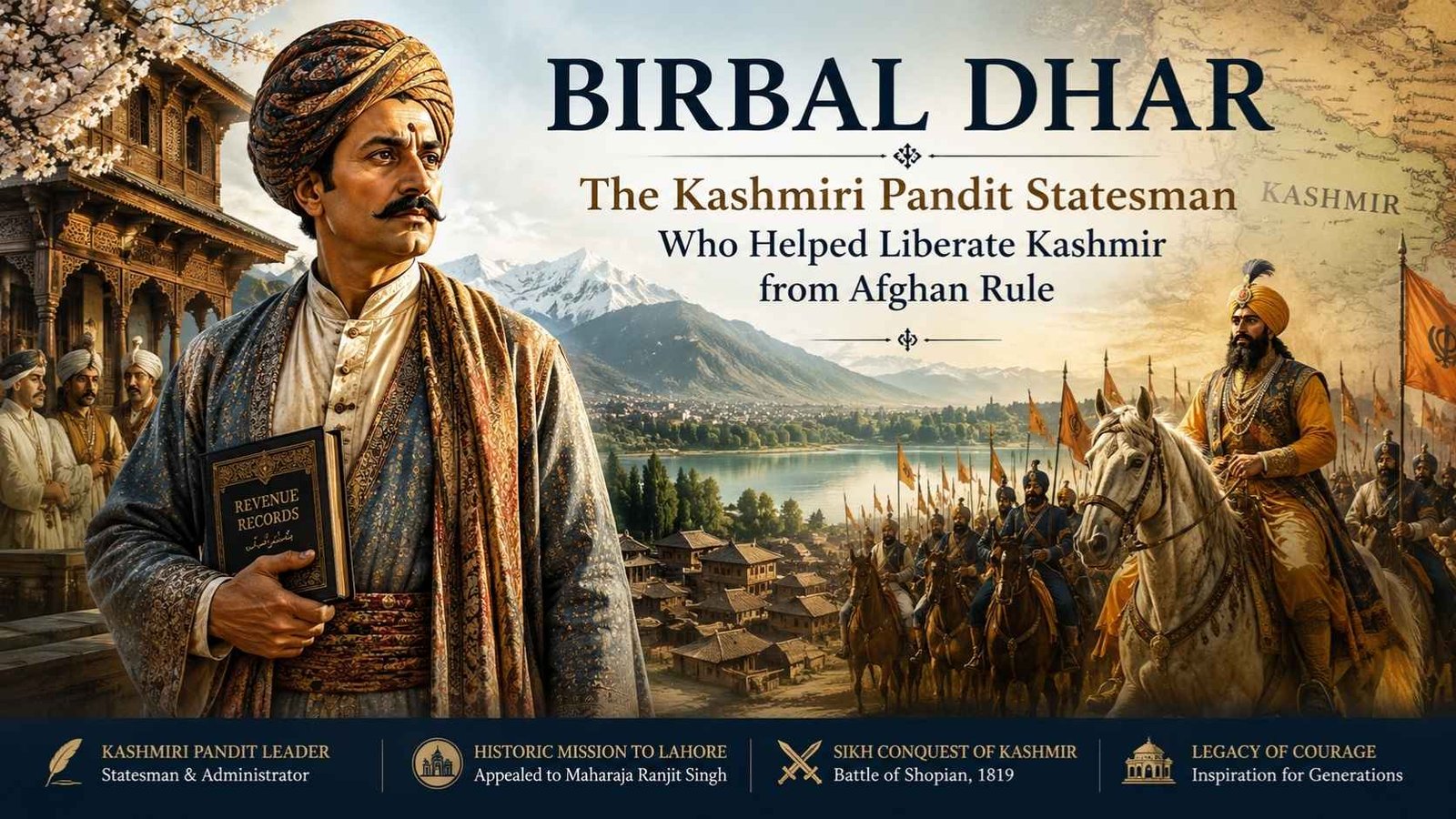
Who Was Birbal Dhar?
Birbal Dhar was a Kashmiri Pandit nobleman and revenue official who served the Afghan administration of Kashmir in the early nineteenth century. He is remembered chiefly for one act: leading a deputation of Kashmiri nobles to Lahore in 1819 to persuade Maharaja Ranjit Singh, ruler of the Sikh Empire, to invade the Kashmir Valley and end Afghan rule.
His appeal, combined with the military and logistical support he provided, contributed directly to the Sikh victory at the Battle of Shopian on 3 July 1819 and the fall of Srinagar shortly afterwards, bringing sixty-seven years of Durrani Afghan rule in Kashmir to a close.
Birbal Dhar’s own career after the conquest was brief and, by most accounts, unhappy. He was restored to his former revenue post under the new Sikh administration but was dismissed in 1821 on charges of corruption that several historians describe as politically motivated. He then withdrew from public affairs. His historical importance rests less on what he achieved for himself than on the political chain of events his journey to Lahore set in motion: the end of Afghan governance in Kashmir and the beginning of Sikh rule, which lasted from 1819 until 1846.
Historical Context: Kashmir Before Birbal Dhar
The Fall of Mughal Authority and the Rise of Afghan Rule
Kashmir had been a province of the Mughal Empire since 1586. As Mughal central authority weakened through the eighteenth century, the province became increasingly difficult to govern from Delhi. In 1752, Ahmad Shah Abdali (Ahmad Shah Durrani), founder of the Durrani Empire based in Kandahar and later Kabul, took control of Kashmir, ending direct Mughal administration and beginning a period of Afghan rule that lasted until 1819.
Over these sixty-seven years, Kashmir witnessed the rule of numerous Afghan governors appointed by successive Durrani rulers in Kabul. Historians studying Persian-language chronicles from the period, particularly the writings of the Kashmiri chronicler Ghulam Muhi-ud-Din Fauq, have identified as many as twenty-eight governors and deputy-governors who administered the Valley.
These officials served under four Afghan rulers: Ahmad Shah Abdali (1752 to 1772), Timur Shah (1772 to 1793), Zaman Shah (1793 to 1800), and later Shah Shuja and Mahmud Shah, whose contested and overlapping reigns lasted from 1801 to 1819.
Most governors remained in office for only a year or two before being replaced. This constant turnover reflected the political instability within the wider Durrani Empire rather than any consistent administrative policy for Kashmir.
The Character of Afghan Administration
Scholarly assessments of Afghan rule in Kashmir describe it as one of the harshest periods in the region’s recorded history. Kashmiri historians consistently portray these decades as a time of political instability, economic hardship, and administrative oppression.
Research examining the administrative record identifies recurring patterns across successive governorships. These included heavy and often arbitrary taxation, the coercive extraction of wealth, and periodic violence against the local population. Non-Muslim communities, particularly Hindus, as well as Shia Muslims, were frequently subjected to harsher treatment.
The economic consequences were severe. Many cultivators reportedly abandoned their land because of excessive taxation, leading to a decline in agricultural production. Contemporary accounts also describe Srinagar as neglected, with the city experiencing prolonged periods of decline under Afghan administration.
This is not to suggest that the entire sixty-seven-year period was uniformly oppressive. Historical records indicate that a small number of Afghan governors were comparatively fair and effective administrators.
The most notable exception was Sukh Jiwan Mal, a Hindu official who assumed effective control of Kashmir between 1753 and 1762. Several historical accounts describe his administration as more moderate and responsive to local needs. His rule ended when Durrani forces re-established their authority over the Valley.
Sukh Jiwan Mal’s administration also included the Kashmiri Pandit official Pandit Mahanand Dhar as one of his principal ministers. His appointment illustrates that Hindu administrators continued to occupy important revenue and civil positions even under nominal Afghan sovereignty. It was within this long-standing administrative tradition of Kashmiri Pandits serving as senior officials under Muslim rulers that Birbal Dhar’s own career emerged more than half a century later.
The Final Afghan Governors: Azim Khan and Jabbar Khan Barakzai
By the second decade of the nineteenth century, effective power within the Durrani Empire had passed to the Barakzai family, a rival clan to the ruling Sadozai dynasty. Mohammad Azim Khan Barakzai, fifth son of the Barakzai chief Payandah Khan, was appointed Afghan governor of Kashmir in 1812. His elder brother, Fateh Khan, held the powerful office of wazir (chief minister) to the nominal Durrani ruler Mahmud Shah. When Fateh Khan was killed in 1818, Azim Khan left Kashmir for Kabul to claim the office of wazir himself, leaving Kashmir in the hands of his half-brother, Jabbar Khan Barakzai, as acting governor.
It was under Jabbar Khan’s short administration, in 1819, that the final crisis of Afghan rule in Kashmir unfolded.
The Rise of the Sikh Empire under Maharaja Ranjit Singh
While Kashmir experienced a succession of Afghan governors, the Sikh Empire under Maharaja Ranjit Singh was steadily consolidating its power across the Punjab plains to the south. Ranjit Singh became the Maharaja of the Sikh Empire in 1801 and ruled from Lahore.
After capturing Attock in 1813 following his victory at the Battle of Haidru, Ranjit Singh turned his attention towards Kashmir. His first major expedition into the Valley in 1814 failed to capture Srinagar. However, the campaign succeeded in bringing several Muslim hill states along the Pir Panjal range, including Bhimber, Rajouri, and Poonch, under Sikh control.
Despite these gains, the Durrani Empire continued to control the strategic mountain passes through the Pir Panjal. This prevented the Sikh forces from maintaining the supply lines needed for a prolonged campaign in Kashmir. As a result, Sikh operations between 1814 and 1819 were largely confined to punitive expeditions against the hill states rather than a renewed attempt to conquer the Valley.
By 1819, the political conditions for a second, more decisive Sikh attempt had come together: growing instability in Kashmir’s Afghan administration, an experienced Sikh military establishment, and, crucially, a direct appeal for intervention from within Kashmir itself.
Birbal Dhar’s Position under Afghan Rule
Birbal Dhar served as a senior revenue official under the Afghan administration of Kashmir from around 1813 to 1819. Historical sources generally describe him as the chief tax collector or revenue minister during the governorships of Azim Khan and Jabbar Khan Barakzai.
His position placed him among the highest-ranking Kashmiri Pandit officials in the Afghan administration. It also reflected a long-established tradition in which the Persian-literate Pandit community occupied key civil and revenue posts, regardless of which dynasty exercised political authority over Kashmir.
Historical accounts describe growing tensions between Birbal Dhar and the Afghan administration during the final years of Afghan rule in Kashmir. Most secondary sources attribute the conflict to Governor Jabbar Khan Barakzai, although some suggest that the confiscation of jagirs (land grants) and revenue disputes had begun earlier under Azim Khan.
According to one detailed narrative, Birbal Dhar and his son, Raja Kak Dhar, escaped Kashmir under the cover of darkness. They crossed the Pir Panjal range with the assistance of the Maliks, local Muslim guardians of the mountain passes, whose own jagirs had reportedly been confiscated by the Afghan authorities.
The same account states that Birbal Dhar left his wife and daughter-in-law in the care of a trusted Muslim associate before departing. This detail suggests that his flight was viewed locally as a political dispute with the Afghan governor’s administration rather than a conflict driven solely by religious or communal divisions.
The Shawl Economy and the Network That Helped Dhar Escape
Ahmad Shah Abdali’s conquest of Kashmir in 1752-1753 ended Mughal provincial rule and brought the Valley under a Durrani military governorate. Most historians consulted for this article argue that the Afghan administration viewed Kashmir primarily as a source of revenue to finance the Durrani Empire’s military campaigns centred around Kabul.
This emphasis on extracting tribute remained a defining feature of Afghan rule. Rather than easing over time, the fiscal burden intensified under successive governors. It reached its peak during the administrations of Azim Khan Barakzai and his half-brother, Jabbar Khan, when taxation and revenue collection became increasingly oppressive.
Kashmir’s famed pashmina shawl industry, renowned far beyond the Valley by the late eighteenth century, was among the sectors most affected by Afghan taxation. Contemporary European travellers, including William Moorcroft and Godfrey Thomas Vigne, described heavy taxes imposed on shawl weavers. Historical accounts suggest these burdens not only continued but became even harsher after 1819 under Sikh rule, when taxes on finished shawls reportedly reached between one-quarter and two-fifths of their value.
The roots of this hardship, however, lay in the Afghan period. Taxes such as the dagshawl placed increasing pressure on artisans and traders. Over the following decades, many Kashmiri weavers and craftsmen migrated to Punjab cities, including Amritsar and Lahore, in search of better opportunities. This movement developed gradually across both the late Afghan and Sikh periods rather than beginning or ending abruptly in 1819.
Agricultural communities also suffered. Muslim and Hindu cultivators alike faced arbitrary grain seizures during years of poor harvest. Later research on Kashmir’s famine history traces these practices to both the Mughal and Afghan administrations. Meanwhile, Kashmiri Pandits, valued for their expertise in Persian revenue administration, occupied an influential yet precarious position. Although they held important fiscal posts, their prominence also made them convenient targets whenever governors sought to raise funds quickly.
Historian R. K. Parmu places Birbal Dhar’s flight within this broader climate of mounting fiscal pressure and administrative instability during the final years of Afghan rule. His escape was not an isolated act of personal courage but relied on a local network that crossed religious and social boundaries.
One scholarly study of Sikh-era Kashmir identifies three Muslim associates, Abdul Qadoos Gojwari, Malik Zulfiqar, and Malik Kamran, as key figures who helped Birbal Dhar leave the Valley. Their assistance aligns with earlier accounts that the Maliks, who controlled the Pir Panjal mountain passes, had their own grievances after the Afghan authorities confiscated their jagirs.
Accompanied by his son, Raja Kak Dhar, Birbal Dhar crossed the Pir Panjal in what most historical accounts place during the early months of 1819. He reached Lahore before Maharaja Ranjit Singh formally launched his Kashmir campaign on 20 April 1819.
Birbal Dhar and Maharaja Ranjit Singh: The Journey to Lahore
After crossing the Pir Panjal, Birbal Dhar and his son reached Jammu. There, Raja Gulab Singh, then a rising noble in Maharaja Ranjit Singh’s service and the future founder of the Dogra dynasty, is said to have assisted them. Through his brother, Raja Dhian Singh, he arranged Birbal Dhar’s introduction to the Lahore court.
Dhian Singh, who served as Ranjit Singh’s wazir (chief minister), presented Birbal Dhar before the Maharaja. This meeting proved to be a turning point in the events leading to the Sikh conquest of Kashmir.
At Lahore, Birbal Dhar urged Ranjit Singh to launch a military campaign against the Afghan administration in Kashmir. He reportedly informed the Maharaja that Azim Khan, the more experienced of the two Barakzai brothers, had already departed for Kabul, leaving the province under the comparatively weaker Jabbar Khan. Birbal Dhar also provided valuable intelligence on the routes leading into the Valley.
Despite this information, Ranjit Singh did not commit to an invasion immediately. Having failed to capture Kashmir during his 1814 campaign, he proceeded cautiously. According to the most detailed surviving account of their meeting, the Maharaja agreed to intervene only after setting certain conditions. As a guarantee of his commitment, Birbal Dhar left his son, Raja Kak Dhar, in Lahore while preparations for the expedition were underway.
Ranjit Singh eventually assembled a substantial army, estimated at around 30,000 troops. The campaign was led by several of his most trusted commanders, including Raja Gulab Singh, Hari Singh Nalwa, Misr Diwan Chand, and Dewan Mokham Chand.
Birbal Dhar’s role during this second Sikh expedition, as during his time at Lahore, is consistently described as that of a guide and source of local intelligence rather than a military commander in his own right. Multiple accounts credit him with helping to direct the Sikh forces through the Kashmir passes and towards Srinagar.
The Battle of Shopian and the Fall of Afghan Kashmir
The Sikh expeditionary force advanced from Lahore in the spring of 1819. Misr Diwan Chand’s column split into three divisions to cross the Pir Panjal range through different passes, defeating Durrani-appointed officials guarding the Behram Pass and other crossing points along the way, before regrouping at Surai Ali on the road towards the town of Shopian.
On 3 July 1819, the advancing Sikh army confronted the Durrani forces at Shopian. Jabbar Khan had fortified his position and deployed heavier artillery than the Sikh commanders had expected, setting the stage for a fierce and closely contested battle.
The Battle of Shopian proved to be one of the decisive engagements in the campaign. Dewan Mokham Chand opened the fighting with an artillery barrage, but repeated Sikh infantry and cavalry assaults initially failed to break the well-entrenched Afghan defences.
The course of the battle changed when Akali Phula Singh, the Nihang Sikh leader and Jathedar of the Akal Takht, led a determined assault on the Afghan positions. During the fighting, Jabbar Khan was wounded, forcing the Durrani army to retreat. The Afghan forces withdrew first towards Muzaffarabad and eventually retreated further to Peshawar and Kabul, bringing nearly seven decades of Afghan rule in Kashmir to an end.
With the Durrani army defeated, the road to Srinagar was left unguarded. The Sikh forces entered the city on 15 July 1819, marking the end of Afghan rule in Kashmir.
Prince Kharak Singh, who led the victorious army into Srinagar, is credited with guaranteeing the safety of the city’s inhabitants and preventing its plunder. Preserving Srinagar was strategically important, as the city was renowned for its thriving pashmina shawl industry and occupied a key position on trade routes linking Punjab, Tibet, Iskardo, and Ladakh.
Once Srinagar was secured, the remaining Afghan authority in Kashmir collapsed without significant resistance. The Sikh victory ended sixty-seven years of Durrani rule in the Valley, which had begun with Ahmad Shah Abdali’s conquest in 1752.
Aftermath: Sikh Administration and Birbal Dhar’s Fall
Following the conquest, Maharaja Ranjit Singh appointed Diwan Moti Ram, the son of Dewan Mokham Chand, as the first Sikh governor of Kashmir. Moti Ram served from 1819 to 1820 and again from 1821 to 1826.
Kashmiri Pandit officials who had supported the Sikh campaign were rewarded with important administrative positions. Alongside Birbal Dhar, at least two other Pandits, Mirza Pandit Dhar and Sukha Ram Safaya, were appointed to senior posts in the new administration.
Birbal Dhar was reinstated to his former position as a senior revenue official under Sikh rule. However, his second tenure proved to be brief. In 1821, he was dismissed on charges of embezzling government revenue.
Several historians suggest that the allegations may have been influenced, at least in part, by court politics rather than representing a straightforward criminal case. However, the available evidence does not allow a definitive conclusion that the charges were fabricated.
After his dismissal, Birbal Dhar withdrew from public life and spent his remaining years in relative obscurity. The surviving secondary literature does not provide a confirmed date of his death or many details about his later life. Rather than speculate, historians generally acknowledge that the historical record becomes silent after this point.
Administrative Consequences of the Sikh Conquest
The change of regime in 1819 had concrete, documented effects on how Kashmir was governed, and these effects were not uniform across communities.
For Kashmiri Pandits, several historical sources describe the early years of Sikh rule as a period of significant change. During Hari Singh Nalwa’s governorship (1820 to 1821), the administration is said to have removed several restrictions imposed during the Afghan period. These included limitations on religious worship, dress, and certain social customs. Contemporary accounts also state that Hindus who had been forcibly converted to Islam under Afghan rule were permitted to return to their original faith.
Hari Singh Nalwa’s administration is also credited with introducing broader administrative reforms. These included the abolition of begar, the system of unpaid forced labour imposed on villagers, and a reduction in the state’s share of revenue from saffron cultivation to encourage agricultural production.
Diwan Moti Ram, the first Sikh governor of Kashmir, also earned a favourable reputation in several historical accounts. The British administrator and historian Lepel Griffin described him as the most capable of the Sikh governors of Kashmir, noting that he was kind-hearted and enjoyed considerable popularity among the local population before resigning in June 1820.
The impact of Sikh rule on Kashmir’s Muslim majority remains a subject of historical debate. While many historians agree that Afghan rule had ended, they differ in their assessment of how conditions changed under the Sikh administration.
Several sources, including Wikipedia’s summary of the period, state that the Sikh government introduced measures widely regarded as restrictive towards Muslims. These included the death penalty for cow slaughter, the closure of Srinagar’s Jama Masjid for congregational prayers, and a ban on the azaan, the Muslim call to prayer. These restrictions reportedly remained in place until the final decade of Sikh rule, when they were lifted under Governor Sheikh Ghulam Muhi-ud-Din.
The reasons behind some of these policies remain contested. Some Kashmiri writers argue that the closure of the Jama Masjid was a security measure taken in response to an alleged conspiracy against Sikh rule rather than an act of religious intolerance. Other scholars, including historian Chitralekha Zutshi, interpret the increased prominence of Hindu and Sikh religious symbolism during this period as part of a broader effort to establish a distinct Sikh political identity following the end of Muslim rule.
European travellers who visited Kashmir during the Sikh period also described widespread poverty among the Muslim peasantry and the continuation of heavy taxation. Their observations suggest that although the change in government brought important benefits to some communities, particularly Kashmiri Pandits, it did not eliminate the economic hardships faced by much of the Valley’s population.
Birbal Dhar’s story marks a decisive turning point in Kashmir’s history, but it is only one chapter in a civilisation that spans more than five millennia. To understand how successive dynasties, empires, and rulers shaped the Valley, explore our comprehensive article on Kashmir’s political history.
Chronological Timeline
- 1586: Kashmir becomes a Mughal province.
- 1752: Ahmad Shah Abdali (Durrani) ends Mughal rule in Kashmir, beginning Afghan governorship of the Valley.
- 1753 to 1762: Sukh Jiwan Mal, a Hindu official, rules Kashmir with comparatively greater local autonomy before Durrani control is reasserted.
- 1801: Ranjit Singh becomes Maharaja of the Sikh Empire, ruling from Lahore.
- 1812: Mohammad Azim Khan Barakzai becomes Afghan governor of Kashmir.
- 1813: Ranjit Singh takes Attock following the Battle of Haidru.
- 1813 to 1819: Birbal Dhar serves as a senior revenue official under the Afghan administration of Kashmir.
- 1814: First Sikh expedition into Kashmir fails to take Srinagar, though several Pir Panjal hill states are subdued.
- 1818: Fateh Khan, wazir to the Durrani ruler, is killed; Azim Khan leaves Kashmir for Kabul, leaving his half-brother Jabbar Khan Barakzai in charge of the province.
- 1819 (date uncertain, before the summer campaign): Birbal Dhar, following mistreatment under Jabbar Khan’s administration, flees Kashmir with his son Raja Kak Dhar and travels via Jammu to Lahore to seek Ranjit Singh’s intervention.
- 3 July 1819: The Battle of Shopian is fought between Sikh forces and Jabbar Khan’s Durrani army; Jabbar Khan is wounded, and his forces retreat.
- 15 July 1819: Sikh forces under Prince Kharak Singh enter Srinagar peacefully, ending Afghan rule in Kashmir.
- 1819: Diwan Moti Ram is appointed the first Sikh governor of Kashmir; Birbal Dhar is reinstated to his former revenue post.
- 1821: Birbal Dhar is dismissed from his post on charges of corruption and withdraws from public life.
- 1846: Sikh rule in Kashmir ends with the Treaty of Amritsar, which transfers Kashmir to Dogra rule under Gulab Singh.
How Historians Evaluate Birbal Dhar’s Legacy
Within Kashmiri Pandit community history and memory, Birbal Dhar is generally remembered as the figure whose appeal to Lahore ended a period of Afghan governance widely regarded, across multiple independent academic surveys, as one of the harshest in Kashmir’s recorded history.
Academic treatments, drawing on Persian-language chronicles and later compiled histories such as R. K. Parmu’s institutional account of Sikh rule and S. R. Bakshi’s survey history of Kashmir, generally present his appeal to Ranjit Singh as one contributing factor among several, alongside the Sikh Empire’s own long-standing strategic interest in Kashmir and its accumulated military experience along the Pir Panjal frontier since 1813 to 1814, rather than as the sole cause of the 1819 conquest.
At the same time, the sources consulted are consistent in treating Birbal Dhar’s specific contributions, guiding the Sikh army, supplying intelligence on Durrani troop movements and invasion routes, and leading the political deputation that secured Ranjit Singh’s commitment, as historically significant and well documented across multiple independent accounts, including the analytical study by scholars examining Sikh administration in Kashmir and the narrative history compiled on Kashmiri Pandit heritage sites. His subsequent dismissal in 1821 is treated by several writers as illustrative of the precariousness of political office even for officials who had rendered substantial service to a new regime, though the surviving sources do not permit a definitive judgement on the truth or falsity of the corruption charges themselves.
Myths, Misconceptions and Disputed Claims
Several points require caution when reading popular accounts of Birbal Dhar:
Sole cause versus contributing factor. Some popular retellings present Birbal Dhar’s appeal as the single decisive cause of the Sikh conquest of Kashmir. The stronger, better-supported reading found across the academic sources is that his appeal was an important trigger and source of tactical intelligence, but that it operated within a wider context of Sikh strategic ambition and prior military preparation dating back to 1813 and 1814.
The identity of the offending governor. Sources vary on whether the immediate mistreatment that drove Birbal Dhar from Kashmir is attributable to Azim Khan or to his half-brother Jabbar Khan specifically. Most detailed accounts place the final breaking point in the period of Jabbar Khan’s acting governorship in 1819, though earlier grievances under Azim Khan’s tenure from 1812 are also recorded.
Sikh rule as uniformly benevolent or uniformly oppressive. Popular accounts often characterise the 1819 to 1846 period in one of two simplified ways, as a straightforward liberation from Afghan tyranny or, alternatively, as a period of comparable oppression directed at a different community. The sourced record does not support either simplification. Reforms benefiting Kashmiri Pandits coexisted with restrictive measures affecting Kashmir’s Muslim majority, and historians such as Chitralekha Zutshi read these measures as part of a deliberate assertion of Sikh political identity rather than as evidence that one community’s experience of the period can stand in for the whole.
Details of Birbal Dhar’s later life and death. No reliable date of death or detailed account of his final years appears in the sources reviewed. Where such detail is absent from the historical record, it should be stated as unknown rather than filled in with plausible-sounding invention.
Comparing the Principal Sources
The most detailed academic study of this period is R. K. Parmu’s A History of Sikh Rule in Kashmir, 1819 to 1846, first published in 1977. Parmu places Birbal Dhar’s role within the broader political and administrative transformation that accompanied the establishment of Sikh rule in Kashmir.
S. R. Bakshi’s Kashmir: History and People (1997) provides the most widely cited concise biography of Birbal Dhar. It serves as the foundation for many later secondary works, including several online encyclopaedic summaries.
Much of the historical understanding of the Afghan period is based on Persian-language chronicles written by authors such as Ghulam Muhi-ud-Din Fauq. These works provide detailed lists of Afghan governors and describe the nature of Durrani administration, forming an important source for later historians studying Kashmir’s political and cultural history.
Another valuable source is Wajeez-ut-Tawarikh (1857) by the nineteenth-century Kashmiri chronicler Ghulam Nabi Shah Khanyari. The chronicle covers both the Sikh and early Dogra periods and is frequently cited by later scholars. However, this article has not relied on the original text directly and instead draws on modern historical studies that discuss and interpret its contents.
Community and advocacy-oriented sources on Kashmiri Pandit history, useful for preserving popular memory and personal or family narratives connecting Birbal Dhar to later events such as the 1990 exodus of Kashmiri Pandits, are generally less rigorous in their sourcing and should be read as testimony to how Birbal Dhar is remembered within the community rather than as substitutes for the academic historical record.
Conclusion: Why Birbal Dhar Still Matters
Birbal Dhar’s place in Kashmiri history is best understood as that of a political catalyst rather than a ruler or military commander. As a senior Kashmiri Pandit revenue official driven to the limits by the Afghan administration, his journey to Lahore in 1819 helped connect local grievances with the expanding ambitions of the Sikh Empire. The military campaign that followed brought an end to sixty-seven years of Afghan rule in Kashmir within a few months.
Yet Birbal Dhar did not personally enjoy the rewards of this political transformation for long. His dismissal from office in 1821 illustrates that those who help shape major historical events do not always benefit from the outcomes they make possible.
For the Kashmiri Pandit community, Birbal Dhar remains an important historical figure. He represents the link between the administrative traditions of Afghan and Sikh Kashmir and later narratives of Kashmiri Pandit identity, resilience, and displacement. At the same time, the broader historical record shows that the transition from Afghan to Sikh rule produced different outcomes for different communities. Rather than presenting a uniformly positive or negative picture, the evidence points to a complex and community-specific transformation.
Sources and Further Reading
- Parmu, R. K. (1977). A History of Sikh Rule in Kashmir, 1819-1846. Department of Education, Jammu and Kashmir Government.
- Bakshi, S. R. (1997). Kashmir: History and People. Sarup & Sons.
- Fauq, Ghulam Muhi-ud-Din (2003 reprint). Chronicle material on Afghan governors of Kashmir, as cited in later academic surveys of Afghan administration.
- Khanyari, Ghulam Nabi Shah. Wajeez-ut-Tawarikh (1857), as described in Mohammad Ishaq Khan, History of Srinagar, 1846-1947: A Study in Socio-Cultural Change (1978).
- Academic and university-hosted analyses of Afghan rule in Kashmir (1752-1819) and of Sikh administration in Kashmir, consulted for administrative and cultural context.
- Wikipedia entries on Birbal Dhar, Mirza Pandit Dhar, Battle of Shopian, Mohammad Azim Khan, Moti Ram, Ranjit Singh, History of Kashmir and related figures, used only as a discovery aid pointing to the primary and secondary sources above, not relied upon as a primary authority.
- Zutshi, Chitralekha, cited via secondary summaries for the interpretation of Sikh-era religious policy as an assertion of Sikh political identity.
- Schofield, Victoria, cited via secondary summaries characterising the severity of Afghan governance towards Kashmir’s Hindu population.
- Griffin, Lepel, cited via secondary summaries for the contemporary British administrative assessment of Diwan Moti Ram’s governorship.
- Moorcroft, William and Trebeck, George. Travels in the Himalayan Provinces of Hindustan and the Punjab (1841), and Vigne, Godfrey Thomas. Travels in Kashmir, Ladakh and Iskardo (1842), both cited via secondary academic summaries for contemporary taxation levels on the Kashmiri shawl trade.
- Kaw, M. A. (1996). “Famines in Kashmir, 1586-1819: The Policy of the Mughal and Afghan Rulers.” The Indian Economic & Social History Review, 33(1), cited via secondary summary for the administrative causes of agrarian hardship.
A note on sourcing: some popular and community-oriented accounts of Birbal Dhar could not be corroborated against the principal academic sources used in this article and have been omitted or explicitly flagged rather than presented as settled fact.

Rohit Tikoo is a published author, researcher, and content strategist with over two decades of writing experience. He is the author of nine books covering Kashmir, Indian philosophy, social issues, and contemporary thought, including Shadows Over the Valley: Operation TUPAC, Cold War Geopolitics, and the Kashmiri Pandits Exodus (2025).
His work focuses on Kashmir’s history, literature, culture, and the lived experiences of the Kashmiri Pandit community. Through extensive research, archival references, and historical analysis, he seeks to document and preserve narratives that are often overlooked in mainstream discourse. His writing on Kashmir has appeared in DAILY EXCELSIOR, HEADLINES TODAY, ONLY KASHMIR, GREATER KASHMIR, NAAD,
VITASTA, CHATTAN, AND VOICE OF SILENCE.
Through rohittikoo.com, he publishes research-based articles, essays, and commentary aimed at fostering informed discussion on Kashmir, Indian civilisation, literature, and contemporary society.