
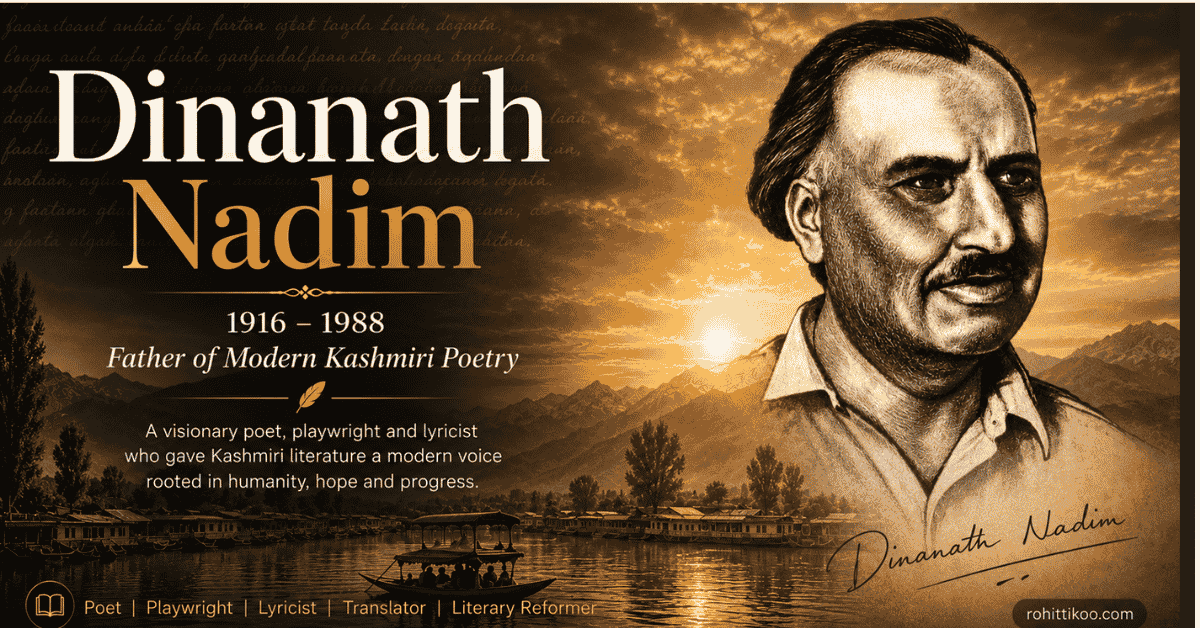
Few writers have transformed a language as profoundly as Dinanath Kaul Nadim transformed Kashmiri literature.
At a time when Kashmiri poetry largely revolved around mysticism, romance, and folklore, Nadim introduced a fresh literary voice rooted in realism, social justice, and human dignity. His work gave modern Kashmiri poetry a new direction while preserving the language’s rich cultural heritage.
Dinanath Nadim grew up during a time of political unrest, social change, and India’s fight for independence. These events shaped the way he saw the world and influenced his poetry. He did not write simply to entertain or admire beauty.
He believed poetry should speak for ordinary people, challenge injustice, and inspire positive change. That is why his poems captured the hopes, struggles, and dreams of common people, making his work meaningful and timeless.
Today, Dinanath Nadim is widely regarded as one of the pioneers of modern Kashmiri literature. His poems, plays, children’s literature, and lyrical works continue to influence writers, scholars, and readers across generations.
His landmark musical play Bombur ta Yemberzal remains one of the finest works ever written in Kashmiri, while his contribution to the Progressive Writers’ Movement helped usher in a new literary era in the Valley.
This article explores Dinanath Nadim’s life, literary achievements, major works, enduring legacy, and the reasons why he remains one of Kashmir’s most celebrated poets.
Who Was Dinanath Nadim?
Dinanath Kaul Nadim was a celebrated Kashmiri poet, playwright, lyricist, translator, and literary reformer who transformed twentieth-century Kashmiri literature. Often regarded as the pioneer of modern Kashmiri poetry.
He broke away from traditional styles and introduced free verse, contemporary themes, and progressive ideas. His writing gave Kashmiri literature a fresh voice that reflected the realities, hopes, and changing aspirations of society.
Born on 18 March 1916 in Srinagar, Nadim initially wrote poetry in Urdu and Hindi. However, encouraged by fellow intellectuals and inspired by the growing movement to strengthen regional languages, he began writing in Kashmiri during the 1930s. This decision proved transformative, not only for his own career but also for the future of Kashmiri literature.
Unlike many earlier poets whose works focused primarily on spirituality or romantic devotion, Nadim addressed issues such as:
- Freedom
- Equality
- Poverty
- Education
- Human rights
- Cultural identity
- Peace
His writing reflected the aspirations of ordinary Kashmiris while maintaining exceptional poetic elegance.
Early Life and Education
Dinanath Nadim was born into a Kashmiri Pandit family in Srinagar, where learning and culture were an integral part of daily life. From an early age, he developed a deep love for literature.
His education introduced him to Persian poetry, Urdu literature, Sanskrit classics, and English writing. These diverse influences broadened his outlook and later shaped his unique literary style, allowing him to blend tradition with modern ideas in a way few writers of his time could.
As a young student, Nadim loved learning new languages and reading great literature. He explored both Eastern and Western literary traditions with equal interest. This wide reading shaped his thinking and encouraged him to try new styles of poetry. Even as he embraced fresh ideas, he stayed true to Kashmir’s rich cultural heritage. His writing blended innovation with tradition in a simple yet powerful way.
During his college years, Nadim discovered the ideas of progressive literature and social reform. These ideas changed the way he looked at the world and shaped his writing. He believed literature should do more than entertain. It should question injustice, give people hope, and inspire positive change in society.
The Turning Point: Choosing Kashmiri as His Literary Language
One of the defining moments in Nadim’s career was his decision to write primarily in Kashmiri.
At the time, many educated writers preferred Urdu, Persian, or English because these languages offered wider readership and greater literary prestige. Kashmiri, despite being spoken by millions, had comparatively limited modern literary development.
Nadim believed that a language thrives when its people use it to express contemporary ideas. He therefore dedicated himself to enriching Kashmiri through innovative poetry, drama, songs, and translations.
This decision helped elevate Kashmiri from being primarily a spoken language to a vibrant medium for modern literary expression.
His commitment inspired numerous younger writers to embrace Kashmiri, contributing to a literary renaissance that continues to influence the language today.
The Birth of Modern Kashmiri Poetry
When Nadim began writing, Kashmiri poetry was dominated by traditional forms and themes inherited from earlier masters such as Mahjoor, Habba Khatoon, and Arnimal. While deeply respected, these traditions left limited room for addressing the social and political realities of the twentieth century.
Nadim did not reject the past. Instead, he built upon it.
He introduced:
- Contemporary vocabulary
- Free verse
- Symbolism
- Real-life characters
- National consciousness
- Democratic ideals
- Social equality
- Humanistic philosophy
His poetry demonstrated that Kashmiri could express modern political thought, personal reflection, and universal human emotions without losing its lyrical beauty.
This innovation earned him recognition as the leading voice of modern Kashmiri literature.
Nadim and the Progressive Writers’ Movement
The emergence of the Progressive Writers’ Movement marked a significant turning point in Indian literature. Inspired by ideals of equality, anti-colonialism, and social reform, the movement encouraged writers to address the realities faced by ordinary people.
Nadim became one of the movement’s foremost representatives in Kashmir.
His progressive outlook did not diminish the artistic quality of his poetry. Instead, it enriched it. His verses combined literary sophistication with emotional depth, allowing readers to connect with both the beauty of the language and the issues confronting society.
His poems frequently explored:
- Hope during difficult times
- Collective responsibility
- Human dignity
- National unity
- Love for one’s homeland
- Peace among communities
Unlike purely political writing, Nadim’s poetry retained a timeless human appeal that continues to resonate with readers across generations.
Major Works of Dinanath Nadim
No discussion of Dinanath Nadim is complete without examining the literary works that transformed Kashmiri literature. As a poet, playwright, lyricist, and translator, Nadim expanded the creative possibilities of the Kashmiri language. His writings combined lyrical beauty with social consciousness, making them relevant across generations.
1. Bombur ta Yemberzal (The Bumblebee and the Narcissus): Among Nadim’s many literary achievements, Bombur ta Yemberzal stands as his most celebrated work. Written as a lyrical opera, it narrates the symbolic love story between a bumblebee (Bombur) and a narcissus flower (Yemberzal).
Far more than a romantic tale, the opera reflects themes of:
- Love and sacrifice
- Harmony between humanity and nature
- Beauty of Kashmir
- Innocence and hope
- The triumph of life over adversity
What makes this work remarkable is its use of Kashmiri folklore, symbolism, and musical dialogue. It became the first opera published in the Kashmiri language, marking a milestone in the history of Kashmiri literature. Even decades after its publication, it continues to be staged in schools, cultural institutions, and theatre festivals across Kashmir.
2. Me Chhum Aash Paghich (I Am Hopeful of Tomorrow): Perhaps no poem captures Nadim’s humanitarian spirit better than Me Chhum Aash Paghich. Written against the backdrop of conflict and uncertainty, it is widely regarded as one of the most powerful anti-war poems in Kashmiri literature.
Rather than glorifying violence, the poem expresses an unwavering belief in peace, compassion, and a better future. Nadim reminds readers that hope can survive even in the darkest times.
The poem remains relevant today because its message transcends politics and speaks to universal human values.
3. Shuhul Kull (The Shady Tree): Shuhul Kull is another landmark work in Nadim’s literary career. This poetic drama explores human relationships, moral choices, and the search for social harmony through symbolic storytelling.
The work received widespread critical acclaim for its literary excellence and artistic innovation. In recognition of its significance, Nadim was awarded the Sahitya Akademi Award for Shuhul Kull in 1986, one of India’s highest literary honours.
4. Vitasta: Named after the ancient Sanskrit name of the Jhelum River, Vitasta is a lyrical opera that celebrates Kashmir’s cultural heritage and historical continuity.
The river serves as more than a geographical feature. It becomes a metaphor for civilisation, memory, and the enduring spirit of Kashmir. Through vivid imagery and evocative language, Nadim portrays the river as a silent witness to centuries of history.
5.Heemaal ta Naaegrai:Drawing inspiration from one of Kashmir’s best-known folk legends, Heemaal ta Naaegrai reimagines the timeless tale of love between Heemaal and the serpent king Nagrai.
Nadim preserved the essence of the traditional story while enriching it with modern literary techniques, poetic dialogue, and psychological depth. His adaptation helped revive interest in Kashmiri folklore among contemporary readers.
6. Safar ta Shehjaar (The Journey and the Shade):In Safar ta Shehjaar, Nadim explores life’s journey through symbolism and introspection. The work reflects on human resilience, companionship, and the search for meaning amid life’s uncertainties.
Like much of Nadim’s writing, it blends philosophical reflection with lyrical expression, inviting readers to contemplate both personal and collective experiences.
Beyond Poetry: A Multifaceted Literary Legacy
Although Nadim is best remembered as a poet, his contribution extended well beyond verse. His literary output included:
- Poetic dramas and operas
- Children’s literature
- Songs and lyrics
- Literary criticism
- Essays
- Translations from other Indian and international languages
Through these diverse forms, he demonstrated that Kashmiri could serve as a rich medium for every genre of modern literature. His efforts inspired a new generation of writers to create original works in their mother tongue, strengthening the literary identity of Kashmir.
Major Awards and National Recognition
Nadim’s immense contribution to Indian literature earned him several prestigious state and national decorations throughout his later life:
- Soviet Land Nehru Award (1971): Honoured for his progressive, peace-centric, and humanitarian literature, which led to an official tour of the Soviet Union.
- Kalhana Award (1985): Conferred upon him in recognition of his lifetime dedication to the cultural heritage of Kashmir.
- Sahitya Akademi Award (1986): Awarded for his masterpiece collection Shuhul Kull (often transliterated as Shihil Kul or Shuhul Kul), cementing his position in the highest echelons of Indian literary history.
Nadim passed away on 7 April 1988 in Jammu, suffering from partial paralysis towards the end of his life, and his final rites were performed in his beloved hometown of Srinagar. He left behind a transformed language and a legacy that continues to inspire subsequent generations of writers across the subcontinent.
Explore more legendary Kashmiri poets

Rohit Tikoo is a published author, researcher, and content strategist with over two decades of writing experience. He is the author of nine books covering Kashmir, Indian philosophy, social issues, and contemporary thought, including Shadows Over the Valley: Operation TUPAC, Cold War Geopolitics, and the Kashmiri Pandits Exodus (2025).
His work focuses on Kashmir’s history, literature, culture, and the lived experiences of the Kashmiri Pandit community. Through extensive research, archival references, and historical analysis, he seeks to document and preserve narratives that are often overlooked in mainstream discourse. His writing on Kashmir has appeared in DAILY EXCELSIOR, HEADLINES TODAY, ONLY KASHMIR, GREATER KASHMIR, NAAD,
VITASTA, CHATTAN, AND VOICE OF SILENCE.
Through rohittikoo.com, he publishes research-based articles, essays, and commentary aimed at fostering informed discussion on Kashmir, Indian civilisation, literature, and contemporary society.