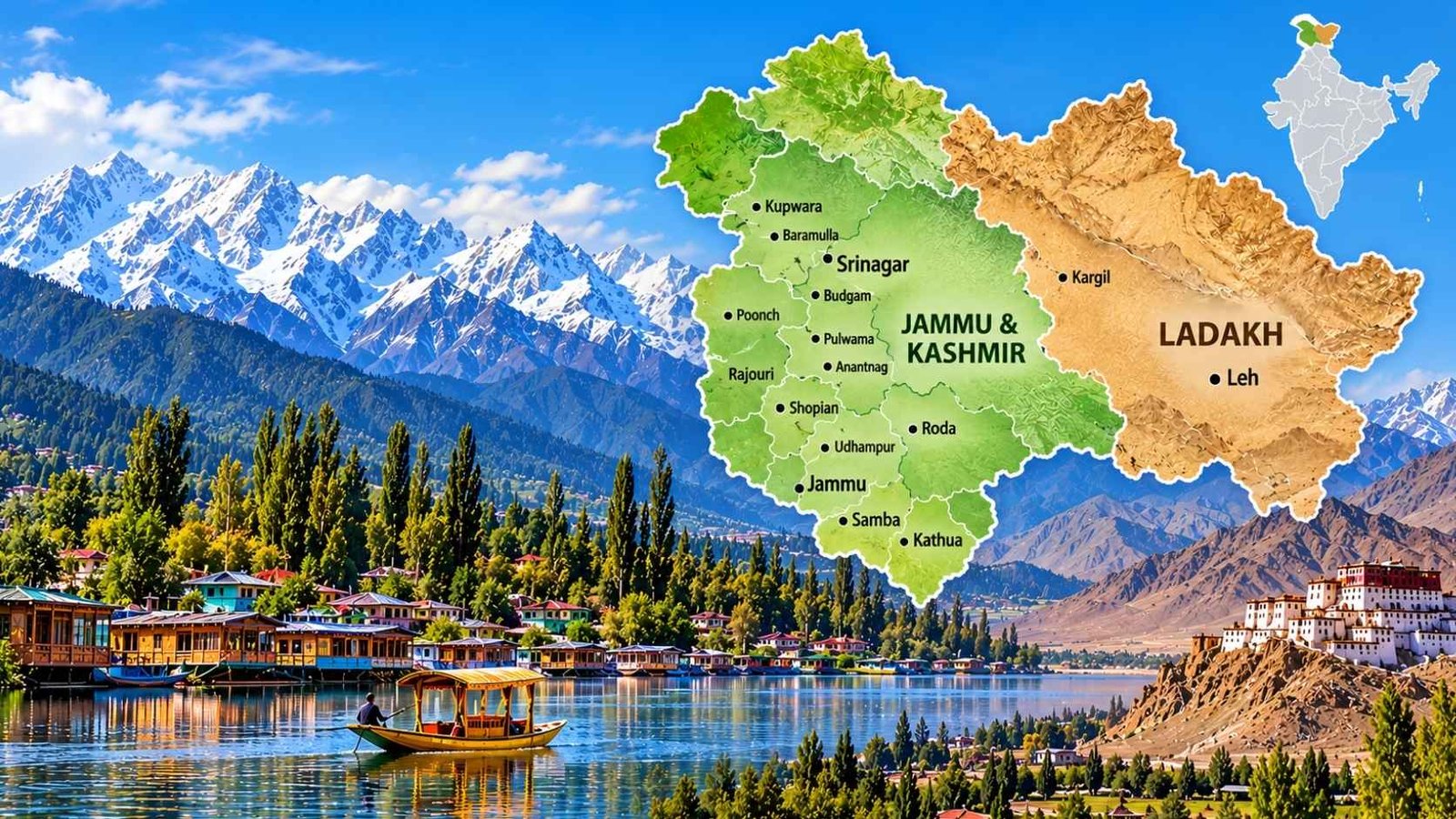
The Jammu and Kashmir Reorganisation Act, 2019 abolished the state of Jammu and Kashmir. It replaced it with two union territories: Jammu and Kashmir, which kept a legislature, and Ladakh, which did not. Parliament passed it on 6 August 2019, a day after it voted to strip Jammu and Kashmir of the special status it had held under Article 370. Seven years on, Jammu and Kashmir still waits for the statehood it was promised, and Ladakh still fights for protections it says it was promised too.
This is the part of the story that Rohit Tikoo’s earlier piece on Article 370 does not cover. That article ends with the Supreme Court’s 2023 judgment. This one picks up where the Reorganisation Act itself begins: what the law actually did, what came apart on the ground when it took effect, and what has and has not been resolved since.
What did the Jammu and Kashmir Reorganisation Act, 2019 actually do?
It split the former state into the Union Territory of Jammu and Kashmir, which has an elected assembly, and the Union Territory of Ladakh, comprising the Kargil and Leh districts, which does not. Home Minister Amit Shah introduced the bill in the Rajya Sabha on 5 August 2019, and it passed the same day by a voice vote recorded as 125 in favour to 61 against. The Lok Sabha passed it the next day, 370 to 70. President Ram Nath Kovind gave his assent on 9 August, and the Act took effect on 31 October 2019, formally Act No. 34 of 2019.
Jammu and Kashmir’s new assembly was set at 107 seats, though 24 of those remain permanently vacant because they represent territory under Pakistani administration. The Lieutenant Governor can nominate up to two additional members to ensure women are represented. The Council of Ministers cannot exceed ten percent of the assembly’s membership, and a single High Court now serves both union territories. The old Legislative Council, an upper house that Jammu and Kashmir had maintained since well before independence, was abolished outright.
Beneath the constitutional architecture, the Act quietly rewrote the region’s legal code. It extended 106 central laws to the two territories, including the Aadhaar Act and the Right to Education Act, repealed 153 state laws, and left another 166 in force. Seven laws were kept but amended, among them the provision that had barred non-permanent residents from leasing land in Jammu and Kashmir. That single amendment, more than any assembly seat count, is what critics of the Act point to when they argue it was designed to change who could own property in the region, not merely how it was governed.
Why was Ladakh separated, and why does it have no legislature?
Because the government decided Ladakh’s demography, geography and strategic position, on the frontier with both China and Pakistan, warranted direct rule from Delhi rather than an elected assembly of its own. The Act places Ladakh under a Lieutenant Governor appointed by the President, with no local legislature at all, a sharper form of central control than the version applied to Jammu and Kashmir.
For some in Leh, in 2019, that trade was initially welcomed: it ended decades of feeling administratively subordinate to Srinagar, the seat of power discussed at length in the broader history of Kashmir. What followed has been messier. The same 2019 election cycle in which the BJP won power nationally saw the party’s own Lok Sabha manifesto promise Ladakh protection under the Constitution’s Sixth Schedule, the provision that gives tribal areas of India’s northeast a measure of self-governing autonomy over land and resources. The pledge was repeated during the 2020 Hill Council elections. Neither has been delivered, and that gap between promise and delivery is the story of Ladakh’s last five years.
What happened on the ground when the Act took effect?
Within hours of Parliament’s vote, the government imposed a curfew across the Kashmir Valley, moved in additional troops, and cut off almost all telephone and internet access. By a government report issued on 6 September 2019, close to 4,000 people had been arrested, including more than 200 local politicians and more than 100 leaders and activists from the separatist All Parties Hurriyat Conference. Two former chief ministers, Omar Abdullah and Mehbooba Mufti, were among those detained. The clampdown lasted, in various forms, for roughly five months in a region home to close to eight million people, and full 4G mobile internet was not restored across the territory until February 2021, about eighteen months after it was switched off.
The government’s case, then and since, has been that the measures were necessary to prevent a repeat of the unrest that followed militant commander Burhan Wani’s death in 2016, and that the long-run reduction in street violence and the resumption of tourism vindicate that call. Rights groups and opposition politicians have made the opposite case: that a democracy detained its own elected leaders and cut off an entire population’s communications without a comparable precedent elsewhere in the country’s history. Both readings belong in the record, and neither cancels the other’s facts. The accession that brought Jammu and Kashmir into India in the first place, signed under very different pressure by Maharaja Hari Singh in October 1947, reserved only defence, external affairs and communications to Delhi. The 2019 lockdown reached far beyond any of those three subjects.
What did the Supreme Court decide about the Reorganisation Act?
On 11 December 2023, a five-judge Constitution Bench led by then Chief Justice D.Y. Chandrachud unanimously upheld the government’s abrogation of Article 370. On the Reorganisation Act specifically, though, the Court did something narrower: it declined to rule on whether splitting a full state into two union territories was itself constitutional. The majority instead relied on an assurance given during the hearings by Solicitor General Tushar Mehta that Jammu and Kashmir’s statehood would eventually be restored and that this would not affect Ladakh, and left the underlying constitutional question open for a future case.
What the Court did order was specific. It directed that assembly elections be held in Jammu and Kashmir no later than 30 September 2024, without waiting for statehood to be restored first, and that “restoration of statehood shall take place at the earliest.” In a concurring opinion, Justice Sanjay Kishan Kaul went further than the majority felt able to, recommending that the government establish a South Africa-style truth and reconciliation commission for Jammu and Kashmir. He wrote that it “should be set up expediently before memory escapes,” arguing that an entire generation had grown up mistrustful and was owed that reckoning. No such commission has been constituted.
Did Jammu and Kashmir get its elections, and did it get its Chief Minister back?
Yes to the first, and yes, eventually, to the second. Assembly elections were held in three phases in September and October 2024, with turnout at 63.88 percent, the territory’s first vote for its own legislature since the state was dissolved. The National Conference won 42 of the assembly’s 90 seats, the BJP took 29, and Congress and the PDP were reduced to six and three respectively. The National Conference and Congress formed a coalition government, and Omar Abdullah, who had himself been detained in the 2019 crackdown, was sworn in as Chief Minister on 16 October 2024, his second term in the role after previously serving from 2009 to 2015. His inauguration followed the Centre’s decision to lift President’s Rule in the territory after six unbroken years.
Two days after taking office, Abdullah’s cabinet passed a resolution formally asking the Centre to restore full statehood. Lieutenant Governor Manoj Sinha approved it three days later. Nearly two years on, as of this writing, that request has not been granted. It is the latest chapter in a dispute over Jammu and Kashmir’s status that runs back through the terms of accession themselves and into the wider India-Pakistan dispute over the region.
Why is Jammu and Kashmir still not a state again?
Because the Centre has repeatedly said statehood will come “at an appropriate time” without naming one, and Omar Abdullah’s government has run out of patience waiting for it. In August 2025, a day after the Supreme Court told petitioners pressing for a statehood timeline to stay “mindful of ground realities” such as the April 2025 Pahalgam terror attack that killed 25 tourists and a resident, Abdullah announced a door-to-door signature campaign covering all 90 assembly constituencies, timed to the eight-week window the Court had given the Centre to respond. A year into his term, marking his government’s first anniversary, he told reporters the Centre had let a self-imposed deadline slip, saying plainly that his party had hoped for restoration “within the first year of our government, but it has not happened.”
By July 2026 the campaign had shifted from petitions to the streets. Addressing a rally at Maharaja Hari Singh Park in Jammu on 12 July, his first major public meeting in that BJP stronghold in years, Abdullah announced a “Delhi Chalo” demonstration for 20 July, telling the crowd that “our silence is being mistaken for weakness.” He pointed to what he called the Centre’s own sequence: delimitation, then election, then statehood, and asked why the last step kept being deferred. Invoking Prime Minister Modi’s 2024 campaign pledge, made in Katra, he argued that a promise made on that soil “should be honoured.” A separate petition asking the Supreme Court to compel restoration within two months, filed by petitioners in October 2024, remains before the Court.
What are Ladakh’s Sixth Schedule and statehood demands, and why have they turned violent?
Ladakh’s civil society, led by the Leh Apex Body and the Kargil Democratic Alliance and fronted publicly by the education reformer Sonam Wangchuk, has spent the years since 2019 pressing for two things: full statehood, and inclusion under the Constitution’s Sixth Schedule to protect Ladakh’s land, jobs and fragile high-altitude environment from outside development. The government’s response has moved from negotiation to confrontation and, briefly, to bloodshed.
Talks through a Home Ministry-led High-Powered Committee did produce results the government points to: Ladakh’s Scheduled Tribe reservation rose from 45 percent to 84 percent, a third of council seats were reserved for women, and Bhoti and Purgi were declared official languages. What talks did not produce was Sixth Schedule status or statehood. According to Wangchuk’s own account, Home Minister Amit Shah told a Ladakh delegation in March 2024 that he would not grant either, “even if the prime minister asks me.”
Wangchuk fasted for 21 days in Leh in March 2024 over the same demands. On 10 September 2025, after what he said was nearly two months without any Home Ministry engagement, he began a 35-day hunger strike. On 24 September, protests in Leh turned violent, leaving four people dead and around 90 injured, with government buildings and vehicles set alight. Two days later, the government cancelled the foreign-funding registration of Wangchuk’s non-profit and detained him under the National Security Act, alleging his rhetoric had incited the unrest. He denied it, and from Jodhpur jail said he would stay in custody “unless there is an independent judicial inquiry into the killing of the four people.”
The Centre revoked his detention roughly six months later, in March 2026, in what the government described as an effort to restore dialogue. It did not last. In June 2026, Wangchuk began a further hunger strike, this time also in solidarity with students protesting a leaked national examination, saying he was prepared to fast for “six weeks or death” unless the government addressed both the exam-system failure and, in his words, “the environment, cultural safeguards in Ladakh and the treatment of students.”
What is the current status, as of September 2026?
Unresolved on both counts. Jammu and Kashmir has an elected government pressing publicly and repeatedly for a promise the Centre has not withdrawn but has also not honoured, with a statehood petition still pending before the Supreme Court. Ladakh has neither statehood nor Sixth Schedule protection, a civil society movement that has already produced one fatal confrontation with the state, and a leading activist who has cycled through hunger strikes, detention and release without the underlying demand being met. The 2019 Act rewrote the map of the former state in a single week. Undoing, or completing, what it started has taken years longer, and as of this writing, is not finished.
Frequently asked questions
What is the difference between the Jammu and Kashmir Reorganisation Act and Article 370?
Article 370 was the constitutional provision that gave Jammu and Kashmir special autonomous status; the presidential orders of 5 August 2019 made it inoperative. The Reorganisation Act, passed the following day, is the separate law that then dissolved the state itself and replaced it with the two union territories. One ended a status; the other redrew the map.
Is Jammu and Kashmir a state or a union territory in 2026?
A union territory. It has an elected Legislative Assembly and Chief Minister, unlike most union territories, but it remains administratively subordinate to a Lieutenant Governor appointed by the Centre, and full statehood has not been restored despite the Supreme Court’s 2023 direction that it happen “at the earliest.”
Does Ladakh have any elected legislature?
No. Ladakh is governed directly by a Lieutenant Governor appointed by the President, with local affairs handled by hill development councils in Leh and Kargil rather than a territorial assembly. This is the core of what the Sixth Schedule and statehood campaigns are trying to change.
Who is Sonam Wangchuk?
An education reformer and climate activist from Ladakh, a Ramon Magsaysay Award winner whose earlier work partly inspired the “Phunsukh Wangdu” character in the film 3 Idiots. Since 2019 he has become the most visible face of Ladakh’s campaign for statehood and Sixth Schedule protection, leading repeated hunger strikes and, in September 2025, being detained under the National Security Act after protests turned violent.
Sources
- ‘The Jammu and Kashmir Reorganisation Bill, 2019’, PRS Legislative Research: https://prsindia.org/billtrack/the-jammu-and-kashmir-reorganisation-bill-2019
- ‘Jammu and Kashmir Reorganisation Act, 2019’, Wikipedia: https://en.wikipedia.org/wiki/Jammu_and_Kashmir_Reorganisation_Act,_2019
- ‘2019-2021 Jammu and Kashmir lockdown’, Wikipedia: https://en.wikipedia.org/wiki/2019%E2%80%932021_Jammu_and_Kashmir_lockdown
- ‘Kashmir: The effects of revoking Article 370’, UK Parliament Commons Library: https://commonslibrary.parliament.uk/kashmir-the-effects-of-revoking-article-370/
- ‘How 2019 changed the Kashmir dispute forever’, Al Jazeera: https://www.aljazeera.com/news/2020/1/1/how-2019-changed-the-kashmir-dispute-forever
- ‘Kashmir Under Siege: Years of Repression Since Article 370’s Revocation’, Kashmir Media Service: https://kmsnews.org/kms/2025/08/06/kashmir-under-siege-years-of-repression-since-article-370s-revocation.html
- Gauri Kashyap and R. Sai Spandana, ‘Abrogation of Article 370 | Judgement Summary’, Supreme Court Observer, 11 December 2023: https://www.scobserver.in/reports/abrogation-of-article-370-judgement-summary/
- ‘Jammu & Kashmir Election Results 2024’, BusinessToday: https://www.businesstoday.in/india/story/jammu-kashmir-jk-assembly-election-results-2024-live-updates-omar-abdullah-national-conference-ganderbal-budgam-ravinder-raina-bharatiya-janata-party-bjp-nowshera-iltija-mufti-pdp-srigufwara-bijbehara-449133-2024-10-08
- Zulfikar Majid, ‘Jammu & Kashmir Assembly Polls 2024 | Omar Abdullah set to form government amid challenges’, Deccan Herald: https://www.deccanherald.com/elections/jammu-and-kashmir/jammu-kashmir-assembly-polls-2024-omar-abdullah-set-to-form-government-amid-challenges-3224330
- Zulfikar Majid, ‘Jammu and Kashmir Assembly Elections 2024: L-G invites Omar Abdullah for taking oath as CM on Oct 16’, Deccan Herald: https://www.deccanherald.com/amp/story/elections%2Fjammu-and-kashmir%2Fjammu-and-kashmir-assembly-elections-2024-l-g-invites-omar-abdullah-for-taking-oath-as-cm-on-oct-16-3231990
- ‘Have received high level assurances on statehood restoration to J&K: Omar Abdullah’, Deccan Herald: https://www.deccanherald.com/india/jammu-and-kashmir/have-received-high-level-assurances-on-statehood-restoration-to-jk-omar-abdullah-3253329
- ‘Omar Abdullah says will launch signature drive for statehood restoration for Jammu and Kashmir’, Deccan Herald: https://www.deccanherald.com/amp/story/india%2Fjammu-and-kashmir%2Fomar-abdullah-says-will-launch-signature-drive-for-statehood-restoration-for-jammu-and-kashmir-3682475
- ‘Omar Abdullah renews call for J&K statehood as National Conference govt marks one year in power’, Deccan Herald: https://www.deccanherald.com/amp/story/india%2Fjammu-and-kashmir%2Fomar-abdullah-renews-call-for-jk-statehood-as-national-conference-govt-marks-one-year-in-power-3766489
- ‘Omar Abdullah escalates statehood fight with ‘Delhi Chalo’ call’, The Federal: https://thefederal.com/category/states/north/jammu-and-kashmir/jammu-and-kashmir-statehood-omar-abdullah-statehood-delhi-chalo-march-249913
- ‘Top court to hear plea for J-K statehood restoration on Aug 8’, The Tribune: https://www.tribuneindia.com/news/j-k/top-court-to-hear-plea-for-jk-statehood-restoration-on-aug-8/amp
- Tarushi Aswani, ‘Why Sonam Wangchuk and Others in Ladakh Are on a Hunger Strike Once Again’, The Wire: https://m.thewire.in/article/rights/why-sonam-wangchuk-and-others-in-ladakh-are-on-a-hunger-strike-once-again
- ‘Press Release on Ladakh’, Press Information Bureau, Ministry of Home Affairs: https://www.pib.gov.in/PressReleasePage.aspx?PRID=2170941®=48&lang=2
- ‘Climate activist Sonam Wangchuk ends 21-day-long hunger strike in Ladakh’, The Tribune: https://www.tribuneindia.com/news/j-k/climate-activist-sonam-wangchuk-ends-21-day-long-hunger-strike-in-ladakh-604347
- ‘Ladakh statehood violence | Activist Sonam Wangchuk arrested under NSA after deadly protests that killed 4’, Deccan Herald: https://www.deccanherald.com/amp/story/india%2Fladakh%2Fladakh-statehood-violence-activist-sonam-wangchuk-arrested-by-police-3744003
- ‘Incarcerated activist Sonam Wangchuk seeks judicial probe into Leh killings’, Deccan Herald: https://www.deccanherald.com/amp/story/india%2Fladakh%2Fincarcerated-activist-sonam-wangchuk-seeks-judicial-probe-into-leh-killings-3753466
- ‘Ladakh Protest Update: Centre Revokes Sonam Wangchuk’s NSA Detention After 6 Months to Restore Peace & Dialogue’, Sunday Guardian Live: https://sundayguardianlive.com/india/ladakh-protest-update-centre-revokes-sonam-wangchuk-nsa-detention-after-6-months-to-restore-peace-dialogue-176217/amp/
- Eshwar, ”Six Weeks or Death’: Sonam Wangchuk Vows to Continue Hunger Strike’, The Quint: https://www.thequint.com/news/politics/sonam-wangchuk-six-weeks-or-death-hunger-strik
Rohit Tikoo is a published author, researcher, and content strategist with over two decades of writing experience. He is the author of nine books covering Kashmir, Indian philosophy, social issues, and contemporary thought, including Shadows Over the Valley: Operation TUPAC, Cold War Geopolitics, and the Kashmiri Pandits Exodus (2025).
His work focuses on Kashmir’s history, literature, culture, and the lived experiences of the Kashmiri Pandit community. Through extensive research, archival references, and historical analysis, he seeks to document and preserve narratives that are often overlooked in mainstream discourse. His writing on Kashmir has appeared in DAILY EXCELSIOR, HEADLINES TODAY, ONLY KASHMIR, GREATER KASHMIR, NAAD,
VITASTA, CHATTAN, AND VOICE OF SILENCE.
Through rohittikoo.com, he publishes research-based articles, essays, and commentary aimed at fostering informed discussion on Kashmir, Indian civilisation, literature, and contemporary society.