
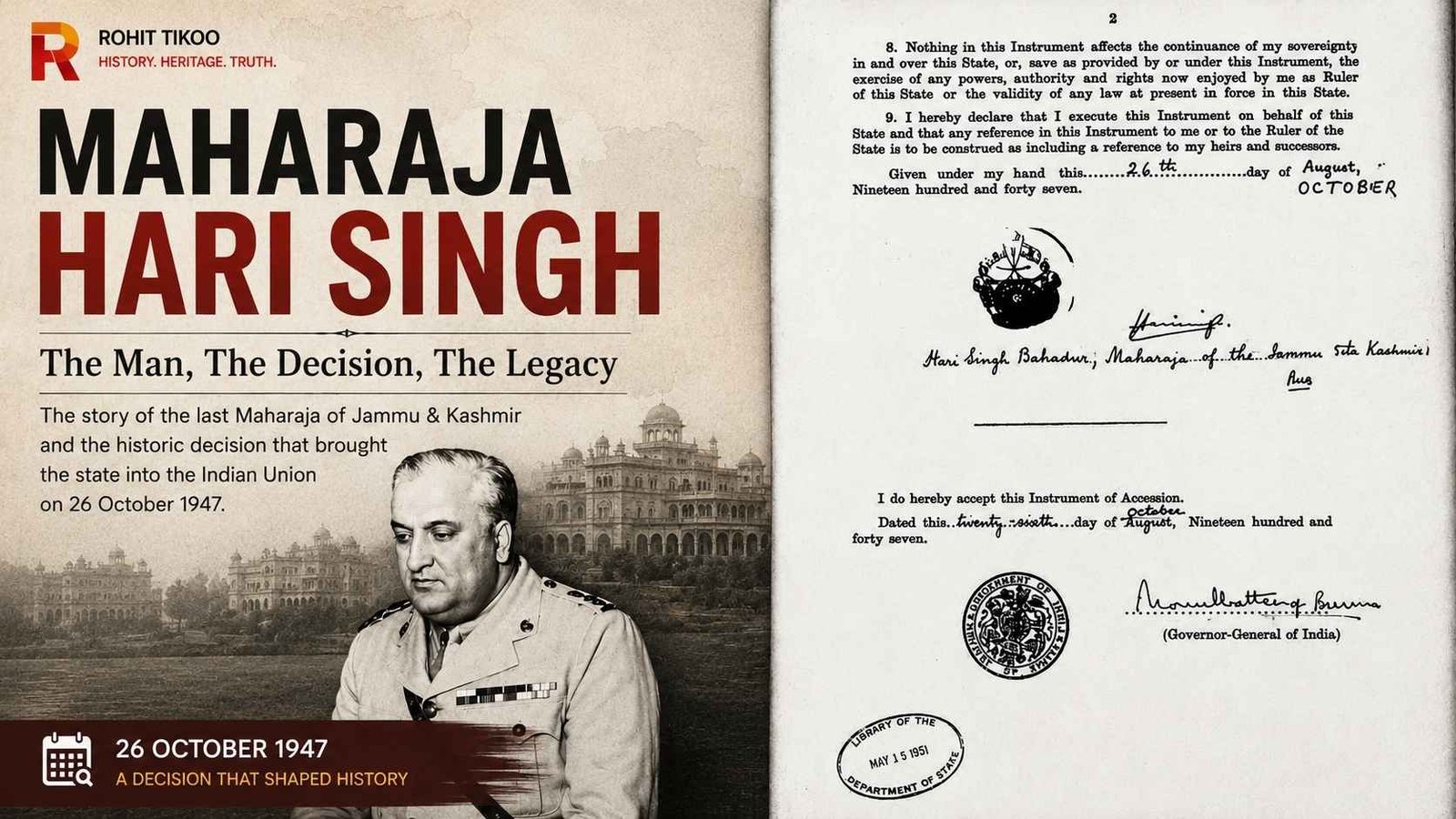
Maharaja Hari Singh was the last ruling monarch of the princely state of Jammu and Kashmir, and the man whose signature on a single document, the Instrument of Accession, brought the state into the Indian Union on 26 October 1947. He signed it only after a Pakistan-backed tribal invasion had already reached the outskirts of Srinagar, and only in exchange for India’s promise of immediate military help. That single decision, taken under siege rather than in calm deliberation, set the terms of a dispute that still shapes Kashmir’s politics eight decades later.
Table of Contents
Who was Maharaja Hari Singh?
Hari Singh was born in September 1895 at Amar Mahal Palace in Jammu, the son of Raja Amar Singh and nephew of the reigning Maharaja Pratap Singh. Since Pratap Singh had no surviving children, Hari Singh was raised as heir presumptive from boyhood. He was educated at Mayo College in Ajmer and trained at the Imperial Cadet Corps in Dehradun, and by 1915, still in his teens, he held command of the state forces.
Pratap Singh died on 23 September 1925, and after a brief spell as prime minister, Hari Singh ascended the throne in February 1926. The British had overruled Pratap Singh’s own choice of successor, a decision that left an early mark of dependence on colonial goodwill over the new Maharaja’s reign.
Hari Singh’s rule was not a simple story of autocracy. In 1932, following the Glancy Commission’s recommendations, he created the Praja Sabha, a legislative assembly with elected representation, at a time when few princely states allowed their subjects any such voice. In 1939, his government produced a written constitution for the state, an early move by the standards of princely India. He made primary education compulsory, restricted child marriage, and opened temples to subjects from lower castes who had previously been barred from them. He attended the Round Table Conferences in London in the early 1930s and later spent months in Britain meeting Winston Churchill during the war years. None of this reform record, however, has ever eclipsed the single decision for which he is chiefly remembered: what he did, and when, in October 1947.
Why did Kashmir not immediately join India or Pakistan?
When British rule over India ended on 15 August 1947, the subcontinent’s roughly 565 princely states were left to choose between acceding to India, acceding to Pakistan, or, in theory, remaining independent. Jammu and Kashmir was the largest and most strategically awkward of these states: a Muslim-majority population ruled by a Hindu monarch, bordering both new dominions, with a population and geography that made almost any choice contentious.
Hari Singh’s preferred course was delay. He hoped Kashmir might remain independent, or at least postpone a decision until the immediate chaos of Partition had settled. On 14 August 1947 his government signed a standstill agreement with Pakistan, a technical arrangement to keep existing postal, telegraph and trade links running while the larger question of accession was left open. He urged India to sign a similar agreement, but India declined pending clearer indications of the Maharaja’s intentions. No such formal standstill agreement was ever concluded between Kashmir and India, a gap that would matter later when Pakistan accused the Maharaja of acceding in bad faith.
Nor was the hesitation purely strategic. His government had also imprisoned Sheikh Abdullah, the popular leader of the National Conference, over the 1946 Quit Kashmir agitation demanding an end to Dogra rule, and relations between the palace and Kashmir’s most influential political figure were openly hostile at the very moment unity was most needed.
What triggered the crisis that forced his hand?
Delay became impossible once violence arrived from two directions at once. In early October 1947, an armed uprising broke out in Poonch, in the state’s western districts, against the Maharaja’s administration. Then, on 22 October 1947, a force of several thousand Pashtun tribesmen, organised and armed with Pakistani backing in what later became known as Operation Gulmarg, crossed the border near Muzaffarabad and advanced into Kashmiri territory.
The tribal lashkar reached Baramulla, a town roughly fifty kilometres from Srinagar, within days. There they stopped, distracted by looting, arson and violence against the town’s inhabitants, a delay that historians generally agree cost the invasion its momentum and gave the Maharaja’s government the days it needed to seek help. Had the tribesmen pressed straight on to Srinagar and its airfield, the military and political situation facing India would have been very different.
With his own forces unable to hold the advance, Hari Singh appealed to Delhi for military assistance. India’s leadership, represented in Kashmir by the civil servant V.P. Menon, made its position clear: Indian troops would not be committed to defend a state that had not formally joined India. Accession had to come first.
What is the Instrument of Accession, and what did it actually say?
The Instrument of Accession was the standard legal document by which a princely state’s ruler joined either the Dominion of India or the Dominion of Pakistan after August 1947, under the framework set out in the Indian Independence Act, 1947. It was not unique to Kashmir; hundreds of other princely rulers signed equivalent instruments in the preceding months. What made Kashmir’s instrument historically significant was less its form than the circumstances under which it was signed, and the political argument that has surrounded it ever since.
By its terms, Hari Singh ceded to the Dominion Legislature of India the power to make laws for Jammu and Kashmir on three subjects only: defence, external affairs, and communications, the last covering railways, posts, telegraphs and similar infrastructure. On every other matter, the instrument explicitly reserved the state’s own legislative sovereignty, and it further stipulated that no future Indian constitutional provision could be extended to the state without the Maharaja’s own consent. This limited scope of accession, rather than a full and unconditional merger, became the legal seed from which Article 370’s later special status for Jammu and Kashmir grew.
When and how did Hari Singh sign the Instrument of Accession?
V.P. Menon flew to Srinagar on 25 October 1947 to assess the situation directly and advised the Maharaja to relocate immediately to the comparative safety of Jammu. Hari Singh made the journey that same night. Menon then returned to Delhi, where India’s leadership agreed to send military help on condition that accession be formalised first, and flew back to Jammu carrying the Instrument of Accession.
According to the standard official account, Menon presented the document to the Maharaja in Jammu, who signed it on 26 October 1947. Menon carried the signed instrument back to Delhi the same day. Lord Mountbatten, as Governor-General of India, formally accepted it on 27 October 1947, and Indian troops were airlifted into Srinagar that same morning, just in time to secure the airfield and push back the tribal advance before it could take the city. A handful of historians, most notably the commentator Prem Shankar Jha, have argued the actual signing took place a day or two earlier than the document’s stated date, before the Maharaja had even left Srinagar, though this remains a minority view against the documentary record and the accounts of the officials directly involved.
In accepting the accession, Mountbatten attached a political condition of his own, set out in his letter of the same date: that once law and order had been restored and the state cleared of the invading force, the question of accession should be settled by ‘a reference to the people’. That promised plebiscite, made to a monarch rather than to Kashmir’s population directly, has never been held, and its unfulfilled status remains one of the central grievances in the Kashmir dispute to this day.
Pakistan’s government, led by Governor-General Muhammad Ali Jinnah, rejected the accession as fraudulent, arguing it breached the spirit of the standstill agreement and had been extracted from the Maharaja under military duress rather than freely given. Indian officials countered that the standstill agreement covered only routine administrative services and created no obligation regarding accession itself, and that the accession was, in any case, requested by the Maharaja rather than imposed on him. A 1950 memorandum from the United States State Department noted that legal advisers within Britain’s Foreign Office regarded the accession’s validity as questionable given Kashmir’s prior arrangements with Pakistan, a sign of how contested the legal question remained even among neutral observers at the time.
What happened to Hari Singh after 1947?
Accession did not restore Hari Singh’s position for long, and his final months as a ruling monarch were clouded by more than the invasion itself. Alongside the fighting in the Kashmir Valley, communal violence swept through the Jammu region that same October and November, and Mahatma Gandhi said publicly at the time that the Maharaja’s own administration bore some responsibility for failing to prevent it. Historians still debate how much of that responsibility belongs to the state itself, a separate and contested question that sits alongside the accession story rather than at its centre.
Sheikh Abdullah, released from prison as the crisis unfolded, was installed as head of an emergency administration and then as the state’s prime minister, a figure Nehru and the Indian government now considered essential to holding Kashmir’s Muslim majority within the union. Pressure from Nehru and Deputy Prime Minister Vallabhbhai Patel mounted against the Maharaja through 1948 and into 1949.
In April 1949, Hari Singh left Jammu for New Delhi and never returned to the state he had ruled for over two decades. In June 1949, he formally appointed his eighteen-year-old son, Karan Singh, as Regent, and left for Bombay, where he lived out the rest of his life on an annual allowance, breeding polo ponies and reportedly keeping one apartment permanently under construction out of superstition. The Jammu and Kashmir monarchy was formally abolished in 1952, with Karan Singh continuing as an appointed head of state rather than a hereditary ruler. Hari Singh died in Bombay on 26 April 1961, having spent his final fourteen years in effective exile from the land he had once ruled. In accordance with his wishes, his ashes were returned to Jammu and immersed in the Tawi river.
Frequently asked questions
When exactly did Maharaja Hari Singh sign the Instrument of Accession?
The official date recorded on the document itself is 26 October 1947, signed in Jammu after the Maharaja had fled Srinagar. Lord Mountbatten, as Governor-General of India, accepted it the following day, 27 October 1947, the same day Indian troops were airlifted into Srinagar.
Why did Hari Singh want Kashmir to stay independent?
As a Hindu ruler over a Muslim-majority population, bordered by both new dominions, Hari Singh calculated that independence, or at least delay, offered him the best chance of retaining power and avoiding a decision that would alienate a large part of his subjects whichever way he chose. This hope collapsed once the tribal invasion of October 1947 made outside military help unavoidable.
What powers did India actually gain under the Instrument of Accession?
Only three: defence, external affairs, and communications. Every other subject of governance remained, on paper, within the Jammu and Kashmir state government’s own authority, a limited accession that later formed the legal basis for the state’s special constitutional status under Article 370.
Did Pakistan accept the accession as valid?
No. Pakistan’s government under Muhammad Ali Jinnah rejected it as fraudulent, arguing the Maharaja had acceded under duress and in violation of the standstill agreement between the two sides. India rejected this argument, and the dispute over the accession’s legitimacy has never been formally resolved between the two countries.
Is Hari Singh’s birthday marked in Jammu and Kashmir today?
Yes. In September 2022, the Jammu and Kashmir administration under Lieutenant Governor Manoj Sinha declared 23 September, Hari Singh’s birthday, a public holiday, describing him as an educationist, social reformer and progressive thinker. The move formed part of a wider, and politically contested, reassessment of his legacy within the region.
A reign remembered for one decision
Maharaja Hari Singh ruled Jammu and Kashmir for two decades, leaving behind a genuine record of institutional reform, and then, in a matter of days in October 1947, made the decision for which history remembers him almost exclusively. The Instrument of Accession he signed was a narrow legal document, three subjects transferred and the rest reserved, but it was signed under the pressure of an invading force and against the backdrop of communal violence within his own state. Its consequences, an unresolved dispute between two nuclear-armed neighbours and a promised plebiscite that never came, have outlasted the Maharaja, his dynasty, and the princely state he once ruled by many decades.
Related reading on the historical topics of Jammu Kashmir
- Operation Gulmarg: Pakistan’s 1947 Tribal Invasion of Kashmir, for a closer look at the invasion that forced Hari Singh’s hand
- Deconstructing Article 370: History and Revocation, for how the limited terms of the 1947 accession shaped Kashmir’s special status decades later
- Kashmir Issue Explained: History, Conflict, and the Ongoing Dispute, for the wider India-Pakistan dispute that grew out of the accession
- Kashmiri Pandit Exodus: A History That Forced a Community to Leave, for how Kashmir’s post-Partition politics eventually culminated in the 1990 exodus
Sources
- Instrument of Accession of Jammu and Kashmir State, primary document text, South Asia Terrorism Portal: https://www.satp.org/satporgtp/countries/india/states/jandk/documents/actsandordinances/instrument_accession.htm
- ‘Instrument of Accession (Jammu and Kashmir)’, Wikipedia: https://en.wikipedia.org/wiki/Instrument_of_Accession_(Jammu_and_Kashmir)
- ‘Hari Singh’, Encyclopaedia Britannica: https://www.britannica.com/biography/Hari-Singh
- ‘Hari Singh’, Wikipedia: https://en.wikipedia.org/wiki/Hari_Singh
- ‘Indo-Pakistani war of 1947-1948’, Wikipedia: https://en.wikipedia.org/wiki/Indo-Pakistani_war_of_1947%E2%80%931948
- ‘1947 Jammu massacres’ (background on Gandhi’s contemporaneous statement regarding the Maharaja’s administration), Wikipedia: https://en.wikipedia.org/wiki/1947_Jammu_massacres
- ‘J&K govt declares Maharaja Hari Singh’s birthday a public holiday’, Greater Kashmir: https://www.greaterkashmir.com/srinagar/jk-govt-declares-maharaja-hari-singhs-birthday-a-public-holiday

Rohit Tikoo is a published author, researcher, and content strategist with over two decades of writing experience. He is the author of nine books covering Kashmir, Indian philosophy, social issues, and contemporary thought, including Shadows Over the Valley: Operation TUPAC, Cold War Geopolitics, and the Kashmiri Pandits Exodus (2025).
His work focuses on Kashmir’s history, literature, culture, and the lived experiences of the Kashmiri Pandit community. Through extensive research, archival references, and historical analysis, he seeks to document and preserve narratives that are often overlooked in mainstream discourse. His writing on Kashmir has appeared in DAILY EXCELSIOR, HEADLINES TODAY, ONLY KASHMIR, GREATER KASHMIR, NAAD,
VITASTA, CHATTAN, AND VOICE OF SILENCE.
Through rohittikoo.com, he publishes research-based articles, essays, and commentary aimed at fostering informed discussion on Kashmir, Indian civilisation, literature, and contemporary society.