
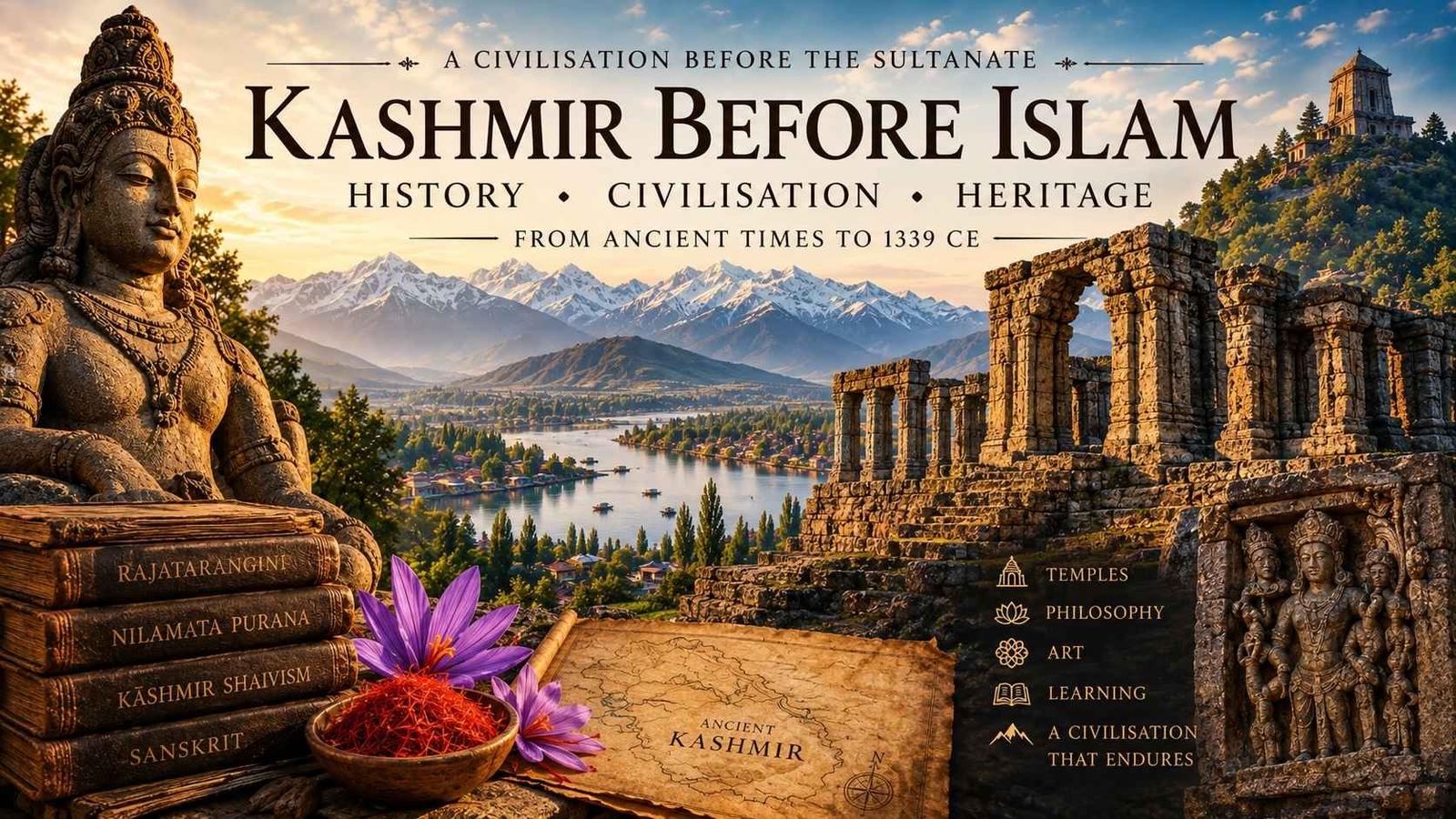
Long before the establishment of the Kashmir Sultanate in 1339 CE, the Kashmir Valley had already emerged as one of the Indian subcontinent’s most remarkable centres of civilisation, philosophy, learning and artistic achievement. Its story stretches back thousands of years, beginning with Neolithic communities that used pit dwellings and gradually evolving into a sophisticated society that produced celebrated philosophers, magnificent temples, influential Sanskrit literature and one of the world’s most influential non-dual philosophical traditions
Yet much of this ancient history remains overshadowed by discussions of later political events. As a result, many readers encounter only a fragmented understanding of Kashmir’s past. The region’s pre-Islamic heritage deserves to be studied on its own merits, not merely as a prelude to later developments.
Understanding Kashmir before Islam is therefore not about promoting any ideological narrative. It is about appreciating how geography, archaeology, literature, religion and statecraft combined over millennia to create a civilisation whose influence extended far beyond the Himalayan valley.
This article examines Kashmir before the arrival of Islam through the lens of archaeological discoveries, primary historical texts and modern scholarship. Wherever possible, it distinguishes between mythology, literary tradition and evidence supported by archaeology. Such an approach is essential for producing a balanced and historically responsible account.
Why the Study of Pre-Islamic Kashmir Matters
Few regions in South Asia possess such an extraordinary combination of natural beauty and intellectual history as Kashmir. For centuries, the valley acted as a bridge between the Indian plains, Central Asia and Tibet. Ideas travelled through its mountain passes alongside merchants, monks, scholars and pilgrims.
Before the fourteenth century, Kashmir had already become renowned for:
- advanced philosophical schools
- Sanskrit scholarship
- temple architecture
- Buddhist learning
- artistic excellence
- sophisticated systems of governance
- vibrant trade networks
The valley also nurtured some of India’s greatest thinkers, including Abhinavagupta, whose writings on philosophy, aesthetics and consciousness continue to influence scholars across the world.
Studying this period reveals that Kashmir’s identity was never static. Instead, it evolved through centuries of interaction between indigenous traditions, Vedic culture, Buddhism and later Shaiva philosophy.
Understanding the Sources of Ancient Kashmir
Writing the history of ancient Kashmir presents a unique challenge. Unlike modern history, which often relies upon official archives and contemporary records, the early history of Kashmir must be reconstructed from several different categories of evidence.
Each source has its strengths and limitations.
Archaeology
Archaeology provides the most objective evidence for Kashmir’s earliest inhabitants.
Excavations at Burzahom, Gufkral, Kanispora and several other sites have revealed settlements dating back to the Neolithic period. Stone tools, bone implements, pottery, human burials, domesticated animal remains and evidence of early agriculture have enabled archaeologists to reconstruct everyday life thousands of years before written history.
Unlike literary traditions, archaeological discoveries are based upon physical evidence that can be scientifically dated and compared.
For this reason, archaeology forms the foundation of our understanding of prehistoric Kashmir.
The Nilamata Purana
Among literary sources, the Nilamata Purana occupies a unique position.
Scholars generally place its composition between the sixth and eighth centuries CE, although it preserves considerably older traditions. Rather than functioning as a political chronicle, it explains Kashmir’s sacred geography, religious festivals, rivers, mountains, customs and cultural life. It also contains the famous tradition describing the draining of the mythical lake known as Satisar by the sage Kashyapa.
Modern historians do not treat the Nilamata Purana as a literal historical record. Instead, they regard it as an invaluable source for understanding how ancient Kashmiris viewed their land, religion and society.
Rajatarangini
If the Nilamata Purana preserves Kashmir’s sacred memory, Kalhana’s Rajatarangini preserves its political memory.
Completed around 1148 to 1150 CE, this remarkable Sanskrit work chronicles Kashmir’s rulers from legendary times to Kalhana’s own lifetime.
Unlike many medieval chroniclers, Kalhana frequently evaluated earlier traditions critically. He compared inscriptions, earlier chronicles, coins and monuments before compiling his narrative. Although the earliest sections contain legendary material, historians generally consider the later portions increasingly reliable. This critical approach has led many scholars to regard Kalhana as one of India’s earliest historians.
Foreign Travellers
Several foreign visitors provide independent glimpses of ancient Kashmir.
Among them, the Chinese Buddhist monk Xuanzang, who travelled through Kashmir during the seventh century, described flourishing monasteries, centres of learning and the coexistence of different religious traditions.
Greek, Persian and later Tibetan sources also contribute valuable information when compared carefully with archaeological evidence.
Coins, Inscriptions and Monuments
Coins help establish the chronology of rulers.
Temple inscriptions reveal religious patronage.
Ancient monuments demonstrate architectural development.
When literary sources are supported by inscriptions and archaeology, historians can reconstruct the past with greater confidence.
Modern historical research increasingly combines all these forms of evidence rather than relying upon a single source.
The Valley That Geography Created
Kashmir’s geography shaped its civilisation in profound ways.
Surrounded by the Pir Panjal Range to the southwest and the Greater Himalayas to the northeast, the Kashmir Valley forms a fertile basin measuring roughly 135 kilometres in length.
Its rivers, forests, lakes and mountain passes made it both naturally protected and strategically important.
The Jhelum River, known in ancient Sanskrit texts as Vitasta, became the valley’s lifeline. Fed by glaciers and numerous tributaries, it nourished agriculture, supported settlements and connected communities throughout the region.
The valley’s fertile alluvial soil enabled early farming, while surrounding mountains supplied timber, minerals and access to trans-Himalayan trade routes.
This unique geography encouraged cultural continuity over thousands of years.
One of Kashmir’s oldest traditions states that the valley was once covered by a vast lake known as Satisar.
According to the Nilamata Purana, a powerful demon named Jalodbhava lived within this lake. Sage Kashyapa is said to have drained the waters by cutting through the surrounding mountains, making the valley habitable for human settlement.
Although this account belongs to sacred tradition rather than empirical history, it contains a striking element that resonates with modern geology.
Geologists believe that the Kashmir Valley was indeed occupied by a large lake in prehistoric times. Over immense geological timescales, tectonic activity and river erosion gradually drained the basin, leaving behind the fertile valley seen today. The thick Karewa deposits found throughout Kashmir provide evidence of this ancient lacustrine environment.
This does not prove the legend. Rather, it illustrates how ancient communities sometimes preserved memories of dramatic environmental changes through mythological narratives.
The First People of Kashmir
The earliest chapter of Kashmir’s human history begins long before kingdoms, temples or written texts.
Archaeological excavations reveal that organised communities occupied the valley during the Neolithic period, roughly from the third millennium BCE.
Among these settlements, Burzahom remains the most significant.
Burzahom: Kashmir’s Earliest Known Settlement
Located on the outskirts of present-day Srinagar, Burzahom is one of South Asia’s most important prehistoric archaeological sites.
Excavations first undertaken during the twentieth century uncovered an extraordinary sequence of human occupation spanning the Neolithic and Megalithic periods.
The settlement immediately attracted international attention because its earliest inhabitants did something rarely seen elsewhere on the Indian subcontinent.
Instead of constructing houses on the ground, they dug deep circular and oval pits into the loess soil.
These underground dwellings provided insulation against Kashmir’s harsh winters and cool summers.
Access was probably gained through ladders made from timber.
The ingenuity of these early settlers demonstrates a sophisticated understanding of their environment.
Daily Life at Burzahom
Archaeological discoveries provide remarkable insights into everyday life.
The inhabitants cultivated crops, raised domesticated animals and supplemented their diet through hunting.
Stone axes, polished celts, bone needles, fishing implements, arrowheads and harvesting tools have all been recovered.
Animal bones indicate the presence of sheep, goats, cattle and dogs.
Wild deer and other animals also formed part of their diet.
One of the most fascinating discoveries is the extensive use of bone tools.
Needles, awls, spear points and harpoons demonstrate impressive craftsmanship that adapted local resources efficiently.
Unlike many prehistoric societies, Burzahom’s people displayed remarkable technological versatility by combining stone and bone industries.
Burial Customs Reveal Social Life
Perhaps the most intriguing discoveries concern burial practices.
Many individuals were buried beneath house floors or within residential compounds.
In several cases, dogs and other animals were buried alongside humans.
Some burials contained red ochre, suggesting ceremonial practices associated with death.
Archaeologists have also identified evidence of trepanation, a prehistoric surgical procedure involving carefully drilling or scraping openings into the human skull. Although the reasons remain debated, such discoveries indicate surprisingly advanced knowledge of human anatomy for the period.
These practices reveal that the people of Burzahom possessed complex beliefs regarding death, ancestry and community.
Gufkral and the Growth of Neolithic Kashmir
Another major Neolithic site lies at Gufkral in present-day Pulwama district.
Excavations here confirmed many cultural patterns first observed at Burzahom while also expanding scholars’ understanding of Kashmir’s prehistoric development.
Gufkral revealed both aceramic and ceramic phases of Neolithic occupation, allowing archaeologists to trace gradual technological and social changes across centuries. The site yielded evidence of pit dwellings, early farming, domesticated animals and evolving pottery traditions.
Together, Burzahom and Gufkral demonstrate that prehistoric Kashmir was neither isolated nor primitive. Instead, it nurtured stable agricultural communities that adapted successfully to their mountain environment long before the emergence of organised kingdoms.
A Civilisation Begins to Take Shape
By the close of the Neolithic period, Kashmir had already undergone a remarkable transformation.
Small groups of hunter-gatherers had evolved into settled farming communities.
Agriculture had become established.
Animal domestication supported stable livelihoods.
Permanent settlements encouraged social organisation.
Religious beliefs were beginning to assume organised forms.
These developments laid the foundations for everything that followed.
Long before Kashmir became celebrated for its temples, philosophers and poets, its earliest inhabitants had already demonstrated resilience, innovation and a deep understanding of the valley they called home.
In the next part, we move from prehistoric settlements to the emergence of the earliest kingdoms, the Mauryan influence, the spread of Buddhism and the political evolution that transformed Kashmir into one of the great civilisations of ancient India.
From the Mauryas to the Golden Age of the Karkotas
The Dawn of Recorded Political History
By the end of the Neolithic and Megalithic periods, Kashmir had already developed into a stable agricultural society. Permanent settlements, growing trade and organised communities created the conditions necessary for the emergence of kingdoms.
Unlike prehistoric Kashmir, this phase is illuminated by literary works, archaeology, coins and foreign accounts. Nevertheless, historians approach these sources with caution. While the Rajatarangini preserves an invaluable dynastic tradition, its earliest chapters combine history with legend. Consequently, modern scholarship regards the political history of Kashmir before the Mauryan period as only partially recoverable.
The Gonanda Tradition: History or Legend?
Kalhana begins the Rajatarangini with King Gonanda I, whom he connects with the Mahabharata tradition through Jarasandha of Magadha and Krishna.
These accounts are culturally significant because they demonstrate how twelfth-century Kashmiris understood their own antiquity. However, they cannot presently be verified through archaeology or contemporary inscriptions.
For this reason, most historians regard the earliest Gonanda rulers as belonging to Kashmir’s legendary historical tradition rather than established political history. The historical reliability of the Rajatarangini increases considerably from the early medieval period onwards, when Kalhana had access to inscriptions, earlier chronicles and administrative records.
Kashmir under the Mauryan Empire
The first ruler whose association with Kashmir enjoys broad scholarly acceptance is Emperor Ashoka Maurya.
During the third century BCE, Ashoka extended Mauryan influence into Kashmir, integrating the valley into one of the largest empires in ancient India.
Kalhana attributes the establishment or expansion of Srinagari, an ancient settlement distinct from modern Srinagar, to Ashoka. Although the exact location remains debated, archaeological evidence confirms increasing urbanisation and Buddhist activity during this period.
The Mauryan administration brought more than political control.
It connected Kashmir with the wider imperial network stretching from Afghanistan to eastern India. Roads improved communication, while state patronage encouraged religious and commercial exchanges.
Did Ashoka Introduce Buddhism to Kashmir?
Popular accounts often state that Ashoka introduced Buddhism into Kashmir.
The evidence, however, is more nuanced.
Buddhist traditions, including the Mahavamsa, associate Ashoka with the dispatch of the monk Majjhantika (Madhyantika) to Kashmir and Gandhara. Later literary traditions credit Ashoka with constructing stupas and supporting monasteries across the valley.
Some scholars argue that Buddhist ideas may already have reached Kashmir before Ashoka through trade routes linking north-western India and Central Asia. Ashoka’s importance therefore lies less in introducing Buddhism than in providing royal patronage that enabled it to flourish.
This distinction is important because it reflects the current historical consensus rather than repeating an oversimplified tradition.
Kashmir Becomes a Centre of Buddhist Learning
Following Mauryan patronage, Buddhism spread rapidly throughout Kashmir.
Monasteries emerged as centres of learning where monks studied philosophy, logic, medicine and Sanskrit.
The valley’s location between India, Central Asia and China transformed it into an intellectual crossroads. Buddhist scholars travelling to and from Central Asia frequently passed through Kashmir, carrying manuscripts, artistic styles and philosophical ideas.
Over the following centuries, Kashmiri monks would play a decisive role in transmitting Buddhist literature into Tibet and China.
The Kushan Age: Kashmir Enters an International World
The political landscape changed dramatically during the first and second centuries CE with the rise of the Kushan Empire.
Founded by the Yuezhi people of Central Asia, the Kushans established one of the ancient world’s greatest commercial empires.
Under rulers such as Kanishka I, Kashmir became integrated into a vast network extending from Central Asia to northern India.
This transformation profoundly influenced the valley’s economy, religion and culture.
Kanishka and the Fourth Buddhist Council
Among Kushan rulers, Kanishka occupies a special place in Kashmiri history.
According to Buddhist literary traditions, he convened the Fourth Buddhist Council in Kashmir, often associated with Kundalvana near present-day Harwan, although scholars continue to debate the precise location and some details of the event.
The council sought to preserve and systematise Buddhist teachings.
Scholars compiled extensive commentaries that later influenced Buddhist philosophy across Central Asia and East Asia.
Whether every traditional detail can be verified remains uncertain. Nevertheless, there is little doubt that Kashmir became one of the foremost centres of Buddhist scholarship during the Kushan age.
The Kushan period transformed Kashmir into a vibrant commercial hub.
Merchants carried:
- silk from China
- precious stones
- wool
- saffron
- horses
- spices
- handcrafted goods
Trade routes crossing the Pir Panjal and Karakoram connected the valley with Gandhara, Bactria, Tibet and the Gangetic plains.
Commercial prosperity encouraged urban growth while exposing Kashmir to diverse artistic traditions.
Elements of Gandharan sculpture, Hellenistic artistic influence and indigenous craftsmanship merged to create distinctive forms of architecture and religious art.
Religion During the Kushan Period
One of the most remarkable characteristics of ancient Kashmir was its religious pluralism.
Buddhism flourished under royal patronage.
At the same time:
- Shaiva traditions continued to grow.
- Naga worship remained influential.
- Early Vaishnava practices survived.
- Local folk traditions persisted.
Rather than replacing one another, these traditions often coexisted and interacted.
This religious diversity became one of Kashmir’s defining characteristics for many centuries.
The Huna Invasions
The fifth and sixth centuries witnessed major political upheavals across northern India.
The Huna invasions affected Kashmir as they did many neighbouring regions.
Among the Huna rulers, Mihirakula is remembered in literary traditions as a powerful yet controversial monarch. While Buddhist texts portray him as a persecutor of Buddhism, modern historians caution that these accounts may reflect sectarian perspectives and should be interpreted critically.
Despite the instability created by this period, Kashmir retained its strategic importance.
Political authority gradually shifted towards indigenous ruling houses.
The Rise of the Karkota Dynasty
During the seventh century CE, Kashmir entered one of the most brilliant periods in its history.
The Karkota dynasty, founded by Durlabhavardhana, transformed the valley from a regional kingdom into a major power of early medieval Asia. Although Kalhana traces the dynasty to the mythical Karkota Naga, historians generally interpret this genealogy as a symbolic claim to legitimacy rather than literal ancestry.
The Karkotas strengthened the administration, consolidated royal authority and encouraged both economic prosperity and cultural development.
Their reign marked the beginning of Kashmir’s classical age.
Lalitaditya Muktapida: Kashmir’s Greatest Monarch?
Among all the rulers of ancient Kashmir, none commands greater admiration than Lalitaditya Muktapida, who ruled during the eighth century CE.
Kalhana describes him as an ambitious conqueror whose campaigns extended across northern India and into parts of Central Asia. Modern historians accept that Lalitaditya was undoubtedly a powerful ruler, although some of the extraordinary conquests recorded in the Rajatarangini are viewed with caution because they cannot always be corroborated independently.
Even after allowing for literary embellishment, his achievements remain remarkable.
Under Lalitaditya:
- Kashmir reached the height of its political influence.
- International trade expanded.
- Monumental architecture flourished.
- Literature and philosophy received royal patronage.
- Diplomatic relations widened across Asia.
His reign represents the political and cultural zenith of pre-Islamic Kashmir.
The Martand Sun Temple
No monument symbolises ancient Kashmir’s architectural achievement more powerfully than the Martand Sun Temple.
Constructed during Lalitaditya’s reign, the temple combined indigenous Kashmiri building traditions with Gandharan, Gupta and classical influences.
Built from finely dressed limestone and overlooking the Kashmir Valley, it reflected both engineering skill and artistic sophistication.
Although now in ruins, the Martand complex remains one of the finest surviving examples of early medieval temple architecture in the Indian subcontinent.
Its grandeur testifies to the wealth, confidence and artistic vision of the Karkota age.
Religion, Philosophy and the Spiritual Landscape of Ancient Kashmir
When modern readers think about religion in ancient Kashmir, they often imagine a succession of faiths replacing one another. The historical evidence suggests a far more complex reality.
Before the arrival of Islam in the fourteenth century, Kashmir was home to several religious traditions that evolved over many centuries. Indigenous cults, Vedic practices, Buddhism, Shaivism, Vaishnavism, Shaktism and Tantric traditions coexisted, interacted and frequently influenced one another. Rather than existing in isolation, they formed a dynamic religious landscape that reflected the valley’s position as a crossroads between the Indian subcontinent, Central Asia and Tibet.
This religious diversity was not a sign of conflict but of cultural vitality. Philosophical debate, temple patronage, monastic learning and ritual innovation flourished side by side, making Kashmir one of the foremost intellectual centres of early medieval Asia.
The Earliest Religious Tradition: Naga Worship
Long before organised Hinduism or Buddhism became established in Kashmir, the valley’s earliest inhabitants revered nature.
Among the most enduring expressions of this indigenous spirituality was the worship of the Nagas, supernatural serpent beings associated with springs, lakes, rivers and fertility. In ancient Indian tradition, Nagas were not merely snakes but powerful guardians of water sources and the natural world.
The Nilamata Purana records numerous sacred springs and lakes dedicated to different Nagas, including Nila Naga, who is presented as the divine protector of Kashmir. According to the text, the valley itself came under his guardianship after Sage Kashyapa made it habitable.
Many of these sacred springs remain places of worship today, illustrating the remarkable continuity of Kashmir’s sacred geography.
Modern historians generally interpret Naga worship as reflecting an indigenous religious tradition that predated the spread of Vedic culture. Rather than disappearing, these beliefs were gradually incorporated into later Hindu practices, where Nagas became integrated into the broader religious framework.
The Arrival of Vedic Traditions
By the first millennium BCE, Kashmir had become increasingly connected with the wider cultural world of northern India.
Vedic religious traditions entered the valley gradually rather than through a single event. Rituals centred on fire sacrifices, reverence for the Vedic deities and the authority of Brahmanical learning became established alongside existing local beliefs.
The Nilamata Purana provides valuable evidence for this synthesis. It describes festivals dedicated to Shiva, Vishnu, Surya and various local deities while simultaneously preserving ancient Naga traditions. This blending of indigenous and Vedic elements became one of the defining characteristics of Kashmiri religious life.
Unlike regions where older traditions were displaced, Kashmir largely absorbed them into an expanding religious framework.
The Rise of Buddhism
The spread of Buddhism transformed Kashmir into one of Asia’s leading centres of learning.
Although Buddhist ideas may have reached the valley before the Mauryan period, it was under Emperor Ashoka’s patronage that Buddhism gained institutional support. During the Kushan era, particularly under Kanishka, Kashmir emerged as an important centre for Buddhist scholarship.
Monasteries served not only as religious institutions but also as universities where monks studied philosophy, medicine, grammar, logic and Sanskrit literature.
Xuanzang, who visited Kashmir in the seventh century, described numerous monasteries housing thousands of monks. His account suggests that Buddhism remained intellectually vibrant even as Hindu traditions continued to flourish.
Kashmiri Buddhist scholars later played a crucial role in transmitting Buddhist philosophy to Tibet and China. Sanskrit texts composed or preserved in Kashmir became foundational works for Tibetan Buddhism, and many survive today only through Tibetan translations.
Society, Learning, Economy and the Cultural Flourishing of Ancient Kashmir
By the tenth century CE, Kashmir had become far more than a Himalayan kingdom. It was a thriving centre of scholarship, commerce and artistic innovation. Its philosophers influenced intellectual traditions across India, its merchants traded with Central Asia, and its architects created monuments that remain among the finest examples of early medieval Indian architecture.
A Society Built on Learning
Perhaps no feature distinguished ancient Kashmir more than its reverence for knowledge.
While many kingdoms measured their greatness through military conquest, Kashmir earned an enduring reputation for intellectual excellence. Sanskrit scholars, philosophers, poets, grammarians, physicians and theologians transformed the valley into one of the foremost centres of learning in South Asia.
Kalhana frequently refers to learned Brahmins, scholars and court intellectuals whose influence extended beyond religious life into administration, diplomacy and education. The accounts of the Chinese monk Xuanzang similarly describe Kashmir as a place where rigorous philosophical debate and scholarly inquiry flourished.
Education was not confined to royal courts. Temples, monasteries and agraharas (settlements endowed to learned Brahmins) functioned as centres of higher learning, where students devoted years to mastering sacred texts, philosophy, grammar, logic, astronomy and medicine.
Knowledge was regarded not merely as a means of social advancement but as a path to spiritual refinement.
Sanskrit: The Language of Intellectual Life
Ancient Kashmir occupies a unique place in the history of Sanskrit literature.
While Sanskrit flourished across much of the Indian subcontinent, Kashmir produced an exceptional concentration of scholars whose works profoundly influenced Indian philosophy, literary criticism and aesthetics.
Among them were:
- Kalhana, author of the Rajatarangini
- Abhinavagupta, philosopher and aesthetician
- Utpaladeva, founder of the Pratyabhijna school
- Kshemaraja, commentator on Shaiva philosophy
- Bilhaṇa, celebrated poet who later served the Western Chalukya court
- Mammaṭa, whose Kāvyaprakāśa became one of India’s most influential works on poetics
Their writings demonstrate that Kashmir was not simply preserving Sanskrit traditions. It was actively shaping them.
Unlike later universities with formal campuses, education in ancient Kashmir developed through interconnected networks of temples, monasteries and scholarly households.
Students often travelled considerable distances to study under renowned teachers.
Instruction included:
- Philosophy
- Grammar
- Logic (Nyāya)
- Mimamsa
- Vedanta
- Kashmir Shaivism
- Buddhist philosophy
- Mathematics
- Astronomy
- Medicine
- Literature
- Poetics
The intellectual climate encouraged debate rather than unquestioning acceptance. Competing philosophical schools challenged one another through formal discussions, commentaries and public disputations.
This tradition of rigorous argument contributed significantly to the sophistication of Kashmiri scholarship.
The Influence of Abhinavagupta Beyond Kashmir
Among Kashmir’s greatest intellectual contributions was the work of Abhinavagupta.
Although remembered primarily as a philosopher of Kashmir Shaivism, his influence extends well beyond religious thought.
His commentary on Bharata’s Nāṭyaśāstra, known as the Abhinavabhāratī, transformed Indian aesthetics.
Abhinavagupta argued that great art allows audiences to experience universal emotions in a purified form. This concept, known as rasa, remains central to the study of Indian literature, theatre, dance and aesthetics.
Modern scholars continue to regard him as one of the greatest philosophers produced by medieval India.
Social Structure in Ancient Kashmir
Kashmiri society reflected many features found elsewhere in early medieval India while also displaying distinctive regional characteristics.
The social order included:
- Royal families
- Nobility
- Brahmins
- Merchants
- Farmers
- Artisans
- Soldiers
- Monastic communities
However, literary sources indicate that learning often commanded greater respect than wealth alone.
Scholars enjoyed royal patronage.
Poets were welcomed at court.
Religious teachers frequently advised kings on matters extending beyond theology.
This close relationship between political authority and intellectual life became one of Kashmir’s defining characteristics.
The Position of Women
Evidence concerning women in ancient Kashmir presents a nuanced picture.
Literary works, inscriptions and royal chronicles indicate that women participated in religious life, owned property in certain circumstances and occasionally exercised political authority.
Queens sometimes acted as regents during periods of dynastic transition.
One of the most remarkable examples is Queen Didda, who ruled during the tenth century. Despite contemporary criticism from some chroniclers, modern historians recognise her as one of medieval India’s most capable rulers.
Women also appear in Sanskrit literature as patrons, poets and participants in religious rituals.
Nevertheless, society remained predominantly patriarchal, and opportunities varied considerably according to social status.
Agriculture: The Foundation of Prosperity
The fertile Kashmir Valley sustained one of the most productive agricultural economies in the Himalayan region.
The Jhelum River and an extensive network of streams irrigated fields that produced:
- Rice
- Wheat
- Barley
- Millet
- Pulses
- Mustard
Fruit cultivation also flourished.
Apples, walnuts, apricots, almonds and grapes became associated with the valley’s rich agricultural landscape.
Among all agricultural products, none acquired greater fame than Kashmiri saffron.
Cultivated primarily in the Pampore region, saffron became one of Kashmir’s most valuable exports and remains internationally renowned today.
Kashmir’s geographical position transformed it into a vital commercial crossroads.
Mountain passes connected the valley with:
- Gandhara
- Punjab
- Ladakh
- Tibet
- Central Asia
- The Tarim Basin
Merchants transported:
- Saffron
- Wool
- Shawls
- Timber
- Medicinal herbs
- Precious stones
- Horses
- Metal goods
In return, they imported luxury products, textiles, manuscripts and artistic influences from distant regions.
Trade enriched the royal treasury while exposing Kashmir to diverse cultural traditions.
Crafts and Industry
Ancient Kashmir developed a reputation for highly skilled craftsmanship.
Its artisans excelled in:
- Wood carving
- Bronze casting
- Stone sculpture
- Metalwork
- Jewellery
- Pottery
The region’s abundant forests supplied excellent timber, encouraging sophisticated wooden architecture alongside monumental stone construction.
Many techniques developed during this period continued to influence Kashmiri craftsmanship for centuries.
Architecture: A Distinctive Kashmiri Style
The architecture of ancient Kashmir differs noticeably from that of the Gangetic plains.
Local builders adapted their designs to the valley’s climate, available materials and seismic conditions.
Characteristic features include:
- High plinths
- Massive limestone blocks
- Steeply pitched roofs in timber structures
- Trefoil arches
- Classical proportions
- Influences from Gandhara and Gupta architecture
This unique synthesis produced one of the most recognisable architectural traditions in early medieval India.
The Great Temples of Ancient Kashmir
Built during the reign of Lalitaditya Muktapida, the Martand Sun Temple remains the finest surviving example of Kashmiri temple architecture.
Its grand collonaded courtyard, monumental entrance and commanding location overlooking the valley reflected both religious devotion and royal ambition.
Although partially destroyed centuries later, its ruins continue to testify to the extraordinary architectural achievement of the Karkota period.
Avantipur Temples
King Avantivarman founded the temples at Avantipur during the ninth century.
Dedicated to Vishnu and Shiva, these monuments display the mature evolution of the Kashmiri architectural style.
Intricate stone carvings, elegant proportions and carefully planned layouts demonstrate the high level of technical skill achieved by Kashmiri architects.
Pandrethan Temple
The small but beautifully preserved temple at Pandrethan illustrates how Kashmiri architects balanced simplicity with refinement.
Its pyramidal roof and carefully dressed stone construction reveal an architectural tradition uniquely adapted to the valley’s environment.
Shankaracharya Temple
Standing atop the Gopadri Hill overlooking Srinagar, the Shankaracharya Temple occupies one of Kashmir’s most significant sacred sites.
Although later modifications complicate precise dating, archaeological evidence suggests that the site has served as a place of worship since antiquity.
Its commanding position symbolises the intimate relationship between Kashmir’s sacred geography and religious life.
Art and Sculpture
Religion inspired much of Kashmir’s artistic production.
Temple walls displayed finely carved deities.
Bronze sculptures reflected remarkable technical sophistication.
Stone reliefs combined indigenous artistic traditions with influences from Gandhara and the Gupta Empire.
Unlike many regions, Kashmir also became known for beautifully illustrated manuscripts, demonstrating the close relationship between literature and visual art.
Governance and Administration
Ancient Kashmir possessed a well-developed administrative structure.
The king stood at the apex of political authority, assisted by ministers, military commanders and revenue officials.
Land revenue formed the principal source of royal income.
Local officials supervised agriculture, taxation and public works.
Although succession disputes occasionally destabilised the kingdom, the administrative framework proved remarkably resilient across successive dynasties.
Kalhana’s detailed descriptions of court politics provide valuable insights into both the strengths and weaknesses of medieval Kashmiri governance.
Everyday Life
For most inhabitants, daily life revolved around agriculture, trade and religious observance.
Villages formed the backbone of society.
Families cultivated fields, tended livestock and participated in seasonal festivals.
Markets connected rural producers with urban centres.
Temples and monasteries served not only religious functions but also acted as centres of education, charity and community life.
The rhythm of life followed the agricultural calendar, while festivals recorded in the Nilamata Purana reinforced a shared cultural identity rooted in the valley’s natural landscape.
By the beginning of the eleventh century, Kashmir had achieved an extraordinary synthesis of intellectual brilliance, economic prosperity and artistic accomplishment.
Its scholars shaped Indian philosophy.
Its architects created enduring monuments.
Its merchants connected South Asia with Central Asia.
Its farmers sustained a flourishing economy.
Its rulers patronised literature, religion and the arts.
Few regions of the medieval Indian subcontinent could match the breadth of Kashmir’s cultural achievements.
Yet beneath this prosperity, political instability had begun to emerge. Dynastic rivalries, court intrigues and external pressures gradually weakened the kingdom. These developments would shape the final chapter of pre-Islamic Kashmir.
The Decline of Ancient Kashmir, the Rise of the Shah Mir Sultanate and the Enduring Legacy of a Civilisation
This concluding section examines one of the most significant transitions in Kashmir’s history. Wherever possible, it distinguishes between contemporary evidence, later literary traditions and modern historical interpretation. The political transition from the Lohara dynasty to the Shah Mir Sultanate was complex and cannot be explained through a single event or individual.
The Twilight of Kashmir’s Classical Age
By the beginning of the eleventh century, Kashmir stood among the most accomplished kingdoms of the Indian subcontinent. Its philosophers had transformed Indian metaphysics, its temples adorned the valley, and its scholars enjoyed international renown.
Yet beneath this cultural brilliance lay growing political instability.
The decline of pre-Islamic Kashmir was not sudden. It unfolded gradually over more than two centuries through dynastic disputes, court intrigues, economic pressures and weakening royal authority.
History repeatedly demonstrates that even the most prosperous civilisations become vulnerable when political institutions begin to fracture.
Kashmir proved no exception.
The Lohara Dynasty
The Lohara dynasty, which ruled from approximately 1003 CE until 1339 CE, inherited one of South Asia’s richest cultural traditions.
Its early rulers maintained much of the administrative system established by their predecessors.
Temples continued to receive patronage.
Agriculture remained productive.
Trade with neighbouring regions persisted.
Scholars continued producing important works in philosophy and literature.
However, Kalhana’s Rajatarangini, later continued by Jonaraja, increasingly describes court rivalries, factional politics and frequent struggles for succession.
Royal authority became less stable as influential ministers, military commanders and regional elites competed for power.
Queen Didda: The Last Great Monarch Before Decline
Among the Lohara rulers, Queen Didda (r. 958–1003 CE) occupies a unique position.
Initially serving as regent for her son and later for her grandsons, she gradually consolidated authority and eventually ruled in her own right.
Kalhana portrays her as politically astute, ambitious and at times ruthless.
Modern historians often view her more favourably than many earlier chroniclers, recognising that she preserved political stability during a turbulent period.
Despite governing within a predominantly patriarchal society, Didda demonstrated exceptional administrative ability.
Her reign represents the final phase of strong central authority before the prolonged decline of the kingdom.
Political Fragmentation
Following Didda’s death, Kashmir experienced increasing political instability.
Several factors contributed to the weakening of the kingdom:
Frequent Successions
Short reigns prevented long-term administrative reforms.
Court Intrigue
Powerful ministers often exercised influence equal to or greater than the king.
Regional Ambitions
Provincial elites increasingly asserted autonomy.
Economic Strain
Repeated conflicts disrupted revenue collection and public administration.
None of these developments alone caused the kingdom’s decline.
Together, however, they steadily eroded the strength of the state.
A Flourishing Culture Amid Political Instability
One of the remarkable features of medieval Kashmir is that cultural achievement continued despite political decline.
Temples remained active.
Scholars continued writing.
Religious debates flourished.
Pilgrimages persisted.
This contrast reminds us that political weakness does not necessarily imply cultural stagnation.
Indeed, many of Kashmir’s greatest philosophical works belong to this later period.
Kashmir had never been isolated.
Its mountain passes connected it with:
- Central Asia
- Tibet
- Punjab
- Gandhara
Merchants, monks, diplomats and migrants had crossed these routes for centuries.
From the thirteenth century onwards, increasing political changes across Central and West Asia influenced Kashmir more directly.
Refugees, traders and adventurers entered the valley in growing numbers.
Among them was Shah Mir, whose future would become inseparable from Kashmir’s political transformation.
Rinchana and a Kingdom in Crisis
One of the most debated episodes in Kashmiri history concerns Rinchana, a prince from Ladakh (or, according to some traditions, from the region of Baltistan).
After entering Kashmir during a period of political turmoil, Rinchana emerged as a significant military and political figure.
Following the death of the ruler Suhadeva and the disruption caused by the invasion of the Turkic commander Dulacha around 1320 CE, Rinchana gained control of Srinagar.
He subsequently married Kota Rani, one of the most remarkable women in Kashmiri history.
Rinchana’s conversion has generated considerable historical discussion.
According to Jonaraja and later chroniclers, Rinchana initially sought acceptance into the Brahmanical fold but was reportedly denied initiation by certain religious authorities. He subsequently accepted Islam under the guidance of the Sufi missionary Bulbul Shah, taking the name Sultan Sadr-ud-Din.
Modern historians advise caution in interpreting this episode. While the conversion itself is widely accepted, the precise motivations remain uncertain. Political considerations, personal conviction, social circumstances and contemporary religious dynamics may all have influenced his decision.
Reducing this complex event to a single explanation oversimplifies the historical evidence.
Kota Rani: The Last Hindu Ruler of Kashmir
Few figures command greater admiration in Kashmiri history than Kota Rani.
Following Rinchana’s death and the subsequent reign of Udayanadeva, she effectively became the kingdom’s leading political figure.
Contemporary and later chronicles describe her as intelligent, determined and administratively capable.
She attempted to preserve Kashmir’s independence during a period of extraordinary political instability.
Among the public works associated with her is the Kutte Kol, a canal traditionally credited with improving flood management around Srinagar.
Whether every detail recorded in later chronicles is historically verifiable remains debated, but there is little doubt that Kota Rani played a central role in Kashmir’s final years as a Hindu kingdom.
Shah Mir, believed to have arrived in Kashmir several decades earlier, gradually acquired influence within the royal court.
Initially serving successive rulers, he carefully expanded his political alliances.
Following the death of Udayanadeva and the weakening of royal authority, Shah Mir emerged as the dominant political figure.
In 1339 CE, he assumed power and established what became known as the Shah Mir Sultanate.
This marked the end of more than two millennia of Hindu and Buddhist dynastic rule in Kashmir.
It also inaugurated a new political era that would profoundly reshape the valley’s history.
Did the Transition Happen Overnight?
Historical evidence clearly indicates that it did not.
Political change occurred gradually.
Religious change unfolded over centuries.
Many Hindu communities remained influential long after 1339.
Buddhist traditions had already declined considerably before the establishment of the Sultanate.
Likewise, Islam had been present in Kashmir through merchants, travellers and Sufi saints before Shah Mir assumed power.
The establishment of Muslim political rule therefore should not be confused with the immediate Islamisation of Kashmiri society.
These were distinct historical processes.
Myths and Historical Reality
Ancient Kashmir has accumulated numerous legends over the centuries.
Separating mythology from historical evidence strengthens rather than weakens appreciation of its civilisation.
| Tradition | Historical Assessment |
| Kashmir was created when Sage Kashyapa drained Satisar | Sacred tradition that may preserve cultural memory of geological change, but not a literal historical event. |
| Gonanda fought in the Mahabharata | Literary tradition recorded in the Rajatarangini, not independently verified. |
| Ashoka founded Srinagar | Widely reported in literary sources; the exact location and extent of the city remain debated. |
| Lalitaditya conquered most of Asia | He was unquestionably a powerful ruler, but some campaigns described by Kalhana are likely literary exaggerations. |
| Kashmir became Islamic immediately after 1339 | Incorrect. Religious and social transformation occurred gradually over several centuries. |
Recognising these distinctions reflects responsible historical practice rather than diminishing Kashmir’s rich heritage.
The Legacy of Pre-Islamic Kashmir
The civilisation that flourished in Kashmir before Islam left an enduring legacy.
Its contributions include:
Philosophy
Kashmir Shaivism remains one of the most sophisticated schools of non-dual philosophy ever developed.
Literature
The Rajatarangini is unique among medieval Indian texts for its historical method and critical engagement with sources.
Aesthetics
Abhinavagupta’s theory of rasa continues to influence literary criticism, theatre and the performing arts.
Architecture
The Martand Sun Temple and the temples of Avantipur stand among the masterpieces of early medieval Indian architecture.
Buddhism
Kashmiri monks and scholars helped transmit Buddhist philosophy to Tibet and East Asia.
Sanskrit Scholarship
Generations of grammarians, poets and philosophers shaped intellectual traditions across the Indian subcontinent.
Timeline of Kashmir Before Islam
| Date | Event |
| c. 3000–2000 BCE | Neolithic settlements at Burzahom and Gufkral |
| c. 1st millennium BCE | Gradual integration of Vedic traditions |
| c. 3rd century BCE | Mauryan rule under Ashoka |
| c. 1st–2nd century CE | Kushan Empire and Kanishka |
| c. 7th century CE | Xuanzang visits Kashmir |
| c. 625 CE | Rise of the Karkota dynasty |
| c. 724–760 CE | Reign of Lalitaditya Muktapida |
| c. 855 CE | Utpala dynasty established |
| c. 950–1003 CE | Reign of Queen Didda |
| 1003 CE | Beginning of the Lohara dynasty |
| c. 1148 CE | Kalhana completes the Rajatarangini |
| c. 1320 CE | Rinchana assumes power |
| 1339 CE | Shah Mir establishes the Sultanate |
Frequently Asked Questions
Was Kashmir entirely Hindu before Islam?
No. Before Islam, Kashmir was home to several religious traditions, including indigenous Naga worship, Buddhism, Shaivism, Vaishnavism, Shaktism and Tantric schools. Buddhism flourished for centuries before gradually declining, while Shaivism became the dominant philosophical tradition in the later pre-Islamic period.
What is the oldest evidence of civilisation in Kashmir?
The earliest confirmed evidence comes from the Neolithic settlements of Burzahom and Gufkral, where archaeologists discovered pit dwellings, polished stone tools, pottery, domesticated animals and evidence of early agriculture dating back several millennia BCE.
Why is the Rajatarangini so important?
Written by Kalhana in the twelfth century, the Rajatarangini is one of the earliest historical chronicles in South Asia. Although its opening chapters contain legendary material, its later sections are valued for their careful use of earlier records, inscriptions and oral traditions.
Why is Kashmir Shaivism significant?
Kashmir Shaivism developed one of the world’s most sophisticated philosophies of non-dualism. Thinkers such as Abhinavagupta and Utpaladeva explored consciousness, aesthetics and spirituality in ways that continue to influence philosophy, literature and religious studies.
Did Islam arrive only with Shah Mir?
No. Muslim merchants, travellers and Sufi missionaries reached Kashmir before Shah Mir established the Sultanate in 1339. His accession marked the beginning of Muslim political rule, but the broader religious transformation of Kashmiri society occurred gradually over succeeding centuries.
Conclusion
The history of Kashmir before Islam is neither a tale of uninterrupted political triumph nor one of inevitable decline. It is the story of a civilisation that transformed a mountain valley into one of Asia’s foremost centres of learning, philosophy and artistic achievement.
From the Neolithic communities of Burzahom to the philosophical brilliance of Abhinavagupta, from the sacred geography of the Nilamata Purana to the historical vision of Kalhana, ancient Kashmir cultivated traditions whose influence extended far beyond the Himalayas.
Its rulers built temples that still inspire awe. Its scholars produced works that remain central to the study of Indian philosophy and aesthetics. Its monks carried knowledge across the Silk Route, while its poets and historians enriched the intellectual heritage of the subcontinent.
Understanding this civilisation requires neither romanticisation nor dismissal. It demands a careful engagement with archaeology, literature, inscriptions and critical scholarship. When approached in this manner, pre-Islamic Kashmir emerges not as a forgotten chapter of history, but as one of the most remarkable civilisations of the medieval world.
The legacy of ancient Kashmir endures, inviting scholars and readers alike to appreciate the depth, diversity, and intellectual richness of a civilisation that helped shape the cultural history of South Asia.

Rohit Tikoo is a published author, researcher, and content strategist with over two decades of writing experience. He is the author of nine books covering Kashmir, Indian philosophy, social issues, and contemporary thought, including Shadows Over the Valley: Operation TUPAC, Cold War Geopolitics, and the Kashmiri Pandits Exodus (2025).
His work focuses on Kashmir’s history, literature, culture, and the lived experiences of the Kashmiri Pandit community. Through extensive research, archival references, and historical analysis, he seeks to document and preserve narratives that are often overlooked in mainstream discourse. His writing on Kashmir has appeared in DAILY EXCELSIOR, HEADLINES TODAY, ONLY KASHMIR, GREATER KASHMIR, NAAD,
VITASTA, CHATTAN, AND VOICE OF SILENCE.
Through rohittikoo.com, he publishes research-based articles, essays, and commentary aimed at fostering informed discussion on Kashmir, Indian civilisation, literature, and contemporary society.