
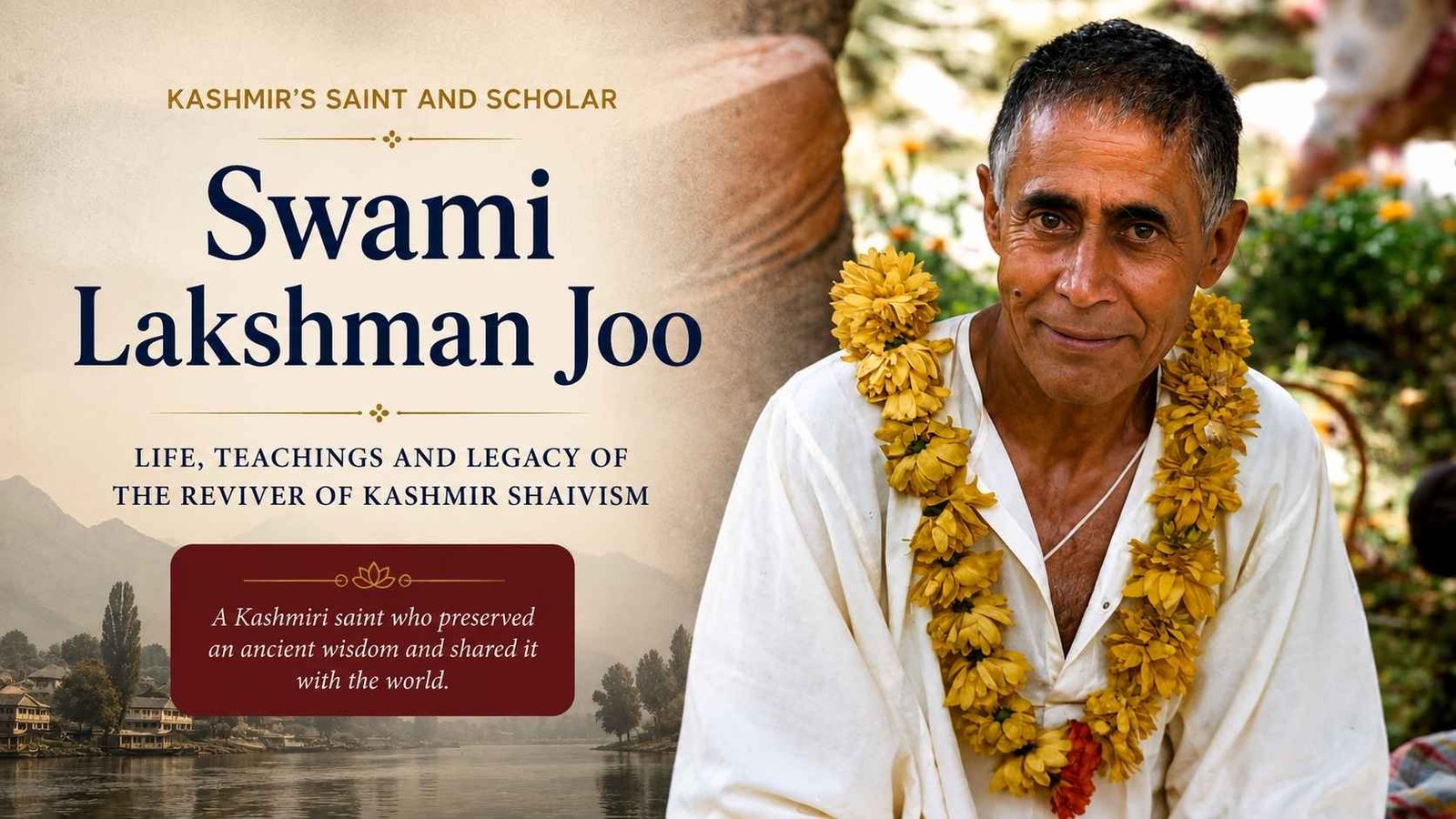
Swami Lakshman Joo (9 May 1907 to 27 September 1991) was a Kashmiri Hindu saint and scholar widely regarded as the last great master of the oral tradition of Kashmir Shaivism, the nondual Tantric philosophy that reached its classical expression in the valley between roughly the ninth and thirteenth centuries CE. Living quietly at his Ishwar Ashram above Srinagar’s Dal Lake, he preserved, practised and taught this tradition through most of the twentieth century, training the disciples, among them John Hughes, Alexis Sanderson and Lilian Silburn, who carried Kashmir Shaivism to readers and students across India, Europe and North America. He is remembered today as the principal figure behind the modern revival of Kashmir Shaivism, and as one of the last teachers to have received it as a living, unbroken lineage rather than encountered it solely as a subject of academic study.
He is known by several closely related names: Swami Lakshman Joo, Swami Lakshmanjoo, and, before he took formal vows, Lakshman Raina. All refer to the same person, and readers researching him will find the spelling varies slightly from source to source.
Swami Lakshman Joo: Early Life and Spiritual Awakening in Srinagar
Swami Lakshman Joo was born Lakshman Raina on 9 May 1907 in the Fateh Kadal quarter of Srinagar, into a Kashmiri Pandit Brahmin family. His father, Narayan Dass Raina, was a businessman credited by the Ishwar Ashram Trust with introducing houseboats to the Kashmir valley. His mother was Aranyamali Raina. He was the fifth of nine children.
His elder brother, Maheshvaranath, first drew him towards spiritual practice at around age 5. From that age until about seven or eight, the family’s priest, Swami Ram Joo, guided the boy’s early religious education. When Ram Joo died, another teacher, Swami Mahtab Kak, became his principal guru, formally initiating him in his mid-teens.
At nineteen, Lakshman Joo underwent an experience he later described as self-realisation. He took a lifelong vow of celibacy soon afterwards and, according to his own account as recorded by his disciples, refused an arranged marriage his family proposed, saying he was already committed to God. From around 1926 to the early 1930s, he studied Sanskrit and the classical texts of Kashmir Shaivism, including Abhinavagupta’s Tantraloka and the Ishvara-pratyabhijna literature, under the scholar Pandit Maheshwar Nath Razdan in Srinagar.
What Is Kashmir Shaivism, and What Was Lakshman Joo’s Role in Reviving It?
Kashmir Shaivism, also called Trika Shaivism, is a nondual Tantric philosophical and meditative tradition that developed in the Kashmir valley and reached its most systematic expression in the writings of Abhinavagupta (c. 950 to 1025 CE), building on earlier foundational texts such as the Shiva Sutras attributed to Vasugupta. Readers wanting the fuller history of the tradition, its major schools and its saint-teachers can find it on RohitTikoo.com’s overview of Kashmir Shaivism’s philosophy, origins and saints.
By the early twentieth century, this tradition had shrunk to a fragile inheritance. The Oxford scholar Alexis Sanderson, who studied under Lakshman Joo for six years, has written that centuries of political change following the end of Hindu rule in Kashmir in the fourteenth century, and the region’s long decline as a centre of Sanskrit learning, had reduced the Kashmiri Pandit families still trained in this literature to perhaps thirty or forty by the early twentieth century.
Lakshman Joo was one of a very small number of people who had inherited both the textual scholarship and the oral, experiential transmission of the tradition side by side. What set him apart, and what scholars and disciples consistently credit as the basis of the modern revival, is that he chose to teach it openly. He taught Indians and non-Indians, men and women, scholars and ordinary seekers, without payment and without the caste or gender restrictions that had traditionally limited access to advanced Shaiva teaching. That decision is largely why Kashmir Shaivism moved, within his own lifetime, from a fading regional inheritance to a subject of serious international study and practice.
The Ishwar Ashram Trust and Life at Nishat
The Ishwar Ashram Trust is the institution that carries forward the teaching and the physical ashram Swami Lakshman Joo established. It is headquartered in Delhi today, with active centres in Srinagar’s Nishat area and in Jammu.
Lakshman Joo built his first ashram residence at Ishber, in the hills above Srinagar, in the early 1930s with his parents’ support. For much of the following decades he lived in long stretches of winter seclusion, receiving visitors and teaching chiefly through the summer months. In 1962 he built the ashram that became the centre of his later teaching life: a residence in the Zaberwan foothills between Nishat Bagh and Guptaganga, overlooking Dal Lake. He installed the Amriteshwar Bhairava temple there, formally inaugurated in 1983, and held daily worship alongside his teaching sessions.
Across these decades, the ashram drew a steady stream of scholars who came specifically to study with him: Lilian Silburn from 1948, Paul Reps in 1957, Mark Dyczkowski from the early 1970s, Alexis Sanderson from 1972 to 1978, and John Hughes from 1971 onward. After Lakshman Joo’s death in 1991, the Ishwar Ashram Trust was formally organised to continue his work of teaching, publishing and preserving Kashmir Shaivism. The ashram at Nishat still functions today under the trust’s stewardship.
What Did Swami Lakshman Joo Teach?
Swami Lakshman Joo taught the Trika system of Kashmir Shaivism, drawing together its Pratyabhijna (‘recognition’) philosophy and its Spanda (‘vibration’) doctrine into a single, practice-oriented teaching. His central point, repeated across his recorded lectures, was that liberation is not achieved through renunciation of the world or through ritual alone, but through sustained, one-pointed awareness carried into ordinary life: eating, walking, listening, working. The aim, in this teaching, is to recognise one’s own identity with Shiva, understood as the single, conscious reality underlying all experience, rather than to escape the world in search of it.
He insisted that understanding had to be verified through direct experience rather than accepted as intellectual doctrine, and he described Kashmir Shaivism as a universal teaching, open, in his own words as recorded by his students, ‘irrespective of caste, colour, creed or sex’. He taught fluently in English, Hindi, Kashmiri and Sanskrit, and he consistently declined payment or monetary gifts for his teaching, a point his disciples describe as central to how he conducted himself as a guru.
Swami Lakshman Joo’s Connection to Abhinavagupta and the Trika Lineage
Swami Lakshman Joo traced his own guru lineage, through his teachers Swami Ram Joo and Swami Mahtab Kak, back to Abhinavagupta, the tenth- and eleventh-century philosopher-mystic generally regarded as the most important systematiser of Trika Shaivism and the author of the vast Tantraloka. This lineage claim is what gave Lakshman Joo’s teaching its particular authority among scholars: he was not simply reading Abhinavagupta’s texts as an outside academic would, but transmitting an oral interpretive tradition that his own teachers had received in turn.
Alexis Sanderson, describing his own six years of study with Lakshman Joo between 1972 and 1978, has written that he learned the entire corpus of Abhinavagupta’s writings under his guidance, taught through close textual analysis rather than simple recitation. Sanderson has credited this training directly with shaping his own subsequent academic career as one of the foremost living authorities on Shaiva Tantric traditions.
Transmitting Kashmir Shaivism to the West: Swami Lakshman Joo’s Disciples
Swami Lakshman Joo’s most consequential legacy may be the generation of scholars and translators he personally trained, several of whom became the primary channel through which Kashmir Shaivism reached readers outside India.
John Hughes, an American disciple who arrived in 1971, spent close to fifteen years recording Lakshman Joo’s lectures on audio and videotape, eventually amassing roughly 470 hours of teaching. Hughes edited and published Kashmir Shaivism: The Secret Supreme, presented to Lakshman Joo on his birthday in 1985, and went on to found the Universal Shaiva Fellowship, later reorganised as the Lakshmanjoo Academy, to publish the remaining recordings after his teacher’s death.
Lilian Silburn, a French Indologist attached to the Centre national de la recherche scientifique in Paris, studied with him from 1948 for roughly a decade and produced her own influential French translations of Kashmir Shaiva texts. Paul Reps, the American writer known for Zen Flesh, Zen Bones, studied the Vijnana Bhairava with him in 1957. Mark Dyczkowski, a scholar then based at Sampurnananda Sanskrit University, studied Abhinavagupta’s works with him in the early 1970s. Bettina Bäumer, the Austrian-born Indologist and long-time translator of Kashmir Shaiva texts, was closely associated with his teaching circle and later co-edited, with Sarla Kumar, the centenary tribute volume Samvidullasah: Manifestation of Divine Consciousness (D. K. Printworld, 2008), gathering essays on his life and significance from scholars and disciples.
Among his Indian disciples, the Sanskritist Jaideva Singh dedicated his 1963 translation of the Pratyabhijnahrdayam to Lakshman Joo, describing him as having ‘unsealed my eyes’ and calling him the ‘Doyen of Shaivagama’.
The Kashmiri Pandit Exodus and Swami Lakshman Joo’s Final Years
When militancy escalated sharply in the Kashmir valley through the late 1980s, culminating in the mass exodus of Kashmiri Pandits from the valley beginning in January 1990, Swami Lakshman Joo did not leave immediately. According to an account by Surendra Munshi published in the journal Vitasta, he remained in Kashmir as the exodus unfolded, deeply affected by the displacement of the community around him. Munshi describes him, in his final months, as ‘a sad man away from the land he loved so much’, writing that he ‘could never reconcile to the changes that tore apart the fabric of society in Kashmir’.
His health, already fragile after a cardiac condition in the early 1980s that required a pacemaker fitted at the All India Institute of Medical Sciences in Delhi, declined further in 1991. In March of that year he travelled to the United States to meet Western devotees, and while there he established the Universal Shaiva Fellowship, formally asking his disciple John Hughes and Hughes’s wife, Denise, to continue publishing his recorded teachings after his death.
The precise circumstances of his final weeks are not fully consistent across the available sources. Both the Ishwar Ashram Trust’s own published life sketch and Munshi’s account in Vitasta state that he was brought to Delhi for medical treatment, was cared for at AIIMS, and was staying at a residence in Noida when he died on 27 September 1991, after which his remains were taken for cremation at Nigambodh Ghat in Delhi. Some other secondary accounts describe his passing simply as occurring at his ashram, without specifying a location, so readers should treat the exact place of his death as reasonably well documented by his own institutional trust, though not stated identically everywhere.
What is not in dispute is that the physical Ishwar Ashram at Nishat was not abandoned. Despite the exodus that emptied the valley of most of its Hindu population that same year, the ashram continued to function, and continues to operate today, one of the very few working institutions of Kashmir Shaivism to have remained in place in the valley itself. Readers wanting the fuller account of the exodus and its impact on the Kashmiri Pandit community can find it in RohitTikoo.com’s account of the 1990 exodus.
What Books or Teachings of Swami Lakshman Joo Are Available Today?
Swami Lakshman Joo published relatively little in his own lifetime, since his primary teaching method was oral lecture and direct dialogue with students rather than formal writing. His main published lifetime work is Kashmir Shaivism: The Secret Supreme, compiled and edited by John Hughes and first presented to him in 1985.
Since his death, the Universal Shaiva Fellowship and Lakshmanjoo Academy have published dozens of further volumes drawn from Hughes’s roughly 470 hours of recordings, including English translations and commentaries on the Shiva Sutras of Vasugupta, the Vijnana Bhairava (published as Vijnana Bhairava: The Practice of Centring Awareness), sections of Abhinavagupta’s Tantraloka, the Spanda Karika, and the Paramarthasara. These remain the primary published record of his teaching and are the texts most often cited by later scholars and students of Kashmir Shaivism.
Why Swami Lakshman Joo Matters to Kashmiri Pandit Heritage
Swami Lakshman Joo matters to Kashmiri Pandit heritage because he preserved a strand of specifically Kashmiri philosophical and spiritual identity, expressed through Kashmiri, Sanskrit and Hindi, at precisely the moment that the community’s continuous presence in the valley itself was becoming precarious. Kashmir Shaivism is not a generic Hindu philosophy that happens to have been practised in Kashmir. It is an intellectual and meditative tradition whose central texts, commentarial lineage and oral transmission developed specifically within the valley, largely among Kashmiri Pandit families, over more than a thousand years.
Because Lakshman Joo trained a wide circle of disciples, both Indian and Western, and because his teaching was extensively recorded before his death, that inheritance survived the 1990 exodus in a form that did not depend on the community’s continued residence in Kashmir to be transmitted. For Kashmiri Pandits scattered after 1990, and for their descendants, his recorded teachings and the institutions built to preserve them represent one of the clearest surviving threads connecting the diaspora back to the valley’s specific spiritual and intellectual history.
Frequently Asked Questions
Did Swami Lakshman Joo have a formal guru? Yes. His early religious education was guided by the family priest Swami Ram Joo, and after Ram Joo’s death, by Swami Mahtab Kak, who formally initiated him in his mid-teens and remained his principal teacher.
Who is generally regarded as his most influential Western academic disciple? Alexis Sanderson, who studied the complete corpus of Abhinavagupta’s writings with Lakshman Joo between 1972 and 1978, is widely credited among Kashmir Shaivism scholars as one of his most academically influential students, alongside Lilian Silburn and Bettina Bäumer.
Did Swami Lakshman Joo marry or have children? No. According to accounts recorded by his disciples, he declined an arranged marriage his family proposed when he was thirteen, took a lifelong vow of celibacy following his self-realisation experience at nineteen, and remained unmarried throughout his life.
Is Kashmir Shaivism still practised today? Yes, though on a much smaller scale than its classical period. It continues through the Ishwar Ashram Trust in India, the Universal Shaiva Fellowship and Lakshmanjoo Academy internationally, and through academic study at universities where scholars such as Alexis Sanderson and Mark Dyczkowski have taught.
What is the difference between the spellings ‘Lakshman Joo’ and ‘Lakshmanjoo’? Both refer to the same person. ‘Lakshman Joo’ (two words) and ‘Lakshmanjoo’ (one word) are simply alternative English renderings of his Kashmiri name, and both appear across published sources, institutional names and academic citations.
Sources
- Sanderson, Alexis. ‘Swami Lakshman Joo and His Place in the Kashmirian Śaiva Tradition.’ In Saṃvidullāsaḥ: Manifestation of Divine Consciousness, Swami Lakshman Joo, Saint-Scholar of Kashmir Śaivism, A Centenary Tribute, edited by Bettina Bäumer and Sarla Kumar, 93 to 126. New Delhi: D. K. Printworld, 2007/2008.
- Bäumer, Bettina, and Sarla Kumar, eds. Saṃvidullāsaḥ: Manifestation of Divine Consciousness, Swami Lakshman Joo, Saint-Scholar of Kashmir Śaivism, A Centenary Tribute. New Delhi: D. K. Printworld, 2008.
- Munshi, Surendra. ‘Life and Legacy of Lakshman Joo.’ Vitasta, 2020.
- Swami Lakshmanjoo. Kashmir Shaivism: The Secret Supreme. Edited by John Hughes. Lakshmanjoo Academy.
- Swami Lakshman Joo. Vijnana Bhairava: The Practice of Centring Awareness. Indica Books.
- Ishwar Ashram Trust. ‘Shaivacharya Swami Lakshmanjoo: Life Sketch.’ ishwarashram.in.
- Ishwar Ashram Trust. Official website, ishwarashramtrust.com.
- Lakshmanjoo Academy. ‘Swami Lakshmanjoo’ and ‘Universal Shaiva Fellowship.’ lakshmanjooacademy.org.
- Wikipedia contributors. ‘Lakshman Joo.’ Wikipedia, The Free Encyclopedia (used for cross-checking dates only, not as a primary factual source).
Related reading on RohitTikoo.com: Kashmir Shaivism: Philosophy, Origins, and the Saints, Abhinavagupta: Master of Kashmir Shaivism and Tantric Wisdom, and Kashmiri Pandits: A Paradise Lost in 1990.

Rohit Tikoo is a published author, researcher, and content strategist with over two decades of writing experience. He is the author of nine books covering Kashmir, Indian philosophy, social issues, and contemporary thought, including Shadows Over the Valley: Operation TUPAC, Cold War Geopolitics, and the Kashmiri Pandits Exodus (2025).
His work focuses on Kashmir’s history, literature, culture, and the lived experiences of the Kashmiri Pandit community. Through extensive research, archival references, and historical analysis, he seeks to document and preserve narratives that are often overlooked in mainstream discourse. His writing on Kashmir has appeared in DAILY EXCELSIOR, HEADLINES TODAY, ONLY KASHMIR, GREATER KASHMIR, NAAD,
VITASTA, CHATTAN, AND VOICE OF SILENCE.
Through rohittikoo.com, he publishes research-based articles, essays, and commentary aimed at fostering informed discussion on Kashmir, Indian civilisation, literature, and contemporary society.