
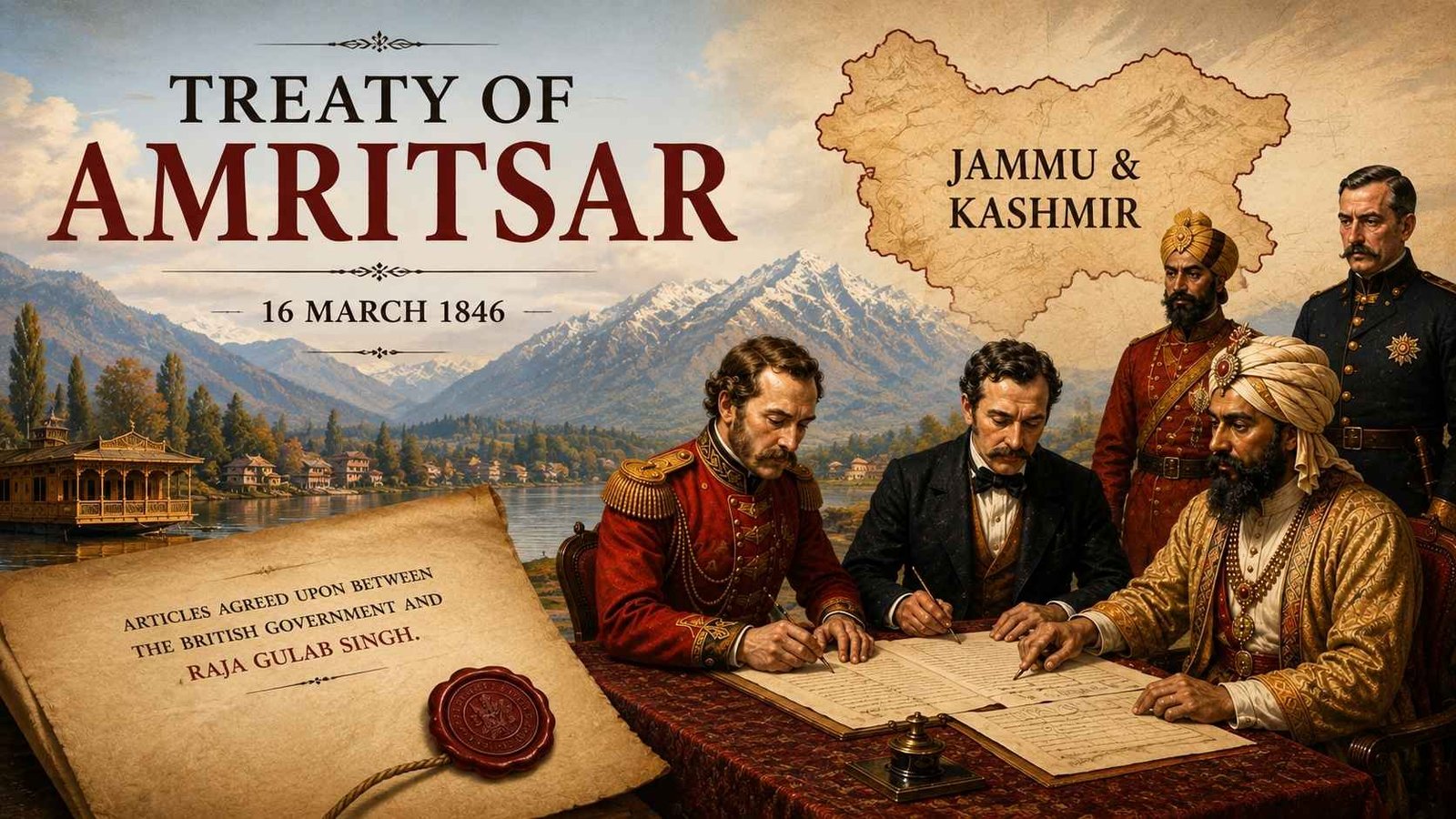
The Treaty of Amritsar, signed on 16 March 1846, transferred the hill country between the Indus and the Ravi, including the Kashmir Valley, from the British East India Company to Raja Gulab Singh of Jammu in exchange for 75 lakh Nanakshahi rupees. It created the princely state of Jammu and Kashmir, installed the Dogra dynasty that would rule it for the next hundred and one years, and drew, for the first time, the boundaries of the territory India and Pakistan have disputed ever since. No Kashmiri was consulted, and that absence is the reason 16 March is still argued about today.
What was the Treaty of Amritsar?
It was a ten-article agreement concluded at Amritsar between the British government, represented by Frederick Currie and Brevet-Major Henry Montgomery Lawrence acting for Governor-General Sir Henry Hardinge, and Gulab Singh, who negotiated in person. Its first article made over to him and his male heirs ‘all the hilly or mountainous country with its dependencies situated to the eastward of the River Indus and the westward of the River Ravi including Chamba and excluding Lahul’, to be held in independent possession.
The treaty is often described in a single line: Kashmir was sold for 75 lakh rupees. That is accurate as far as the money goes, and misleading about how the transaction came to happen at all. To understand it you have to start with a war the Kashmiris had no part in.
Who was Gulab Singh, and how did he come to be in the room?
Gulab Singh was born on 17 October 1792 into a Hindu Dogra Rajput family of the Jamwal line, which had held Jammu since the medieval period. His fortunes, and his family’s, were transformed by the same power that had absorbed them: in 1808 Ranjit Singh annexed the Dogra kingdom after the Battle of Jammu, and in 1809 the young Gulab Singh enlisted in the Sikh army.
He rose fast. By 1820 Ranjit Singh had granted Jammu to his father, Kishore Singh, as a hereditary fief, and when Kishore Singh died in 1822 Gulab Singh was confirmed as Raja of Jammu. Over the following years he took Rajouri and Kishtwar and campaigned across Punjab and the north-west frontier on the Sikh court’s behalf, while quietly building a hill kingdom of his own.
The Valley itself was not his to take, and it had not belonged to its own rulers for a very long time. Kashmir passed to the Mughals with Akbar’s annexation in 1586, to the Afghan Durranis in the early 1750s, and to the Sikhs in 1819, when Ranjit Singh’s army under Misr Diwan Chand defeated the Afghan governor Jabbar Khan at Shopian on 3 July and marched into Srinagar twelve days later. By the 1840s the Valley had been governed from somewhere else for more than two and a half centuries, and Gulab Singh’s Jammu was one of the hill principalities held under that same Sikh umbrella.
The most consequential expansion of his own territory was not carried out by Gulab Singh personally but by his general, Zorawar Singh Kahluria. From 1834 Zorawar Singh led campaigns across some of the highest terrain on earth, breaking the Ladakhi army under Banko Kahlon and forcing the Gyalpo of Ladakh into tribute by 1835. In the winter of 1839 to 1840 he took Skardu and brought Baltistan under Dogra control. In 1841 he pushed into western Tibet, storming Taklakot on 6 September, before Tibetan and Chinese forces killed him at the Battle of To-yo on 12 December 1841.
This matters for reading the treaty properly. By 1846 Gulab Singh already ruled Jammu, Ladakh and Baltistan by conquest. What he did not hold was the Valley of Kashmir, the richest and most coveted piece of the map, and that is what the money bought.
How did the First Anglo-Sikh War produce the treaty?
Ranjit Singh died in 1839, and the Sikh Empire he had built fell into a decade of court intrigue and army mutinies. The First Anglo-Sikh War followed in 1845, ending in a decisive East India Company victory at Sobraon on 10 February 1846.
Gulab Singh’s part in that war has been argued over ever since. As one of the Lahore Durbar’s most senior figures, he kept his own forces out of the fighting, then emerged afterwards as the man the British were willing to negotiate with, serving briefly as Wazir of the Sikh Empire. The peace terms he helped settle became the Treaty of Lahore of 9 March 1846: the Sikh state ceded the Jullundur Doab between the Beas and the Sutlej, drastically cut its army, and accepted an indemnity of one and a half crore rupees.
The Lahore Durbar could not pay. Unable to raise the sum, it ceded the hill territories between the Beas and the Indus, Kashmir and Hazara among them, to the Company. Article XII of the Lahore treaty separately recognised Gulab Singh’s independent sovereignty in whatever territories the British might make over to him by a further agreement.
The British had a problem of their own. They had acquired a vast, remote and expensive mountain frontier they did not particularly want to garrison. Gulab Singh had cash, an army, local standing and a record of cooperation. Hardinge offered to recognise him as sovereign of the ceded hill country if he paid the outstanding indemnity, and Gulab Singh accepted. Seven days after Lahore, the bargain was written down at Amritsar.
What did the treaty actually say?
The ten articles are short and worth knowing individually, because they set the terms of the state’s existence until 1947.
- Article 1 transferred the hill country east of the Indus and west of the Ravi, including Chamba and excluding Lahul, to Gulab Singh and his male heirs in independent possession.
- Article 2 left the eastern boundary to be surveyed and fixed later by commissioners of both governments.
- Article 3 set the payment at 75 lakh Nanakshahi rupees, of which 50 lakh were due by 1 October 1846.
- Article 4 barred Gulab Singh from altering the limits of his territory without British agreement.
- Article 5 required him to refer disputes with Lahore or with neighbouring states to British arbitration and abide by the result.
- Article 6 obliged him to place his whole military force at British disposal for operations in the hills or adjoining areas.
- Article 7 forbade him to employ any British subject, or any European or American, without British consent.
- Article 8 bound him to honour specified provisions of the separate British engagement with the Lahore Durbar of 11 March 1846.
- Article 9 promised him British protection against external enemies.
- Article 10 required him to acknowledge British supremacy by presenting annually one horse, twelve shawl goats (six male and six female) and three pairs of Cashmere shawls.
Read together, the articles describe something narrower than the sovereignty the phrase ‘independent possession’ suggests. Gulab Singh could not change his borders, settle his own quarrels, hire a European or move his army independently. He got a throne. Britain got a buffer state on the approaches to Central Asia, paid for by its ruler, and an annual delivery of goats and shawls as the token of who was really in charge.
Why is the Treaty of Amritsar described as a sale?
Because a sum of money is written into the text, and because of what that sum came to stand for afterwards. It is the question every account of 1846 arrives at, and the two answers historians give rest on the same document.
The first reading takes the wording at face value. A price was named, an instalment date was fixed, a territory and everyone living in it passed from one authority to another, and nobody living there was consulted. The Kashmiri historian Abdul Ahad has argued that the treaty commodified an entire population and set the pattern of extraction that followed, and that framing has been the dominant one in Kashmiri political memory for well over a century.
The second reading places the payment in its immediate context. The 75 lakh was, in origin, an unpaid war indemnity owed by the Lahore Durbar to the East India Company, not a price the Company set on land it had chosen to put up for offer. Gulab Singh was already an established ruler of Jammu, Ladakh and Baltistan in his own right, and on this account the treaty confirmed and enlarged an existing kingdom rather than conjuring one out of a cash payment. The document speaks of territory and dependencies, not of subjects.
What neither reading avoids is the outcome. Whatever the legal character of the transaction, the practical result was that an entire population acquired a new dynasty through an arrangement settled over its head, in a year when nobody thought to ask what the people of the Valley wanted. That fact, rather than the word chosen for it, is what shaped the century to come.
Did Kashmir accept the new Maharaja?
Not immediately, and not quietly. The Sikh governor of Kashmir, Shaikh Imam-ud-Din, refused to hand the Valley over. By July 1846 he had gathered some 13,000 troops and the backing of regional chiefs, encouraged, according to contemporary accounts, by the Sikh Wazir Lal Singh, who had his own grudge against Gulab Singh.
In September 1846 Imam-ud-Din’s forces defeated a Dogra contingent near Srinagar, killing Diwan Lakhpat Rai and about a hundred men while losing roughly twenty-five of their own. Gulab Singh appealed to the British, who sent some 10,000 troops under Brigadier Wheeler, supported by 17,000 Sikh soldiers. Outnumbered and abandoned by his allies, Imam-ud-Din left Kashmir on 25 October and surrendered on 1 November.
Gulab Singh entered Srinagar as Maharaja on 9 November 1846, eight months after signing the treaty, escorted into the Valley by a British army.
What did Dogra rule mean for Kashmiris?
The record of the next century is mixed, and flattening it in either direction does the history no favours.
On the credit side, the Dogras assembled and held together a state of extraordinary diversity, stretching from the Punjab plains through the Valley to Ladakh, Baltistan and Gilgit. Maharaja Ranbir Singh, who took power from his ailing father in February 1856 and ruled until 1885, codified the state’s civil and criminal law into the Ranbir Penal Code, which remained in force in Jammu and Kashmir until 2019. He was a serious patron of Sanskrit learning, founding a Sanskrit school at the Raghunath Temple in Jammu and employing pandits and maulvis to translate religious and medical works into Urdu, Dogri and Hindi. The manuscript collection he built up ran to roughly 5,000 works when Sir Aurel Stein catalogued it. For the Kashmiri Pandit community, Dogra patronage of Sanskrit scholarship and of Hindu institutions, together with a large share of the administrative posts, made this a period of relative security after centuries in which their position had been far more precarious.
For the Muslim peasantry and artisan classes of the Valley, the same century looked very different. Land revenue was heavy, begar, unpaid forced labour, was a routine instrument of state, and the dagshawl tax on the shawl trade squeezed the weavers who produced Kashmir’s most famous export. On 29 April 1865, hundreds of shawl weavers marched to Zaldagar in Srinagar to protest against the tax and their conditions. Dogra troops under Colonel Bijoy Singh intercepted them at the Haji Rather Sum bridge and opened fire on an unarmed crowd, killing twenty-eight men on the spot and injuring over a hundred, with further deaths as people fled or drowned in the Kuti Ko’el stream. It is remembered as one of the earliest organised labour protests anywhere in the world, and it was put down with rifles.
The historian Mridu Rai has argued that the deeper problem was not simply harsh taxation but the way the Dogra state grounded its legitimacy in Hindu religious identity while ruling a Muslim majority, planting a politics of religious grievance that would define Kashmir for the next century and a half. It is a reading worth sitting with rather than swallowing whole. It explains a great deal about how communal lines hardened in the Valley, but it can also flatten the real variation between four very different reigns, and between a peasant in Anantnag and a clerk in Srinagar living under the same Maharaja.
Outsiders noticed. Lieutenant Robert Thorp travelled through Kashmiri villages between 1865 and 1868, documenting land tenure, revenue and forced labour, and published attacks on the administration in the Anglo-Indian press. His collected writings appeared posthumously in 1870 as Cashmere Misgovernment, in which he called the government produced by the Treaty of Amritsar a disgrace to the British name. Thorp died in Srinagar on 22 November 1868 at the age of thirty, officially of a ruptured heart; poisoning was widely suspected at the time, and his gravestone reads ‘He gave his life for Kashmir’. Two decades later Walter Roper Lawrence, appointed Settlement Commissioner for Jammu and Kashmir from 1889 to 1894, carried out the land settlement that finally began to fix peasant rights on paper, and recorded what he found in The Valley of Kashmir (1895), still one of the fullest accounts of the period.
The four Dogra maharajas
- Gulab Singh (1846 to 1856), founder of the dynasty, who transferred power to his son in February 1856 and died on 30 June 1857.
- Ranbir Singh (1856 to 1885), who backed the British during the revolt of 1857, sending troops to the siege of Delhi, recovered Gilgit in 1860 and secured tribute from Hunza and Nagar by 1870.
- Pratap Singh (1885 to 1925), appointed by the Governor-General over his father’s own preference for the younger son Amar Singh, and for years stripped of effective power by a British-supervised State Council.
- Hari Singh (1925 to 1947 in practice, and until 1949 in name), the last ruling Maharaja, who leased the Gilgit Agency to the British on 26 March 1935 and took it back on 30 July 1947, weeks before Partition.
Why 1846 still matters
The treaty’s afterlife has been longer than its text. The state it created was the largest princely state in British India by area and the most awkwardly composed, and every crisis since has been argued in terms it set.
In May 1946, two months after the treaty’s centenary, Sheikh Abdullah launched the Quit Kashmir movement with the claim that the Treaty of Amritsar was nothing more than a sale deed, that Kashmiris had been bought along with the land, and that ‘sovereignty is not the birthright of Maharaja Hari Singh’. Crowds chanted for the Amritsar deed to be torn up and the Dogras to leave. The state answered with force: more than twenty people were killed and around three hundred arrested, and on 10 September 1946 Abdullah was convicted of sedition and sentenced to three years. He was still in prison when the tribal invasion of October 1947 changed everything, and the ruler he had denounced signed the Instrument of Accession that brought Jammu and Kashmir into India.
Every element of the dispute that followed was laid down in 1846. Borders drawn to settle a war rather than to suit anybody living inside them. A dynasty that did not share the faith of most of its subjects, and whose right to rule was contested almost from the start. A frontier at Gilgit that Britain leased and returned within a single reign, and that changed hands again within months of Partition. When people say the Kashmir problem began in 1947, they are describing the moment it detonated, not the moment it was assembled.
Frequently asked questions
How much did Gulab Singh pay for Kashmir?
Seventy-five lakh Nanakshahi rupees, the currency of the Sikh Empire, equivalent to 7.5 million rupees. Article 3 of the treaty required 50 lakh of that to be paid by 1 October 1846. The sum originated as the unpaid balance of the war indemnity the defeated Lahore Durbar owed the East India Company.
What exactly did the Treaty of Amritsar transfer?
All the hilly country east of the Indus and west of the Ravi, including Chamba and excluding Lahul, with its dependencies. With later boundary adjustments, including the return of Hazara in exchange for territory near Jammu and the separation of Chamba in 1847, this became the princely state of Jammu and Kashmir.
Who signed the Treaty of Amritsar?
Frederick Currie and Brevet-Major Henry Montgomery Lawrence signed for the British government under Governor-General Sir Henry Hardinge, and Gulab Singh signed for himself. No representative of the Kashmiri population was present, and none was consulted.
Who ruled Kashmir before the Dogras?
The Valley had not been under indigenous rule since the sixteenth century. Mughal rule began with Akbar’s annexation in 1586, Afghan Durrani rule followed in the early 1750s, and Sikh rule began in 1819 after Ranjit Singh’s army defeated the Afghan governor at Shopian. The Dogras were the fourth outside power in succession, and the only one to buy the Valley rather than take it.
What role did Gulab Singh play in the First Anglo-Sikh War?
He was one of the Lahore Durbar’s senior figures, but he kept his own forces out of the fighting, and after the defeat at Sobraon he became the man the British were prepared to deal with, serving briefly as Wazir and helping to settle the peace terms. Historians read those months in two ways. One holds that a senior servant of the Sikh state stood aside at its moment of crisis and came away with a kingdom. The other holds that he was already an independent hill ruler in Jammu, Ladakh and Baltistan, that the collapse of the Sikh Empire was not of his making, and that he salvaged what he could from it. Both readings rest on the same sequence of events, and the disagreement is about his motives rather than his actions.
Why do Kashmiris mark 16 March?
Because it is the date their homeland changed hands without them. In Kashmiri political memory the treaty is remembered as the bainama, the sale deed, and the anniversary has been used since the 1940s to make the argument that Dogra rule, and by extension every settlement built on top of it, rested on a transaction rather than on consent.
Did the Treaty of Amritsar create Article 370?
Not directly, but the line runs through it. The treaty created the princely state as a distinct political entity; that state’s separate existence is what made an Instrument of Accession necessary in 1947; and the narrow terms of that accession, covering defence, external affairs and communications alone, became the basis of Article 370. Without 1846 there is no princely state to accede, and no special status to argue over.
A hundred and one years from one signature
Gulab Singh signed at Amritsar on 16 March 1846 and entered Srinagar under British escort on 9 November of the same year. His great-grandson signed away the state’s independence on 26 October 1947. Between those two documents lie the Zaldagar killings, Robert Thorp’s grave, Lawrence’s settlement, the Quit Kashmir agitation and the making of a political dispute that has outlived the empire that arranged it, the dynasty that paid for it, and the state it brought into being.
The Treaty of Amritsar is a short document. Ten articles, one payment, one horse and twelve goats a year. It is worth reading in full, because almost everything contested about Kashmir since has been an argument about what those ten articles were entitled to do.
Related reading on RohitTikoo.com
- Maharaja Hari Singh and the 1947 Instrument of Accession, for how the Dogra dynasty’s rule ended
- History of Kashmir: From Ancient Civilisations to Modern Conflict, for the longer arc the Dogra century sits inside
- Deconstructing Article 370: History and Revocation, for the constitutional afterlife of the princely state
- Kashmir Issue Explained: History, Conflict, India-Pakistan, for the dispute that grew out of the borders 1846 drew
- Kota Rani: The Last Queen of Kashmir, for the end of the last indigenous dynasty to rule the Valley
Sources
- ‘Treaty between the British Government and Maharajah Gulab Singh, concluded at Amritsar, March 16, 1846’, full text of the ten articles: https://www.indianewsnetwork.com/20191206/treaty-between-the-british-government-and-maharajah-gulab-singh-concluded-at-amritsar-march-16-1846
- ‘Treaty of Amritsar (1846)’, on the negotiations and the later boundary adjustments, Wikipedia: https://en.wikipedia.org/wiki/Treaty_of_Amritsar_%281846%29
- ‘Treaty of Lahore’, on Article XII and the terms imposed on the Sikh state, Wikipedia: https://en.wikipedia.org/wiki/Treaty_of_Lahore
- ‘Treaties of Lahore, Amritsar and Bhyroval’, Anglo-Sikh Wars: https://www.anglosikhwars.com/treaty-of-lahore-1846/
- ‘Battle of Sobraon, 10 February 1846’, Anglo-Sikh Wars: https://www.anglosikhwars.com/battle-of-sobroan-10-feb-1846/
- ‘Gulab Singh’, Wikipedia: https://en.wikipedia.org/wiki/Gulab_Singh
- ‘Zorawar Singh Kahluria’, Wikipedia: https://en.wikipedia.org/wiki/Zorawar_Singh_Kahluria
- ‘Shaikh Imam-ud-Din’, on the 1846 resistance to the Dogra takeover, Wikipedia: https://en.wikipedia.org/wiki/Shaikh_Imam-ud-Din
- ‘Ranbir Singh of Jammu and Kashmir’, Wikipedia: https://en.wikipedia.org/wiki/Ranbir_Singh_of_Jammu_and_Kashmir
- ‘Ranbir Penal Code’, Wikipedia: https://en.wikipedia.org/wiki/Ranbir_Penal_Code
- ‘1865 Zaldagar massacre’, Wikipedia: https://en.wikipedia.org/wiki/1865_Zaldagar_massacre
- ‘Robert Thorpe (Indian Army officer)’, on Cashmere Misgovernment (1870), Wikipedia: https://en.wikipedia.org/wiki/Robert_Thorpe_%28Indian_Army_officer%29
- ‘Walter Roper Lawrence’, on the 1889 to 1894 land settlement, Wikipedia: https://en.wikipedia.org/wiki/Walter_Roper_Lawrence
- ‘The Valley of Kashmir‘ (1895), Wikipedia: https://en.wikipedia.org/wiki/The_Valley_of_Kashmir
- ‘Gilgit Agency’, on the 1935 lease and its 1947 retrocession, Wikipedia: https://en.wikipedia.org/wiki/Gilgit_Agency
- ‘Battle of Shopian’, on the Sikh annexation of the Kashmir Valley in 1819, Wikipedia: https://en.wikipedia.org/wiki/Battle_of_Shopian
- ‘History of Kashmir’, for the succession of Mughal, Afghan and Sikh rule over the Valley, Wikipedia: https://en.wikipedia.org/wiki/History_of_Kashmir
- Abdul Ahad, ‘Bought and Sold: Remembering the Treaty of Amritsar, 16 March 1846’, Kashmir Times: https://kashmirtimes.com/opinion/comment-articles/bought-and-sold-remembering-the-treaty-of-amritsar-16-march-1846
- ‘Treaty of Amritsar: Kashmir Sold and Inflicted’, Outlook India: https://www.outlookindia.com/national/treaty-of-amritsar-kashmir-sold-and-inflicted-news-270614
- ‘The Quit Kashmir Movement 1946’, Research Journal of Humanities and Social Sciences: https://rjhssonline.com/HTML_Papers/Research%20Journal%20of%20Humanities%20and%20Social%20Sciences__PID__2024-15-2-9.html
- Mridu Rai, Hindu Rulers, Muslim Subjects: Islam, Rights, and the History of Kashmir (Princeton University Press, 2004), for the argument on Dogra legitimacy and religious identity: https://en.wikipedia.org/wiki/Mridu_Rai

Rohit Tikoo is a published author, researcher, and content strategist with over two decades of writing experience. He is the author of nine books covering Kashmir, Indian philosophy, social issues, and contemporary thought, including Shadows Over the Valley: Operation TUPAC, Cold War Geopolitics, and the Kashmiri Pandits Exodus (2025).
His work focuses on Kashmir’s history, literature, culture, and the lived experiences of the Kashmiri Pandit community. Through extensive research, archival references, and historical analysis, he seeks to document and preserve narratives that are often overlooked in mainstream discourse. His writing on Kashmir has appeared in DAILY EXCELSIOR, HEADLINES TODAY, ONLY KASHMIR, GREATER KASHMIR, NAAD,
VITASTA, CHATTAN, AND VOICE OF SILENCE.
Through rohittikoo.com, he publishes research-based articles, essays, and commentary aimed at fostering informed discussion on Kashmir, Indian civilisation, literature, and contemporary society.