
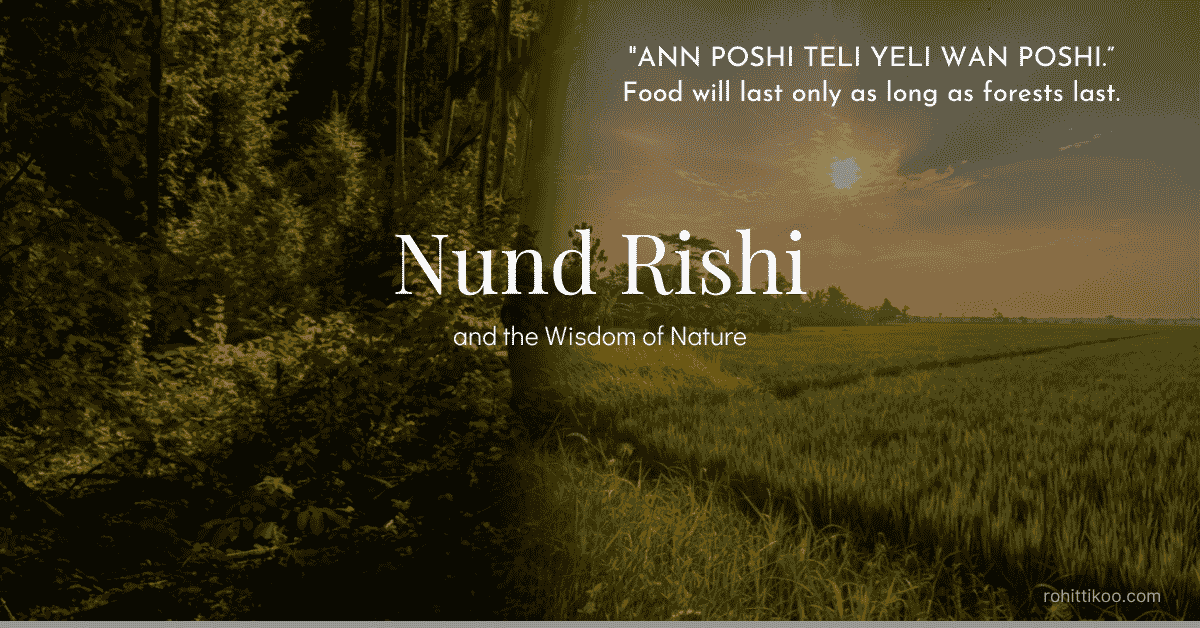
“Ann poshi teli yeli wan poshi.”
Food will last only as long as forests last.
Six centuries have passed since Nund Rishi uttered these words. Yet every passing year makes them more relevant.
The glaciers are melting.
The rivers are shrinking.
The forests are disappearing.
The summers are becoming harsher.
The rains are becoming unpredictable.
Scientists call it climate change.
Environmentalists call it global warming.
Nund Rishi had called it much earlier.
He understood a simple truth. If man wages war against nature, nature eventually retaliates.
The tragedy is not that we failed to understand his message. The tragedy is that we understood it and ignored it.
Every day, thousands of trees are cut down in the name of development. Mountains are blasted. Rivers are choked. Forests are reduced to concrete colonies. The greed of man has become larger than the needs of man.
The irony is painful.
We speak of saving the planet while destroying the very forests that sustain life.
Let’s try to understand Nund Rishi better
Who was Nund Rishi
Nund Rishi, also known as Sheikh Noor-ud-Din Noorani, remains one of the most revered spiritual figures in Kashmir. He is widely remembered as the patron saint of Kashmir, the founder of the Rishi Order, and a major voice in Kashmiri mystical poetry.
His poetry, especially his shruks, occupies a special place in Kashmir’s literary and devotional tradition because it is written in the local Kashmiri voice, speaks to everyday human life, and carries a depth of spiritual reflection that still feels alive
Scholarly work on Nund Rishi places him alongside Lal Ded as one of the two most influential saint-poets in Kashmir. That pairing matters because both figures helped shape a spiritual vocabulary that is local, accessible, and enduring. Their work is often discussed not only in religious terms but also as part of the formation of Kashmiri literary identity. In this sense, Nund Rishi is not just a saint remembered through legend, but a poet whose words became part of Kashmir’s cultural inheritance.
The Poetry of Nund Rishi
The poetry of Nund Rishi is most commonly associated with shruks, a form of Kashmiri mystical verse. These poems are central to his legacy because they carry his spiritual teachings in a concise and memorable form.
In the sources consulted, shruks are presented as a key expression of Kashmiri devotional poetry and as the poetic medium through which Nund Rishi communicated his ideas. This makes his contribution significant not only for religion but for the history of the Kashmiri language itself.
Nund Rishi’s poetry is described as morally serious and spiritually focused.
It is linked with reflection on the transient nature of life, the inner discipline of the spiritual path, and the search for truth. His verses are also associated with critiques of hypocrisy and empty scholarship, especially in relation to religious authority.
That critical element gives his poetry a social edge as well as a mystical one. He is remembered as a saint who spoke not only to spiritual seekers but also to ordinary people.
One of the important features of his poetry is its rootedness in the Kashmiri vernacular. Rather than existing as an elite literary exercise detached from daily life, his verse is tied to the cultural and emotional world of the valley.
This vernacular quality helped make his ideas accessible and memorable across generations. It also contributed to the durability of his poetic reputation, because the poetry could circulate through oral and devotional practice as well as written transmission.
Themes in Nund Rishi’s Verses
اون کٔچھے نہٕ اَنی گٔتے
وُدُر کُلۍ فٔٹے نہٕ ژاہ
Oun Ktchey Na Unigatey
Wadur Kuley Fati Na Zhah
The blind do not fear darkness.
The otter does not fear the river.
Nund Rishi uses two brilliant, contrasting metaphors to explain how fear disappears when something becomes a fundamental part of your identity or environment:
-
The Blind and Darkness: For someone without sight, darkness is not a scary, external threat. It is an absolute reality. There is no contrast, no expectation of light, and therefore, no fear of the dark.
-
The Otter and the River: For the otter, the churning, dangerous river is not an adversary to cross. It is home. The very element that might drown a human is the exact space where the otter finds its freedom, food, and life.
Intellectually, he is pointing out that fear only exists in the gap between what we are and what we experience. When you truly accept a state of being, or when you are perfectly aligned with your environment, anxiety vanishes.
Epistemology: How We Perceive Reality
There is a striking philosophical depth here regarding how human beings acquire knowledge and experience truth. Nund Rishi suggests that true understanding is not objective or detached; it must be experiential.
The otter knows the river through its skin, its fur, and its survival instincts. It does not study the river from the bank. In the same way, Nund Rishi argued that spiritual truth cannot be learned merely by reading scriptures or engaging in dry intellectual debates. It must be lived. When a person reaches spiritual maturity, the trials of the world (symbolised by the dark or the raging river) stop causing terror because that person has developed the spiritual “lungs” to breathe underwater.
Nund Rishi and the Common People
A strong feature of the available literature on Nund Rishi is the emphasis on his connection to ordinary people.
His poetry is described as expressing concern for the lives of the poor and common people of Kashmir. This is one reason his legacy has remained so broad and deeply rooted in popular memory.
He is not remembered only in elite religious or literary settings; he belongs to everyday Kashmiri cultural consciousness.
His spiritual message was not presented in abstract isolation from society. Instead, it carried ethical weight and a practical moral voice.
That combination of mystical seriousness and social accessibility helped define his significance as both saint and poet. It also explains why his influence survived across religious communities and historical change.
In Kashmir, a saint-poet who speaks in the local language and addresses the human condition will often endure longer than one who remains remote from ordinary life.
Relationship with Lal Ded
Nund Rishi is frequently discussed alongside Lal Ded, the great Kashmiri Shaivite saint-poet. This comparison is not casual; it reflects their joint importance in the literary and spiritual history of Kashmir.
Both figures are central to the Kashmiri devotional imagination, and both are associated with a form of poetry that speaks directly to existential and spiritual concerns. In literary histories, they are often treated as foundational voices.
The significance of this pairing lies in the fact that Kashmiri spirituality developed through dialogue across traditions. Nund Rishi’s poetry did not emerge in isolation from earlier Kashmiri thought, and his place beside Lal Ded demonstrates the interwoven character of the region’s religious culture.
Their poetry continues to be read together because both are understood as shaping the language through which Kashmir has spoken about the self, God, and suffering. For that reason, any serious discussion of Nund Rishi’s poetry must also acknowledge the larger Kashmiri saint-poetic tradition in which he stands.
The Socio-Cultural Resonance
What makes Nund Rishi’s intellect so enduring is his choice of language and imagery. Instead of using complex Sanskrit or Arabic theological terms that would only appeal to elite scholars, he used the local vocabulary of Kashmir.
By using the otter (wadur) and local concepts of darkness, he democratised high philosophy. He took massive existential truths, like the concepts of detachment (vairagya) and absolute trust in the divine (tawakkul), and translated them into the everyday observations of a Kashmiri peasant, fisherman, or weaver.
Takeaway:
Nund Rishi’s shruks are models of intellectual economy. He strips away heavy academic language to deliver a sharp truth: true peace comes from aligning your inner state with your outer reality, rendering the external terrors of the world completely powerless over you.
Why His Poetry Still Matters
Nund Rishi’s poetry still matters because it is both spiritually rich and culturally foundational. It preserves a Kashmiri voice that is intimate, devotional, and ethically serious.
It also offers a record of how a saint-poet could shape a region’s moral imagination without relying on grand philosophical abstraction. The endurance of his verse shows that poetry in Kashmir has never been merely ornamental; it has been a means of spiritual instruction and communal identity.
For modern readers, his work remains important because it speaks to timeless concerns: mortality, humility, truth, and devotion. It also continues to matter because it shows how vernacular poetry can become a vehicle for lasting cultural authority.
Nund Rishi’s shruks are not only relics of a past century; they are part of the continuing memory of Kashmir. That is why he remains widely known as Sheikh-ul-Alam and as the patron saint of Kashmir.
Summary
Nund Rishi is one of Kashmir’s most important saint-poets, revered as the patron saint of Kashmir and remembered for his shruks, his mystical teachings, and his founding role in the Rishi Order.
His poetry is significant because it combines spiritual discipline, social awareness, and vernacular literary power. The central themes of his verse include death, nothingness, devotion, and the critique of hypocrisy. These qualities make him a lasting figure in Kashmir’s religious, literary, and cultural history.
Nund Rishi’s legacy survives because his poetry speaks in a voice that is rooted in Kashmir yet broad enough to remain meaningful across generations.
He is remembered not only as a saint but as a poet whose words helped shape how Kashmir understood faith, suffering, and moral life. That combination is what makes him one of the enduring pillars of Kashmiri civilisation.
articulate as better in human language. His poetry, especially his shruks, holds a unique place in the literary and devotional history of the valley because it speaks in the Kashmiri idiom, addresses ordinary life, and carries a deep spiritual seriousness.
For readers interested in Kashmiri culture, Sufism, and the evolution of dialect religious expression, Nund Rishi stands at the centre of the tradition
His poetry, especially his shruks, occupies a special place in Kashmir’s literary and devotional tradition because it is written in the local Kashmiri voice, speaks to everyday human life, and carries a depth of spiritual reflection that still feels alive.
For anyone exploring Kashmiri culture, Sufism, and the growth of religious expression in the region’s own language, Nund Rishi remains one of its central figures.
FAQs about Nund Rishi
Who was Nund Rishi?
Nund Rishi, also known as Sheikh Noor-ud-Din Noorani and Sheikh-ul-Alam, was a 14th-century Kashmiri saint, poet, philosopher, and founder of the Rishi Order. He is regarded as one of the most influential spiritual figures in Kashmir and is remembered for his Shruks, which continue to shape Kashmiri literature, spirituality, and cultural thought.
Why is Nund Rishi important in Kashmiri literature?
Nund Rishi occupies a central place in Kashmiri literature because he used the Kashmiri language to express profound spiritual and philosophical ideas. His Shruks transformed everyday experiences into reflections on human nature, morality, self-awareness, and the relationship between man and the Divine.
What are Shruks?
Shruks are short mystical verses composed by Nund Rishi. Written in simple Kashmiri, they convey deep philosophical insights through everyday imagery drawn from nature, village life, human relationships, and spiritual experience.
What is the meaning of “Ann Poshi Teli Yeli Wan Poshi”?
“Ann Poshi Teli Yeli Wan Poshi” means:
“Food will survive only as long as forests survive.”
The verse highlights the inseparable relationship between human survival and nature. Centuries before environmental science emerged, Nund Rishi understood that forests sustain water, agriculture, biodiversity, and ultimately human life itself.

Rohit Tikoo is a published author, researcher, and content strategist with over two decades of writing experience. He is the author of nine books covering Kashmir, Indian philosophy, social issues, and contemporary thought, including Shadows Over the Valley: Operation TUPAC, Cold War Geopolitics, and the Kashmiri Pandits Exodus (2025).
His work focuses on Kashmir’s history, literature, culture, and the lived experiences of the Kashmiri Pandit community. Through extensive research, archival references, and historical analysis, he seeks to document and preserve narratives that are often overlooked in mainstream discourse. His writing on Kashmir has appeared in DAILY EXCELSIOR, HEADLINES TODAY, ONLY KASHMIR, GREATER KASHMIR, NAAD,
VITASTA, CHATTAN, AND VOICE OF SILENCE.
Through rohittikoo.com, he publishes research-based articles, essays, and commentary aimed at fostering informed discussion on Kashmir, Indian civilisation, literature, and contemporary society.