
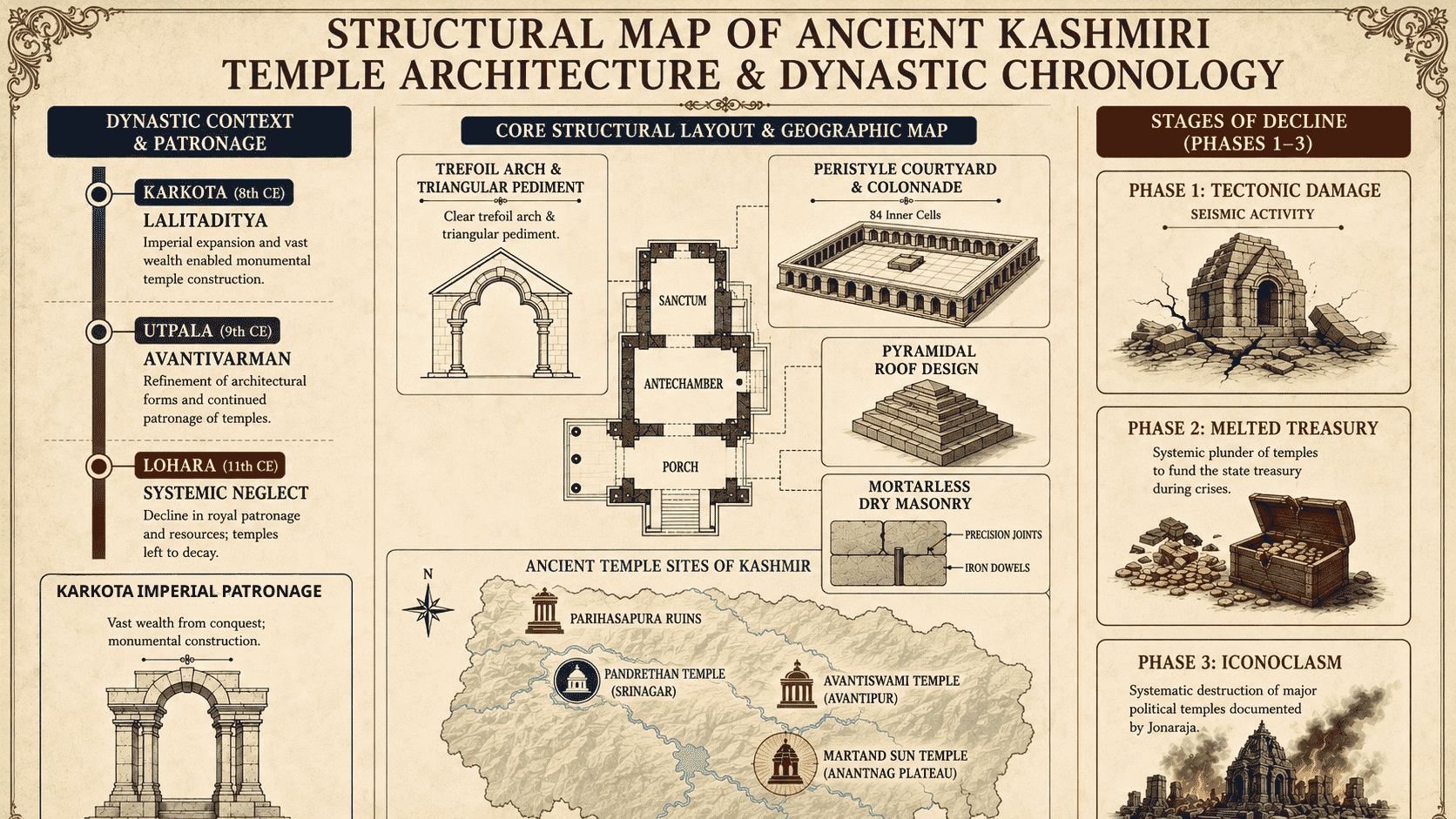
The lost temples of Kashmir tell the story of one of India’s most remarkable yet least understood civilisations. Most people know only the Martand Sun Temple near Anantnag, but for nearly five centuries, the Kashmir Valley was home to dozens of magnificent temples dedicated to Shiva, Vishnu, Surya, and the Divine Mother. Today, many survive as ruins, while others have almost disappeared from memory.
Long before kings began building large stone temples, the valley was already a sacred landscape. Ancient texts such as the Nīlamata Purāṇa describe Kashmir as a land of holy springs, rivers, lakes, and mountains. People worshipped at natural sites that later became home to temples dedicated to Hindu gods and goddesses.
By the 8th century, Kashmir had become a wealthy kingdom. Its rulers controlled important trade routes connecting northern India with Central Asia and Tibet. The wealth generated through trade and agriculture allowed them to build ambitious public works, including cities, canals, monasteries, and temples.
Unlike many temples in the plains of India, Kashmiri temples had to withstand heavy snowfall, cold winters, and frequent earthquakes. Local architects responded with a style that was both practical and beautiful. They used large limestone blocks, thick walls, steep roofs, and elegant trefoil arches to create buildings that blended naturally with the Himalayan landscape.
The result was a style found nowhere else in India.
Martand: The Temple That Became the Face of Ancient Kashmir
If there is one temple that represents Kashmir’s lost heritage, it is the Martand Sun Temple.
Located near Anantnag, about 60 kilometres from Srinagar, the temple stands on a high plateau overlooking the Kashmir Valley. Even in ruins, it remains one of the most impressive ancient monuments in India.
Martand represents the height of the Karkota imperial style. King Lalitaditya built it during the eighth century on a high plateau near Anantnag. The central temple features a clear three-part layout: a porch (ardhamandapa), a middle chamber (antarala), and a dark inner sanctum (garbhagriha). A colonnade with 84 small shrines surrounds the central space. This layout matches sacred solar geometry. The Wikipedia architectural record for the Martand Sun Temple provides complete floor plans of this site.
Martand was dedicated to Surya, the Sun God.While India has several famous Sun temples, including Konark in Odisha and Modhera in Gujarat, Martand is older than Konark by nearly five centuries. It belongs to a completely different architectural tradition.
The first thing visitors notice is its setting.
The temple overlooks the entire valley. On a clear day, the snow-covered Pir Panjal mountains form a dramatic backdrop. The location was carefully chosen. Ancient builders understood that a temple was more than a place of worship. It also reflected the power and prestige of the king who commissioned it.
The temple complex originally consisted of a central shrine surrounded by a large rectangular courtyard. Around the courtyard stood a series of smaller chambers that probably housed subsidiary shrines or accommodated priests and pilgrims. Massive limestone columns enclosed the complex, creating one of the most distinctive temple layouts in medieval India.
Although much of the roof has disappeared, the surviving walls still demonstrate the extraordinary skill of Kashmiri stone masons. They cut huge limestone blocks with remarkable precision, fitting them together so accurately that many sections have survived for over 1,200 years despite earthquakes and harsh Himalayan winters.
Architecturally, Martand does not resemble the temples of Khajuraho, Bhubaneswar, or Tamil Nadu. Instead, it reflects a uniquely Kashmiri style. Trefoil arches, fluted pillars, tall entrance gateways, and steep roof forms combine local building traditions with artistic influences that travelled into Kashmir through Gandhara and the northwestern frontier.
Archaeology confirms that Martand was one of the grandest temples ever built in the valley. What it cannot fully reveal is how magnificent the monument looked when complete. Historians rely on surviving masonry, sculptural fragments, and comparisons with other Kashmiri temples to reconstruct its original appearance.
Even in its ruined state, Martand remains the finest surviving symbol of Kashmir’s ancient civilisation.
Avantipur: The Twin Temples of an Imperial Capital
About 30 kilometres north of Anantnag lie the ruins of Avantipur, once the capital of the Utpala dynasty.
King Avantivarman, who ruled during the ninth century CE, founded the city and built two magnificent temples that still dominate the archaeological site today.
One temple, known as Avantiswami, was dedicated to Vishnu.
King Avantivarman built this Vishnu temple in the ninth century at his capital along the Jhelum River. The complex uses a panchayatana plan, which places four smaller shrines at the corners of the main central room. River silt buried the structure for centuries, which protected the stone faces from erosion. The carvings show local court styles, foreign clothes, and traditional deities. The Archaeological Survey of India portal details the conservation history of these recovered stone columns.
The other, Avantisvara, honoured Shiva.
Together, they show how Kashmir’s temple architecture continued to evolve after the Karkota period.
At first glance, the layout feels familiar. Visitors pass through a grand entrance before entering a large courtyard. The main shrine stands on a raised platform in the centre, while smaller structures surround it.
Look closer, however, and the differences become clear.
The carvings are more refined. Decorative details appear richer. Stone panels display floral patterns, divine figures, and geometric designs that reveal the growing confidence of Kashmiri craftsmen.
Excavations carried out by archaeologists uncovered carved capitals, sculptural fragments, and architectural elements scattered across the site. These discoveries help historians understand how the temples originally looked before centuries of damage and stone removal altered the landscape.
Avantipur also reminds us that Kashmir’s temple tradition did not depend on a single ruler. Successive dynasties continued to build, improve, and expand sacred sites, creating an architectural legacy that lasted for hundreds of years.
Pandrethan: The Temple Time Almost Forgot
Unlike Martand or Avantipur, the temple at Pandrethan does not overwhelm visitors with its size.
Instead, it impresses through balance and craftsmanship.
Located on the outskirts of Srinagar, the small stone temple stands beside a spring, surrounded by water for much of the year.
Many historians consider it one of the best-preserved examples of medieval Kashmiri architecture.
Its survival is partly due to luck.
Over centuries, soil gradually buried part of the structure, protecting its lower sections from weather and human interference. As a result, many original architectural features remain intact.
The temple follows a simple square plan. Each side displays careful symmetry, while the steep pyramidal roof reflects the practical needs of a region that experiences heavy snowfall.
Nothing about Pandrethan feels excessive.
Every stone appears carefully measured. Every carving serves a purpose. The result is a temple that demonstrates how Kashmiri architects achieved elegance without relying on monumental scale.
It also proves an important point.
Not every great temple in Kashmir belonged to a vast royal complex. Smaller shrines served local communities across the valley and formed an equally important part of its sacred landscape.
Naranag: A Temple Complex Hidden in the Himalayas
Drive northeast from Srinagar towards the Sind Valley, and the landscape begins to change.
The roads narrow.
The forests grow denser.
Snow-fed streams cut through the mountains.
Nestled within this dramatic setting lies Naranag, one of Kashmir’s most fascinating temple complexes.
Unlike Martand, which dominates an open plateau, Naranag blends into its natural surroundings.
Several stone temples stand here, built over different periods. Archaeologists believe the complex remained active for centuries, with later rulers expanding earlier structures instead of replacing them.
The site occupies an important place in Kashmir’s religious geography.
For centuries, pilgrims travelling towards the high Himalayan shrines, including Amarnath, passed through this region. Naranag served as both a place of worship and a resting point along these ancient routes.
Its architecture reflects familiar Kashmiri features—high platforms, trefoil arches, carefully dressed limestone blocks, and impressive entranceways—but the mountain setting gives the complex a character all its own.
Even today, standing among the ruins with forests rising behind them, it is easy to understand why ancient builders chose this location.
The temple was never separate from nature.
It became part of it.
Mamal: A Temple That Never Fell Silent
Most of Kashmir’s ancient temples survive only as ruins.
Mamal Temple, near Pahalgam, tells a different story.
Dedicated to Shiva, it is believed to be one of the oldest surviving temples in the valley. Unlike Martand or Avantipur, worship never completely stopped here.
That continuity makes Mamal unique.
Generations have visited the shrine for more than a thousand years, allowing it to remain a living temple rather than simply an archaeological monument.
Architecturally, Mamal is modest.
It lacks the scale of Martand and the elaborate layout of Avantipur.
Yet its importance lies elsewhere.
It shows that Kashmir’s temple tradition did not consist only of monumental royal projects. Smaller temples served villages and local communities for centuries. They preserved religious traditions even as kingdoms rose and fell around them.
Sometimes, the quietest monuments tell the longest stories.
Payar: The Forgotten Temple Few Visitors Know About
Hidden near Anantnag stands another reminder of Kashmir’s remarkable temple tradition.
The Payar Temple rarely appears in travel guides, yet archaeologists consider it an important example of medieval Kashmiri architecture.
Although much of the structure has collapsed, the surviving entrance, platform, and carved stonework still display the distinctive features seen at larger monuments across the valley.
Its presence also raises an important question.
How many similar temples have disappeared without leaving enough remains to study?
The answer is impossible to know.
Archaeologists continue to discover foundations, sculptures, and carved stones across Kashmir, suggesting that the valley once contained far more temples than the handful now familiar to visitors.
Every new discovery adds another piece to a much larger historical puzzle.
I’ll continue seamlessly with the remaining sections covering Parihasapura, Bumzuv, Narastan, Ushkur, what happened to Kashmir’s temples, archaeology versus myth, conservation, and the concluding legacy until the article is complete.
Parihasapura: The Lost City of a Powerful King
Today, Parihasapura looks like an ordinary village surrounded by fields. At first glance, there is little to suggest that it was once one of the grandest royal cities in Kashmir.
More than 1,200 years ago, this was the capital of King Lalitaditya Muktapida.
According to the 12th-century historian Kalhana in the Rajatarangini, Lalitaditya built magnificent temples, monasteries, palaces, and enormous statues here. The city reflected the wealth and confidence of a ruler who wanted to make Kashmir one of the leading kingdoms of his time.
Sadly, very little of that city survives.https://rohittikoo.com/lalitaditya-muktapida-kashmir-emperor/
Over the centuries, many of its stone blocks were reused to build houses, bridges, and other structures. Nature did the rest. Floods, earthquakes, and neglect gradually buried much of the ancient capital beneath farmland.
Archaeological excavations have uncovered the foundations of several temples, sculptures, stone pillars, and decorative fragments. These discoveries confirm that Parihasapura was once a major religious and political centre.
Although visitors cannot see the city in its original form, the buried remains remind us that many of Kashmir’s greatest monuments have simply disappeared from view. They have not vanished from history—they are waiting to be understood.
Bumzuv: A Forgotten Temple Hidden in Plain Sight
Not every important temple in Kashmir attracts crowds.
Some survive quietly, almost unnoticed, beside villages where daily life continues as it has for generations.
The temple at Bumzuv, near Mattan in Anantnag district, is one such example.
Only parts of the structure remain, but the surviving stonework clearly belongs to Kashmir’s medieval architectural tradition. Archaeologists have identified its characteristic trefoil arches, carefully cut limestone blocks, and raised platform.
Unlike Martand, Bumzuv has received very little public attention.
That is unfortunate because smaller temples like this help historians understand how widespread temple building had become. Monumental royal temples represented only one part of the story. Hundreds of smaller shrines served local communities across the valley.
Each one adds another chapter to Kashmir’s forgotten sacred landscape.
Narastan: A Temple Shaped by Time
The village of Narastan, in the Budgam district, preserves another little-known temple that deserves far greater recognition.
The shrine is dedicated to Shiva and probably dates to the early medieval period. Although time has damaged much of the structure, several original architectural elements still survive.
Its entrance doorway displays the elegant stone carving that became a hallmark of Kashmiri craftsmanship. Thick walls and a compact design suggest that the builders understood the challenges posed by heavy snowfall and frequent earthquakes.
Unlike larger temple complexes, Narastan offers a glimpse into everyday religious life.
This was not an imperial monument built to celebrate royal power.
It was a community temple—a place where villagers gathered for festivals, rituals, and worship throughout the year.
Sites like Narastan remind us that Kashmir’s temple tradition belonged not only to kings but also to ordinary people.
Ushkur: Traces of a Temple Town
Near Baramulla lies the ancient settlement of Ushkur, known in early Buddhist sources as Huṣkapura.
The town occupies an important place in Kashmir’s history because it flourished under both Buddhist and Hindu rulers.
Today, only scattered remains survive.
Archaeologists have identified temple fragments, sculptural remains, and evidence of earlier settlements that point to a long history of religious activity.
Although much of ancient Ushkur disappeared centuries ago, the site illustrates an important feature of Kashmir’s past.
The valley’s religious traditions did not develop in isolation.
Buddhist monasteries, Hindu temples, sacred springs, and pilgrimage routes often existed within the same cultural landscape. Different communities shared the same geography while contributing to Kashmir’s rich artistic and architectural heritage.
What Happened to Kashmir’s Temples?
This is the question almost every visitor asks.
Unfortunately, there is no single answer.
Many websites reduce the story to one event or one ruler. History is rarely that simple.
Different temples disappeared for different reasons.
Some suffered serious damage during earthquakes. Kashmir lies in one of the most active seismic zones in the Himalayas, and historical records describe several powerful earthquakes that destroyed buildings across the valley.
Others declined when kingdoms collapsed.
Building a large temple required enormous resources. Maintaining it required even more. Priests, craftsmen, musicians, administrators, and labourers depended on royal grants and agricultural income. When dynasties weakened or political power shifted, many temples lost the financial support that kept them functioning.
Some monuments slowly fell into ruin.
Villagers reused dressed stone to build homes, boundary walls, bridges, and public buildings. This was common across medieval India. Once a temple stopped functioning, its carefully cut stone became a valuable building material.
There were also periods of deliberate destruction.
Historical sources and archaeological evidence show that some temples were damaged during political and religious conflicts, particularly after the establishment of the Kashmir Sultanate in the 14th century.
One ruler often associated with this period is Sultan Sikandar (1389–1413), whom later Persian chroniclers called Butshikan, meaning “destroyer of idols.”
Modern historians, however, urge caution.
Some medieval accounts were written decades after the events they describe and often reflect political or religious viewpoints. Archaeology confirms that certain temples were destroyed or damaged, but it does not support sweeping claims that every temple in Kashmir disappeared during a single reign.
The evidence instead points to a much longer process shaped by politics, economics, natural disasters, and changing patterns of patronage.
Every temple has its own history.
Comparative Archaeological Matrix
This table isolates the core structural data of the primary surviving monuments.
| Site Name | Dynastic Era | Century | Primary Deity | Key Architectural Element | Preservation Status |
| Martand | Karkota Dynasty | 8th CE | Surya (Sun God) | 84-cell courtyard, double-chambered core | Roof collapsed; outer columns stand |
| Avantiswami | Utpala Dynasty | 9th CE | Vishnu | Panchayatana matrix, detailed wall reliefs | Excavated courtyard; base blocks intact |
| Avantishvara | Utpala Dynasty | 9th CE | Shiva | Large entry gatehouse, massive floor plinth | Highly ruined; core foundation remains |
| Pandrethan | Late Utpala Era | 10th CE | Shiva | Central spring location, intact roof vault | Excellent; interior ceiling fully preserved |
The Dynamics of Structural Collapse
The destruction of Kashmir’s temples was a slow process. Historians divide the decline into three distinct phases.
Tectonic Shift
The Kashmir Valley is a highly active seismic zone. The heavy, mortarless stone roofs created massive downward pressure. Earthquakes destabilised the walls over time, causing the heavy roofs to fall inward and smash the stone floors.
Fiscal Collapse
Civil war during the Lohara Dynasty (eleventh to fourteenth centuries) hurt the agrarian economy. Without regular tax income, kings stopped paying for temple repairs. Rulers like King Harsha (1089–1101 CE) plundered the temples to save the state budget. He created a formal government office called the Devutpatana-nayaka (destroyer of gods) to melt down gold and silver idols for currency.
Systematic Iconoclasm
Active worship at these sites ended under Sultan Sikandar (1389–1413 CE). The court historian Jonaraja recorded this transition in his updates to the Rajatarangini. The state targeted large temples because they were centres of political power for the old elite. Workers used crowbars, log fires, and early gunpowder mixtures to pull down the massive stone walls at Martand and Avantipur.
Modern Conservation Realities
Today, these sites face serious environmental threats. The porous limestone easily absorbs rainwater, which allows moss and lichen to grow. The organic acids from these plants eat into the detailed carvings. The UNESCO World Heritage Centre preservation guidelines outline how experts use chemical washes to clear these growths without altering the stone colour. Managing the flow of tourists is also critical to prevent shifts in the dry-stone foundations.
What Archaeology Tells Us
Ancient ruins often give rise to legends.
Archaeology helps separate legend from evidence.
When archaeologists excavate a temple site, they study far more than standing walls. They examine foundations, stone carvings, pottery, coins, inscriptions, drainage systems, and construction techniques.
These details reveal when a temple was built, how it expanded over time, and sometimes even how it fell into ruin.
At Martand, excavations have helped scholars understand the layout of the vast temple complex.
At Avantipur, carved fragments have allowed historians to reconstruct parts of the original buildings.
At Parihasapura, buried foundations have revealed the scale of a royal capital that had almost disappeared from memory.
Archaeology also teaches humility.
Many questions remain unanswered.
We still do not know exactly how several temples looked when complete. Wooden roofs have disappeared. Sculptures have been lost. Inscriptions remain incomplete.
Good history recognises these gaps instead of filling them with speculation.
That is what makes archaeology so valuable.
It tells us not only what we know but also what we still have to discover.
Why These Temples Still Matter
It is easy to think of these monuments as relics of a distant past.
They are much more than that.
The lost temples of Kashmir tell the story of a society that valued architecture, engineering, sculpture, literature, and craftsmanship. They remind us that the valley was once one of the great cultural centres of early medieval India.
They also challenge many common assumptions.
Kashmir was never isolated from the rest of the subcontinent. Its artists exchanged ideas with neighbouring regions while creating an architectural style that remained uniquely their own. Its rulers built cities, temples, monasteries, and irrigation systems that reflected a sophisticated understanding of both engineering and urban planning.
Perhaps most importantly, these monuments belong to everyone’s shared heritage.
They are not simply Hindu monuments or archaeological sites. They are part of India’s civilisational history and part of Kashmir’s cultural identity. Preserving them means preserving the story of the people who built them, worshipped in them, repaired them, and passed their memory from one generation to the next.
The Legacy of a Forgotten Civilisation
The ruins of Martand, Avantipur, Naranag, Pandrethan, Mamal, Payar, Bumzuv, Narastan, Ushkur, and Parihasapura are scattered across the Kashmir Valley.
Seen individually, they are impressive monuments.
Seen together, they reveal something much larger.
They tell the story of a civilisation that turned a Himalayan valley into one of the finest centres of temple architecture in Asia. For nearly five centuries, Kashmiri builders developed a style that was elegant, practical, and unlike anything found elsewhere in India. Their work reflected not only religious faith but also artistic confidence, engineering skill, and royal ambition.
Time has taken much of that world away.
Earthquakes shattered walls. Kingdoms disappeared. Cities were abandoned. Stones found new uses. Wars left their mark. Nature slowly reclaimed what people left behind.
Yet the civilisation itself has not been lost.
It survives in the ruins that still stand, in the chronicles that recorded their history, and in the work of archaeologists who continue to uncover new pieces of Kashmir’s remarkable past.
Every fallen pillar, every carved doorway, and every weathered stone reminds us that history does not disappear overnight.
Frequently Asked Questions About Kashmir’s Lost Temples
Which is the most famous ancient temple in Kashmir?
The Martand Sun Temple near Anantnag is the best-known ancient temple in Kashmir. Built in the 8th century by King Lalitaditya Muktapida, it is considered one of the finest examples of early medieval temple architecture in India. Even in ruins, its scale and location make it one of the valley’s most iconic historical monuments.
How many ancient temples once existed in Kashmir?
No one knows the exact number.
Archaeologists have identified dozens of temple sites across the Kashmir Valley, while medieval texts such as the Rajatarangini mention many more that have either disappeared or remain unexcavated. Some survive as standing ruins, while others are known only through archaeological remains or historical records.
What makes Kashmiri temple architecture unique?
Kashmiri temples look very different from the temples of Khajuraho, Konark, or South India.
Their most distinctive features include:
- Large limestone blocks instead of sandstone or granite.
- Trefoil arches above doorways.
- High platforms supporting the main shrine.
- Spacious rectangular courtyards.
- Steep roof designs suited to heavy snowfall.
- A simple yet elegant style that blends local craftsmanship with influences from Gandhara and northwestern India.
These features created an architectural style found almost nowhere else.
Why are so many temples in ruins today?
There isn’t one simple answer.
Different temples declined for different reasons. Some suffered damage during earthquakes, while others lost royal patronage as kingdoms changed. Building stones were often reused in later construction, and some temples were damaged or destroyed during periods of political and religious conflict. Centuries of neglect and natural weathering also took a heavy toll.
Historians study each site separately rather than assuming every temple shared the same fate.
Are these temples protected today?
Many of the major sites, including Martand, Avantipur, and Naranag, are protected archaeological monuments. The Archaeological Survey of India (ASI) carries out conservation work at several locations, although smaller temples often need greater attention and better protection.
Can tourists visit these temples?
Yes.
Most major temple sites are open to visitors year-round, though winter weather may limit access. Anyone visiting should remember that these are important heritage sites, not just tourist attractions.
Simple steps—such as avoiding littering, not climbing on fragile structures, and respecting local customs—help preserve these monuments for future generations.
Why This Story Matters Today
The lost temples of Kashmir are more than ancient ruins.
They remind us that civilisations are not remembered only through books. They survive through the monuments they leave behind.
Every temple tells a different story. Martand speaks of imperial ambition. Avantipur reflects artistic refinement. Pandrethan celebrates precision over size. Naranag shows how faith and nature came together in the Himalayas. Smaller temples such as Payar, Bumzuv, and Narastan remind us that ordinary communities also shaped Kashmir’s sacred landscape.
Together, they reveal a chapter of Indian history that deserves far more attention than it receives.
Much remains to be discovered. Archaeologists continue to study forgotten sites, historians continue to re-examine old chronicles, and conservationists continue to protect what survives. Each new discovery adds another piece to the story of a civilisation that once made Kashmir one of the greatest centres of temple architecture in Asia.
The ruins may be silent today, but they still have much to teach us.

Rohit Tikoo is a published author, researcher, and content strategist with over two decades of writing experience. He is the author of nine books covering Kashmir, Indian philosophy, social issues, and contemporary thought, including Shadows Over the Valley: Operation TUPAC, Cold War Geopolitics, and the Kashmiri Pandits Exodus (2025).
His work focuses on Kashmir’s history, literature, culture, and the lived experiences of the Kashmiri Pandit community. Through extensive research, archival references, and historical analysis, he seeks to document and preserve narratives that are often overlooked in mainstream discourse. His writing on Kashmir has appeared in DAILY EXCELSIOR, HEADLINES TODAY, ONLY KASHMIR, GREATER KASHMIR, NAAD,
VITASTA, CHATTAN, AND VOICE OF SILENCE.
Through rohittikoo.com, he publishes research-based articles, essays, and commentary aimed at fostering informed discussion on Kashmir, Indian civilisation, literature, and contemporary society.