
नमोऽस्तु ते शारदे देवि काश्मीरपुरवासिनि ।
त्वामहं प्रार्थये नित्यं विद्यादानं च देहि मे ॥
Salutations to You, O Goddess Sharada, who dwells in the sacred land of Kashmir. I bow before You each day and pray for the gift of wisdom.
Some journeys begin with footsteps, while others begin in the heart.
For countless Kashmiri Pandits scattered across India and the world, the road to Shankaracharya and Mata Ragnya begins long before they reach the Valley.
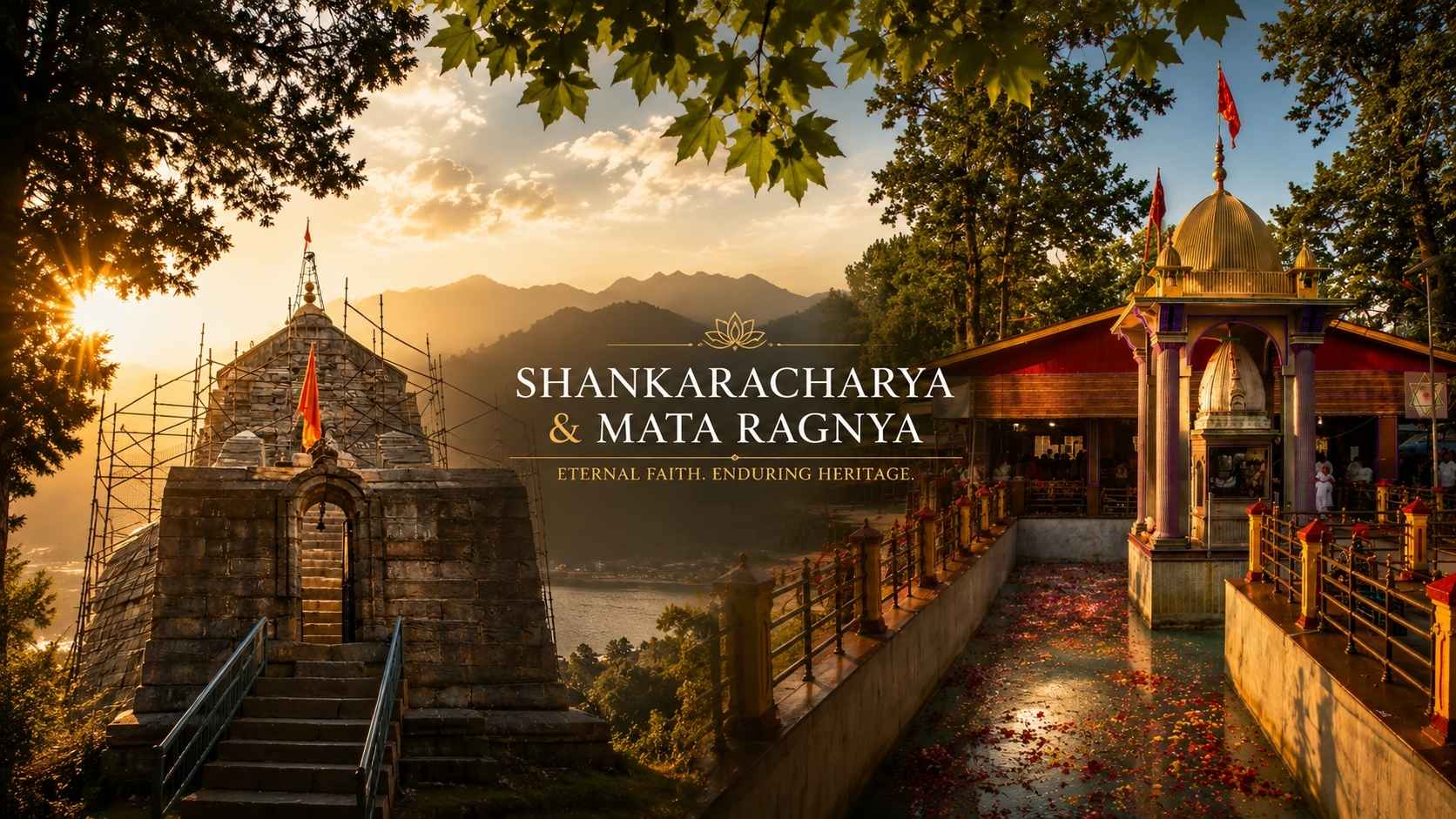
Shankaracharya and Mata Ragnya: Sacred Shrines That Safeguard the Soul of Kashmiri Pandits
It begins with stories narrated by grandparents, faded family photographs, temple bells remembered from childhood, and prayers whispered in homes that stand hundreds or even thousands of kilometres away from Kashmir.
To an outsider, these are two celebrated temples in a land known for its breathtaking beauty. To a Kashmiri Pandit, they are something far deeper. They are places where faith has survived political upheaval, where memory has outlived exile, and where an ancient civilisation continues to breathe despite the passage of centuries.
When the Kashmiri Pandit community was forced to leave the Valley in 1990, homes were abandoned, neighbourhoods fell silent, and generations found themselves uprooted from the land their ancestors had inhabited for centuries. Yet what many remember most vividly is not a house or a street. It is the sacred rhythm of life that was left behind.
The climb to Gopadri Hill begins before the sun fully rises, and the deodar trees seem to bless the path with their fragrance. The first sight of the sacred spring at Tulmul stills something restless in the heart. Conch shells rise into the morning air on Jyeshtha Ashtami, as if to say: come home, come and pray.
Even today, more than three decades after the exodus, thousands of Kashmiri Pandits return each year to offer prayers at these shrines. Many travel from Delhi, Jammu, Pune, Bengaluru, London, New Jersey, Sydney, and countless other places where life has taken them.
Children born outside Kashmir often make the pilgrimage alongside grandparents who once walked these paths in their youth.
For them, the journey is not simply religious.
It is a memory return. It is returning home.
A Civilisation Rooted in Sacred Geography
Every civilisation leaves behind monuments. Some build fortresses. Others raise palaces. Kashmir created something different. Its greatest inheritance was our sacred temples. The temples were the soul of Kashmir, where faith found its voice, memories found a home, and generations found their identity.
The rivers, springs, forests, mountains, and temples of Kashmir were never viewed as separate from daily life. They formed an interconnected spiritual world where nature itself was regarded as divine. This vision finds expression in the Nilamata Purana, one of the earliest texts associated with Kashmir.
Although compiled between the sixth and eighth centuries CE, it preserves traditions that are considerably older and portrays the Valley as a land sanctified by countless sacred sites.
Centuries later, the historian Kalhaṇa, in his twelfth-century chronicle Rajatarangini, described a flourishing land of temples, scholars, monasteries, and royal patronage. His work remains one of the most important historical sources for medieval Kashmir and reveals the remarkable cultural vitality of the region before the political transformations that followed.
By the early medieval period, Kashmir had emerged as one of India’s foremost centres of Sanskrit learning and philosophy. It gave the world profound thinkers such as Abhinavagupta, Utpaladeva, Somananda, and Kshemaraja, whose works on Kashmir Shaivism continue to influence scholars worldwide.
Religion in Kashmir was never confined to ritual alone. It embraced philosophy, poetry, music, aesthetics, and contemplation. Temples became places where devotion and knowledge met, where seekers gathered not only to worship but also to debate, study, and reflect.
This intellectual tradition earned Kashmir a reputation as Sharada Desha, the Land of Goddess Sharada, the divine embodiment of wisdom.
It is within this sacred and scholarly landscape that the story of Shankaracharya Temple unfolds.
Shankaracharya Temple: The Hill That Never Forgot
Long before visitors see the temple itself, they see the hill.
Rising nearly a thousand feet above the waters of Dal Lake, Gopadri Hill dominates the skyline of Srinagar. At its summit stands one of the oldest surviving Hindu shrines in Kashmir, quietly watching over the Valley as it has done for centuries.
The climb is deliberate.
Each flight of stone steps draws the pilgrim farther away from the bustle of the city below. As the air grows cooler and the view widens, the journey begins to feel less like an ascent of a hill and more like a gradual shedding of worldly concerns.
When devotees finally enter the temple precincts, many instinctively fall silent.
Some experiences do not invite conversation.
They invite reflection.
It has its story, it has its tradition.
When the great philosopher Adi Shankara arrived in Kashmir in the early ninth century, he encountered a highly sophisticated school of thought in Kashmir Shaivism. The local scholars challenged his dualistic philosophy, grounding their arguments in the ultimate reality of cosmic vibration.
According to historical accounts preserved in the oral traditions of the Saraswat Brahmins, it was here that the reformer underwent a profound spiritual transformation, realising that energy and consciousness are inseparable.
His foundational hymn, the Saundarya Lahiri, was born from this exact realisation on the heights of Gopadri, celebrating the supreme goddess as the animating power of existence. Here is a verse from Saundarya Lahiri,
शिवः शक्त्या युक्तो यदि भवति शक्तः प्रभवितुं न चेदेवं देवो न खलु कुशलः स्पन्दितुमपि
“Only when united with Shakti does Shiva possess the power to create; without Her, even the Lord is unable to stir.”
A Shrine Older Than Its Name
Ancient sources refer to the hill as Gopadri, traditionally associated with King Gopaditya. The present structure reflects several phases of construction and restoration carried out over many centuries. Archaeological studies suggest that significant portions of the existing temple belong to the early medieval period, though earlier foundations may lie beneath the present monument.
The sanctum enshrines a Shiva Linga, affirming the temple’s long association with Shaiva worship, a tradition that profoundly shaped the religious life of Kashmir.
Unlike the towering temple complexes of southern India or the intricately carved shrines of central India, the Shankaracharya Temple possesses an austere dignity.
Its massive stone walls rise without unnecessary ornament. Its elevated platform conveys quiet strength. Its compact sanctum encourages contemplation rather than spectacle. Everything about the temple reflects restraint. Perhaps that is why its presence lingers in the mind long after one has descended the hill.
Adi Shankaracharya and the Tradition of Kashmir
No account of this temple is complete without speaking of Adi Shankaracharya, the philosopher whose name it now bears.
According to enduring Hindu tradition, Adi Shankaracharya visited Kashmir during his spiritual journeys across the Indian subcontinent in the eighth century CE. Kashmir at the time was renowned as one of the foremost centres of learning, attracting scholars from distant regions.
Traditional accounts hold that Shankaracharya engaged in philosophical discussions with the learned scholars of Kashmir and attained recognition at the Sarvajña Peetha, the legendary Throne of Omniscience associated with supreme knowledge.
Historians approach these accounts with appropriate caution. Contemporary records from Shankaracharya’s lifetime are scarce, and many biographies describing his travels were composed centuries later. As a result, some details belong to the realm of religious tradition rather than verifiable history.
Yet traditions also preserve cultural memory.
Whether viewed through the lens of faith or history, the association between Adi Shankaracharya and Kashmir has endured for well over a millennium. It symbolises the meeting of Advaita Vedanta with the rich philosophical heritage of Kashmir Shaivism, two streams of Indian thought that sought, in different ways, to understand the nature of ultimate reality.
For generations of devotees, the temple has therefore represented not only devotion to Lord Shiva but also the pursuit of knowledge, introspection, and spiritual awakening.
The View That Lives in Memory
Ask an elderly Kashmiri Pandit about the Shankaracharya Temple, and they may begin not with the shrine itself but with the view.
They remember Dal Lake glistening beneath the morning sun. The houseboats are resting quietly on the water. The Chinar trees are changing colour with the seasons. The snow resting on distant peaks.
Children are climbing the steps with their parents.
Families pausing to catch their breath before the final ascent. Many of these memories belong to a Kashmir that exists today only in recollection.
When the community left the Valley in 1990, the temple remained where it had always been, standing above Srinagar in silent witness. While families rebuilt their lives in unfamiliar cities, Gopadri Hill continued to receive the first rays of dawn, the autumn mist, the winter snow, and the prayers of those who could still reach it.
In exile, the image of the temple acquired a meaning it had never possessed before.
It became proof that some parts of the home could not be carried away.
Photographs of the shrine found a place in drawing rooms and prayer corners across Jammu, Delhi, Mumbai, Bengaluru, and beyond. Parents pointed to those pictures while telling children about the Kashmir they had lost. Grandparents described the climb, the silence, and the peace that awaited at the summit.
For many young Kashmiri Pandits born after the exodus, the Shankaracharya Temple was first encountered not through pilgrimage but through memory inherited from others.
When they finally make the climb themselves, they often discover something unexpected.
The place feels strangely familiar.
Not because they have been there before, but because they have carried it within them all their lives.
Mata Ragnya Bhagwati: The Mother Who Never Left Her Children
Every civilisation has a sacred place where history, faith, and memory come together. For Kashmiri Pandits, that place is Tulmul, the abode of Mata Ragnya Bhagwati, lovingly known as Mata Kheer Bhawani.
While Kashmir is home to many revered temples, none occupies the same place in the hearts of our community as the shrine at Tulmul. We do not remember her simply as the presiding deity of an ancient temple. We remember her as our Mother, whose presence has comforted generations through moments of joy, uncertainty, and sorrow.
The bond between Mata Ragnya and the Kashmiri Pandit community is difficult to explain to someone who has never experienced it. It is not built only through scriptures or temple rituals. It begins at home. Many of us first heard her name from our grandparents long before we understood the history of Kashmir.
Her image adorned our prayer rooms, Her stories were narrated on winter evenings, and Her annual yatra was spoken of with the same excitement with which families prepare to visit a beloved relative. Before we learnt where Tulmul lay on a map, we already knew that it was where our Mother lived.
The approach of Jyeshtha Ashtami transformed every Kashmiri Pandit household into a place of quiet anticipation. Mothers prepared offerings with care, fathers discussed travel arrangements, and children counted the days until the journey began.
The pilgrimage was never treated as an obligation. It was a joyful family tradition, eagerly awaited throughout the year. Even those who had visited Tulmul countless times approached each pilgrimage with the same devotion, believing that no visit to the Mother’s abode was ever the same as the last.
The excitement of the yatra found expression in simple Kashmiri songs that echoed through homes across the Valley. These were not verses composed by celebrated poets, nor were they part of elaborate temple liturgy. They belonged to the everyday life of the community and were sung with affection as families prepared to leave for Tulmul.
Yatra Geet in buses
Tul muley Prāray, shur ta batchh hethh lārey.
“Wait for us at Tulmul, Mother. We are coming with our children and our families.”
A similar expression of devotion accompanied journeys to another sacred abode of the Goddess.
Khanabārani Prāray, shur ta batchh hethh lārey.
“Wait for us at Khanabarani, Mother. We are coming with our children and our families.”
These simple lines reveal something profound about the relationship between the devotee and the Divine Mother. They are not prayers seeking wealth, success, or relief from suffering. Instead, they sound like the affectionate assurance of a child telling a waiting mother that the family is on its way home.
That intimacy has always distinguished the worship of Mata Ragnya within the Kashmiri Pandit tradition.
The sacred traditions associated with Mata Ragnya Bhagwati tell us that the Goddess did not arrive in Kashmir by chance. According to a cherished belief preserved for centuries, She was originally worshipped in Lanka during the reign of Ravana.
Although Ravana was renowned for his learning and devotion to Lord Shiva, his growing arrogance led him away from Dharma. It was then that the Divine Mother withdrew Her grace. After the victory of Lord Rama, Lord Hanuman, the very embodiment of devotion and selfless service, brought Mata Ragnya from Lanka to Kashmir, where She chose the tranquil village of Tulmul as Her eternal abode.
Whether one approaches this account as sacred tradition or spiritual symbolism, its message has remained unchanged across generations. The Divine chooses righteousness over power, humility over pride, and devotion over worldly glory.
For Kashmiri Pandits, Tulmul is sacred because it is believed to be the place chosen by the Mother herself. Every pilgrimage therefore, carries the feeling of returning to a home that has welcomed countless generations before us.
Unlike many celebrated temples across India, the heart of Tulmul is not defined by towering architecture or ornate carvings. It is defined by its sacred spring. Surrounded by majestic Chinar trees and enclosed within a serene temple complex, the spring has inspired reverence for centuries.
Pilgrims often find themselves standing silently before its tranquil waters, sensing a peace that is difficult to express in words.
Among Kashmiri Pandits, the spring has always been regarded as more than a natural source of water. It is believed to reflect the living presence of Mata Ragnya Bhagwati. Generations have cherished the belief that the changing colours of the spring convey the Mother’s blessings and, at times, Her concern for Her children.
Within the collective memory of the community, many elders have recalled that the waters appeared unusually dark before some of the most difficult periods in Kashmir’s history, including the events that preceded the exodus of 1990.
These memories continue to be narrated with reverence, strengthening the conviction that the Mother never ceases to watch over those who seek Her grace.
Perhaps that is why devotees stand before the spring in silence. They do not come searching for spectacle or mystery. They come with folded hands, trusting that the Mother who has guided generations before them continues to bless every pilgrim who arrives with faith in the heart.
When the Valley Gathered at Tulmul
If there was one day that reflected the spirit of the Kashmiri Pandit community in its fullest expression, it was Jyeshtha Ashtami. The annual yatra to Mata Ragnya Bhagwati was never viewed merely as a religious observance. It was a homecoming. Families who had not met for months looked forward to this day with the same eagerness as they did to a family reunion.
The journey to Tulmul was as much about renewing relationships as it was about offering prayers before the Mother.
Long before sunrise, the roads leading to Tulmul would come alive with pilgrims. Buses, private vehicles, and groups travelling together gradually filled the temple precincts with an atmosphere that words can scarcely capture.
The shade of the ancient Chinar trees, the fragrance of incense, the water flowing, the chanting of sacred hymns, and the sight of devotees carrying bowls of kheer created a scene that remains etched in the memories of generations.
Every face reflected devotion, yet there was also an unmistakable sense of belonging. Tulmul was not simply a destination. It was the spiritual home of an entire community.
For children, the yatra was an unforgettable experience. They watched elders offer kheer at the sacred spring, listened to stories of Mata Ragnya narrated by grandparents, and learnt traditions that no book could ever teach. Many of those children are grandparents today, yet they still speak of those pilgrimages with remarkable clarity. They remember the cool waters of the spring, the rustling leaves of the Chinars, the warmth of community meals, and the feeling that, for one sacred day, the whole of Kashmir seemed to gather before the Mother.
The offering of kheer itself carried a quiet symbolism. Prepared with simple ingredients found in every household, it reminded devotees that the Divine values sincerity above grandeur. Rich or poor, every family approached the Mother with the same humble offering and the same faith. It is why the temple came to be affectionately known as Kheer Bhawani, although devotees have always worshipped Her as Mata Ragnya Bhagwati.
When Exile Interrupted the Pilgrimage
The events of 1990 changed the course of Kashmiri Pandit history in ways that continue to shape the community even today. Families were compelled to leave the Valley, carrying with them little more than what they could gather in haste.
Homes, orchards, books, and family heirlooms were left behind, but the deepest loss could never be measured in material terms. It was the separation from the sacred landscape that had nurtured generations of faith.
For many displaced Kashmiri Pandits, the thought that caused the greatest anguish was not simply leaving their ancestral home. It was the knowledge that the annual journey to Tulmul had suddenly become uncertain.
A pilgrimage that had united families for generations could no longer be undertaken as naturally as before. Elderly parents who had never imagined spending a Jyeshtha Ashtami away from Mata Ragnya found themselves in refugee camps and temporary shelters, carrying memories that were often stronger than hope itself.
Yet exile did not weaken devotion. If anything, it deepened it. Stories of Tulmul were narrated with even greater affection, photographs of the shrine found a place in newly established homes, and children born far from Kashmir grew up hearing about the sacred spring as though it were part of their own childhood.
The physical distance from the Valley only strengthened the emotional bond between the community and the Mother they believed continued to watch over them.
The Mother Travelled With Her Children
History records that people left Kashmir. What history cannot fully record is that they carried their faith with them.
As Kashmiri Pandits rebuilt their lives in Jammu, Delhi, and other parts of India, the desire to remain connected with Mata Ragnya found expression in a deeply moving way. Temples dedicated to the Goddess began to emerge wherever the community settled, not as substitutes for Tulmul, but as sacred spaces where traditions could continue, and future generations could remain connected with their spiritual roots.
Among the most cherished of these is the Mata Kheer Bhawani Temple at Janipur in Jammu. For thousands of displaced families, this temple became a place where familiar prayers once again filled the air.
During Jyeshtha Ashtami, devotees gathered with the same offerings of kheer, the same hymns, and the same longing that had accompanied them to Tulmul for generations. While nothing could replace the original shrine in Kashmir, Janipur became a place where memories found comfort and faith found continuity.
A similar story unfolded in the Delhi-NCR region with the establishment of the Mata Kheer Bhawani Temple at Shalimar Garden, Sahibabad, Ghaziabad.
For Kashmiri Pandits who had made Delhi their home, the temple became far more than a place of worship. It became a meeting place where children learnt about their heritage, elders shared stories of Kashmir, and families celebrated Jyeshtha Ashtami with the same devotion that had once filled the temple courtyard at Tulmul.
The geography had changed, but the relationship between the Mother and her children remained untouched.
These temples stand today as powerful reminders that faith cannot be displaced. A homeland may be left behind, but the traditions that define a people continue wherever they are lovingly preserved.
The Soul of a Community Lives Here
Much has been written about the history of Kashmir, its rulers, its monuments, and its political transformations. Yet the story of Mata Ragnya Bhagwati reminds us that the true strength of a civilisation often lies elsewhere. I
It lives in the memories passed from grandparents to grandchildren, in songs that survive without ever being written down, in annual pilgrimages that bind families together, and in the unwavering belief that the Divine Mother never abandons Her children.
Even today, many young Kashmiri Pandits visit Tulmul for the first time after hearing about it throughout their childhood. They recognise the sacred spring from old family photographs. They know the names of the Chinar trees because their grandparents spoke of them with affection. They arrive as pilgrims, yet they also arrive as descendants returning to a place that has always existed in family memory. In that moment, history becomes personal, and faith becomes an inheritance.
Yatra Geet
Tul muley Prāray, shur ta batchh hethh lārey.
“Wait for us at Tulmul, Mother. We are coming with our children and our families.”
These simple words once announced the beginning of a pilgrimage. Today, they carry an even deeper meaning. They express a promise that exile could not erase and time could not diminish. Every generation repeats them with the hope that the journey to the Mother’s abode will continue, and that the traditions entrusted to us will be passed lovingly to those who come after us.
The Mother Still Waits
The waters of the sacred spring continue to flow at Tulmul, just as they have for centuries.

Rohit Tikoo is a published author, researcher, and content strategist with over two decades of writing experience. He is the author of nine books covering Kashmir, Indian philosophy, social issues, and contemporary thought, including Shadows Over the Valley: Operation TUPAC, Cold War Geopolitics, and the Kashmiri Pandits Exodus (2025).
His work focuses on Kashmir’s history, literature, culture, and the lived experiences of the Kashmiri Pandit community. Through extensive research, archival references, and historical analysis, he seeks to document and preserve narratives that are often overlooked in mainstream discourse. His writing on Kashmir has appeared in DAILY EXCELSIOR, HEADLINES TODAY, ONLY KASHMIR, GREATER KASHMIR, NAAD,
VITASTA, CHATTAN, AND VOICE OF SILENCE.
Through rohittikoo.com, he publishes research-based articles, essays, and commentary aimed at fostering informed discussion on Kashmir, Indian civilisation, literature, and contemporary society.