
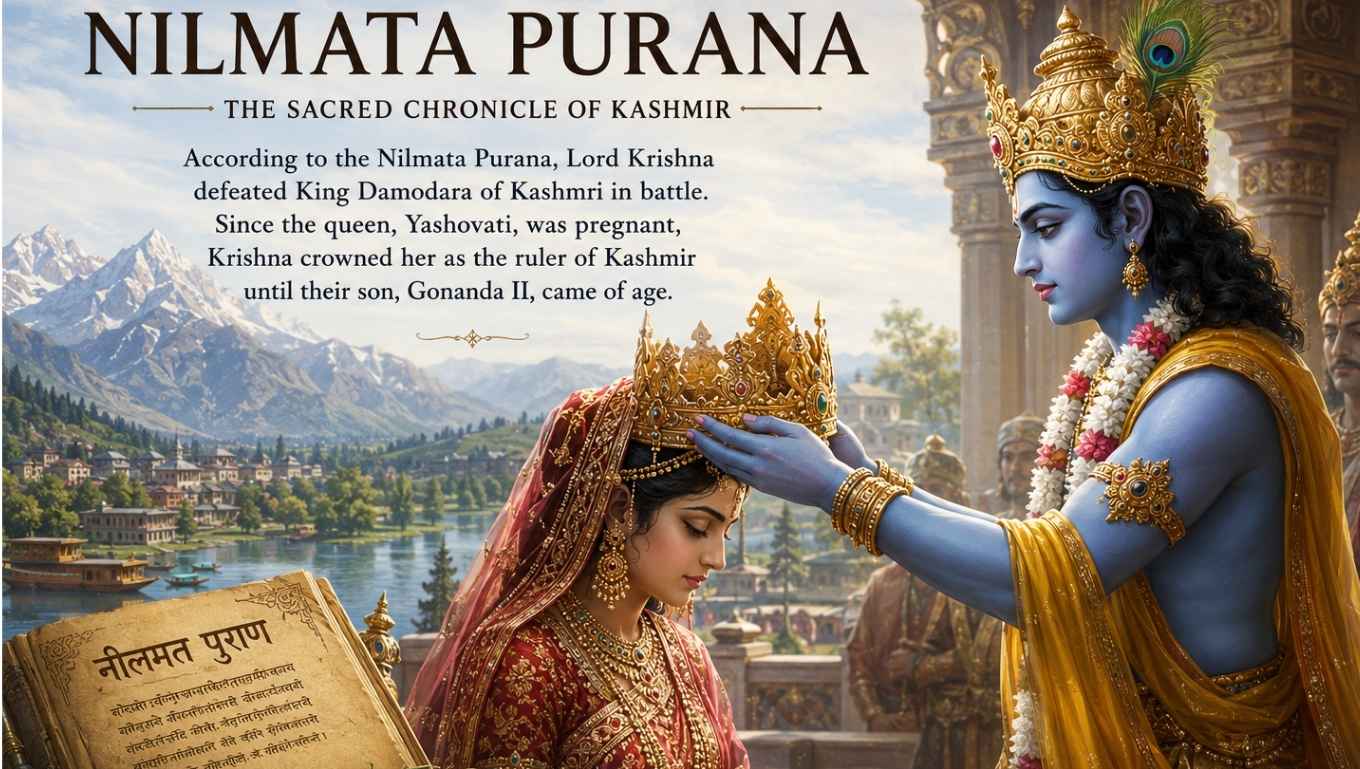
The Nilamata Purana (Sanskrit: Nīlamata Purāṇa) is one of the most important surviving Sanskrit texts for understanding the cultural, religious and geographical history of ancient Kashmir. Although classified as a Purāṇa, it differs significantly from the eighteen Mahāpurāṇas. Rather than presenting a universal cosmology or extensive genealogies of gods and kings, it focuses almost exclusively on Kashmir (Kaśmīra)—its sacred landscape, seasonal rituals, local deities, rivers, festivals and origin traditions.
For historians, the Nilamata Purana is far more than a religious text. It is one of the earliest literary sources to describe Kashmir’s social customs, pilgrimage traditions, agricultural calendar and sacred geography. The twelfth-century historian Kalhaṇa explicitly relied on it while composing the Rājataraṅgiṇī, the earliest sustained historical chronicle of Kashmir, demonstrating the text’s enduring authority within the region.
Modern scholarship treats the Nilamata Purana as a complex source. Its narratives combine mythology, religious instruction and cultural memory. Consequently, historians do not read it as a literal historical record; instead, they analyse it alongside archaeology, epigraphy, linguistics and later historical texts to reconstruct aspects of early Kashmiri society
WHAT IS NILMATA PURAN
The Nilamata Purana is a regional Sanskrit Purāṇa centred on the Valley of Kashmir. Much of the narrative is presented as a dialogue in which King Janamejaya asks the sage Vaiśampāyana why Kashmir did not participate in the Mahābhārata war. This question leads to an extended account of Kashmir’s mythical origins, sacred geography, ritual practices and early rulers.
Unlike many other Purāṇic texts, its principal aim is not to recount the universal creation of the world but to explain why Kashmir is regarded as a sacred land. It introduces the Nāga king Nīla, from whom the text derives its name, and describes how the sage Kaśyapa transformed the primordial lake known as Satisar into the inhabited Kashmir Valley.
Quick Facts
| Historical importance | One of the principal literary sources for early Kashmiri cultural history |
| Topic | Details |
| Original language | Sanskrit |
| Literary genre | Regional Purāṇa (Kāśmīra Māhātmya) |
| Subject | Kashmir’s sacred geography, mythology, festivals and culture |
| Estimated composition | Commonly placed between the sixth and eighth centuries CE, although scholarly debate continues |
| Principal figure | Nīla, the Nāga king |
| Major themes | Sacred geography, Nāga worship, seasonal festivals, pilgrimage, and social customs |
| Historical importance | One of the principal literary sources for early Kashmiri cultural history |
Table of Contents
CULTURAL ANTHROPOLOGY AND DAILY LIFE IN ANCIENT KASHMIR
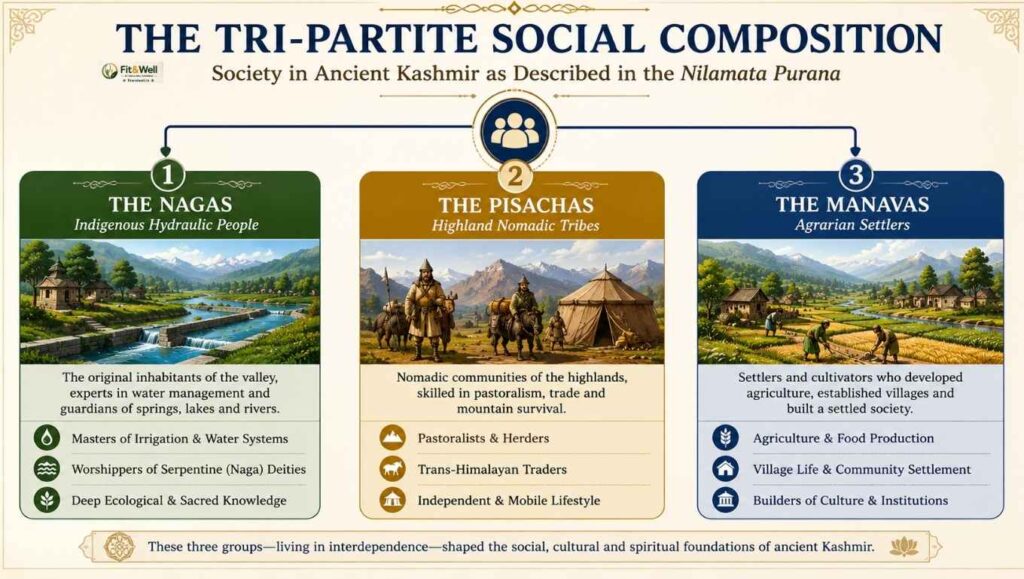
The Nilamata Purana is an exceptional document for cultural anthropology because it looks past elite court politics to record the mundane, domestic habits of ordinary citizens. It details a complex multi-ethnic cohabitation. The original inhabitants, the Nagas, who were associated with water and springs, and the Pisachas, who were associated with the harsh, snow-bound highlands, are forced by royal decree to integrate with the arriving Manavas, or human settlers, peacefully. This is political philosophy disguised as mythology. It outlines the assimilation of indigenous tribes into a growing agrarian society.
The social fabric described is remarkably egalitarian. The text provides explicit instructions on how to survive the brutal Kashmiri winters, outlining the storage of grains, the heating of homes, and the creation of community spaces.
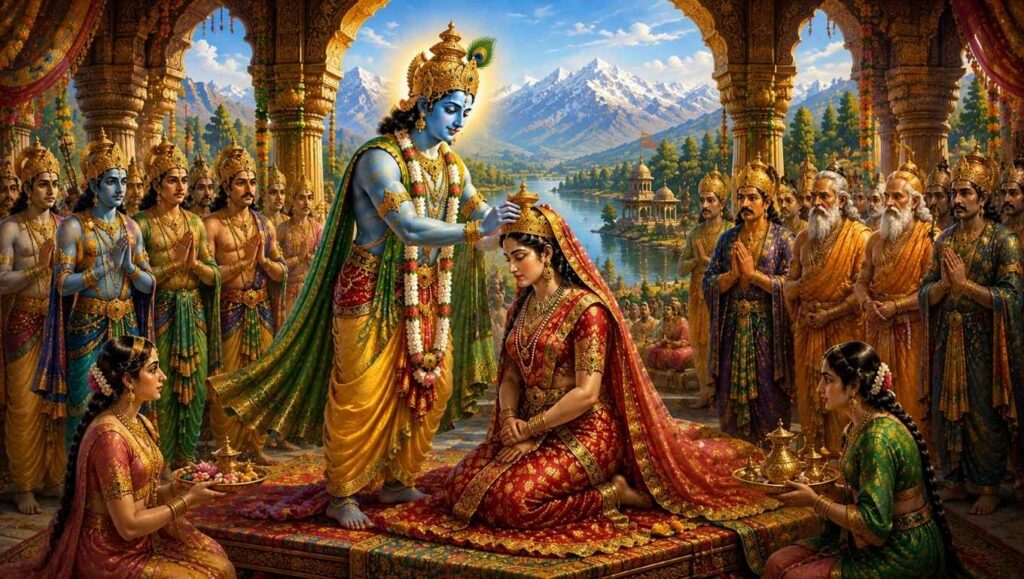
Ancient Kashmiri society placed an exceptionally high premium on the legal and political status of women. When King Damodara I fell in battle against Yadava forces, Lord Krishna himself intervened to ensure that the king’s pregnant widow, Yasovati, was crowned as the absolute ruler of Kashmir. The text explicitly commands the subjects to respect her authority, proclaiming that the ruler of Kashmir is a manifestation of the divine, regardless of gender.
This historical precedent occurred centuries before later queens like Sugandha or Didda took the throne, establishing a deep-rooted cultural tradition of female sovereignty. Daily life in the valley was dictated by the rhythm of the waters. The text functions as an early environmental mandate, prohibiting the pollution of natural springs and outlining strict guidelines for seasonal agriculture, food storage, and winter survival.
Scholars tracking these social transitions often reference the cultural anthologies available through the Indira Gandhi National Centre for the Arts collections.
The dietary descriptions within the text provide a vivid picture of early domestic life. Rice was the absolute staple food, supplemented by barley, pulses, and various leafy vegetables. The text mentions the consumption of meat during specific winter rituals, particularly those dedicated to appeasing the Pisachas, who occupied the valley during the coldest months when the human population retreated to safer zones. Milk, clarified butter, and honey were highly prized, used both for daily sustenance and as ritual offerings.
Clothing was designed primarily for climate utility. The text references woollen garments, blankets, and skin guards necessary to withstand the sub-zero temperatures of the valley. Festivals were marked by the wearing of fresh clothes, the application of perfumed pastes, and the adornment of homes with flowers and local greenery. The text paints a picture of a society that, despite its geographic isolation, maintained sophisticated standards of comfort, hygiene, and artistic expression.
| Festival Name | Hindu Month | Primary Deity | Cultural & Ritual Significance | Modern Survival |
| Vitasta Mahatmya | Bhadrapada | Goddess Vitasta (Parvati) | Celebration of the river’s birth, featuring floating lamps and offerings to celebrate the life-giver of the valley. | Observed by Kashmiri Pandits as Vitasta Truvah. |
| Naga Panchami | Sravana | Nila Naga & Serpent Deities | Cleansing of natural freshwater springs, offering milk to propitiate the guardians of water security. | Continued across the subcontinent, localized at Kashmiri springs. |
| Buddha Jayanti | Vaisakha | The Buddha | Feeding of Buddhist monks, installation of Buddha statues, and ecumenical public celebrations. | Partially integrated into seasonal spring festivals. |
| Margasirsa Festivities | Margasirsa | The Pisachas | Ritual offerings made to the spirits of the cold to ensure safety before the onset of heavy winter snows. | Echoed in the traditional winter cuisine and protective rituals. |
| Kashyapa Puja | Asvina | Sage Kashyapa | Commemoration of the valley’s creation, emphasising agricultural thanksgiving and the storage of harvested grains. | Merged into broader autumn harvest celebrations. |
| Takshaka Yatra | Kartika | Takshaka Naga | Pilgrimage to the sacred spring of Takshaka, focusing on healing and protection from winter ailments. | Traced in local folklore surrounding historic spring sites. |
THE PRIMARY CHARACTERS OF THE PURANA
Understanding the human and divine interplay of the text requires a clear guide to its primary actors:
- Kashyapa: The primordial sage who orchestrates the reclamation of the valley. He represents the arrival of advanced knowledge, engineering skills, and administrative order to the region.
- Nila: The king of the Nagas and the ultimate custodian of the valley’s social and religious laws. He acts as the link between the ancient indigenous water-worship cultures and the newer Brahmanical settlers.
- Jalodbhava: The aquatic demon whose destruction is required for civilisation to begin. Geomythology interprets him as the personification of the destructive, untamed water tables that originally submerged the valley floor.
- Yasovati: The widow of Damodara I, installed on the throne by Krishna. She stands as one of the earliest legally recognised female monarchs in Indian literature, establishing the long-standing tradition of Kashmiri female political agency.
- Gonanda II: The infant son of Yasovati, whose minority rule during the events of the Mahabharata war explained why Kashmir did not field an army at Kurukshetra.
- Brahadasva: The venerable sage who narrates the history of Kashmir to King Janamejaya, providing the structural frame through which the entire Purana is delivered to the audience.
INFLUENCE ON LATER LITERATURE AND TEXTUAL TRANSMISSION
The footprint of this text stretches far across the history of Northern India. When Kalhana sat down in 1148 CE to write his masterpiece, the Rajatarangini, he explicitly stated in his opening verses that he had consulted the ancient text of the Nilamata Purana to reconstruct the early history of his homeland. He noted that before his time, the historical records were fractured and confused, and it was this specific text that provided the chronological anchor for the ancient kings.
Beyond formal history, the text deeply influenced the development of Kashmir Shaivism. The localised rituals dedicated to the Nagas and the sacred springs were gradually layered with the sophisticated monistic philosophy of scholars like Abhinavagupta. The springs that were once viewed as the literal homes of serpent spirits became understood as physical focuses for meditation and spiritual realisation.
The preservation of the text itself is an extraordinary story of survival. Written primarily on fragile birch-bark manuscripts in the distinct Sharada script, the text was highly vulnerable to the damp climate of the valley and the political upheavals of the medieval period.
FREQUENTLY ASKED QUESTIONS
WHAT IS THE NILAMATA PURANA?
The Nilamata Purana is an ancient regional compendium from Kashmir that serves as the ultimate cultural, ritual, and geographical matrix of the valley. It is formally classified as an Upa-Purana, which denotes a minor or secondary Purana rather than one of the eighteen universal Mahapuranas. The text operates as a localised sacred manual, focusing intensely on the unique customs, sacred sites, and environmental preservation laws governing the ancient valley floor.
Unlike macro-level texts that focus on cosmic creation, this specific chronicle is highly localised, serving to establish social harmony and define regional identity. It blends early hydraulic management codes with domestic rituals, ensuring that the arriving human population could live peacefully alongside the indigenous tribes. The text remains the oldest surviving literary monument dedicated entirely to the heritage of the Kashmiri people.
WHO WROTE THE NILAMATA PURANA?
The exact individual authorship of the text remains anonymous, representing a collective editorial effort by the early intellectual elite and chroniclers of the valley. The internal structural narrative is framed as a sacred conversation between King Janamejaya and the venerable sage Bhrigudasva, who relates the history of the land at the king’s request. This classic dialogue format was the traditional method used to preserve and transmit historical and cultural lore across generations.
The compilation reflects the work of local priests, hydrologists, and community leaders who sought to institutionalise regional customs into a permanent framework. By formalising these traditions under the spiritual authority of the Naga king Nila, the anonymous compilers ensured absolute compliance from the populace. The text represents the unified voice of a society coding its laws, seasonal survival tactics, and historical memories into sacred verse.
WHEN WAS THE NILAMATA PURANA WRITTEN?
Textual stratification and linguistic analysis place the core composition of the text between the fourth and eighth centuries CE. The earliest layers took shape during a period when indigenous water-worship practices were systematically integrated into the expanding Brahmanical framework of Northern India. This puts its baseline compilation centuries ahead of later medieval chronicles, establishing it as the absolute chronological foundation for the valley’s written history.
The text underwent minor updates over the following centuries to absorb changing religious dynamics, including a notable inclusion around 550 CE that integrated the Buddha into the local pantheon. When the renowned Indologist Georg Bühler recovered early birch-bark manuscripts in the valley in 1875, it confirmed the text’s ancient status. These primary documents paved the way for modern chronological reconstructions of early South Asian history.
WHY IS THE NILAMATA PURANA IMPORTANT?
The exceptional importance of the text lies in its dual identity as a historical repository and an early environmental mandate. It provides the essential cultural and historical blueprint that validates the antiquity of Kashmir, saving its early history from dissolving into total obscurity. Without this textual baseline, later masterpiece epics would completely lose their foundational context and dynastic starting points.
Furthermore, it offers an invaluable window into ancient resource management and civic planning. By elevating rivers and springs to divine status, it institutionalised a sophisticated system of ecological protection that guaranteed the survival of an agrarian society. It stands as a profound testament to how an early human civilisation successfully used cultural laws to govern a fragile alpine ecosystem.
WHAT DOES THE NILAMATA PURANA SAY ABOUT THE ORIGIN OF KASHMIR?
The narrative states that the Kashmir Valley was originally a vast, deep alpine lake named Satisar, which translates to the lake of Sati. A predatory water demon named Jalodbhava lived within these hidden depths, using the submerged terrain as a base to terrorise the communities living along the mountain rims. To reclaim the land, the sage Kashyapa initiated a divine intervention that resulted in the mountain wall being broken open at the Baramulla gorge.
The rapid draining of the lake exposed the fertile valley floor, trapping the demon and allowing human settlement to flourish. This legendary account directly mirrors physical reality, as modern limnological and geological studies confirm the valley floor was indeed covered by a massive lake during the Pleistocene epoch. The unique raised clay mounds known as karewas stand as the literal sedimentary proof of this prehistoric lacustrine draining.
WHO WAS NILA IN THE NILAMATA PURANA?
Nila is celebrated as the sovereign king of the Kashmiri Nagas, the ancient indigenous subterranean and water spirits who guarded the valley’s freshwater sources. He is described as a powerful, benevolent ruler who possessed absolute mastery over the weather, natural springs, and seasonal water systems. As the chief custodian of the valley, he held the ultimate authority to dictate the laws of human habitation and religious practice.
When the human settlers first arrived in the reclaimed valley, it was Nila who issued the foundational social and ritual codes to ensure peaceful cohabitation. He acted as the vital cultural bridge between the indigenous hydraulic tribes and the new agrarian communities. His instructions turned the harsh, waterlogged landscape into an organised, sustainable civilisation.
WHO WAS SAGE KASHYAPA?
Sage Kashyapa is the primordial patriarch and cultural hero who orchestrates the physical and spiritual reclamation of the valley. Driven by compassion for the mountain communities, he performed intense austerities to secure divine assistance to drain the prehistoric Satisar lake. His actions successfully broke the mountain barrier, turning an uncultivable inland sea into a fertile basin fit for human progress.
Beyond the mythology, Kashyapa represents the historical influx of advanced engineering skills, agricultural knowledge, and structured administrative systems into early Kashmir. He embodies the transition from a wild, untamed wilderness to a highly organised society. The very name of the region, historically recorded as Kasmira, derives its etymological roots directly from his name, cementing his status as the foundational father of the land.
WHO WAS JALODBHAVA?
Jalodbhava is the chaotic, water-born demon whose absolute control over the alpine lake kept the valley uninhabitable for humans. His name literally translates to born of water, and his mythological narrative represents the constant threat of catastrophic floods, uncultivable marshlands, and destructive water levels. His presence symbolised the hostile, chaotic elements of nature before the arrival of human engineering.
From a geomythological perspective, the destruction of Jalodbhava is a clear metaphor for the taming of the valley’s original water tables. Breaking the mountains at the Baramulla Gorge permanently lowered the flood line, reclaiming the swampy bottomlands for systematic agriculture. The demon’s defeat represents the triumph of early human society over a hostile, volatile landscape.
IS THE NILAMATA PURANA HISTORY OR MYTHOLOGY?
The text is an intricate blend of geomythology, historical memory, and cultural documentation that cannot be dismissed as simple fiction. While the prose uses the traditional language of divine intervention and demonic battles, the physical settings, tribal dynamics, and geological events are deeply grounded in real history. It is an ancient collective memory coded into the language of the sacred.
My firm position: Dismissing this text as pure mythology is a failure of historical analysis. The text accurately records real geographic locations, precise river confluences, and real tectonic transformations like the draining of the valley basin. It represents an authentic historical core wrapped in a symbolic narrative style, requiring modern researchers to decode the physical facts hidden within the legend.
WHY DO HISTORIANS STUDY THE NILAMATA PURANA?
Historians study the verses because they provide the oldest comprehensive window into the regional ethnography, topography, and social evolution of ancient Northern India. The text is a goldmine for understanding how early communities formed distinct identities away from the major imperial centres of the mainland. It allows researchers to track the gradual assimilation of indigenous tribes into the broader subcontinental culture.
Additionally, the text provides the mandatory geographical and dynastic markers needed to cross-reference later medieval histories. It records the names of early settlements, ancient river systems, and early political lineages that would otherwise be entirely lost to time. It acts as the primary analytical tool for reconstructing the socio-political evolution of the early Western Himalayan region.
HOW RELIABLE IS THE NILAMATA PURANA AS A HISTORICAL SOURCE?
The reliability of the text is exceptional when evaluated for its geographical precision, cultural anthropology, and descriptions of everyday life. Its topographic mapping of the Jhelum river system, ancient confluences like the Sindhu-Vitasta junction, and local mountain passes match modern maps with surprising accuracy. It functions as an uncorrupted guide to the physical realities of ancient Kasmira.
However, its dynastic chronology must be handled with analytical care, as it links local rulers to the epic timelines of the Mahabharata to build political authority. The value of the text is found not in its exact tracking of royal regnal years, but in its absolute fidelity to the social laws, economic realities, and ecological practices of early Kashmiri society.
WHAT FESTIVALS ARE DESCRIBED IN THE NILAMATA PURANA?
The text establishes a comprehensive calendar of seasonal festivals built entirely around the agricultural and hydrological cycles of the valley. The most critical of these is the Vitasta Mahatmya, celebrated in the month of Bhadrapada to mark the birth of the Jhelum river, featuring the lighting of floating lamps. The Naga Panchami festival is mandated in the month of Sravana, focusing on the ritual cleansing of natural freshwater springs.
The text also details unique winter celebrations like the Margasirsa Festivities, which required making specific food offerings to appease the Pisachas before the onset of heavy winter snows. It remains highly unique for ordering the public celebration of Buddha Jayanti in the month of Vaisakha. This seasonal calendar shows a society whose spiritual life was completely attuned to the rhythms of its climate.
WHAT DOES THE NILAMATA PURANA REVEAL ABOUT ANCIENT KASHMIRI SOCIETY?
The verses reveal a highly egalitarian, sophisticated, and remarkably inclusive social structure that placed an exceptionally high premium on the status of women. The historic coronation of Queen Yasovati, who was installed as the absolute ruler of Kashmir by divine decree, proves that early Kashmiri law recognised absolute female sovereignty centuries before the medieval era. The text explicitly commands the populace to respect her authority as a divine manifestation.
The text also documents a multi-ethnic society that integrated indigenous spring keepers, nomadic highland tribes, and new agrarian settlers into a unified civic order. The economy was heavily agrarian, relying on advanced rice cultivation, winter grain storage, and sophisticated canal networks. It paints a vivid picture of a resilient community that used cooperation and strict social laws to withstand the isolated, brutal winter months.
WHAT IS THE RELATIONSHIP BETWEEN THE NILAMATA PURANA AND THE RAJATARANGINI?
The text serves as the absolute historiographical foundation and primary source material for the opening books of Kalhana’s Rajatarangini, composed in 1148 CE. Kalhana explicitly states in his introduction that he consulted this ancient Puranic chronicle to correct the confused, broken lineages of the ancient kings. It provided him with the structural timeline needed to map out the legendary Gonanda Dynasty.
Without the geographical details and dynastic lineages preserved in the older purana, Kalhana would have lacked the historical framework required to build his masterwork. While the purana focuses on ritual laws and geomythology, the Rajatarangini evolves this data into a structured, sequential political history of statecraft. The two texts form an inseparable literary continuum tracking the history of the valley.
DOES THE NILAMATA PURANA MENTION THE MAHABHARATA?
The text firmly links the political history of the isolated valley to the broader epic traditions of the Mahabharata. It documents the reign of King Gonanda I, a powerful Kashmiri monarch who chose to align his kingdom with Jarasandha against Lord Krishna. This geopolitical alignment led to a direct military conflict, resulting in Gonanda I being slain by Balarama on the banks of the Yamuna River.
The narrative also tracks the subsequent reign of Damodara I and his pregnant widow Queen Yasovati, explaining that their infant son, Gonanda II, was too young to participate in the great Kurukshetra war. This clever narrative integration served a crucial purpose. It explained why Kashmir’s massive military forces were absent from the main epic battle, while firmly anchoring the kingdom within the political consciousness of ancient India.
WHAT IS SACRED GEOGRAPHY IN THE NILAMATA PURANA?
Sacred geography is the practice of mapping a physical territory through a spiritual and ecological lens, turning natural landmarks into protected cultural spaces. The text details a highly precise network of sacred sites, tracking the Vitasta River from its origin at Verinag down through confluences like modern Shadipur. Every lake, mountain peak, and freshwater stream is assigned a specific spiritual guardian or deity.
This meticulous mapping served a vital practical purpose for the state. By declaring natural features like Wular Lake or high-altitude passes to be the sacred abodes of the Nagas, the text effectively created ancient ecological sanctuaries. It transformed basic geographic features into spaces protected by religious law, ensuring resource conservation across the kingdom.
WHAT DOES THE NILAMATA PURANA SAY ABOUT NAGA WORSHIP?
The text positions Naga worship as the absolute foundation of early Kashmiri spiritual and civic life. The Nagas, envisioned as serpentine water deities, were understood to be the primary owners and guardians of the valley’s freshwater resources. The text outlines strict ritual laws requiring citizens to make regular offerings of milk, saffron, and flowers to these spring deities to ensure continuous water security.
This focus shows that early Kashmiri religion was deeply intertwined with hydrological realities. The Nagas were not merely mythological figures; they were the divine gatekeepers of the natural springs that fed the valley’s crucial irrigation canals. Honouring the Nagas was a direct investment in the environmental stability and agricultural survival of the state.
DOES THE NILAMATA PURANA DESCRIBE EVERYDAY LIFE?
The ancient chronicle is an exceptional document for cultural anthropology because it looks past elite court politics to record the mundane, domestic habits of ordinary citizens. It provides detailed descriptions of the staple diet, noting that rice was the main food source, supplemented by barley, pulses, and winter stores of honey and clarified butter. It even details the seasonal clothing shifts, referencing the heavy woollen blankets and protective winter gear needed to survive the sub-zero temperatures.
The text also records the vibrant recreational life of the community, detailing public festivals filled with music, theatrical performances, and athletic competitions. It outlines the architectural heating layout of homes and the creation of shared community spaces to combat winter isolation. It captures the authentic texture of a working society, preserving the domestic reality of the ancient valley.
WHERE CAN I READ AN ENGLISH TRANSLATION OF THE NILAMATA PURANA?
The definitive, universally recognised English translation is the comprehensive two-volume critical edition prepared by the late scholar Dr Ved Kumari Ghai. Published through the Jammu and Kashmir Academy of Art, Culture, and Languages, this masterwork remains the global academic standard for studying the text. You can examine detailed manuscript breakdowns and access related archival records via the Bhandarkar Oriental Research Institute digital archives.
Volume one offers an exhaustive socio-cultural and analytical study of the text’s historical context, while volume two features the critically restored Sanskrit verses alongside their direct English translation. Physical copies are maintained in major global research centres and academic libraries specialising in classical South Asian literature.
WHAT LANGUAGE WAS THE NILAMATA PURANA WRITTEN IN?
The text was composed entirely in classical Sanskrit, utilising the traditional Puranic verse structures to record its extensive geographical and ritual data. The oldest surviving physical copies were meticulously written on local birch bark using the unique, indigenous Sharada script, which developed as the primary literary script of the Western Himalayan region.
The use of Sanskrit allowed the regional intellectual elite to communicate local laws using the sophisticated, universal literary language of ancient India. Meanwhile, preserving the text in the local Sharada script ensured that these crucial records remained distinctively Kashmiri. This linguistic choice perfectly balanced subcontinental connectivity with a fierce protection of regional independence.
WHY IS THE NILAMATA PURANA STILL RELEVANT TODAY?
The ongoing relevance of the text stems from its status as an irreplaceable witness to the cultural and ecological continuity of the Kashmir Valley. In an era marked by rapid environmental degradation and shifting identities, this ancient code stands as a profound reminder of a time when human society lived in perfect balance with its natural landscape. It demonstrates that the survival of a culture depends entirely on the protection of its natural resources.
To look upon the clay ridges of Baramulla is to see the physical contour of an ancient memory, a landscape where the boundary between the deep geological past and human storytelling completely dissolves. The valley stands as a monument to human resilience against environmental change, anchored forever by the ink of its first true chroniclers.

Rohit Tikoo is a published author, researcher, and content strategist with over two decades of writing experience. He is the author of nine books covering Kashmir, Indian philosophy, social issues, and contemporary thought, including Shadows Over the Valley: Operation TUPAC, Cold War Geopolitics, and the Kashmiri Pandits Exodus (2025).
His work focuses on Kashmir’s history, literature, culture, and the lived experiences of the Kashmiri Pandit community. Through extensive research, archival references, and historical analysis, he seeks to document and preserve narratives that are often overlooked in mainstream discourse. His writing on Kashmir has appeared in DAILY EXCELSIOR, HEADLINES TODAY, ONLY KASHMIR, GREATER KASHMIR, NAAD,
VITASTA, CHATTAN, AND VOICE OF SILENCE.
Through rohittikoo.com, he publishes research-based articles, essays, and commentary aimed at fostering informed discussion on Kashmir, Indian civilisation, literature, and contemporary society.