
I bow in humble obeisance to Mata Rupa Bhawani, daughter of Sharika, disciple of Lal Ded’s silence before her own, who lived so entirely between two faiths
Kashmir has given the world many who dissolved the line between faiths. Lal Ded, whose Vakhs were carried by Hindu and Muslim alike for six centuries before Rupa Bhawani was born. Nund Rishi, whose order gathered Hindu ascetics and Muslim mystics into a single, uneasy fellowship. Rupa Bhawani belongs among them,
Key Facts About Rupa Bhawani Birth name: Alakheshwari Born: 1621, Safa Kadal, Srinagar Died: 1721, observed as Sahib Saptami Spiritual lineage: Regarded in Kashmiri tradition as the successor to Lal Ded (Lalleshwari) Legacy: Mystic poetess and yogini, remembered as a figure who bridged Kashmir Shaivism and Sufi Islam Major shrines: Safa Kadal, Waskura, Chashma Shahi (Manigam), Laar
Who Was Rupa Bhawani?
Rupa Bhawani was a seventeenth-century Kashmiri Pandit mystic, born to Pandit Madhav Joo Dhar, a devout worshipper of the goddess Sharika at Hari Parvat. Tradition holds that Madhav Joo circled the sacred hill barefoot for years, praying for a child, and that he regarded his daughter, once born, as a form of Sharika herself. Her father introduced her to yoga from a young age.
A Marriage She Would Not Keep
Rupa Bhawani was married young, as was customary, to Pandit Hiranand Sapru. It did not last as a conventional household. Her nightly visits to Hari Parvat for sadhana unsettled her husband’s family. Her mother-in-law and husband turned against her.
She left.
This was renunciation, the same path Lal Ded is traditionally said to have taken generations before her. Rupa Bhawani withdrew to Chashma Shahi near Manigam, then to Laar and Waskura, spending years in solitary meditation across villages of Ganderbal district. These sites, along with Safa Kadal, are today known as the Rupa Bhawani Asthapanas, places of her spiritual establishment.
The Successor to Lal Ded
Kashmiri tradition regards Rupa Bhawani as continuing the line of Lal Ded, three centuries her senior. She is said to have described Lal Ded as a spiritual predecessor whose presence she carried within her own soul.
Her collected sayings, said by one account to number 146 Vakhs, were preserved orally for generations. Scholar T.N. Dhar later translated a portion of these into English. Beyond this, this article has not been able to verify further specifics of her poetry or its transmission independently, and none are claimed here.
A Saint Who Belonged to No Single Faith
What sets Rupa Bhawani apart in Kashmir’s spiritual history is how completely she refused to be claimed by one community. She is said to have held long dialogues with the Sufi saint Shah Qalandar, exchanges described in one account as each trying, half in earnest and half in jest, to draw the other toward their own path, without either succeeding. Muslims in Kashmir came to revere her as Rupa Aarifa, a Muslim mystic in her own right. Hindus revered her as a living form of Sharika.
This reflects a broader Kashmiri tradition in which the Rishi order and Kashmir Shaivism had long coexisted in the same valley. Rupa Bhawani stood at the point where those two currents met.
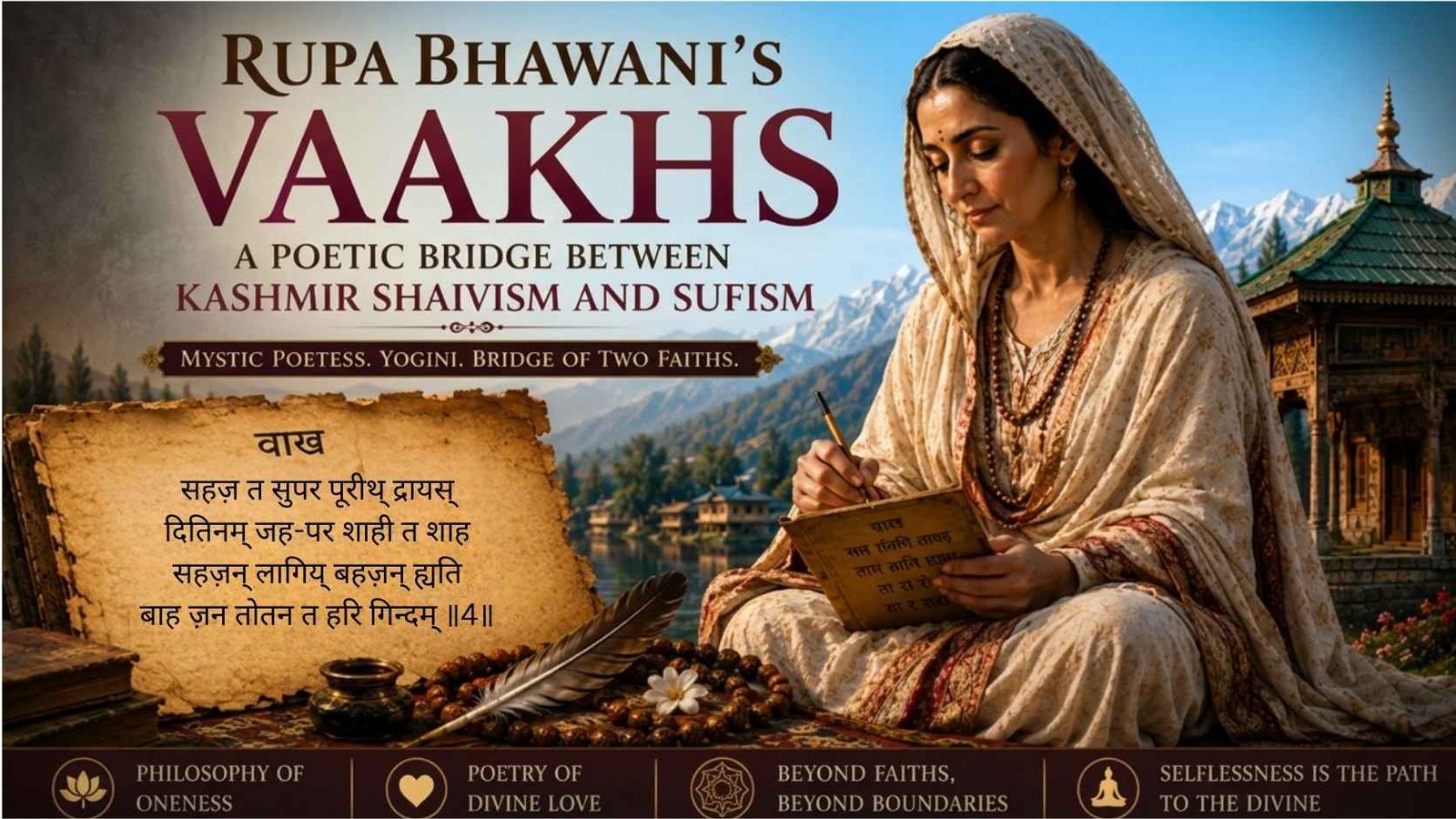
Rupa Bhawani’s Vaakhs: A Poetic Bridge Between Kashmir Shaivism and Sufism
Rupa Bhawani blended Hindu Kashmir Shaivism with Islamic Sufism by recognising and expressing the shared ultimate reality underlying both traditions. She achieved this profound synthesis through her spiritual philosophy, poetic expression, and inclusive daily practices:
- Philosophical Synthesis: She saw that the Kashmir Shaiva concept of Shiva-consciousness and the Sufi experience of fana (the annihilation or dissolution of the individual ego) point toward the same divine reality. She understood that the Sufi emphasis on the direct experience of divine love and the inadequacy of external religious forms resonated deeply with the non-dual insights of Kashmir Shaivism. Throughout her teachings, she emphasised that the dissolution of the self and “selflessness” are essential for achieving realisation and oneness with God, a core theme bridging both faiths.
- Fluid Poetic Imagery: In her poetic verses, known as Vaakhs, Bhawani utilised a fluid spiritual language that seamlessly moved between Shaiva and Sufi registers. She addressed the divine simultaneously as the “Shiva” of the Kashmiri Hindu tradition and as the “Beloved,” a central concept in Sufi mysticism. Her poetry frequently features Sufi motifs—such as the consuming power of divine love and the total annihilation of the ego—which she mapped with intuitive mastery onto the Shaiva understanding of jiva (individual consciousness) uniting with Shiva (universal consciousness).
- Cross-Traditional Practices: Her primary place of residence and spiritual practice in Srinagar was at Khanqah-i-Shokta, a name that incorporates the Persian term Khanqah (a Sufi lodge or hospice). This naming convention highlights the cross-traditional nature of her physical spiritual centre. Operating outside of strict sectarian boundaries, she accepted both Hindus and Muslims as her disciples and devotees, offering her spiritual guidance universally.
- Accessible Teachings: Following in the footsteps of her spiritual predecessor, Lal Ded, she composed her Vaakhs in colloquial Kashmiri. She took the highly sophisticated principles of both Kashmir Shaivism and Islamic Sufism and made them accessible to the common people by using familiar, everyday imagery to explain ultimate truths.
Through this deep integration, Rupa Bhawani emerged as a unifying spiritual figure who transcended doctrinal boundaries and fostered a lasting mutual harmony between the Hindu and Muslim communities of 17th-century Kashmir.
Rupa Bhawani’s Vaakhs are short, aphoristic mystical verses that she spoke extempore. The term Vaakh translates simply to “speech” or “utterance” in Kashmiri. While she delivered these soul-stirring sermons orally in colloquial Kashmiri, her devotees subsequently recorded them in manuscript form on Burj (bhojpatra leaves) using the Sharda script.
Language and Forms of Rupa Bhawani’s Vakhs
The verses typically range from three to seven lines in length. Although grounded in everyday Kashmiri, some of her Vaakhs are composed in an uncommon, complex language that blends Sharda, Sanskrit, Persian, Hindi, and Punjabi. Because of this linguistic complexity, only highly learned and elevated souls have been able to successfully translate their meanings.
She employed an immediate, earthy, and accessible poetic style, using concrete images from daily Kashmiri life—such as weaving, rivers, mountains, and the domestic sphere—to convey abstract, ineffable spiritual truths. A defining feature of her style is a direct, intimate form of address. In her poetry, the “I” of the poem often speaks directly to the “you” of the reader’s own mind, sometimes scolding the mind for its restlessness and other times encouraging it toward spiritual liberation.
Core Themes and Philosophy: The Vaakhs are broadly classified into four areas: salvation, knowledge-seeking, divine ecstasy, and self-realisation. Key concepts explored in her poetry include:
- Yogic Practice and Awakening: Rupa Bhawani frequently described her own yogic practices and the awakening of the Kundalini using accessible language. For instance, she writes about dashing “into the nether regions” to bring “the vital breath up,” which awakens her Kundalini with inner mystic sounds (nada).
- Selflessness and Annihilation of the Ego: A central pillar of her poetry is the belief that the total dissolution of the ego is a prerequisite for divine communion. She famously wrote, “Selflessness is the sign of the selfless; Bow down at the door of the selfless”.
- The Role of the Guru: She deeply revered the spiritual teacher, viewing the guru as the essential conduit for divine grace. At the same time, her Vaakhs consistently point seekers toward their own “inner guru”—the inherently enlightened dimension of personal consciousness.
- Synthesis of Traditions: Her verses seamlessly map the Sufi imagery of the “Beloved” and the total consumption of divine love onto the Kashmir Shaiva framework of the individual soul (jiva) merging with universal consciousness (Shiva).
Rupa Bhawani’s Vaakhs carry the weight of direct, lived spiritual realisation rather than mere bookish doctrine. Because they transcend strict religious boundaries and express a universal inner journey, her verses have been overwhelmingly embraced and sung by both Hindu and Muslim communities in Kashmir during their cultural and religious discourses. Today, a collection of these profound sayings is preserved in a book titled Rupabhavani Rahasyopadesha
The Legend of Her Death
No episode from her life is repeated more often than the story of her passing in 1721, though the story itself is not told the same way twice. In every version, her death sets off a dispute: Kashmir’s Muslim community wants her buried by Islamic rites, insisting she was theirs, while Hindu devotees want her cremated.
From there, the accounts diverge. One version holds that when the shroud covering her body was lifted, no body remained, only a lock of her hair, said to be preserved at her shrine to this day, leaving neither side able to claim her remains. A separate, widely circulated account instead describes the matter being taken to the Mughal governor of the time, with the Mata reviving briefly to instruct her brother before the dispute was resolved. Sources do not agree on which telling is original, and this article makes no claim as to which is accurate. What both versions agree on is the underlying point: in death, as in life, no single community could fully claim her.
Sahib Saptami: Remembering Rupa Bhawani Today
Sahib Saptami in Kashmir is the annual commemoration of Mata Rupa Bhawani’s mahanirvana and holds deep religious and cultural significance for Kashmiri Hindus. It is observed as a day of remembrance, prayer, hawan, and devotional offerings, especially kheer and prasadam.
Sahib Saptami marks the day in 1721 when Rupa Bhawani left her earthly body, and the day became known as Sahib Saptami.
Sahib Saptami is not just a religious date; it is a living expression of Kashmiri memory, saint veneration, and cultural continuity. For many Kashmiri Hindus, it connects spiritual devotion with identity, ancestry, and the preservation of tradition across generations.
The Mata Shree Roop Bhawani Temple, Talab Tillo
In Jammu, devotees worship her at the Mata Shree Roop Bhawani Temple in Talab Tillo, managed by the Shri Alakh Sahiba Trust. The temple is located at Mata Shree Roopbhawani Lane, 49/2, Tirath Nagar, Talab Tillo, Jammu, Pin-180002.
Why Her Story Still Matters
Kashmiri Pandit history is too often reduced to loss alone. Rupa Bhawani’s life sits alongside it as something else: a woman who left a failing marriage, built a spiritual practice from solitude in the Ganderbal hills, and became a figure so trusted across religious lines that, even in death, competing communities could not settle whose she was.

Rohit Tikoo is a published author, researcher, and content strategist with over two decades of writing experience. He is the author of nine books covering Kashmir, Indian philosophy, social issues, and contemporary thought, including Shadows Over the Valley: Operation TUPAC, Cold War Geopolitics, and the Kashmiri Pandits Exodus (2025).
His work focuses on Kashmir’s history, literature, culture, and the lived experiences of the Kashmiri Pandit community. Through extensive research, archival references, and historical analysis, he seeks to document and preserve narratives that are often overlooked in mainstream discourse. His writing on Kashmir has appeared in DAILY EXCELSIOR, HEADLINES TODAY, ONLY KASHMIR, GREATER KASHMIR, NAAD,
VITASTA, CHATTAN, AND VOICE OF SILENCE.
Through rohittikoo.com, he publishes research-based articles, essays, and commentary aimed at fostering informed discussion on Kashmir, Indian civilisation, literature, and contemporary society.