
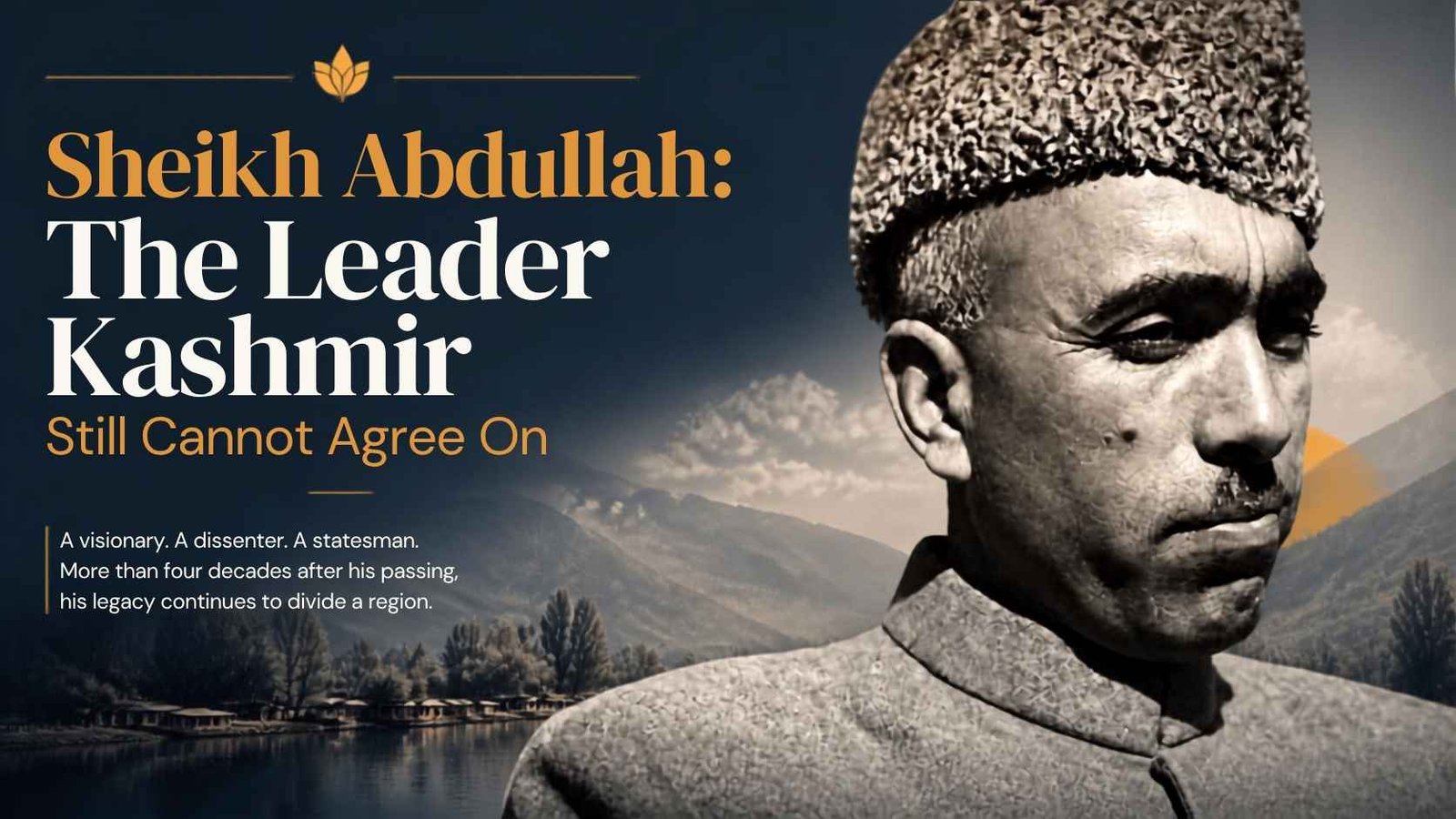
Sheikh Mohammad Abdullah (5 December 1905 to 8 September 1982) was the dominant political figure of twentieth-century Kashmir. He led the mass movement against Dogra rule, endorsed the state’s accession to India in 1947, governed as its prime minister, abolished landlordism without paying a rupee in compensation, was dismissed and jailed by the very republic he had helped bring Kashmir into, and returned to power twenty-two years later having quietly abandoned the demand for a plebiscite. No other figure shaped what Kashmir became between 1931 and 1982, and none is argued over more bitterly today.
Almost every claim made about him is contested by somebody. To Kashmiri Muslims of one generation he was the man who gave the peasant his field; to another he was the man who traded a nation’s aspiration for a chief minister’s chair. To many Kashmiri Pandits he is the leader under whom their community’s position in the Valley began to erode. To the Government of India of 1953, he was a security risk. All four readings draw on the same documented life.
Quick reference
- Born: 5 December 1905, Soura, near Srinagar
- Died: 8 September 1982, Srinagar, aged 76
- Founded: All Jammu and Kashmir Muslim Conference (October 1932), renamed the National Conference in 1939
- Held office: Prime Minister of Jammu and Kashmir from 5 March 1948 to August 1953; Chief Minister from 9 July 1977 until his death
- Time in detention: arrested nine times, roughly twenty-two years in custody by his own account
From a physics degree to the gates of Central Jail
Abdullah’s route into politics ran through a classroom, not a durbar. He took a degree from Punjab University in 1928 and a postgraduate degree in physics from Aligarh Muslim University in 1930, having earlier studied at Prince of Wales College in Jammu and Islamia College in Lahore. He then took a teaching post, and left it for politics.
What turned him into a leader was the summer of 1931. A man from the North-West Frontier Province named Abdul Qadir, arrested on 25 June 1931 after what a contemporary official account called ‘a very unrestrained and inflammatory speech’, was tried inside Srinagar’s Central Jail. On 13 July, as the session judge arrived at about one in the afternoon, ‘a crowd of four or five thousand Mohammadans had collected at the jail’, swelling to roughly seven thousand. The police opened fire.
How many died is itself disputed, and the dispute matters because it has been carried forward for ninety-five years. The contemporary official record cited in Dr Anu Mankotia’s 2026 study states that ‘ten men were killed by the firing at the jail and several wounded’. Kashmiri commemorative accounts, including the version repeated in Kashmiri newspapers to this day, put the figure at twenty-two men shot while attempting to call the azaan.
What followed the firing is less often mentioned in the commemorations. The same official account records that ‘one section of the mob on this way back from the jail invaded the Maharaj Ranbir Ganj Bazaz’, where it ‘looted and burnt Hindu shops destroying or carrying away property worth several lakhs and inflicted bodily injury on several Hindus’. The day that founded modern Kashmiri Muslim politics also left the Valley’s communities looking at one another differently, and both halves of it belong in the record.
The killings forced Maharaja Hari Singh’s hand. Having first treated the agitation as a law-and-order matter, he appointed the Glancy Commission, which recognised the grievances of Kashmiri Muslims. Abdullah, in the words of Mankotia’s study, ‘became more popular among the masses after this event’. The Commission’s findings also produced a counter-current that the scholar Bilal Ahmad Mir notes plainly: Abdullah ‘would have been aware of the resentment the Glancy Commission’s recommendations had caused among the Valley’s most politicised Kashmiri Pandits’.
Muslim Conference to National Conference
In October 1932 Abdullah founded the All Jammu and Kashmir Muslim Conference. In 1939 it was renamed the National Conference, opening membership beyond Muslims and reorienting the party towards a secular, anti-feudal programme.
The change is one of the most argued-over decisions of his career. To his admirers it was the moment Kashmiri politics chose class over communal identity. To his Kashmiri Muslim critics, including the writer Ashiq Hussain Bhat, it was the moment the movement was captured: Bhat contends that the party ‘was under firm control of non-Muslims, prominent among them being Sardar Budh Singh, Prem Nath Bazaz, Kashyap Bando and others’. That criticism has been aimed at Abdullah from within Kashmir, not from outside it, which is worth registering before it is filed away as an Indian or Pandit complaint.
Naya Kashmir, 1944: the document that outlived him
The National Conference presented the Naya Kashmir manifesto in 1944, after an annual session attended by Jawaharlal Nehru, Khan Abdul Ghaffar Khan and Maulana Abul Kalam Azad. It ran to fifty-two articles. It guaranteed ‘equal status’ to permanent residents and ‘complete freedom of faith, conscience and worship’, along with free speech and a free press.
Two of its provisions did more than the rest. A peasants’ charter held that ‘every peasant has the right to land’. A separate women’s charter set out to help women attain ‘their just, equal and rightful place in society’. In a princely state still governed under a Dogra maharaja, both were radical propositions rather than manifesto decoration.
Naya Kashmir is the key to understanding everything Abdullah did in office. He did not improvise his land reform once he had power. He had published the programme in 1944 and then, given the chance, carried it out almost to the letter.
Quit Kashmir, 1946: sovereignty as a legal question
In May 1946 Abdullah launched the Quit Kashmir movement, which attacked Dogra rule at its foundation by arguing that the Treaty of Amritsar of 1846 had been nothing more than a sale deed, and that sovereignty over Kashmir had therefore never legitimately belonged to the Maharaja.
He was arrested on 20 May 1946 near Muzaffarabad and arraigned for treason and sedition. Asaf Ali appeared for his defence. The sessions judge sentenced him to three years’ simple imprisonment and a fine of five hundred rupees.
The arrest drew Nehru personally into Kashmir’s affairs. On 16 June 1946 Nehru defied the ban on his entry, crossed into the state via the Kohala bridge, and was himself placed under house arrest in a dak bungalow. The friendship that decided Kashmir’s fate eighteen months later was forged in that prosecution.
1947: from prison cell to head of government
When the tribal invasion came in October 1947, Abdullah was a man convicted of sedition by the state he was about to run. The sequence that followed was extraordinarily compressed. On 26 October 1947 the ruler signed the Instrument of Accession, ‘in duress’ in Mankotia’s phrase; on 30 October 1947 the Maharaja placed Abdullah at the head of the administration. The emergency arrangement was replaced by a popular interim government on 5 March 1948, and Abdullah was appointed Prime Minister of Jammu and Kashmir on that date.
His endorsement was the reason the accession was held politically. As the record of Maharaja Hari Singh and the 1947 Instrument of Accession sets out, Abdullah was ‘released from prison as the crisis unfolded, was installed as head of an emergency administration and then as the state’s prime minister’, and Nehru regarded him as essential to keeping Kashmir within the Indian Union. A maharaja’s signature transferred a state. A popular leader’s assent made it stick while Pakistan’s tribal columns were burning their way towards Srinagar.
He is also credited, by Kashmiri accounts sympathetic to him, with protecting Kashmiri Pandits during the communal violence of 1947.
He joined India’s Constituent Assembly on 16 June 1949. He never spoke in its debates, yet he negotiated the terms on which Jammu and Kashmir entered the Union, terms that became Article 370.
Land to the tiller: the 1950 reform that remade the Valley
The Jammu and Kashmir Big Landed Estates Abolition Act, Samvat 2007, corresponding to 1950, is the single most consequential law Abdullah ever passed. Section 25 capped a proprietor at 182 kanals, which is twenty-two and three-quarter acres, excluding orchards and fuel and fodder land. Section 2(d) defined the beneficiary narrowly as ‘a person who tills land with his own hands’ and who was in cultivating possession when the Act commenced. Land above the ceiling passed to that tiller in ownership right.
Section 26 is the clause that made it revolutionary rather than merely redistributive: ‘No compensation shall be paid in respect of land from which expropriation has taken place under this Act.’ An annuity was provided for limited periods, and nothing more. The tiller paid the former owner nothing. A ceiling of 160 kanals was imposed on the tiller in turn, so the reform could not simply manufacture a new landed class.
The scale was immediate. By the end of March 1953, 188,775 acres had been transferred to 153,399 tillers, and by the end of April 1953 the figure stood at 192,652 acres attested in favour of 160,939 tillers. In total, roughly 9,000 landowners lost about 450,000 acres of surplus land. The scholar Brecher, quoted by Aijaz Ashraf Wani, called it ‘the most sweeping agrarian reform undertaken in the Indo-Pakistan subcontinent since the partition’, and on the numbers he was not exaggerating.
What the reform meant for Kashmiri Pandits
This is the part of Abdullah’s record that matters most to the Pandit community, and it needs stating carefully, because the honest answer is narrower than the version usually circulated.
What the sources do support is this. The reforms of the 1950s redistributed land from large landowners to peasants and landless labourers. In the Jammu region, as Maqsood Hussain Para and Altaf Hussain Para record, ‘the majority of landlords and moneylenders were Hindus, and the axe naturally fell on them’. Between 1950 and 1952 large numbers of landless peasants became peasant proprietors, mostly Muslims in the Valley but including some 250,000 lower-caste Hindus in Jammu.
In the Valley, the reform fell on the proprietors, and Bilal Ahmad Mir’s study of Pandit displacement frames the consequences in terms of perception as much as property. ‘The reforms and the decline of the Maharaja’s authority contributed to their sense of marginalisation and resentment towards the new political order,’ he writes, and the belief that ‘the government favoured the Muslim majority in the Kashmir Valley contributed to their sense of insecurity and marginalisation’. Even a Kashmiri account broadly sympathetic to Abdullah concedes that ‘clouds of mistrust were created by Hindu landlords who had lost their lands’.
What no source consulted for this article supports is a communal breakdown of the 9,000 expropriated proprietors in the Valley, or a reliable figure for how many Pandit families left Kashmir in the decade that followed. Those numbers are asserted confidently in a great deal of online writing. They are not, on the available record, established, and the longer history of the Kashmiri Pandit community is not well served by figures nobody can source.
What can be said on the record is this. The 1950 Act was a genuine emancipation for the Valley’s Muslim peasantry, carried out at the direct expense of the proprietary class, without compensation. It is the point from which scholarship on Pandit displacement dates the community’s sense of losing its place in the new order, and no honest account of Abdullah can leave that consequence out of the ledger alongside the achievement.
How the alliance with Delhi broke
Abdullah’s authority in the early 1950s was close to absolute, and the manner of it did him lasting damage. In the 1951 Constituent Assembly election, National Conference candidates were returned unopposed in 73 of 75 constituencies and defeated independents in the remaining two. The results, in the flat assessment of one survey of the state’s elections, were ‘disputable’. A hostile contemporary account went further, alleging that opposition candidates ‘were kept out either by wholesale rejection of nomination papers or plain physical coercion’, and describing the party’s Peace Brigade as a body that terrorised opponents into submission.
Jammu answered. From the beginning of December 1952 the Praja Parishad ran a satyagraha demanding that accession be finalised by a resolution of the state’s Constituent Assembly. Syama Prasad Mookerjee took the campaign national under the slogan ‘Ek desh mein do Vidhan, do Nishan nahin chalenge’, that two constitutions and two flags in one country would not do. Abdullah described Mookerjee’s proposed visit as ‘inopportune’. Mookerjee entered the state from Pathankot on 11 May 1953 and was arrested. On 23 June 1953 he died in detention in Srinagar in circumstances that have never been satisfactorily explained.
Seven weeks later Abdullah was gone. His cabinet had divided over the state’s relationship with India, with demands circulating for a separate flag, a separate constitution and a separate head of state. The stated grounds for his removal were that he had established a liaison with the Pakistan government, had talked of an independent Kashmir, and had lost the confidence of his cabinet.
The mechanics of the night are worth recording precisely, because the two dates in circulation are both defensible. Mankotia’s account has the Sadr-i-Riyasat dismissing the government and ordering the arrest on 8 August 1953. Kashmiri accounts date the removal to 9 August and place the arrest at Gulmarg. The Kashmir Times reconstruction reconciles them: Bakshi Ghulam Mohammad ‘had already been invited to form a new government at 1 A.M’, and Abdullah ‘was served his dismissal order and arrested at 4.20 A.M’, the order coming from the Sadr-i-Riyasat, Dr Karan Singh. For roughly three hours, Jammu and Kashmir had two prime ministers.
The Kashmir Conspiracy Case and twenty-two lost years
What followed was not a brief detention. Abdullah was held from August 1953, released in January 1958, and re-arrested that April. On 24 October 1958 a trial opened before a special magistrate’s court at Jammu on a charge of conspiracy to overthrow the state government and facilitate the annexation of Kashmir by Pakistan.
Thirty people were accused, among them his former revenue minister Mirza Afzal Beg. Two turned approvers, and nine were tried in absentia. The prosecution alleged an underground organisation, coordination with Pakistani intelligence, a campaign of bomb explosions in 1957 and 1958, and that the Plebiscite Front had been founded as cover for the conspiracy. The prosecution closed its case on 1 May 1961. The proceedings were withdrawn in 1964 as a political decision, and no verdict was ever delivered.
The Plebiscite Front was established by Beg in 1955. Abdullah patronised the movement from 1955 to 1972 while carefully never joining it, a distinction that says a good deal about how he handled risk. By 1972 he was saying publicly that he had never differed with India on the fact of accession, ‘but only on the question of quantum of accession’. Across his life he was arrested nine times and, by his own reckoning, spent about twenty-two years in custody in jails at Ooty, Kodaikanal, Udhampur and Kud. He described those years as wasted in political wilderness.
The 1975 Accord: what he actually signed away
The Indira-Sheikh Accord was announced on 24 February 1975, negotiated by G. Parthasarathi for Indira Gandhi and Mirza Afzal Beg for Abdullah.
Its terms repay reading, because they are far less generous than the word ‘accord’ suggests. Jammu and Kashmir was affirmed as ‘a constituent unit of the Union of India’ which ‘shall, in its relation with the Union, continue to be governed by Article 370’. Residuary powers of legislation would remain with the state, but Parliament would continue to hold power to legislate against activities ‘directed towards disclaiming, questioning or disrupting the sovereignty and territorial integrity of India’. On the central grievance, the erosion of autonomy after 1953, the state government won only the right to ‘review’ laws made by Parliament or extended to the state after 1953. A review, not a reversal.
The plebiscite demand was simply not mentioned. Beg dissolved the Plebiscite Front in 1975 to revive the National Conference in its place, and Abdullah, in Ashiq Hussain Bhat’s acid phrase, ‘lost no time to take its membership’. The accord returned him to power after twenty-two years. Whether it returned anything to Kashmir is the question his Kashmiri critics have never stopped asking.
1977, and the funeral of a million people
The state’s first genuinely free and fair election came in 1977. The National Conference won 47 of 76 seats on 46.2 per cent of the vote, including 39 of the 42 seats in the Kashmir Valley. Abdullah was sworn in as Chief Minister on 9 July 1977.
It is a striking fact that the man Delhi had prosecuted as a Pakistani conspirator won the cleanest election the state had ever held, and won it comfortably. It is an equally striking fact that the same National Conference machinery would preside over the rigged election of 1987 that broke the Valley’s faith in the ballot altogether.
Abdullah remained Chief Minister until he died on 8 September 1982, aged 76. He was succeeded by his son Farooq Abdullah. Around a million mourners followed the funeral procession; four died in the crush, and scores fainted. Decades on, his grave was still under guard, which is the plainest possible statement of how unsettled his memory remains.
Why are 13 July and 5 December no longer public holidays in Jammu and Kashmir?
Because both were removed after the reading down of Article 370 in 2019, and successive holiday calendars have kept them out.
Martyrs’ Day on 13 July commemorates those killed outside Central Jail in 1931. It was excised from the list of public holidays after 2019. Abdullah’s birth anniversary on 5 December went with it. The calendar issued for 2026 left both out again, despite the National Conference having repeatedly asked for their restoration. Tanvir Sadiq of the National Conference put the constitutional position bluntly: ‘despite the elected government being in favour, unelected authorities are opposing it’, and ‘the declaration of a holiday on such occasions is no longer within the powers of the elected government; the final decision rests with the Centre’.
The commemoration has not stopped; it has simply been policed. Ahead of Martyrs’ Day in July 2026, all roads to the Naqshband Sahib graveyard in Srinagar’s old city were barred to politicians, with ‘a siege of concertina wires, plastic barricades, GI sheets and poles’ laid near Nowhatta. Iltija Mufti said the family had been ‘placed under house arrest on the eve of Martyrs’ Day for reasons best known to JK Police’. The restrictions followed the previous year, when Chief Minister Omar Abdullah scaled the graveyard fence to pay his tribute after police locked the gates.
A sitting chief minister scaling a fence to lay flowers at the graves that made his party, while the administration he nominally heads bars the road, is as good a summary of the Abdullah inheritance as any historian could write.
Frequently asked questions
Was Sheikh Abdullah pro-India or pro-independence?
Both, at different times, and the ambiguity was deliberate. He endorsed accession in 1947 and negotiated the terms of Jammu and Kashmir’s entry into the Union. By 1953 his cabinet was divided over demands for a separate flag, constitution and head of state, and India charged him with conspiring to hand Kashmir to Pakistan, a charge withdrawn in 1964 without a verdict. In 1972 he stated that he had never disputed the fact of accession, only its quantum. Many Indian leaders nonetheless believed his ultimate aim was independence.
What did Sheikh Abdullah do for Kashmiri farmers?
The Big Landed Estates Abolition Act of 1950 capped proprietors at 182 kanals, or twenty-two and three-quarter acres, and transferred the surplus to the tiller in ownership right with no compensation paid to the former owner. By April 1953, 192,652 acres had been attested in favour of 160,939 tillers.
Why do many Kashmiri Pandits view Sheikh Abdullah critically?
Chiefly because the 1950 land reform abolished proprietorship without compensation, and because the political order that followed left Pandits feeling that the state favoured the Muslim majority. Scholarship on Pandit displacement traces the community’s sense of marginalisation and insecurity to precisely this period, citing both the reforms and the decline of the Maharaja’s authority.
Why was Sheikh Abdullah dismissed in 1953?
He was dismissed by the Sadr-i-Riyasat, Dr Karan Singh, because he had established a liaison with Pakistan, had spoken of an independent Kashmir, and had lost his cabinet’s confidence. Bakshi Ghulam Mohammad was invited to form a government at 1 am, and Abdullah was arrested at 4.20 am.
How long was Sheikh Abdullah in jail?
He was arrested nine times and, by his own account, spent about twenty-two years in detention, including the long stretch from August 1953 that was broken only briefly in early 1958.
What was the 1975 Kashmir Accord?
An agreement announced on 24 February 1975 under which Jammu and Kashmir remained a constituent unit of the Union governed by Article 370, residuary legislative powers stayed with the state subject to Parliament’s power over threats to sovereignty and territorial integrity, and the state government gained the right to review laws extended to it after 1953. It made no mention of a plebiscite and returned Abdullah to power.
Sources
- Britannica, ‘Sheikh Muhammad Abdullah’, Encyclopaedia Britannica. https://www.britannica.com/biography/Sheikh-Muhammad-Abdullah
- ‘Sheikh Muhammad Abdullah’, Encyclopedia.com. https://www.encyclopedia.com/people/history/south-asian-history-biographies/sheikh-muhammad-abdullah
- ‘Sheikh Mohammad Abdullah’, Constituent Assembly Debates member profile, Constitution of India. https://www.constitutionofindia.net/members/sheikh-mohammad-abdullah/
- Government of Jammu and Kashmir, The Jammu and Kashmir Big Landed Estates Abolition Act, 2007 (Act No. XVII of 2007). https://prsindia.org/files/bills_acts/acts_states/jammu-and-kashmir/1950/1950J&K17.pdf
- Aijaz Ashraf Wani, ‘Costly Land Reforms’, Kashmir Life, 17 July 2019. https://kashmirlife.net/costly-land-reforms-issue-16-vol-11-215417/
- Maqsood Hussain Para and Altaf Hussain Para, ‘Politics of Land Reforms in Jammu and Kashmir’, North Asian International Research Journal of Social Science and Humanities, vol. 3, issue 10, October 2017. https://www.nairjc.com/assets/img/issue/GOm5vE_0jaD4L_j73Ipo_GENeQW_165861.pdf
- Bilal Ahmad Mir, ‘Kashmiri Pandits Amid Conflict-induced Displacement: Facts, Issues, and the Future Ahead’, Journal of Internal Displacement, vol. 14, no. 1, January 2024. https://journalofinternaldisplacement.org/index.php/JID/article/download/150/90/
- Anu Mankotia, ‘Society and Religion in Kashmir: Uprising of 13th July 1931’, International Journal of Creative Research Thoughts, vol. 14, issue 2, 2026. https://www.ijcrt.org/papers/IJCRT2602230.pdf
- Anu Mankotia, ‘Dismissal of Sheikh Abdullah Government in 1953’, Library Progress International, vol. 43, no. 1, 2023. https://bpasjournals.com/library-science/index.php/journal/article/download/4425/4346/9473
- Nasir Hussain, ‘The Political Fallout of July 13, 1931: Kashmir’s Historical Memory in Contention’, Kashmir Times, 6 March 2025. https://kashmirtimes.com/opinion/comment-articles/struggle-of-memory-and-forgetting
- ‘Naya Kashmir (1944-2014), The History of National Conference’s Manifestos’, Outlook India. https://www.outlookindia.com/national/naya-kashmir-1944-2014-the-history-of-national-conference-s-manifestos-weekender_story-291803
- ‘Sheikh Abdullah: A Political Sufferer-II’, Kashmir Observer, 10 September 2012. https://kashmirobserver.net/2012/09/10/sheikh-abdullah-a-political-sufferer-ii/
- ‘Sheikh Mohammad Abdullah: Villain or Hero?’, Kashmir Observer, 4 December 2018. https://kashmirobserver.net/2018/12/04/sheikh-mohammad-abdullah-villain-or-hero/
- Puran Chand, ‘Elections in Jammu and Kashmir Since 1951’, Journal of Emerging Technologies and Innovative Research, vol. 10, issue 4, April 2023. https://www.jetir.org/papers/JETIR2304080.pdf
- Kamal Ahmed Siddiqui, Asri Adab, January to April 1990, reproduced in Kashmir Sentinel, August 2002. https://panunkashmir.org/kashmirsentinel/aug2002/13.html
- Arun Anand, ‘How Syama Prasad Mookerjee launched first nationwide campaign on J&K and paid with his life’, ThePrint, 23 June 2020. https://theprint.in/india/how-syama-prasad-mookerjee-launched-first-nationwide-campaign-on-jk-and-paid-with-his-life/446397/
- ‘When J&K Had 2 Prime Ministers, For 3 Hours?’, Kashmir Times, 26 February 2024. https://kashmirtimes.com/jammu-and-kashmir-news/the-day-jk-had-two-prime-ministers-unveiling-the-political-drama-of-1953
- M J Aslam, ‘August 9, 1953: Why Sheikh Abdullah was removed?’, Kashmir Life, 17 August 2018. https://kashmirlife.net/august-9-1953-why-sheikh-abdullah-was-removed-183655/
- ‘Trial of Sheikh Abdullah on Conspiracy Charges’, Keesing’s Record of World Events, vol. 7, August 1961. https://web.stanford.edu/group/tomzgroup/pmwiki/uploads/1309-1961-08-xx-KS-a-RRW.pdf
- Ashiq Hussain Bhat, ‘An Enigma Called Sheikh’, Kashmir Life, 2 December 2013. https://kashmirlife.net/enigma-called-sheikh-49330/
- ‘Indira Abdullah Accord 1975’, Kashmir Life, 24 February 2010. https://kashmirlife.net/indira-abdullah-accord-1975-365160/
- Mohammad Sayeed Malik, ‘1977: J&K’s Electoral Watershed’, Greater Kashmir, 9 July 2026. https://www.greaterkashmir.com/opinion/1977-jks-electoral-watershed-12147090
- Sheikh Qayoom, ‘Jayalalithaa’s demise revives memories of Sheikh Abdullah’s death in Kashmir’, Muslim Mirror, 6 December 2016. https://muslimmirror.com/jayalalithaas-demise-revives-memories-of-sheikh-abdullahs-death-in-kashmir/
- ‘J&K holiday calendar 2026: July 13, Sheikh Abdullah’s anniversary holidays given a miss yet again’, Greater Kashmir, 15 December 2025. https://www.greaterkashmir.com/gk-top-news/jk-holiday-calendar-2026-july-13-sheikh-abdullahs-anniversary-holidays-given-a-miss-yet-again/
- ‘Access to Naqshband Sahib graveyard barred ahead of Martyrs’ Day’, Kashmir Images, 13 July 2026. https://thekashmirimages.com/2026/07/13/access-to-naqshband-sahib-graveyard-barred-ahead-of-martyrs-day/

Rohit Tikoo is a published author, researcher, and content strategist with over two decades of writing experience. He is the author of nine books covering Kashmir, Indian philosophy, social issues, and contemporary thought, including Shadows Over the Valley: Operation TUPAC, Cold War Geopolitics, and the Kashmiri Pandits Exodus (2025).
His work focuses on Kashmir’s history, literature, culture, and the lived experiences of the Kashmiri Pandit community. Through extensive research, archival references, and historical analysis, he seeks to document and preserve narratives that are often overlooked in mainstream discourse. His writing on Kashmir has appeared in DAILY EXCELSIOR, HEADLINES TODAY, ONLY KASHMIR, GREATER KASHMIR, NAAD,
VITASTA, CHATTAN, AND VOICE OF SILENCE.
Through rohittikoo.com, he publishes research-based articles, essays, and commentary aimed at fostering informed discussion on Kashmir, Indian civilisation, literature, and contemporary society.