
Saqiya lubey lubaab, chaav mai Jaam-i-Jamai.
Tashne lab gasi sehraab, chaav mai Jaam-i-Jamai.
A Literary RenderingO Cupbearer, fill the Cup of Jamshid with the purest essence. Let these parched lips savour its wine.
For nearly two centuries, these immortal lines have echoed through Kashmir. They have been sung in homes, remembered in cultural gatherings, and carried across generations, long after the poet who composed them left this world. Few opening verses in Kashmiri literature have travelled so far or endured so gracefully.
To a modern reader, the imagery of the Cupbearer, the wine, and the Cup of Jamshid may appear literal. Yet Rasul Mir inherited a poetic tradition in which these symbols expressed love, beauty, wisdom, longing, and spiritual awakening. His poetry invites the reader beyond the visible world into one where emotion is conveyed through metaphor and every image carries multiple meanings.
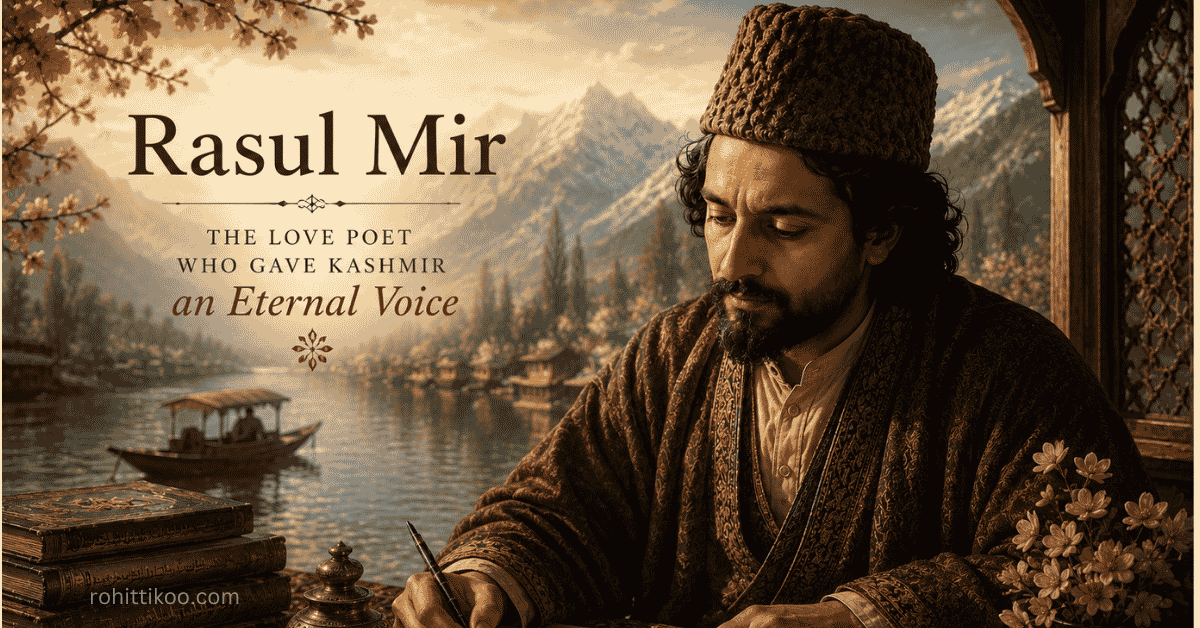
As one of the finest voices in Kashmiri literature, Rasul Mir transformed his native language into a lyrical expression of love that continues to resonate. More than a century after his passing, his poetry remains alive not only in books but also in the collective memory of the people, earning him a place among the most beloved poets the Valley has produced.
This article seeks to understand Rasul Mir through the world that shaped him, the poetry that made him immortal, and the literary legacy he left behind. Where historical evidence is available, it has been followed. Where scholars differ, those differences have been acknowledged. Legends and oral traditions have been treated with respect but are not presented as established history.
For a poet whose greatest gift was language, there can be no better introduction than his own words.
The Valley That Shaped a Poet
The life of Rasul Mir is easier to trace through his poetry than through historical records. Like many literary figures of nineteenth-century Kashmir, he left behind verses that have survived more faithfully than the details of his own biography.
Even the exact year of his birth remains the subject of scholarly discussion. Different researchers have proposed different dates based on the historical evidence available to them, though there is broad agreement that Rasul Mir belonged to the middle decades of the nineteenth century and was born in Dooru Shahabad, in the present-day Anantnag district of Jammu and Kashmir.
The uncertainty surrounding his chronology reflects the historical realities of the time. Poetry travelled through memory, music, and oral tradition, while personal histories were rarely documented with the same care. Much of what is known about Rasul Mir has therefore been reconstructed from literary evidence, historical references, and later scholarly research. Although aspects of his life remain open to debate, there is little disagreement about the significance of his contribution to Kashmiri literature.
To understand Rasul Mir, one must first understand the Kashmir into which he was born.
Nineteenth-century Kashmir was a meeting place of languages and literary traditions. Persian remained the language of scholarship, administration, and refined literary expression. Arabic continued to shape religious learning, while Sanskrit preserved an older philosophical inheritance. Kashmiri, however, was the language of everyday life. It was spoken within homes, sung during celebrations, and carried across generations through stories and folk songs.
It was also a civilisation where poetry belonged to the people. Long before printed books became common, poems travelled from village to village through memory and music. A verse survived because it was remembered. A poet survived because his words continued to be sung. In such a world, literary success was measured not by publication but by remembrance.
Rasul Mir received a traditional education in Persian, introducing him to the works of classical masters such as Hafiz, Saadi, and Jami. Their poetry shaped his understanding of metaphor, rhythm, and lyrical expression. Yet his greatest achievement lay not in writing Persian poetry, but in bringing its artistic refinement into the Kashmiri language.
Rather than imitating Persian literature, Rasul Mir absorbed its symbolic richness and allowed it to flourish within the landscapes, speech, and emotional life of Kashmir. His poems retained the elegance of classical imagery while remaining rooted in the experiences of ordinary people. Readers encountered familiar orchards instead of distant gardens, local rhythms instead of foreign cadences, and emotions expressed in a language that belonged to their own lives.
This union of literary refinement and emotional simplicity became the defining quality of Rasul Mir’s poetry. It also explains why his verses passed so naturally into the oral tradition. Long before scholars collected and studied his works, the people of Kashmir had already preserved them through memory and song. That quiet act of remembrance became the foundation of his immortality.
Rasul Mir: The Making of a Romantic Voice
Many poets of nineteenth-century Kashmir were educated in Persian, but only a few transformed Kashmiri literature. Rasul Mir achieved this not by abandoning the classical tradition, but by giving it a distinctly Kashmiri voice. The themes that had flourished for centuries in Persian poetry, such as love, beauty, longing, youth, separation, and hope, found new life in his native language.
His beloved did not inhabit an imagined Persian garden; she walked through the orchards and meadows of Kashmir. Its rivers, blossoms, seasons, and village life became inseparable from his poetic imagination. The emotions he expressed were universal, yet the world in which they unfolded belonged unmistakably to the Valley.
This balance between the universal and the local gave Rasul Mir’s poetry a rare quality. It could be appreciated by readers familiar with classical literary traditions, while remaining accessible to ordinary Kashmiris who encountered his verses through song rather than scholarship.
Modern critics often describe Rasul Mir as the foremost romantic poet of Kashmir. The description reflects more than the subjects he chose to write about. His poetry treats love not as ornament or sentiment, but as one of the defining experiences of human life. Joy and longing, hope and separation, beauty and transience coexist with remarkable naturalness, giving his verses an emotional honesty that continues to speak across generations. It is this humanity, more than any single metaphor or literary device, that explains why Rasul Mir remains one of the enduring voices of Kashmiri literature.
The Poetry That Made Rasul Mir Immortal
Every poet writes about love, but only a few succeed in giving love a voice that survives their own lifetime. Rasul Mir belonged to that rare company.
His poetry is often described as romantic, but the word scarcely captures its depth. Love, in Rasul Mir’s verse, is not confined to admiration between two people. It is an emotional landscape shaped by longing, hope, separation, beauty, memory, and the quiet expectation of reunion. These experiences are expressed with such naturalness that the poems continue to feel intimate, even to readers separated from the poet by nearly two centuries.
Unlike many poets who sought complexity for its own sake, Rasul Mir wrote with remarkable clarity. His verses possessed the elegance of classical Persian poetry, yet they remained deeply rooted in the speech and sensibilities of Kashmir. This rare balance allowed his poems to move effortlessly between literary circles and ordinary homes, where they were remembered not because they were studied, but because they were loved.
One of Rasul Mir’s greatest achievements was his ability to transform familiar images into enduring symbols of human emotion:
- A garden became more than a place of flowers.
- Spring suggested renewal and hope.
- Flowing streams reflected the movement of life itself.
- The beloved was never merely an individual but the embodiment of beauty, longing, and emotional fulfilment.
These images carried echoes of the Persian literary tradition, yet in Rasul Mir’s hands they acquired the fragrance, colours, and rhythms of Kashmir. His poetry also demonstrates remarkable restraint. He rarely overwhelms the reader with elaborate ornamentation or philosophical argument. Instead, his verses achieve their effect through simplicity, musicality, and emotional sincerity. It is perhaps this quality that has enabled them to survive so naturally within Kashmir’s oral tradition. They invite the listener rather than demanding admiration.
His Most Loved Poems
Although Rasul Mir’s surviving body of work is relatively modest, several of his compositions have become enduring treasures of Kashmiri literature. Successive generations have found within them a deep reflection of their own emotions, ensuring they remain an active part of the Valley’s collective memory.
Rasul Mir’s most celebrated works include:
- Saqiya Lubey Lubaab (Chaw Mai Jaam-i-Jamai): A profound lyrical composition that employs the imagery of the Cupbearer and the legendary Cup of Jamshid to express the soul’s yearning for love, beauty, wisdom, and spiritual fulfilment. It stands among Rasul Mir’s finest examples of Persian symbolism rendered through the Kashmiri language.
- Dil Hai Nyunam Tsuri Lo Lo: A tender love lyric in which the poet lays bare the vulnerability of the human heart. Through its musical cadence and emotional simplicity, the poem expresses longing, devotion, and the quiet surrender that often accompanies true love.
- Bal Maraeyo: One of Rasul Mir’s most cherished romantic songs, celebrating youthful beauty and the irresistible charm of the beloved. Rich in melody and emotional warmth, it has remained a favourite in Kashmiri folk music for generations.
- Baeliye Ruthe Me Yaar: A poignant expression of separation and reconciliation, the poem reflects the pain of estrangement and the enduring hope that love can overcome distance and misunderstanding. Its emotional restraint is one of its greatest strengths.
- Lalas Vantai Chus Sawaal: Written in the form of an intimate conversation, this lyrical composition explores the delicate emotions between lovers. The poem captures affection, curiosity, and emotional vulnerability with remarkable simplicity and grace.
- Lo Lati Lo: A melodious folk lyric remembered for its rhythmic beauty and gentle romantic expression. Its enduring popularity reflects Rasul Mir’s ability to transform everyday emotions into songs that continue to resonate with listeners across generations.
- Rind Posh Maal: Perhaps the most widely recognised song associated with Rasul Mir, Rind Posh Maal celebrates the beauty of nature, youth, festivity, and the joy of communal life. Its memorable refrain has become an enduring symbol of Kashmiri cultural identity, sung at weddings, festivals, and traditional gatherings, and later introduced to a wider audience through the Hindi film Mission Kashmir.
A Note on Attribution
The association of Rind Posh Maal with Rasul Mir is widely accepted in Kashmiri literary tradition and appears in published collections of his poetry. At the same time, its long journey through oral tradition has also given rise to discussions about its transmission and attribution. Rather than diminishing its significance, this reflects the remarkable way in which the song became part of Kashmir’s shared cultural inheritance, transcending the boundaries between written literature and living folklore.
The enduring popularity of Rind Posh Maal extends far beyond Kashmir. Its inclusion in the Bollywood film Mission Kashmir (2000) introduced one of Kashmir’s most cherished folk songs to audiences across India.Taken together, these poems reveal why Rasul Mir continues to occupy such a distinguished place in Kashmiri literature. They are not remembered merely because they were beautifully written, but because successive generations found within them a reflection of their own emotions. That enduring dialogue between poet and people remains Rasul Mir’s greatest legacy.
A Poet Beyond Comparison
Few descriptions have followed Rasul Mir as consistently as the phrase “The John Keats of Kashmir.” Over the years, literary historians and critics have used the comparison to help readers unfamiliar with Kashmiri literature appreciate the lyrical beauty and emotional depth of his poetry.
The comparison is understandable. Like the English Romantic poet John Keats, Rasul Mir celebrated youth, beauty, love, nature, and the fleeting moments that give human life its deepest meaning. Both poets possessed an extraordinary sensitivity to the emotional world, and both transformed ordinary experiences into enduring poetry. Their verses continue to be admired not because they describe grand historical events, but because they illuminate the quiet emotions that unite people across cultures and centuries.
The resemblance, however, should not be mistaken for influence. There is no evidence that Rasul Mir drew inspiration from Keats or that the two poets belonged to the same literary tradition. They lived in different worlds, wrote in different languages, and were shaped by entirely different cultural inheritances. Keats emerged from the English Romantic movement, while Rasul Mir inherited the rich literary traditions of Persian and Kashmir, giving them a distinctive voice in his mother tongue.
The comparison therefore serves as a literary reference rather than a measure of achievement. It offers readers a familiar point of entry into Rasul Mir’s poetry but cannot fully explain his place in Kashmiri literature.
For generations of Kashmiris, Rasul Mir has never needed comparison. His songs have been sung in village gatherings, remembered in family traditions, and performed by musicians who may never have read a page of English Romantic poetry. His verses became part of everyday life because they spoke directly to the human heart, not because they resembled the work of another poet.
Every literary tradition produces voices that define it. For England, one such voice is John Keats. For Kashmir, it is Rasul Mir. Both deserve to be appreciated within the worlds that gave them birth. Perhaps that is the highest compliment one can pay Rasul Mir. The comparison may introduce him to new readers, but his poetry soon renders comparison unnecessary. Once the reader enters his world, the borrowed title quietly falls away, leaving only the unmistakable voice of a poet whose language, imagery, and emotional depth belong entirely to Kashmir.
The Poet Who Never Left Kashmir
Some poets remain confined to the pages of literary history. Rasul Mir chose a different path. His poetry found its home in the voices of ordinary people.
For generations, his verses have been sung at weddings, cultural gatherings, and musical performances, passing naturally from one generation to the next. In Kashmir, poetry has never belonged exclusively to books. It has lived in memory, in melody, and in everyday life. Rasul Mir became part of that living tradition.
The enduring appeal of his poetry is reflected in the many artists who have kept his words alive. Among the most memorable moments in this continuing journey came in the summer of 1966, when the legendary Indian singer Asha Bhosle recorded a composition by Rasul Mir for Radio Kashmir, Srinagar. More than a century after the poet’s lifetime, his verses found a new voice, introducing his poetry to audiences far beyond the Valley. It was a reminder that great literature does not belong to one generation alone; it continually discovers new listeners.
His influence extends beyond radio and the concert stage. Many of Rasul Mir’s compositions have become an inseparable part of Kashmir’s musical heritage, performed by folk singers, classical vocalists, and contemporary artists alike. Songs associated with him continue to resonate wherever the Kashmiri language is cherished.
Among the most recognisable is Rind Posh Maal, whose joyful refrain has become synonymous with Kashmiri folk culture. For decades, it has echoed through weddings, festivals, and community celebrations, expressing the Valley’s love for music and collective celebration. Its familiar refrain reached audiences across India through the Hindi film Mission Kashmir (2000), introducing countless listeners to a treasured element of Kashmiri cultural tradition. Regardless of the scholarly discussions surrounding its textual history, its place in the cultural memory of Kashmir remains unquestioned.
Rasul Mir’s legacy, however, extends beyond individual poems. He demonstrated that Kashmiri could express the same lyrical elegance and emotional depth found in the great literary traditions of the world. By drawing upon the richness of Persian poetic symbolism while remaining deeply rooted in the language and landscape of Kashmir, he helped shape a literary tradition that continues to inspire readers, singers, and scholars alike.
The historical record may leave certain questions unanswered. Scholars may continue to debate aspects of his chronology or revisit the attribution of particular compositions. Such discussions are a natural part of literary scholarship. They do not diminish Rasul Mir’s achievement. If anything, they remind us that the life of a poet is often less important than the life of his poetry.
Nearly two centuries after Rasul Mir composed his verses, the longing expressed in Saqiya Lubey Lubaab has lost none of its power. Every generation approaches that poem with its own questions, its own hopes, and its own understanding of love. That is the privilege of great poetry: it never offers the same meaning twice.
Perhaps this is why Rasul Mir has never truly left Kashmir. He lives wherever his songs are sung. He lives wherever the Kashmiri language continues to celebrate love, beauty, and hope. Above all, he lives in the hearts of those who discover, in his poetry, that the deepest human emotions remain unchanged by time.
History remembers the poet. Kashmir continues to sing him.
To experience the deep musicality of his craft firsthand, you can listen to a beautiful rendition of Lalas Vantai Chus Sawaal.
Explore the lives and works of Habba Khatoon, Lal Ded, Arnimal, and Mahjoor, whose poetry continues to shape the literary heritage of Kashmir.

Rohit Tikoo is a published author, researcher, and content strategist with over two decades of writing experience. He is the author of nine books covering Kashmir, Indian philosophy, social issues, and contemporary thought, including Shadows Over the Valley: Operation TUPAC, Cold War Geopolitics, and the Kashmiri Pandits Exodus (2025).
His work focuses on Kashmir’s history, literature, culture, and the lived experiences of the Kashmiri Pandit community. Through extensive research, archival references, and historical analysis, he seeks to document and preserve narratives that are often overlooked in mainstream discourse. His writing on Kashmir has appeared in DAILY EXCELSIOR, HEADLINES TODAY, ONLY KASHMIR, GREATER KASHMIR, NAAD,
VITASTA, CHATTAN, AND VOICE OF SILENCE.
Through rohittikoo.com, he publishes research-based articles, essays, and commentary aimed at fostering informed discussion on Kashmir, Indian civilisation, literature, and contemporary society.