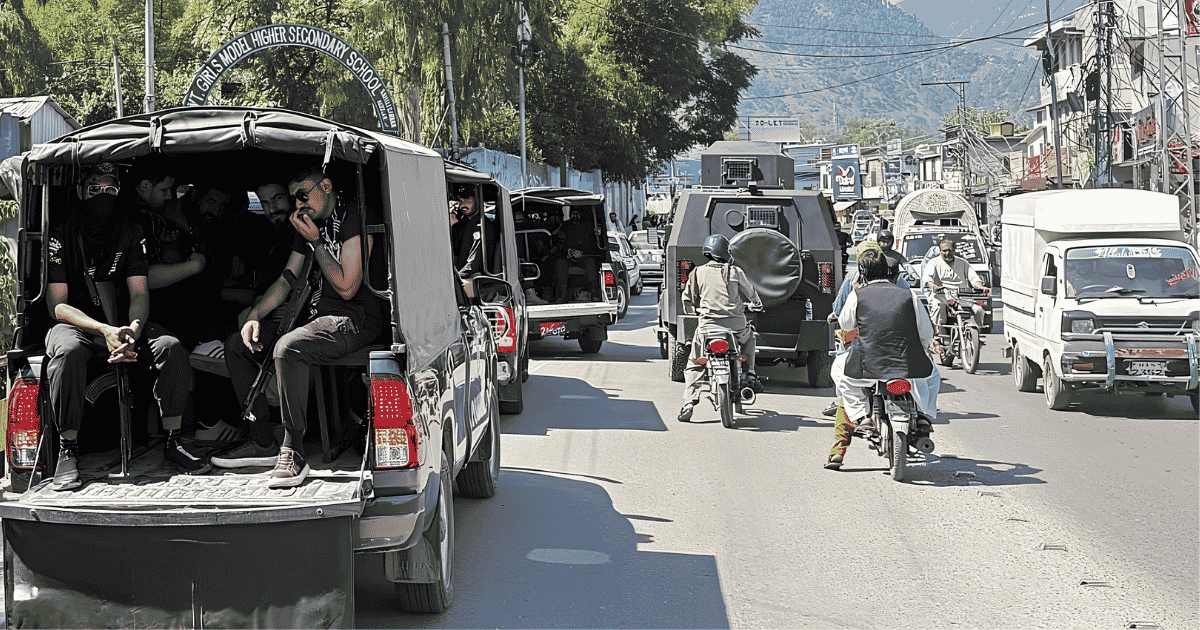
Security forces patrol a street in Rawalakot during the Pakistan-Occupied Kashmir protest movement in June 2026 following the ban on the Jammu Kashmir Joint Awami Action Committee (JAAC).
Security personnel move through Rawalakot after authorities banned the Jammu Kashmir Joint Awami Action Committee and deployed additional forces across Pakistan-occupied Kashmir in June 2026. (Image courtesy: BBC News)

Pakistan-Occupied Kashmir Protest: Why Rawalakot Exposed Islamabad’s Kashmir Narrative

A Kashmiri Pandit's Perspective on the Pakistan-Occupied Kashmir Protest I left Kashmir thirty-six years ago. My family did not leave by choice, nor had we planned to abandon the valley…

Comments Off on Pakistan-Occupied Kashmir Protest: Why Rawalakot Exposed Islamabad’s Kashmir Narrative
Portrait of Arnimal in traditional Kashmiri Pandit attire, wearing authentic Dejhoor earrings and seated against a scenic Kashmir backdrop, symbolizing the poetess's life, love, and literary legacy.
Arnimal, the celebrated 18th-century Kashmiri Pandit poetess, depicted in traditional attire with authentic Dejhoor earrings, reflecting the emotional depth and cultural richness of her poetry.

Arnimal: The Kashmiri Poet Who Turned Abandonment Into Poetry

Pain has a strange, insular effect on the human psyche. It possesses the unique capacity to shut out the external world, creating a sudden silence in which a person is…

Comments Off on Arnimal: The Kashmiri Poet Who Turned Abandonment Into Poetry
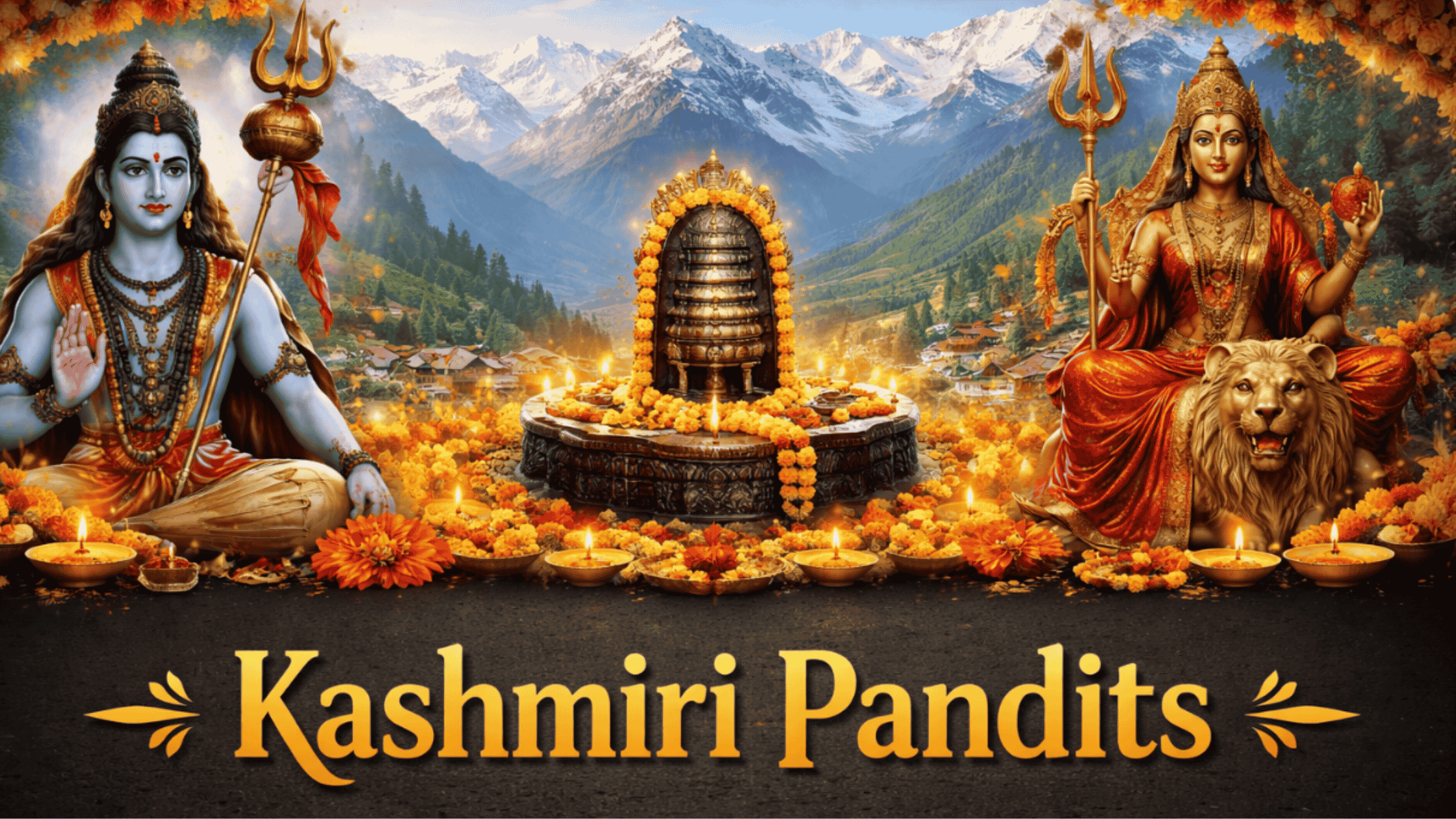
Sacred representation of Kashmiri Pandits with Lord Shiva, Goddess Sharika, and a Shivling in a Himalayan valley symbolizing faith, loss, and exile.
Faith that remained rooted even after exile. The spiritual and cultural identity of Kashmiri Pandits against the backdrop of the Kashmir Valley.

From Exile to Erasure: How NFSA Integration Threatens Kashmiri Pandit Identity

The concept of 'home' for the Kashmiri Pandit community has undergone a radical, involuntary transformation. Since the exodus of 1990, the physical markers of our civilisation (Our heritage temples, the…

Comments Off on From Exile to Erasure: How NFSA Integration Threatens Kashmiri Pandit Identity
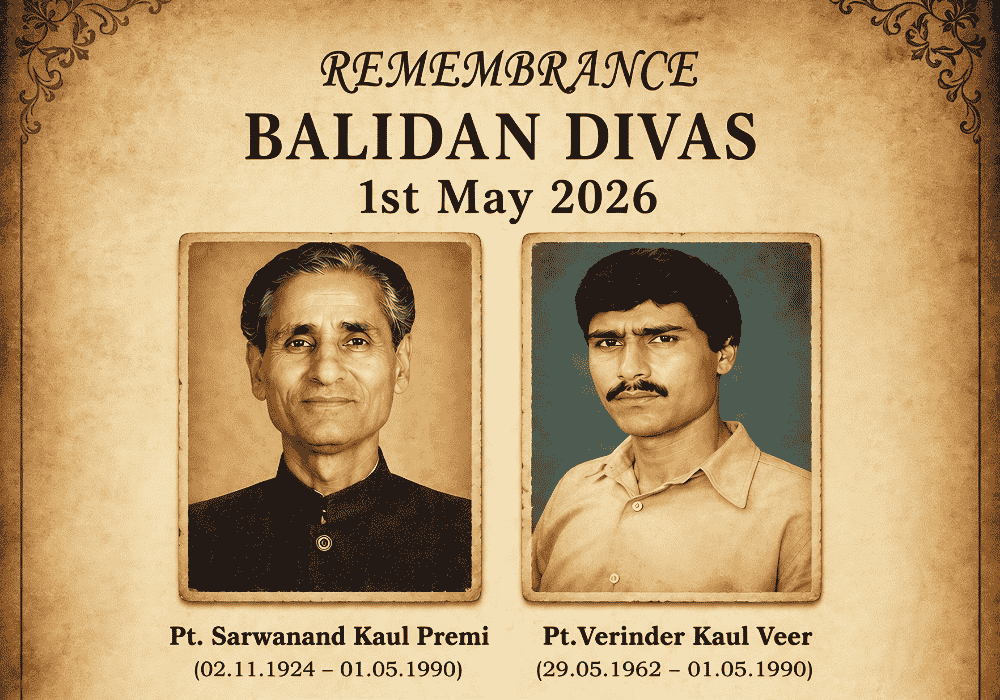
alidan Divas remembrance poster for Pt. Sarwanand Kaul Premi and Pt. Verinder Kaul Veer, martyred on 1 May 1990 during the Kashmiri Pandit exodus
Pt. Sarwanand Kaul Premi (02.11.1924 — 01.05.1990) and his son Pt. Verinder Kaul Veer (29.05.1962 — 01.05.1990), abducted on 28 April 1990 and martyred on 1 May 1990 in Kashmir.

Remembering Sarwanand Kaul Premi: On His 36th Martyrdom Anniversary

Author's Preface This article was not written from a distance. It was written ahead of the 36th martyrdom anniversary of Sarwanand Kaul Premi and his son, Virender Kaul, at the…

Comments Off on Remembering Sarwanand Kaul Premi: On His 36th Martyrdom Anniversary
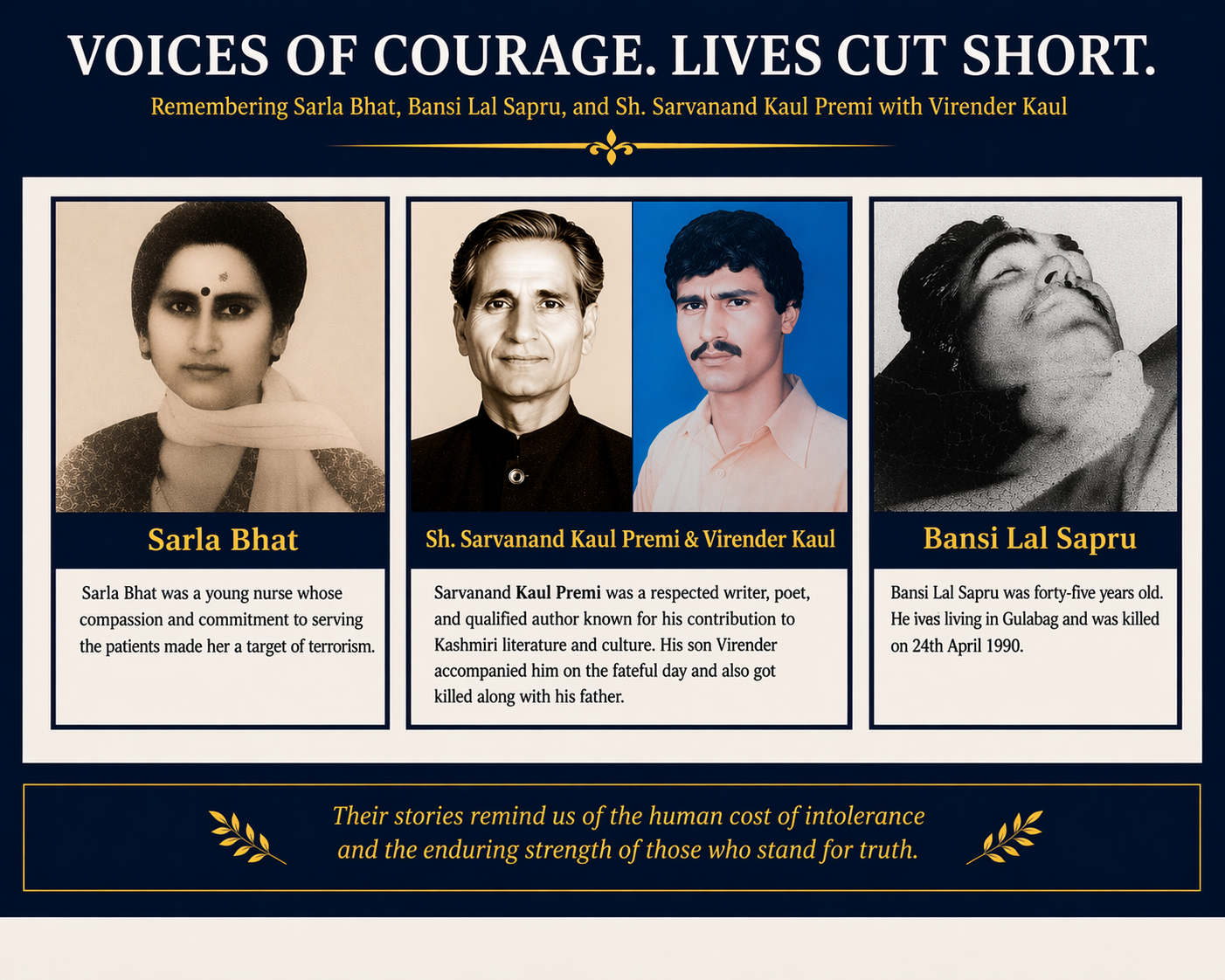
Memorial collage featuring Sarla Bhat, Bansi Lal Sapru, and Sarvanand Kaul Premi with Virender Kaul, Targeted victims of April 1990 Killings in Kashmir
A tribute to Sarla Bhat, Bansi Lal Sapru, and Sh. Sarvanand Kaul Premi with his son Virender Kaul, whose lives were lost in 1990.

April 1990 Killings in Kashmir: Stories Behind Targeted Killings

April 1990 Killings in Kashmir marked a grim phase of targeted violence, where individuals were singled out and killed in a climate of fear and silence. This article documents verified…

Comments Off on April 1990 Killings in Kashmir: Stories Behind Targeted Killings
Memorial-style image depicting the killing of Bansi Lal Sapru in Kashmir 1990, with candle and tribute note representing Kashmiri Pandit exodus violence.
A symbolic reconstruction of the killing of Bansi Lal Sapru in Gulab Bagh, Srinagar, reflecting the targeted violence faced by Kashmiri Pandits during the 1990 exodus.

The Killing of Bansi Lal Sapru in1990

  Spring came to the Kashmir Valley in 1990 with blood on its hands. Bansi Lal Sapru, a forty-five-year-old Kashmiri Pandit from Gulab Bagh, Srinagar, never saw summer. His neighbours…

Comments Off on The Killing of Bansi Lal Sapru in1990
Illustrated collage showing Bhushan Lal Raina with grieving mother, scenes of violence during the 1990 Kashmiri Pandit exodus, and portraits of Girija Tickoo, Verinder Kaul Premi, Sarvanand Kaul Premi, and Sarla Bhat
A visual representation of targeted killings during the 1990 Kashmiri Pandit exodus, featuring Bhushan Lal Raina alongside documented victims including Girija Tickoo, Verinder Kaul Premi, Sarvanand Kaul Premi, and Sarla Bhat.

Bhushan Lal Raina: The Night Before He Was to Leave Kashmir

Bhushan Lal Raina was 29 years old and worked at the Sher-i-Kashmir Institute of Medical Sciences (SKIMS) in Soura. He lived in Ompora, Budgam, with his elderly mother and was…

Comments Off on Bhushan Lal Raina: The Night Before He Was to Leave Kashmir
Martand Sun Temple in Anantnag built by Lalitaditya Muktapida showing ancient Kashmiri stone architecture
The central shrine of the Martand Sun Temple in Anantnag, a masterpiece of 8th century architecture built by Emperor Lalitaditya Muktapida.

Lalitaditya Muktapida: The Kashmir Emperor Who Took On Arabs, Tibetans, and Built an Empire

  In Anantnag, south Kashmir, 84 carved columns rise from the earth in various states of ruin. The Martand Sun Temple, built in the 8th century, stands on a high…

Comments Off on Lalitaditya Muktapida: The Kashmir Emperor Who Took On Arabs, Tibetans, and Built an Empire
Kalhana writing the Rajatarangini in ancient Kashmir with temples, kings, and battle scenes in the background
Kalhana, the 12th-century historian, documenting Kashmir’s past in the Rajatarangini with a focus on truth, evidence, and ethical kingship

Kalhana: Kashmir’s First and Greatest Historian

Kalhana was Kashmir's first and greatest historian. He wrote without royal patronage, without flattery, and without the political obligations that corrupted nearly every other chronicle of his era. What he…

Comments Off on Kalhana: Kashmir’s First and Greatest Historian
Kalhana writing Rajatarangini manuscript beside Jhelum river in Kashmir with shikaras and Himalayan mountains
Kalhana, the 12th-century Kashmiri historian, composing the Rajatarangini along the serene banks of the Jhelum River.

Rajatarangini by Kalhana: India’s Oldest History Book Explained

"He alone is worthy to narrate the history of kings whose mind, though cleansed by the waters of knowledge, remains unruffled by passion — who regards the deeds of rulers…

Comments Off on Rajatarangini by Kalhana: India’s Oldest History Book Explained
History of Kashmir scholars reading ancient manuscripts near a traditional Kashmiri temple in the Kashmir Valley
Kashmiri Pandit scholars study ancient manuscripts near a traditional temple in the Kashmir Valley, reflecting the community’s long tradition of scholarship and learning.

The Keepers of the Valley: A History of the Kashmiri Pandits

Introduction Kashmir. The name conjures alpine lakes, saffron fields, and snow-capped peaks. But behind this beauty lies the History of the Kashmiri Pandits At its heart stands a people who…

Comments Off on The Keepers of the Valley: A History of the Kashmiri Pandits
History of Kashmir visual collage showing ancient temples, Mughal gardens, Srinagar cityscape, Dal Lake houseboats, and the Line of Control in the Himalayan valley.
A visual representation of the History of Kashmir, featuring ancient ruins, Mughal heritage, Srinagar’s Dal Lake houseboats, and the mountainous landscape shaped by centuries of culture and conflict.

History of Kashmir: From Ancient Civilisations to Modern Conflict

Kashmir is the northernmost jewel of India, a land whose history stretches back more than 5,000 years. Cradled in the western Himalayas, this valley of extraordinary beauty has given the…

Comments Off on History of Kashmir: From Ancient Civilisations to Modern Conflict